Standard Reduction Potentials at 25 c Half-reaction E°(volts) U4+ + e- ---> U3+ -0.607 U3+ + 3e-...
| Half-reaction | E°(volts) |
| U4+ + e- ---> U3+ | -0.607 |
| U3+ + 3e- --->U | -1.798 |
| U4+ + 4e- --->U | -1.500 |
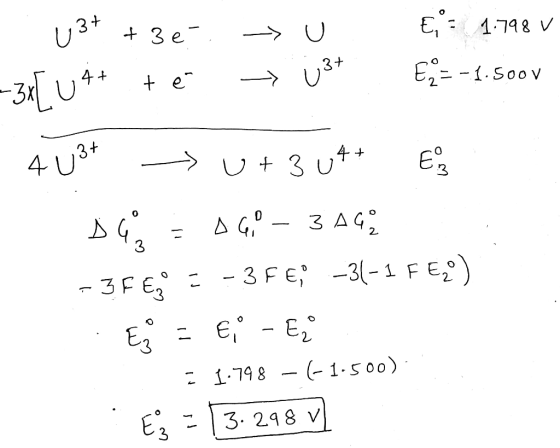
In a disproportionation reaction, the same species is oxidized and reduced. Use the data given above to analyze the disproportionation reaction:
|
4U3+ --->U + 3U4+ |
Will U3+ disproportionate in aqueous solution? To justify your answer, what is the standard cell voltage for the disproportionation reaction?____ V
Homework Answers
Add Answer to:
Standard Reduction Potentials at 25 c
Half-reaction
E°(volts)
U4+ + e-
---> U3+
-0.607
U3+ + 3e-...
A Cacat Pb2+ Pb galvanic cell is constructed in which the standard cell voltage is 0.277...
 A Cacat Pb2+ Pb galvanic cell is constructed in which the standard cell voltage is 0.277 V Calculate the free energy change at 25°C when 0.866 g of Pb plates out, if all concentrations remain at their standard value of 1 M throughout the process. What is the maximum amount of work that could be done by the cell on its surroundings during this experiment? AGⓇE Maximum work Use the References to access important values if needed for this question....
In a galvanic cell, one half-cell consists of a lead strip dipped into a 1.00 M...
 In a galvanic cell, one half-cell consists of a lead strip dipped into a 1.00 M solution of Pb(NO). In the second half-cell, solid germanium is in contact with a 1.00 M solution of Ge(NO), Ge is observed to plate out as the galvanic cell operates, and the initial cell voltage is measured to be 0.250 V at 25°C. (a) Write balanced equations for the half-reactions at the anode and the cathode. Show electrons as e'. Use the smallest integer...
consider the following standard reduction potentials. Reduction Half-Reaction Eo (volts) Al3+(aq) + 3e− → Al(s) −...
consider the following standard reduction potentials. Reduction Half-Reaction Eo (volts) Al3+(aq) + 3e− → Al(s) − 1.66 Fe2+(aq) + 2e− → Fe(s) − 0.44 Sn2+(aq) + 2e− → Sn(s) − 0.14 The Al/Al3+ half-reaction can be paired with the other two to produce voltaic cells because ________ A) Al is a more powerful oxidizing agent B) Fe and Sn are readily oxidized Al is a more powerful reducing agent C) Al3+ is a more powerful oxidizing agent D) Al3+...
pls explain in great detail why Consider the following standard reduction potentials Reduction Half-Reaction A1+ (aq)...
 pls explain in great detail why
Consider the following standard reduction potentials Reduction Half-Reaction A1+ (aq) + 3e A1(s) Fe2+ (aq) + 2e-Fe(s) Sn2+ (aq) + 2e - Sn(s) E (volts) -1.66 0.44 0.14 The AIAP half-reaction can be paired with the other two to produce voltaic cells because Als* is a more powerful reducing agent OOO Al is a more powerful oxidizing agent o Fe and Sn are readily oxidized Al is a more powerful reducing agent AB+ is...
pls explain in great detail why
Consider the following standard reduction potentials Reduction Half-Reaction A1+ (aq) + 3e A1(s) Fe2+ (aq) + 2e-Fe(s) Sn2+ (aq) + 2e - Sn(s) E (volts) -1.66 0.44 0.14 The AIAP half-reaction can be paired with the other two to produce voltaic cells because Als* is a more powerful reducing agent OOO Al is a more powerful oxidizing agent o Fe and Sn are readily oxidized Al is a more powerful reducing agent AB+ is...
Given the following two half reactions with their standard reduction potentials: Rh3+(aq) + 3e− → Rh(s)...
Given the following two half reactions with their standard reduction potentials: Rh3+(aq) + 3e− → Rh(s) E° = 0.76 V Au+(aq) + e− → Au(s) E° = 1.69 V What is the cell potential (E, in Volts) for a cell at 298.15 K whose anode consists of [Rh3+] = 0.40 M and Rh(s), and whose cathode consists of [Au+] = 0.10 M and Au(s)?
Standard Electrode Potentials at 25?C Reduction Half-Reaction E?(V) F2(g)+2e? ?2F?(aq) 2.87 Au3+(aq)+3e? ?Au(s) 1.50 Cl2(g)+2e? ?2Cl?(aq)...
Standard Electrode Potentials at 25?C Reduction Half-Reaction E?(V) F2(g)+2e? ?2F?(aq) 2.87 Au3+(aq)+3e? ?Au(s) 1.50 Cl2(g)+2e? ?2Cl?(aq) 1.36 O2(g)+4H+(aq)+4e? ?2H2O(l) 1.23 Br2(l)+2e? ?2Br?(aq) 1.09 NO3?(aq)+4H+(aq)+3e? ?NO(g)+2H2O(l) 0.96 Ag+(aq)+e? ?Ag(s) 0.80 I2(s)+2e? ?2I?(aq) 0.54 Cu2+(aq)+2e? ?Cu(s) 0.16 2H+(aq)+2e? ?H2(g) 0 Cr3+(aq)+3e? ?Cr(s) -0.73 2H2O(l)+2e? ?H2(g)+2OH?(aq) -0.83 Mn2+(aq)+2e? ?Mn(s) -1.18 How can the table be used to predict whether or not a metal will dissolve in HCl? In HNO3? Drag the terms on the left to the appropriate blanks on the right to...
Given the following standard reduction potentials: Tl(3+) + e(-) ---> Tl(2+) E°= -0.37 V Tl(3+) +...
Given the following standard reduction potentials: Tl(3+) + e(-) ---> Tl(2+) E°= -0.37 V Tl(3+) + 2e(-) ---> Tl(+) E°= 1.25 V (a) Calculate the half-cell potential for the half-reaction Tl(2+) + e(-) ---> Tl(+) (b) Determine of the following disproportionate reaction will occur sponta- neously in aqueous solution in the standard condition. 2Tl(2+)(aq) ---> Tl(3+)(aq) + Tl(+)(aq)
4. A galvanic cell is composed of these two half-cells, with the standard reduction potentials shown:...
 4. A galvanic cell is composed of these two half-cells, with the standard reduction potentials shown: Cu2+(aq) + 2e Cu(s) Fe3+(aq) + 3e,-- Fe(s) +0.34V +0.77V What is the standard free energy change for the cell reaction of this galvanic cell?
The standard reduction potentials of the following half-reactions are given in Appendix E in the textbook:...
The standard reduction potentials of the following half-reactions are given in Appendix E in the textbook: Ag+(aq)+e−→Ag(s)= .799 Cu2+(aq)+2e−→Cu(s)= .337 Ni2+(aq)+2e−→Ni(s)= -.28 Cr3+(aq)+3e−→Cr(s). = -.74 1. Determine which combination of these half-cell reactions leads to the cell reaction with the largest positive cell emf. 1st and 2nd, 1st and 3rd, 1st and 4th, 2nd and 3rd, 3rd and 4th. It isn't the first or last one because I have gotten it wrong twice. 2. Calculate the value of this emf....
♡ Search this course Faded 0 x cell potentials given below. Standard Reduction Potentials (Volts) at...
 ♡ Search this course Faded 0 x cell potentials given below. Standard Reduction Potentials (Volts) at 25 °C 12() + 2 6 2 I'(aq) 0.535 02(g) + 4 Hz0+ (aq) + 4 € -6 H,00 1.229 2 H2O(l) + 2 € H2(g) + 2 OH"(aq) -0.828 Sc3(aq) + 3 e Sc(s) -2.080 Half-reaction at anode: Half-reaction at cathode: Se*(aq) + 3 6 —- Sc(S) -2.080|| Half-reaction at anode: Half-reaction at cathode: (b) What is the expected decomposition potential?
 A Cacat Pb2+ Pb galvanic cell is constructed in which the standard cell voltage is 0.277 V Calculate the free energy change at 25°C when 0.866 g of Pb plates out, if all concentrations remain at their standard value of 1 M throughout the process. What is the maximum amount of work that could be done by the cell on its surroundings during this experiment? AGⓇE Maximum work Use the References to access important values if needed for this question....
 In a galvanic cell, one half-cell consists of a lead strip dipped into a 1.00 M solution of Pb(NO). In the second half-cell, solid germanium is in contact with a 1.00 M solution of Ge(NO), Ge is observed to plate out as the galvanic cell operates, and the initial cell voltage is measured to be 0.250 V at 25°C. (a) Write balanced equations for the half-reactions at the anode and the cathode. Show electrons as e'. Use the smallest integer...
 pls explain in great detail why
Consider the following standard reduction potentials Reduction Half-Reaction A1+ (aq) + 3e A1(s) Fe2+ (aq) + 2e-Fe(s) Sn2+ (aq) + 2e - Sn(s) E (volts) -1.66 0.44 0.14 The AIAP half-reaction can be paired with the other two to produce voltaic cells because Als* is a more powerful reducing agent OOO Al is a more powerful oxidizing agent o Fe and Sn are readily oxidized Al is a more powerful reducing agent AB+ is...
pls explain in great detail why
Consider the following standard reduction potentials Reduction Half-Reaction A1+ (aq) + 3e A1(s) Fe2+ (aq) + 2e-Fe(s) Sn2+ (aq) + 2e - Sn(s) E (volts) -1.66 0.44 0.14 The AIAP half-reaction can be paired with the other two to produce voltaic cells because Als* is a more powerful reducing agent OOO Al is a more powerful oxidizing agent o Fe and Sn are readily oxidized Al is a more powerful reducing agent AB+ is...
 4. A galvanic cell is composed of these two half-cells, with the standard reduction potentials shown: Cu2+(aq) + 2e Cu(s) Fe3+(aq) + 3e,-- Fe(s) +0.34V +0.77V What is the standard free energy change for the cell reaction of this galvanic cell?
 ♡ Search this course Faded 0 x cell potentials given below. Standard Reduction Potentials (Volts) at 25 °C 12() + 2 6 2 I'(aq) 0.535 02(g) + 4 Hz0+ (aq) + 4 € -6 H,00 1.229 2 H2O(l) + 2 € H2(g) + 2 OH"(aq) -0.828 Sc3(aq) + 3 e Sc(s) -2.080 Half-reaction at anode: Half-reaction at cathode: Se*(aq) + 3 6 —- Sc(S) -2.080|| Half-reaction at anode: Half-reaction at cathode: (b) What is the expected decomposition potential?
Most questions answered within 3 hours.
-
Where is the error in this code sequence?
String s1 = "Hello";
String s2 = "ello";...
asked 10 months ago -
Financial data for Joel de Paris, Inc., for last year
follow:
Joel de Paris, Inc.
Balance...
asked 10 months ago -
Consider this reaction:
Al2(SO4)3 (aq)+ BaCl3
(aq) Al2Cl6 (aq)- +
3BaSO4(s) . What is the...
asked 10 months ago -
Suppose that Savneet is considering increasing her
recent random sample from 20 car rentals to 40...
asked 10 months ago -
Trucks arrive at an unloading terminal at an average rate of 120
per hour.
Trucks arrive...
asked 10 months ago -
Why are methanol and ethanol completely soluble in water while
octanol is not very little soluble....
asked 10 months ago -
A facilities manager at a university reads in a research report
that the mean amount of...
asked 10 months ago -
When the CuSO4 is rehydrated by adding water to the anhydrous
compound, is this an endothermic...
asked 10 months ago -
A ray of sunlight is passing from diamond into crown glass; the
angle of incidence is...
asked 10 months ago -
A block of mass 0.249 kg is placed on top of a light, vertical
spring of...
asked 10 months ago -
how do the kidneys compensate in the presences of acidosis
a) trigger hyperventilate
b) reserve acid...
asked 10 months ago -
Question 501 pts
The rental rate of capital to the firm increases. Which of the
following...
asked 10 months ago