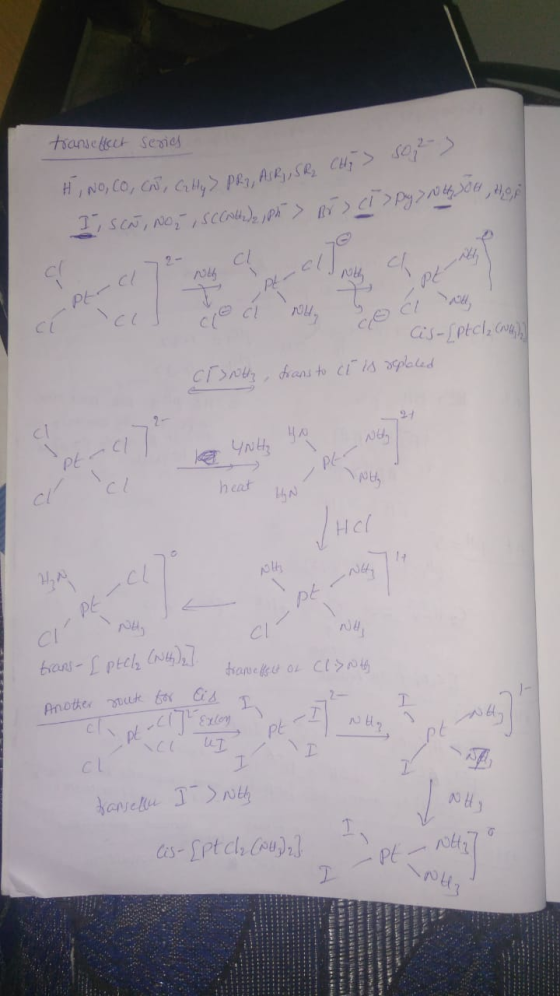
![6. Using the trans effect series suggest synthetic routes to cis- and trans-[PtCl2(NH3)2] from [PtCl4] as a starting material](http://img.homeworklib.com/questions/2b23ddc0-73df-11ea-b58e-f98e0f9a5618.png?x-oss-process=image/resize,w_560)
Homework Answers
Add Answer to:
6. Using the trans effect series suggest synthetic routes to cis- and trans-[PtCl2(NH3)2] from [PtCl4] as...
7 Using the trans effect series suggest synthetic routes to cis- and trans-[PtCl2(NH3)2] from [Pt(NH3)4]2+ as...
 7 Using the trans effect series suggest synthetic routes to cis- and trans-[PtCl2(NH3)2] from [Pt(NH3)4]2+ as a starting material.
Draw the molecules cis-[PtCl2(NH3)2] versus trans-[PtCl2(NH3)2]. a) If you assume the NH3 groups ...
Draw the molecules cis-[PtCl2(NH3)2] versus trans-[PtCl2(NH3)2]. a) If you assume the NH3 groups rotate freely and the out of plane hydrogens do not lower the symmetry, what is the point group symmetry? b) If the NH3 groups do not rotate freely, what are the possible point groups? I have the drawn molecules just unsure how to find the point groups.
Draw the molecules cis-[PtCl2(NH3)2] versus trans-[PtCl2(NH3)2]. a) If you assume the NH3 groups rotate freely and...
Draw the molecules cis-[PtCl2(NH3)2] versus trans-[PtCl2(NH3)2]. a) If you assume the NH3 groups rotate freely and the out of plane hydrogens do not lower the symmetry, what is the point group symmetry? b) If the NH3 groups do not rotate freely, what are the possible point groups? I have the drawn molecules just unsure how to find the point groups.
4. Propose two synthetic routes to trans-1-methyl-2-(methylthio)cyclohexane (below) from the starting compound (a) cis-1-chloro-2-methylcyclohexane; (b) trans-1-chloro-2-...
 4. Propose two synthetic routes to trans-1-methyl-2-(methylthio)cyclohexane (below) from the starting compound (a) cis-1-chloro-2-methylcyclohexane; (b) trans-1-chloro-2- methylcyclohexane. SCH CH3 5. Rank each of the following groups of substrates in order of decreasing S 2 reactivity. a. b. C. CHỊCH,CH,CI, CHÚCI, (CH, CH) CHOI (CH3),CHCH,CH,Br, (CH3),CHCH,Br, (CH3),CHBr CHỊCH,CI, CH, CH,I, (CH,),CHCl, CH2CH2Br
1. Propose synthetic routes to prepare the compounds from the shown starting materials in 2 steps....
 1. Propose synthetic routes to prepare the compounds from the shown starting materials in 2 steps. Use any reagents as necessary: OH U from OH
uiz Problems - Provide an answer for each in the space provided. 1. Suggest a reasonable...
 uiz Problems - Provide an answer for each in the space provided. 1. Suggest a reasonable series of synthetic transformations (i.e. a series of reagents and reaction conditions) to prepare cis-2-methylcyclohexyl acetate CA) from trans-2-methylcyclohexanol (this problem is worth 4 points) H3C CH3 A (target molecule)
Successful synthetic routes must contain a minimum of 4 steps and at least one reaction from...
Successful synthetic routes must contain a minimum of 4 steps and at least one reaction from each chapter (7,8,9). 7 - SN2, E2, SN1, E1 8 - Addition of Alkenes 9 - Addition of Alkynes You should provide the correct IUPAC name for each organic chemical used and produced in your chemical synthesis. USE (Z) - 2 - Propenyl - cyclohexane as a starting material. The end product does not matter, just make sure to use a technique from each...
21. Which of the following are coordination isomers? (a) cis-[CoCl2(en)2]Cl and trans-[CoCl2(en)2]Cl (b) [Cr(NH3)[Fe(CN) ] and...
 21. Which of the following are coordination isomers? (a) cis-[CoCl2(en)2]Cl and trans-[CoCl2(en)2]Cl (b) [Cr(NH3)[Fe(CN) ] and [Fe(NH3)6][Cr(CN)] (c) [CoBr(NH3)sSO4 and [CrSO4(NH3)s]Br (d) [Co(NO2)(NH3)s]Cl2 and [Cr(ONO)(NH3)s] Cl2 (e) Both (b) and (c) Review your answer (CIRCLE): Are you (1) confident; (2) somewhat confident; or (3) unsure/guessing?
21. Which of the following are coordination isomers? (a) cis-[CoCl2(en)2]Cl and trans-[CoCl2(en)2]Cl (b) [Cr(NH3)[Fe(CN) ] and [Fe(NH3)6][Cr(CN)] (c) [CoBr(NH3)sSO4 and [CrSO4(NH3)s]Br (d) [Co(NO2)(NH3)s]Cl2 and [Cr(ONO)(NH3)s] Cl2 (e) Both (b) and (c) Review your answer (CIRCLE):...
21. Which of the following are coordination isomers? (a) cis-[CoCl2(en)2]Cl and trans-[CoCl2(en)2]Cl (b) [Cr(NH3)[Fe(CN) ] and [Fe(NH3)6][Cr(CN)] (c) [CoBr(NH3)sSO4 and [CrSO4(NH3)s]Br (d) [Co(NO2)(NH3)s]Cl2 and [Cr(ONO)(NH3)s] Cl2 (e) Both (b) and (c) Review your answer (CIRCLE): Are you (1) confident; (2) somewhat confident; or (3) unsure/guessing?
21. Which of the following are coordination isomers? (a) cis-[CoCl2(en)2]Cl and trans-[CoCl2(en)2]Cl (b) [Cr(NH3)[Fe(CN) ] and [Fe(NH3)6][Cr(CN)] (c) [CoBr(NH3)sSO4 and [CrSO4(NH3)s]Br (d) [Co(NO2)(NH3)s]Cl2 and [Cr(ONO)(NH3)s] Cl2 (e) Both (b) and (c) Review your answer (CIRCLE):...
5. The following substitution reaction was carried out using either cis-1-bromo-3-ethylcyclohexane or trans-1-bromo-3-ethyl cyclohexane. Explain the...
 5. The following substitution reaction was carried out using either cis-1-bromo-3-ethylcyclohexane or trans-1-bromo-3-ethyl cyclohexane. Explain the observations using the mechanism for this reaction and displaying the species (starting material, products, etc) in the chair conformation. Br Bu N+ Br- CH,CH, ether CH,CH, Minor CH,CH, Major a)the same mixture is obtained from either starting material Note that for the cis- example not much of it reacts. For the trans-example most of it is transformed into the cis. Bu N+ Br- b)...
1. Name this compound according to the IUPAC system, including stereochemistry (cis/trans, EIZ), if relevant. CIS-3-...
 1. Name this compound according to the IUPAC system, including stereochemistry (cis/trans, EIZ), if relevant. CIS-3- isopropyl Cyclopent-l-ene 3 2. Using the compound in #1 as the starting material for all these reactions, write in the products, including stereochemistry if relevant: HBr 1. Hg(OAC)2, H20 2. NaBH Br2 1. BH, 2. H2O2, OH Bra H2O Pd mcpba
 7 Using the trans effect series suggest synthetic routes to cis- and trans-[PtCl2(NH3)2] from [Pt(NH3)4]2+ as a starting material.
 4. Propose two synthetic routes to trans-1-methyl-2-(methylthio)cyclohexane (below) from the starting compound (a) cis-1-chloro-2-methylcyclohexane; (b) trans-1-chloro-2- methylcyclohexane. SCH CH3 5. Rank each of the following groups of substrates in order of decreasing S 2 reactivity. a. b. C. CHỊCH,CH,CI, CHÚCI, (CH, CH) CHOI (CH3),CHCH,CH,Br, (CH3),CHCH,Br, (CH3),CHBr CHỊCH,CI, CH, CH,I, (CH,),CHCl, CH2CH2Br
 1. Propose synthetic routes to prepare the compounds from the shown starting materials in 2 steps. Use any reagents as necessary: OH U from OH
 uiz Problems - Provide an answer for each in the space provided. 1. Suggest a reasonable series of synthetic transformations (i.e. a series of reagents and reaction conditions) to prepare cis-2-methylcyclohexyl acetate CA) from trans-2-methylcyclohexanol (this problem is worth 4 points) H3C CH3 A (target molecule)
 21. Which of the following are coordination isomers? (a) cis-[CoCl2(en)2]Cl and trans-[CoCl2(en)2]Cl (b) [Cr(NH3)[Fe(CN) ] and [Fe(NH3)6][Cr(CN)] (c) [CoBr(NH3)sSO4 and [CrSO4(NH3)s]Br (d) [Co(NO2)(NH3)s]Cl2 and [Cr(ONO)(NH3)s] Cl2 (e) Both (b) and (c) Review your answer (CIRCLE): Are you (1) confident; (2) somewhat confident; or (3) unsure/guessing?
21. Which of the following are coordination isomers? (a) cis-[CoCl2(en)2]Cl and trans-[CoCl2(en)2]Cl (b) [Cr(NH3)[Fe(CN) ] and [Fe(NH3)6][Cr(CN)] (c) [CoBr(NH3)sSO4 and [CrSO4(NH3)s]Br (d) [Co(NO2)(NH3)s]Cl2 and [Cr(ONO)(NH3)s] Cl2 (e) Both (b) and (c) Review your answer (CIRCLE):...
21. Which of the following are coordination isomers? (a) cis-[CoCl2(en)2]Cl and trans-[CoCl2(en)2]Cl (b) [Cr(NH3)[Fe(CN) ] and [Fe(NH3)6][Cr(CN)] (c) [CoBr(NH3)sSO4 and [CrSO4(NH3)s]Br (d) [Co(NO2)(NH3)s]Cl2 and [Cr(ONO)(NH3)s] Cl2 (e) Both (b) and (c) Review your answer (CIRCLE): Are you (1) confident; (2) somewhat confident; or (3) unsure/guessing?
21. Which of the following are coordination isomers? (a) cis-[CoCl2(en)2]Cl and trans-[CoCl2(en)2]Cl (b) [Cr(NH3)[Fe(CN) ] and [Fe(NH3)6][Cr(CN)] (c) [CoBr(NH3)sSO4 and [CrSO4(NH3)s]Br (d) [Co(NO2)(NH3)s]Cl2 and [Cr(ONO)(NH3)s] Cl2 (e) Both (b) and (c) Review your answer (CIRCLE):...
 5. The following substitution reaction was carried out using either cis-1-bromo-3-ethylcyclohexane or trans-1-bromo-3-ethyl cyclohexane. Explain the observations using the mechanism for this reaction and displaying the species (starting material, products, etc) in the chair conformation. Br Bu N+ Br- CH,CH, ether CH,CH, Minor CH,CH, Major a)the same mixture is obtained from either starting material Note that for the cis- example not much of it reacts. For the trans-example most of it is transformed into the cis. Bu N+ Br- b)...
 1. Name this compound according to the IUPAC system, including stereochemistry (cis/trans, EIZ), if relevant. CIS-3- isopropyl Cyclopent-l-ene 3 2. Using the compound in #1 as the starting material for all these reactions, write in the products, including stereochemistry if relevant: HBr 1. Hg(OAC)2, H20 2. NaBH Br2 1. BH, 2. H2O2, OH Bra H2O Pd mcpba
Most questions answered within 3 hours.
-
Where is the error in this code sequence?
String s1 = "Hello";
String s2 = "ello";...
asked 10 months ago -
Financial data for Joel de Paris, Inc., for last year
follow:
Joel de Paris, Inc.
Balance...
asked 10 months ago -
Consider this reaction:
Al2(SO4)3 (aq)+ BaCl3
(aq) Al2Cl6 (aq)- +
3BaSO4(s) . What is the...
asked 10 months ago -
Suppose that Savneet is considering increasing her
recent random sample from 20 car rentals to 40...
asked 10 months ago -
Trucks arrive at an unloading terminal at an average rate of 120
per hour.
Trucks arrive...
asked 10 months ago -
Why are methanol and ethanol completely soluble in water while
octanol is not very little soluble....
asked 10 months ago -
A facilities manager at a university reads in a research report
that the mean amount of...
asked 10 months ago -
When the CuSO4 is rehydrated by adding water to the anhydrous
compound, is this an endothermic...
asked 10 months ago -
A ray of sunlight is passing from diamond into crown glass; the
angle of incidence is...
asked 10 months ago -
A block of mass 0.249 kg is placed on top of a light, vertical
spring of...
asked 10 months ago -
how do the kidneys compensate in the presences of acidosis
a) trigger hyperventilate
b) reserve acid...
asked 10 months ago -
Question 501 pts
The rental rate of capital to the firm increases. Which of the
following...
asked 10 months ago