Draw the molecules cis-[PtCl2(NH3)2] versus trans-[PtCl2(NH3)2]. a) If you assume the NH3 groups ...
Draw the molecules cis-[PtCl2(NH3)2] versus trans-[PtCl2(NH3)2].
a) If you assume the NH3 groups rotate freely and the out of plane hydrogens do not lower the symmetry, what is the point group symmetry?
b) If the NH3 groups do not rotate freely, what are the possible point groups?
I have the drawn molecules just unsure how to find the point groups.
Homework Answers


Add Answer to:
Draw the molecules cis-[PtCl2(NH3)2] versus trans-[PtCl2(NH3)2]. a) If you assume the NH3 groups ...
Draw the molecules cis-[PtCl2(NH3)2] versus trans-[PtCl2(NH3)2]. a) If you assume the NH3 groups rotate freely and...
Draw the molecules cis-[PtCl2(NH3)2] versus trans-[PtCl2(NH3)2]. a) If you assume the NH3 groups rotate freely and the out of plane hydrogens do not lower the symmetry, what is the point group symmetry? b) If the NH3 groups do not rotate freely, what are the possible point groups? I have the drawn molecules just unsure how to find the point groups.
7 Using the trans effect series suggest synthetic routes to cis- and trans-[PtCl2(NH3)2] from [Pt(NH3)4]2+ as...
 7 Using the trans effect series suggest synthetic routes to cis- and trans-[PtCl2(NH3)2] from [Pt(NH3)4]2+ as a starting material.
6. Using the trans effect series suggest synthetic routes to cis- and trans-[PtCl2(NH3)2] from [PtCl4] as...
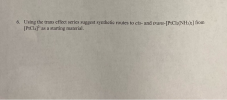 6. Using the trans effect series suggest synthetic routes to cis- and trans-[PtCl2(NH3)2] from [PtCl4] as a starting material.
Part B: cis and trans 1,2-dibromo cyclopentane 1. Draw cis-1,2-dibromocyclopentane and its mirror image below: 2....
 Part B: cis and trans 1,2-dibromo cyclopentane 1. Draw cis-1,2-dibromocyclopentane and its mirror image below: 2. How many carbons in this compound are chiral, (bonded to 4 different groups? 3. Are the molecules superimposable? 1. Can this compound exist as a pair of enantiomers? 5. Which atom (according to IUPAC nomenclature) in the ring does the plane of symmetry cut in half? 6. Draw trans-1,2-dibromocyclopentane and its mirror image below:
Cart B: cis and trans 1,2-dibromo cyclopentane 1. Draw cis-1,2-dibromocyclopentane and its mirror image below: 3...
 Cart B: cis and trans 1,2-dibromo cyclopentane 1. Draw cis-1,2-dibromocyclopentane and its mirror image below: 3 H HY Hmong CM 1 2. How many carbons in this compound are chiral, (bonded to 4 0 groups? 2 cox bons 3. Are the molecules superimposable? us, they axb. 4. Can this compound exist as a pair of enantiomers? 5. Which atom (according to IUPAC nomenclature) in the ring does the plane of symmetry cut in half? Carbon * 6. Draw trans-1,2-dibromocyclopentane and...
2. 2) Draw three-dimensional depictions of the following molecules. For each molecule provide theoretical bond angles,...
2. 2) Draw three-dimensional depictions of the following molecules. For each molecule provide theoretical bond angles, shape, and electron group geometry (ie octahedral, tetrahedral, bent, etc.). For each molecule, provide all possible structural and geometric isomers. If the molecule/ion possesses resonance structures, draw all relevant structures? What is the point group of each structure? If the compound is chiral, draw its enantiomer. a. C(CN)BrFCl b. WBr3Cl3 c. PtCl2(NH3)2 (square planar) d. NiCl2(NH3)2 (tetrahedral) e. PCl2F3 f. NO3-
how does the structure on thr bottom left have 2 stereocenters? I see both Carbons in the CH3 being bonded directly...
 how does the structure on thr bottom left have 2 stereocenters? I
see both Carbons in the CH3 being bonded directly to a H, -CH2 and
another -CH3. i do not see how there are 4 different groups that
each chiral carbon is attached to
os structures are show cand trans molecules srent sequence of groups ul (CH3) group and les initially, a-CH- ction gives, initially, a aded to four different 1,2-Disubstituted Cyclohexanes Now consider 1,2-dimethylcyclohexane. The cis and trans...
how does the structure on thr bottom left have 2 stereocenters? I
see both Carbons in the CH3 being bonded directly to a H, -CH2 and
another -CH3. i do not see how there are 4 different groups that
each chiral carbon is attached to
os structures are show cand trans molecules srent sequence of groups ul (CH3) group and les initially, a-CH- ction gives, initially, a aded to four different 1,2-Disubstituted Cyclohexanes Now consider 1,2-dimethylcyclohexane. The cis and trans...
3. Cyclic compounds The presence of the ring in all but very large ring cyclic molecules...
 3. Cyclic compounds The presence of the ring in all but very large ring cyclic molecules prevents full rotation of the ring atoms. For this reason, stereoisomerism may also occur in cyclic molecules. a) Prepare a model of cyclohexane, C6H12. Draw the condensed formula. b) Build a model of methylcyclohexane (C7H14) by replacing one of the hydrogens of cyclohexane with a methyl group. Draw the skeletal formula for methylcyclohexane. 2 c) How many different isomers exist for methylcyclohexane (CyH34)? d)...
2.1. Name the following compound. Specify cis/trans geometry, if applicable. Q.2. Draw line structure for cis-4-methyl-2-hexene....
 2.1. Name the following compound. Specify cis/trans geometry, if applicable. Q.2. Draw line structure for cis-4-methyl-2-hexene. 03. Draw a strucrure with molecular formula CH,20 which exhibits cis/trans isomerism, and also has a chiral center. How many stereoisomers are possible for this molecular formular? Q.4. What is the index of hydrogen deficiency of a compound with molecular formula C-H, BINO? Q.5. How many stereoisomers of 4-chloro-2-pentene exist? a 1 6 . 2 c. 3 d. 4.
8. (pls each) For the following molecules, draw both chair conformers resulting from a ring-riip. and...
 8. (pls each) For the following molecules, draw both chair conformers resulting from a ring-riip. and then indicate which structure predominates at equilibrium (if either. When a group specified you must draw out the structure of that group for full credit (no abbreviations wioned here!). Either enantiomer of each is acceptable. a. 2-sopropyl-5-methylcyclohexanol (The methyl and hydroxyl groups are cls, and the isopropyl group is trans to both). b. cis-1-sobutyl-3-fluorocyclohexane C. (4 pts) Draw the more stable conformation of b....
 7 Using the trans effect series suggest synthetic routes to cis- and trans-[PtCl2(NH3)2] from [Pt(NH3)4]2+ as a starting material.
 6. Using the trans effect series suggest synthetic routes to cis- and trans-[PtCl2(NH3)2] from [PtCl4] as a starting material.
 Part B: cis and trans 1,2-dibromo cyclopentane 1. Draw cis-1,2-dibromocyclopentane and its mirror image below: 2. How many carbons in this compound are chiral, (bonded to 4 different groups? 3. Are the molecules superimposable? 1. Can this compound exist as a pair of enantiomers? 5. Which atom (according to IUPAC nomenclature) in the ring does the plane of symmetry cut in half? 6. Draw trans-1,2-dibromocyclopentane and its mirror image below:
 Cart B: cis and trans 1,2-dibromo cyclopentane 1. Draw cis-1,2-dibromocyclopentane and its mirror image below: 3 H HY Hmong CM 1 2. How many carbons in this compound are chiral, (bonded to 4 0 groups? 2 cox bons 3. Are the molecules superimposable? us, they axb. 4. Can this compound exist as a pair of enantiomers? 5. Which atom (according to IUPAC nomenclature) in the ring does the plane of symmetry cut in half? Carbon * 6. Draw trans-1,2-dibromocyclopentane and...
 how does the structure on thr bottom left have 2 stereocenters? I
see both Carbons in the CH3 being bonded directly to a H, -CH2 and
another -CH3. i do not see how there are 4 different groups that
each chiral carbon is attached to
os structures are show cand trans molecules srent sequence of groups ul (CH3) group and les initially, a-CH- ction gives, initially, a aded to four different 1,2-Disubstituted Cyclohexanes Now consider 1,2-dimethylcyclohexane. The cis and trans...
how does the structure on thr bottom left have 2 stereocenters? I
see both Carbons in the CH3 being bonded directly to a H, -CH2 and
another -CH3. i do not see how there are 4 different groups that
each chiral carbon is attached to
os structures are show cand trans molecules srent sequence of groups ul (CH3) group and les initially, a-CH- ction gives, initially, a aded to four different 1,2-Disubstituted Cyclohexanes Now consider 1,2-dimethylcyclohexane. The cis and trans...
 3. Cyclic compounds The presence of the ring in all but very large ring cyclic molecules prevents full rotation of the ring atoms. For this reason, stereoisomerism may also occur in cyclic molecules. a) Prepare a model of cyclohexane, C6H12. Draw the condensed formula. b) Build a model of methylcyclohexane (C7H14) by replacing one of the hydrogens of cyclohexane with a methyl group. Draw the skeletal formula for methylcyclohexane. 2 c) How many different isomers exist for methylcyclohexane (CyH34)? d)...
 2.1. Name the following compound. Specify cis/trans geometry, if applicable. Q.2. Draw line structure for cis-4-methyl-2-hexene. 03. Draw a strucrure with molecular formula CH,20 which exhibits cis/trans isomerism, and also has a chiral center. How many stereoisomers are possible for this molecular formular? Q.4. What is the index of hydrogen deficiency of a compound with molecular formula C-H, BINO? Q.5. How many stereoisomers of 4-chloro-2-pentene exist? a 1 6 . 2 c. 3 d. 4.
 8. (pls each) For the following molecules, draw both chair conformers resulting from a ring-riip. and then indicate which structure predominates at equilibrium (if either. When a group specified you must draw out the structure of that group for full credit (no abbreviations wioned here!). Either enantiomer of each is acceptable. a. 2-sopropyl-5-methylcyclohexanol (The methyl and hydroxyl groups are cls, and the isopropyl group is trans to both). b. cis-1-sobutyl-3-fluorocyclohexane C. (4 pts) Draw the more stable conformation of b....
Most questions answered within 3 hours.
-
Where is the error in this code sequence?
String s1 = "Hello";
String s2 = "ello";...
asked 10 months ago -
Financial data for Joel de Paris, Inc., for last year
follow:
Joel de Paris, Inc.
Balance...
asked 10 months ago -
Consider this reaction:
Al2(SO4)3 (aq)+ BaCl3
(aq) Al2Cl6 (aq)- +
3BaSO4(s) . What is the...
asked 10 months ago -
Suppose that Savneet is considering increasing her
recent random sample from 20 car rentals to 40...
asked 10 months ago -
Trucks arrive at an unloading terminal at an average rate of 120
per hour.
Trucks arrive...
asked 10 months ago -
Why are methanol and ethanol completely soluble in water while
octanol is not very little soluble....
asked 10 months ago -
A facilities manager at a university reads in a research report
that the mean amount of...
asked 10 months ago -
When the CuSO4 is rehydrated by adding water to the anhydrous
compound, is this an endothermic...
asked 10 months ago -
A ray of sunlight is passing from diamond into crown glass; the
angle of incidence is...
asked 10 months ago -
A block of mass 0.249 kg is placed on top of a light, vertical
spring of...
asked 10 months ago -
how do the kidneys compensate in the presences of acidosis
a) trigger hyperventilate
b) reserve acid...
asked 10 months ago -
Question 501 pts
The rental rate of capital to the firm increases. Which of the
following...
asked 10 months ago