
Homework Answers
![. Take general equation a A+ bB cC + d D. Rate law: I hate - CAT - - Ate] = LACC LEDE for the gire. Similarly you can write r](http://img.homeworklib.com/questions/a4cad890-73f3-11ea-b52a-2170fa200af4.png?x-oss-process=image/resize,w_560)
Add Answer to:
1. Which relationship correctly compares the rates of the following reactants and products? 2 NOCI(g) →...
The initial rates of reaction for 2 NO(g) + Cl 2 (g) – 2 NOCI(g) are:...
 The initial rates of reaction for 2 NO(g) + Cl 2 (g) – 2 NOCI(g) are: Expt Initial [NO] Initial [Cl2] 0.0125 M 0.0510 M 0.0250 M 0.0255 M 0.0500 M 0.0255 M Determine the rate law for the reaction in the form, rate = .... Initial Rate M 5-1 9.08 9.08 18.2
6. (1 pt) Which represents an ENDOTHERMIC reaction? a. 10 kJ + reactants - products b....
 6. (1 pt) Which represents an ENDOTHERMIC reaction? a. 10 kJ + reactants - products b. reactants-> products + 10 kJ C reactants - products d. reactants-products 7. (1 pt) Which represents a reaction that requires a catalyst? a. 10 kJ + reactants-> products b. reactants -> products + 10 kJ c. reactants products d. reactants-> products 8. (1 pt) Which represents reversible reaction? a. 10 kJ + reactants -> products b. reactants-> products + 10 kJ C. reactants products...
1. The reaction 2 NOCI(g) → 2 NO(g) + Cl.(g) occurs in one step, with E,...
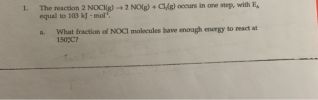 1. The reaction 2 NOCI(g) → 2 NO(g) + Cl.(g) occurs in one step, with E, equal to 103 kJ. mol". a. What fraction of NOCI molecules have enough energy to react at 150°C?
Which of the following statements correctly reflects the order of reactants, products and overall reaction for...
Which of the following statements correctly reflects the order of reactants, products and overall reaction for the following reaction: 2NO(g) + 2H2(g)---->N2(g)+2H20(g) rate=k[NO]2 A) 2nd order NO, 2nd order H2, 4th order Overall B) 2nd order NO, zero order H2, 2nd order Overall C) 2nd order NO, 1st order H2, 3rd order Overall D) 4th order NO, zero order H2, 4th order Overall E) not enough information given.
7. Which relationship regarding the quantities of reactants and products associated with the following reaction is N...
 7. Which relationship regarding the quantities of reactants and products associated with the following reaction is NOT correct? 6H,O(TM)+P 0.8) - 4H,PO (aq) 6 molecules + 1 molecule - 4 molecules 18 mol + 6 mol 12 mol 324 g +852 g -- 1176g 6xmol+xmol 4xmol y(27g)+y(71g)-+y(98g) o that it decomposes to sodium
At 35°C, K =2.0 x 10⁻⁸ for the reaction 2 NOCI(9) = 2 NO(g) + Cl2(9)...
 At 35°C, K =2.0 x 10⁻⁸ for the reaction 2 NOCI(9) = 2 NO(g) + Cl2(9) Calculate the concentrations of all species at equilibrium for each of the following original mixtures. a. 2.2 moles of pure NOCI in a 2.0-L flask [NOCI) = M [NO] = | М [Cl] = M b. 1.0 mole of NOCI and 1.0 mole of NO in a 1.0-L flask [NOCI) = M [NO] = M (Cl2] = 1 M c. 2.0 mole of NOCl...
Provide missing reactants or products: 6. Provide missing reactants or products and indicate stereochemistry where appropriate...
 Provide missing reactants or products:
6. Provide missing reactants or products and indicate stereochemistry where appropriate 60 pts | Mi NaO, C. 11,0 I NH2 1. NaN, 2. Brat 3. H,0" Cht H₂C=CH₂ 1. Eers CH, 2. Ag 0,11,0, Ileat (CIICO), Pyridine HNO, KCNCIN
Provide missing reactants or products:
6. Provide missing reactants or products and indicate stereochemistry where appropriate 60 pts | Mi NaO, C. 11,0 I NH2 1. NaN, 2. Brat 3. H,0" Cht H₂C=CH₂ 1. Eers CH, 2. Ag 0,11,0, Ileat (CIICO), Pyridine HNO, KCNCIN
Consider the following equilibrium systems. Which direction will the reactions shift (reactants or products) when cooled?...
 Consider the following equilibrium systems. Which direction will the reactions shift (reactants or products) when cooled? 2CO(g) + O2(g) = 2CO2(8) H2(g) + 12(g) = 2HI(g) H2(g) + 12(s) = 2H1(2) 12(g) = 21(2) AH = -566 kJ AH = -2.70 kJ AH = +53.0 kJ AH = +36.2 kJ _ a. reactants, reactants, reactants, reactants b.reactants, reactants, products, products c. products, products, products, products d. products, products, reactants, reactants | 0 0 0 0
19. Which of the following are chain propagation reactions? (1) C 2CI (2) Cl, H. 2...
 19. Which of the following are chain propagation reactions? (1) C 2CI (2) Cl, H. 2 HCI - CI (3) CH . Cie... → CH, HCI (4) CH, CI - CHCI+ CI (5) CH, CL - CHCI (6) CH. H . CH Hz a) 1 and 2 b) 2 and 5 C) 3 and 6 d) 3 and 4 e) 1 and 6 20. Which of the following correctly depicts the protonation of methanol? CH3OH + HABr 0 CH₃OH₂ +...
2, Give the relative rates of disappearance of reactants and formation of products for each of...
 2, Give the relative rates of disappearance of reactants and formation of products for each of the following reactions. (a) 2 NO(g) +Br2(g) - 2 NOBr(g) (b) N2(g) + 3 H2(g) → 2 NH3(g) 3. In the reaction 2 03(g) → 3。2(g), the rate of formation of O2 is 1.5 x 10⁻³ molVL s. What is the rate of decom- position of 03? In the synthesis of ammonia, if-Δ[H21/Δt 4.5 × 10⁻⁴ mol/L-min, what is Δ[NH3VAt? N2(g) + 3 H2(g)...
 The initial rates of reaction for 2 NO(g) + Cl 2 (g) – 2 NOCI(g) are: Expt Initial [NO] Initial [Cl2] 0.0125 M 0.0510 M 0.0250 M 0.0255 M 0.0500 M 0.0255 M Determine the rate law for the reaction in the form, rate = .... Initial Rate M 5-1 9.08 9.08 18.2
 6. (1 pt) Which represents an ENDOTHERMIC reaction? a. 10 kJ + reactants - products b. reactants-> products + 10 kJ C reactants - products d. reactants-products 7. (1 pt) Which represents a reaction that requires a catalyst? a. 10 kJ + reactants-> products b. reactants -> products + 10 kJ c. reactants products d. reactants-> products 8. (1 pt) Which represents reversible reaction? a. 10 kJ + reactants -> products b. reactants-> products + 10 kJ C. reactants products...
 1. The reaction 2 NOCI(g) → 2 NO(g) + Cl.(g) occurs in one step, with E, equal to 103 kJ. mol". a. What fraction of NOCI molecules have enough energy to react at 150°C?
 7. Which relationship regarding the quantities of reactants and products associated with the following reaction is NOT correct? 6H,O(TM)+P 0.8) - 4H,PO (aq) 6 molecules + 1 molecule - 4 molecules 18 mol + 6 mol 12 mol 324 g +852 g -- 1176g 6xmol+xmol 4xmol y(27g)+y(71g)-+y(98g) o that it decomposes to sodium
 At 35°C, K =2.0 x 10⁻⁸ for the reaction 2 NOCI(9) = 2 NO(g) + Cl2(9) Calculate the concentrations of all species at equilibrium for each of the following original mixtures. a. 2.2 moles of pure NOCI in a 2.0-L flask [NOCI) = M [NO] = | М [Cl] = M b. 1.0 mole of NOCI and 1.0 mole of NO in a 1.0-L flask [NOCI) = M [NO] = M (Cl2] = 1 M c. 2.0 mole of NOCl...
 Provide missing reactants or products:
6. Provide missing reactants or products and indicate stereochemistry where appropriate 60 pts | Mi NaO, C. 11,0 I NH2 1. NaN, 2. Brat 3. H,0" Cht H₂C=CH₂ 1. Eers CH, 2. Ag 0,11,0, Ileat (CIICO), Pyridine HNO, KCNCIN
Provide missing reactants or products:
6. Provide missing reactants or products and indicate stereochemistry where appropriate 60 pts | Mi NaO, C. 11,0 I NH2 1. NaN, 2. Brat 3. H,0" Cht H₂C=CH₂ 1. Eers CH, 2. Ag 0,11,0, Ileat (CIICO), Pyridine HNO, KCNCIN
 Consider the following equilibrium systems. Which direction will the reactions shift (reactants or products) when cooled? 2CO(g) + O2(g) = 2CO2(8) H2(g) + 12(g) = 2HI(g) H2(g) + 12(s) = 2H1(2) 12(g) = 21(2) AH = -566 kJ AH = -2.70 kJ AH = +53.0 kJ AH = +36.2 kJ _ a. reactants, reactants, reactants, reactants b.reactants, reactants, products, products c. products, products, products, products d. products, products, reactants, reactants | 0 0 0 0
 19. Which of the following are chain propagation reactions? (1) C 2CI (2) Cl, H. 2 HCI - CI (3) CH . Cie... → CH, HCI (4) CH, CI - CHCI+ CI (5) CH, CL - CHCI (6) CH. H . CH Hz a) 1 and 2 b) 2 and 5 C) 3 and 6 d) 3 and 4 e) 1 and 6 20. Which of the following correctly depicts the protonation of methanol? CH3OH + HABr 0 CH₃OH₂ +...
 2, Give the relative rates of disappearance of reactants and formation of products for each of the following reactions. (a) 2 NO(g) +Br2(g) - 2 NOBr(g) (b) N2(g) + 3 H2(g) → 2 NH3(g) 3. In the reaction 2 03(g) → 3。2(g), the rate of formation of O2 is 1.5 x 10⁻³ molVL s. What is the rate of decom- position of 03? In the synthesis of ammonia, if-Δ[H21/Δt 4.5 × 10⁻⁴ mol/L-min, what is Δ[NH3VAt? N2(g) + 3 H2(g)...
Most questions answered within 3 hours.
-
Where is the error in this code sequence?
String s1 = "Hello";
String s2 = "ello";...
asked 11 months ago -
Financial data for Joel de Paris, Inc., for last year
follow:
Joel de Paris, Inc.
Balance...
asked 11 months ago -
Consider this reaction:
Al2(SO4)3 (aq)+ BaCl3
(aq) Al2Cl6 (aq)- +
3BaSO4(s) . What is the...
asked 11 months ago -
Suppose that Savneet is considering increasing her
recent random sample from 20 car rentals to 40...
asked 11 months ago -
Trucks arrive at an unloading terminal at an average rate of 120
per hour.
Trucks arrive...
asked 11 months ago -
Why are methanol and ethanol completely soluble in water while
octanol is not very little soluble....
asked 11 months ago -
A facilities manager at a university reads in a research report
that the mean amount of...
asked 11 months ago -
When the CuSO4 is rehydrated by adding water to the anhydrous
compound, is this an endothermic...
asked 11 months ago -
A ray of sunlight is passing from diamond into crown glass; the
angle of incidence is...
asked 11 months ago -
A block of mass 0.249 kg is placed on top of a light, vertical
spring of...
asked 11 months ago -
how do the kidneys compensate in the presences of acidosis
a) trigger hyperventilate
b) reserve acid...
asked 11 months ago -
Question 501 pts
The rental rate of capital to the firm increases. Which of the
following...
asked 11 months ago