
Homework Answers
Add Answer to:
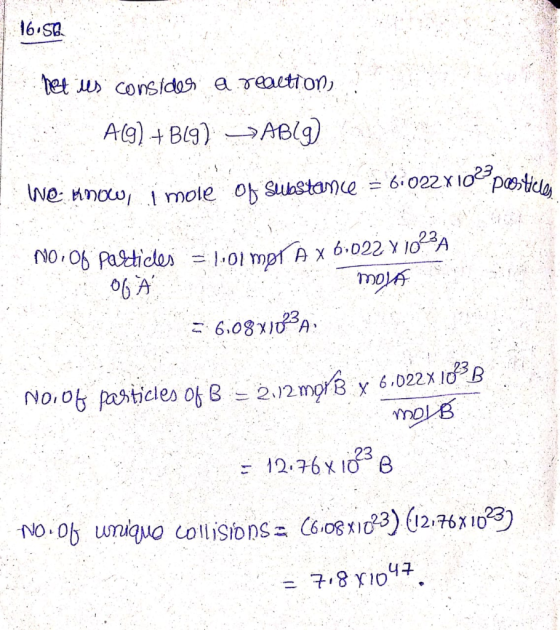
in the vessel? 16.56 For the reaction A(g)+ B(g) AB(g), how collisions between A and B...
5. The fraction of collisions with sufficient energy for a reaction to occur can be calculated...
5. The fraction of collisions with sufficient energy for a reaction to occur can be calculated using the exponential portion of the Arrhenius equation: (4 pts) Using your calculated activation energy for this reaction (your answer to question 1), determine the fraction of collisions that have sufficient energy at the following temps: 20C and 30C. -Calculated activation energy: 128.78 kJ/mol.
16.62 For the reaction A, + B, 2AB, Erwd = 125 kJ/mol and Entrev) = 85...
 16.62 For the reaction A, + B, 2AB, Erwd = 125 kJ/mol and Entrev) = 85 kJ/mol. Assuming the reaction occurs in one step, (a) draw a reaction energy diagram; (b) calculate AHXn; and (c) sketch a possible transition state.
this is all that is given 21. A reaction proceeds by a series of elementary steps...
 this is all that is given
21. A reaction proceeds by a series of elementary steps as shown below. The activation energy and heat of reaction are shown for each step. Step No. Activation energy Elementary step A + B → AB Enthalpy of reaction 4 kJ/mol -10 kJ/mol AB + C → ABC + BC 30 kJ/mol +5.2 kJ/mol ABC + B → AB + BC 10 kJ/mol -7.8 kJ/mol a) What is the overall equation for this reaction?...
this is all that is given
21. A reaction proceeds by a series of elementary steps as shown below. The activation energy and heat of reaction are shown for each step. Step No. Activation energy Elementary step A + B → AB Enthalpy of reaction 4 kJ/mol -10 kJ/mol AB + C → ABC + BC 30 kJ/mol +5.2 kJ/mol ABC + B → AB + BC 10 kJ/mol -7.8 kJ/mol a) What is the overall equation for this reaction?...
Answer the following questions for the reaction sequence A + B --> AB --> C -->...
 Answer the following questions for the reaction
sequence A + B --> AB --> C --> P. A table of energy
values for this reaction sequence is found above.
1. Draw a diagram of the reaction profile. Label and
include all enthalpy changes (delta H) and activation energies for
all steps. Draw to scale.
2. Find the activation energy for the overall reaction
A + B --> P. Also find the activation energy for the reverse
reaction P --> A...
Answer the following questions for the reaction
sequence A + B --> AB --> C --> P. A table of energy
values for this reaction sequence is found above.
1. Draw a diagram of the reaction profile. Label and
include all enthalpy changes (delta H) and activation energies for
all steps. Draw to scale.
2. Find the activation energy for the overall reaction
A + B --> P. Also find the activation energy for the reverse
reaction P --> A...
21. A reaction proceeds by a series of elementary steps as shown below. The activation energy...
 21. A reaction proceeds by a series of elementary steps as shown below. The activation energy and heat of reaction are shown for each step. Step No. Elementary step Activation energy Enthalpy of reaction A + B2 → AB, 4 kJ/mol -10 kJ/mol 2 AB2+ C → ABC + BC 30 kJ/mol +5.2 kJ/mol 3 ABC + B2 → AB + BC 10 kJ/mol -7.8 kJ/mol a) What is the overall equation for this reaction? (1 mark) b) What is...
how do i do these two questions? Assume that the reaction: CO(g) + H2O(g) = CO2(g)...
 how do i do these two questions?
Assume that the reaction: CO(g) + H2O(g) = CO2(g) + H2(g) occurs in an ideal mixture of ideal gases. At 700.K, K=3.61. At this temperature, AG° equals: Select one: a.-7.47 kJ b. Oku 0 C. -3.74 kJ o d. 7.47 kJ -200 kJ. For the following reaction producing 1 mol of oxygen gas at a particular temperature, AH NO(g) +O3(g) → NO2(g) + O2(g) The activation energy is 11 kJ/mol. What is the...
how do i do these two questions?
Assume that the reaction: CO(g) + H2O(g) = CO2(g) + H2(g) occurs in an ideal mixture of ideal gases. At 700.K, K=3.61. At this temperature, AG° equals: Select one: a.-7.47 kJ b. Oku 0 C. -3.74 kJ o d. 7.47 kJ -200 kJ. For the following reaction producing 1 mol of oxygen gas at a particular temperature, AH NO(g) +O3(g) → NO2(g) + O2(g) The activation energy is 11 kJ/mol. What is the...
3. Consider the decomposition reaction: 5A (g) 근 2 B(g) + C(g). You place 3.00 mol of A(g) in a reaction vessel mainta...
 3. Consider the decomposition reaction: 5A (g) 근 2 B(g) + C(g). You place 3.00 mol of A(g) in a reaction vessel maintained at P-2 bar and T-298.15 K. For this reaction, ΔGor-70.0 kJ/mol (a) Derive an exact expression for Kpin terms of the extent of reaction at equilibrium, ξeq (b) Calcaulate the value licatons you make.
3. Consider the decomposition reaction: 5A (g) 근 2 B(g) + C(g). You place 3.00 mol of A(g) in a reaction vessel maintained...
3. Consider the decomposition reaction: 5A (g) 근 2 B(g) + C(g). You place 3.00 mol of A(g) in a reaction vessel maintained at P-2 bar and T-298.15 K. For this reaction, ΔGor-70.0 kJ/mol (a) Derive an exact expression for Kpin terms of the extent of reaction at equilibrium, ξeq (b) Calcaulate the value licatons you make.
3. Consider the decomposition reaction: 5A (g) 근 2 B(g) + C(g). You place 3.00 mol of A(g) in a reaction vessel maintained...
The gas-phase reaction of NO with F2 to form NOF and F has an activation energy...
The gas-phase reaction of NO with F2 to form NOF and F has an activation energy of Ea = 6.30 kJ/mol and a frequency factor of A = 6.00×10⁸ M−1⋅s−1 . The reaction is believed to be bimolecular: NO(g)+F2(g)→NOF(g)+F(g) Part A What is the rate constant at 641 ∘C ? Express your answer to three significant digits with the appropriate units. For compound units, place a multiplication dot between units (e.g. J⋅mol−1⋅K−1). Which of the following statements reasonably explains why...
Use the energy diagrams of the two reactions to answer the questions. Reaction A Reaction B...
 Use the energy diagrams of the two reactions to answer the questions. Reaction A Reaction B Energy HHHH! (kJ/mol Energy 100 (kJ/mol) 50 Reaction progress Reaction progress What is the change in energy for reaction A? What is the change in energy for reaction B? AEX = kJ/mol AE/x = kJ/mol What is the activation energy for reaction A? What is the activation energy for reaction B? E = kJ/mol E.= kJ/mol Question 2 of 20 > For the reaction...
The hypothetical reaction A(g)+B(g)->C(g)+D(g) was studied in order to determine its activation energy. The appropriate data...
 The hypothetical reaction A(g)+B(g)->C(g)+D(g) was studied in
order to determine its activation energy. The appropriate data was
collected, analyzed, and graphed to produce the following graph.
Use the graph below to answer the questions:
a)What is the correct label for the x-axis
b)What is the correct label for the y-axis
c)What is the activation energy, in Kj/mol, for this
reaction?
Linear Fit for: Data Set IY y=mxeb m (Slope): -1435 [Y-intercept): 28.07 Correlation: -0.9970 RMSE: 0.1183 0.005 0.0045 0.004 0.0035
The hypothetical reaction A(g)+B(g)->C(g)+D(g) was studied in
order to determine its activation energy. The appropriate data was
collected, analyzed, and graphed to produce the following graph.
Use the graph below to answer the questions:
a)What is the correct label for the x-axis
b)What is the correct label for the y-axis
c)What is the activation energy, in Kj/mol, for this
reaction?
Linear Fit for: Data Set IY y=mxeb m (Slope): -1435 [Y-intercept): 28.07 Correlation: -0.9970 RMSE: 0.1183 0.005 0.0045 0.004 0.0035
 16.62 For the reaction A, + B, 2AB, Erwd = 125 kJ/mol and Entrev) = 85 kJ/mol. Assuming the reaction occurs in one step, (a) draw a reaction energy diagram; (b) calculate AHXn; and (c) sketch a possible transition state.
 this is all that is given
21. A reaction proceeds by a series of elementary steps as shown below. The activation energy and heat of reaction are shown for each step. Step No. Activation energy Elementary step A + B → AB Enthalpy of reaction 4 kJ/mol -10 kJ/mol AB + C → ABC + BC 30 kJ/mol +5.2 kJ/mol ABC + B → AB + BC 10 kJ/mol -7.8 kJ/mol a) What is the overall equation for this reaction?...
this is all that is given
21. A reaction proceeds by a series of elementary steps as shown below. The activation energy and heat of reaction are shown for each step. Step No. Activation energy Elementary step A + B → AB Enthalpy of reaction 4 kJ/mol -10 kJ/mol AB + C → ABC + BC 30 kJ/mol +5.2 kJ/mol ABC + B → AB + BC 10 kJ/mol -7.8 kJ/mol a) What is the overall equation for this reaction?...
 Answer the following questions for the reaction
sequence A + B --> AB --> C --> P. A table of energy
values for this reaction sequence is found above.
1. Draw a diagram of the reaction profile. Label and
include all enthalpy changes (delta H) and activation energies for
all steps. Draw to scale.
2. Find the activation energy for the overall reaction
A + B --> P. Also find the activation energy for the reverse
reaction P --> A...
Answer the following questions for the reaction
sequence A + B --> AB --> C --> P. A table of energy
values for this reaction sequence is found above.
1. Draw a diagram of the reaction profile. Label and
include all enthalpy changes (delta H) and activation energies for
all steps. Draw to scale.
2. Find the activation energy for the overall reaction
A + B --> P. Also find the activation energy for the reverse
reaction P --> A...
 21. A reaction proceeds by a series of elementary steps as shown below. The activation energy and heat of reaction are shown for each step. Step No. Elementary step Activation energy Enthalpy of reaction A + B2 → AB, 4 kJ/mol -10 kJ/mol 2 AB2+ C → ABC + BC 30 kJ/mol +5.2 kJ/mol 3 ABC + B2 → AB + BC 10 kJ/mol -7.8 kJ/mol a) What is the overall equation for this reaction? (1 mark) b) What is...
 how do i do these two questions?
Assume that the reaction: CO(g) + H2O(g) = CO2(g) + H2(g) occurs in an ideal mixture of ideal gases. At 700.K, K=3.61. At this temperature, AG° equals: Select one: a.-7.47 kJ b. Oku 0 C. -3.74 kJ o d. 7.47 kJ -200 kJ. For the following reaction producing 1 mol of oxygen gas at a particular temperature, AH NO(g) +O3(g) → NO2(g) + O2(g) The activation energy is 11 kJ/mol. What is the...
how do i do these two questions?
Assume that the reaction: CO(g) + H2O(g) = CO2(g) + H2(g) occurs in an ideal mixture of ideal gases. At 700.K, K=3.61. At this temperature, AG° equals: Select one: a.-7.47 kJ b. Oku 0 C. -3.74 kJ o d. 7.47 kJ -200 kJ. For the following reaction producing 1 mol of oxygen gas at a particular temperature, AH NO(g) +O3(g) → NO2(g) + O2(g) The activation energy is 11 kJ/mol. What is the...
 3. Consider the decomposition reaction: 5A (g) 근 2 B(g) + C(g). You place 3.00 mol of A(g) in a reaction vessel maintained at P-2 bar and T-298.15 K. For this reaction, ΔGor-70.0 kJ/mol (a) Derive an exact expression for Kpin terms of the extent of reaction at equilibrium, ξeq (b) Calcaulate the value licatons you make.
3. Consider the decomposition reaction: 5A (g) 근 2 B(g) + C(g). You place 3.00 mol of A(g) in a reaction vessel maintained...
3. Consider the decomposition reaction: 5A (g) 근 2 B(g) + C(g). You place 3.00 mol of A(g) in a reaction vessel maintained at P-2 bar and T-298.15 K. For this reaction, ΔGor-70.0 kJ/mol (a) Derive an exact expression for Kpin terms of the extent of reaction at equilibrium, ξeq (b) Calcaulate the value licatons you make.
3. Consider the decomposition reaction: 5A (g) 근 2 B(g) + C(g). You place 3.00 mol of A(g) in a reaction vessel maintained...
 Use the energy diagrams of the two reactions to answer the questions. Reaction A Reaction B Energy HHHH! (kJ/mol Energy 100 (kJ/mol) 50 Reaction progress Reaction progress What is the change in energy for reaction A? What is the change in energy for reaction B? AEX = kJ/mol AE/x = kJ/mol What is the activation energy for reaction A? What is the activation energy for reaction B? E = kJ/mol E.= kJ/mol Question 2 of 20 > For the reaction...
 The hypothetical reaction A(g)+B(g)->C(g)+D(g) was studied in
order to determine its activation energy. The appropriate data was
collected, analyzed, and graphed to produce the following graph.
Use the graph below to answer the questions:
a)What is the correct label for the x-axis
b)What is the correct label for the y-axis
c)What is the activation energy, in Kj/mol, for this
reaction?
Linear Fit for: Data Set IY y=mxeb m (Slope): -1435 [Y-intercept): 28.07 Correlation: -0.9970 RMSE: 0.1183 0.005 0.0045 0.004 0.0035
The hypothetical reaction A(g)+B(g)->C(g)+D(g) was studied in
order to determine its activation energy. The appropriate data was
collected, analyzed, and graphed to produce the following graph.
Use the graph below to answer the questions:
a)What is the correct label for the x-axis
b)What is the correct label for the y-axis
c)What is the activation energy, in Kj/mol, for this
reaction?
Linear Fit for: Data Set IY y=mxeb m (Slope): -1435 [Y-intercept): 28.07 Correlation: -0.9970 RMSE: 0.1183 0.005 0.0045 0.004 0.0035
Most questions answered within 3 hours.
-
Where is the error in this code sequence?
String s1 = "Hello";
String s2 = "ello";...
asked 11 months ago -
Financial data for Joel de Paris, Inc., for last year
follow:
Joel de Paris, Inc.
Balance...
asked 11 months ago -
Consider this reaction:
Al2(SO4)3 (aq)+ BaCl3
(aq) Al2Cl6 (aq)- +
3BaSO4(s) . What is the...
asked 11 months ago -
Suppose that Savneet is considering increasing her
recent random sample from 20 car rentals to 40...
asked 11 months ago -
Trucks arrive at an unloading terminal at an average rate of 120
per hour.
Trucks arrive...
asked 11 months ago -
Why are methanol and ethanol completely soluble in water while
octanol is not very little soluble....
asked 11 months ago -
A facilities manager at a university reads in a research report
that the mean amount of...
asked 11 months ago -
When the CuSO4 is rehydrated by adding water to the anhydrous
compound, is this an endothermic...
asked 11 months ago -
A ray of sunlight is passing from diamond into crown glass; the
angle of incidence is...
asked 11 months ago -
A block of mass 0.249 kg is placed on top of a light, vertical
spring of...
asked 11 months ago -
how do the kidneys compensate in the presences of acidosis
a) trigger hyperventilate
b) reserve acid...
asked 11 months ago -
Question 501 pts
The rental rate of capital to the firm increases. Which of the
following...
asked 11 months ago