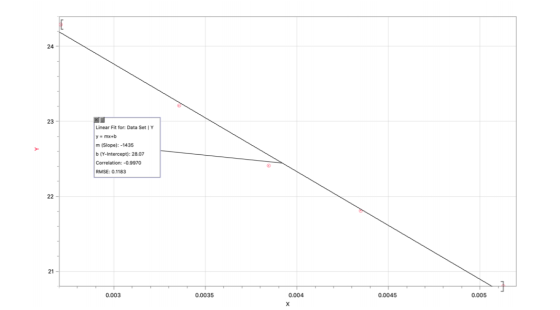
The hypothetical reaction A(g)+B(g)->C(g)+D(g) was studied in order to determine its activation energy. The appropriate data was collected, analyzed, and graphed to produce the following graph. Use the graph below to answer the questions:
a)What is the correct label for the x-axis
b)What is the correct label for the y-axis
c)What is the activation energy, in Kj/mol, for this reaction?
Homework Answers
 Upvote
if you find the answer is helpful. Thank you and have a great day.
Stay safe
Upvote
if you find the answer is helpful. Thank you and have a great day.
Stay safe
Add Answer to:
The hypothetical reaction A(g)+B(g)->C(g)+D(g) was studied in
order to determine its activation energy. The appropriate data...
Given the following data for the following hypothetical reaction, determine the activation energy. You may upload...
 Given the following data for the following hypothetical reaction, determine the activation energy. You may upload a graph. ered 2.00 Experiment Temperature (°C) tion 10 Rate Constant k (M/s) 1.53 x 10⁻⁶ 6.14 x 10⁻⁶ 1.48 x 10⁻⁵ 4.15 x 10⁻⁵ 1.21 x 10⁻⁴ 20 30 40 50 EP U S x x 44 B I AD 3 3 va 12 T ©
The rate data of the reaction was collected at different temperatures (°C) and functions of the...
 The rate data of the reaction was collected at different temperatures (°C) and functions of the data plotted to determine the activation energy. 18 17 T 16.5 36.2 47.7 57.3 k 9.86 x 10⁴ 2.01 x 10⁶ 9.84 x 10⁶ 3.41 x 10⁷ 16 y = (-1.37 x 10^)x + 58.8 15 14 13 12 = 11 10 0.0030 0.0031 0.0032 0.0033 0.0034 0.0035 1. Clearly label the x and y axes (above) with the proper function. 2. Determine Ea...
Rate Determination and Activation Energy DATA TABLE Trial Temperature (°C) Rate constant, (S-1) 0.00157 24 0.007435...
 Rate Determination and Activation Energy DATA TABLE Trial Temperature (°C) Rate constant, (S-1) 0.00157 24 0.007435 2 16 3 11 0.005563 4 1. Po above, using Temperce ahd. the rate сон dik, as they axis. 2. Determine the activation energy, Ea, by plotting the natural log of k vs. the reciprocal of absolute temperature. You can calculate 1/T (first convert T to K) and in k manually, or use Excel to do it. You will also need to make a...
ause the reaction is first order wiurTo stant, k, by plotting a graph of In Absorbance...
 ause the reaction is first order wiurTo stant, k, by plotting a graph of In Absorbance vs. time. hoose New Calculated Column from the Data menu. nter "In Absorbance" as the Name, and leave the unit blank. nter the correct formula for the column into the Equation edit e Function list, and selecting "Absorbance" from the Variables list c lick on the y-axis label. Choose In Absorbance. A graph of In absorhan ow be displayed. Change the scale of the...
please help with C and D Part A Determine the activation energy for the reaction Ea...
 please help with C and D
Part A Determine the activation energy for the reaction Ea 89.5 kJ mol Previous Answers Correct Significant Figures Feedback: Your answer 89.475 kJ mol 1 was either rounded differently or used a different number of significant figures than required for this part. Part B Determine the frequency factor for the reaction. A-4.22x10¹¹ s Determine the rate constant at 10 °C. Express your answer using two significant figures The kinetics of this reaction were studied...
please help with C and D
Part A Determine the activation energy for the reaction Ea 89.5 kJ mol Previous Answers Correct Significant Figures Feedback: Your answer 89.475 kJ mol 1 was either rounded differently or used a different number of significant figures than required for this part. Part B Determine the frequency factor for the reaction. A-4.22x10¹¹ s Determine the rate constant at 10 °C. Express your answer using two significant figures The kinetics of this reaction were studied...
Need help with the first picture. Data provided in pictures #2 & #3 Determining the Activation...
 Need help with the first picture. Data provided in pictures #2
& #3
Determining the Activation Energy and Collision Frequency Factor for Reaction 1 Part 1. Transfer the reaction rate for runs 9.12 from Data Sheet 3. Then calculate the rate constant (R) at each temperature based on the reaction orders determined in parts and Record the results in Tables * = 18,0 ->15.0416"5,0216" Equation 6 ->25 10 2. Calculate the natural logarithm of the rate constant. In ) and...
Need help with the first picture. Data provided in pictures #2
& #3
Determining the Activation Energy and Collision Frequency Factor for Reaction 1 Part 1. Transfer the reaction rate for runs 9.12 from Data Sheet 3. Then calculate the rate constant (R) at each temperature based on the reaction orders determined in parts and Record the results in Tables * = 18,0 ->15.0416"5,0216" Equation 6 ->25 10 2. Calculate the natural logarithm of the rate constant. In ) and...
Data Sheet Part A: Dependence of Reaction Rate on Concentration Table 1 H Temperature Time Relati...
 Can someone please help me finish the tables and
calculations.
Thanks in advance
Data Sheet Part A: Dependence of Reaction Rate on Concentration Table 1 H Temperature Time Relative mixture ! (seconds) | rate 1000 Reaction BrOsl (eC) . 1235.6 Avg. time 2. 67.S 3. 08,24 Avg. time 2. 74.2 3. 70.74.O Avg. time 24.o' 4 弘·11 0.2 OD3 0.00 8 100 o.oy | 23.5 3. 29. Avg. time 교 Table 2: Calculations for the [I']. [Bro, & [H'] BrOs...
Can someone please help me finish the tables and
calculations.
Thanks in advance
Data Sheet Part A: Dependence of Reaction Rate on Concentration Table 1 H Temperature Time Relative mixture ! (seconds) | rate 1000 Reaction BrOsl (eC) . 1235.6 Avg. time 2. 67.S 3. 08,24 Avg. time 2. 74.2 3. 70.74.O Avg. time 24.o' 4 弘·11 0.2 OD3 0.00 8 100 o.oy | 23.5 3. 29. Avg. time 교 Table 2: Calculations for the [I']. [Bro, & [H'] BrOs...
will work with up to 3 partners (similar to a lab group) to prepare a written report which analyzes kinetic data that has been provided to you. All student groups will receive data for the hy...
 will work with up to 3 partners (similar to a lab group) to prepare a written report which analyzes kinetic data that has been provided to you. All student groups will receive data for the hypothetical reaction aAlE) products where a is a numeric variable and A is a chemical variable. The reaction therefore has the form of a decomposition reaction, in which a single substance forms one or more new substances. For consistency, all concentrations start out at 1.000...
 Given the following data for the following hypothetical reaction, determine the activation energy. You may upload a graph. ered 2.00 Experiment Temperature (°C) tion 10 Rate Constant k (M/s) 1.53 x 10⁻⁶ 6.14 x 10⁻⁶ 1.48 x 10⁻⁵ 4.15 x 10⁻⁵ 1.21 x 10⁻⁴ 20 30 40 50 EP U S x x 44 B I AD 3 3 va 12 T ©
 The rate data of the reaction was collected at different temperatures (°C) and functions of the data plotted to determine the activation energy. 18 17 T 16.5 36.2 47.7 57.3 k 9.86 x 10⁴ 2.01 x 10⁶ 9.84 x 10⁶ 3.41 x 10⁷ 16 y = (-1.37 x 10^)x + 58.8 15 14 13 12 = 11 10 0.0030 0.0031 0.0032 0.0033 0.0034 0.0035 1. Clearly label the x and y axes (above) with the proper function. 2. Determine Ea...
 Rate Determination and Activation Energy DATA TABLE Trial Temperature (°C) Rate constant, (S-1) 0.00157 24 0.007435 2 16 3 11 0.005563 4 1. Po above, using Temperce ahd. the rate сон dik, as they axis. 2. Determine the activation energy, Ea, by plotting the natural log of k vs. the reciprocal of absolute temperature. You can calculate 1/T (first convert T to K) and in k manually, or use Excel to do it. You will also need to make a...
 ause the reaction is first order wiurTo stant, k, by plotting a graph of In Absorbance vs. time. hoose New Calculated Column from the Data menu. nter "In Absorbance" as the Name, and leave the unit blank. nter the correct formula for the column into the Equation edit e Function list, and selecting "Absorbance" from the Variables list c lick on the y-axis label. Choose In Absorbance. A graph of In absorhan ow be displayed. Change the scale of the...
 please help with C and D
Part A Determine the activation energy for the reaction Ea 89.5 kJ mol Previous Answers Correct Significant Figures Feedback: Your answer 89.475 kJ mol 1 was either rounded differently or used a different number of significant figures than required for this part. Part B Determine the frequency factor for the reaction. A-4.22x10¹¹ s Determine the rate constant at 10 °C. Express your answer using two significant figures The kinetics of this reaction were studied...
please help with C and D
Part A Determine the activation energy for the reaction Ea 89.5 kJ mol Previous Answers Correct Significant Figures Feedback: Your answer 89.475 kJ mol 1 was either rounded differently or used a different number of significant figures than required for this part. Part B Determine the frequency factor for the reaction. A-4.22x10¹¹ s Determine the rate constant at 10 °C. Express your answer using two significant figures The kinetics of this reaction were studied...
 Need help with the first picture. Data provided in pictures #2
& #3
Determining the Activation Energy and Collision Frequency Factor for Reaction 1 Part 1. Transfer the reaction rate for runs 9.12 from Data Sheet 3. Then calculate the rate constant (R) at each temperature based on the reaction orders determined in parts and Record the results in Tables * = 18,0 ->15.0416"5,0216" Equation 6 ->25 10 2. Calculate the natural logarithm of the rate constant. In ) and...
Need help with the first picture. Data provided in pictures #2
& #3
Determining the Activation Energy and Collision Frequency Factor for Reaction 1 Part 1. Transfer the reaction rate for runs 9.12 from Data Sheet 3. Then calculate the rate constant (R) at each temperature based on the reaction orders determined in parts and Record the results in Tables * = 18,0 ->15.0416"5,0216" Equation 6 ->25 10 2. Calculate the natural logarithm of the rate constant. In ) and...
 Can someone please help me finish the tables and
calculations.
Thanks in advance
Data Sheet Part A: Dependence of Reaction Rate on Concentration Table 1 H Temperature Time Relative mixture ! (seconds) | rate 1000 Reaction BrOsl (eC) . 1235.6 Avg. time 2. 67.S 3. 08,24 Avg. time 2. 74.2 3. 70.74.O Avg. time 24.o' 4 弘·11 0.2 OD3 0.00 8 100 o.oy | 23.5 3. 29. Avg. time 교 Table 2: Calculations for the [I']. [Bro, & [H'] BrOs...
Can someone please help me finish the tables and
calculations.
Thanks in advance
Data Sheet Part A: Dependence of Reaction Rate on Concentration Table 1 H Temperature Time Relative mixture ! (seconds) | rate 1000 Reaction BrOsl (eC) . 1235.6 Avg. time 2. 67.S 3. 08,24 Avg. time 2. 74.2 3. 70.74.O Avg. time 24.o' 4 弘·11 0.2 OD3 0.00 8 100 o.oy | 23.5 3. 29. Avg. time 교 Table 2: Calculations for the [I']. [Bro, & [H'] BrOs...
 will work with up to 3 partners (similar to a lab group) to prepare a written report which analyzes kinetic data that has been provided to you. All student groups will receive data for the hypothetical reaction aAlE) products where a is a numeric variable and A is a chemical variable. The reaction therefore has the form of a decomposition reaction, in which a single substance forms one or more new substances. For consistency, all concentrations start out at 1.000...
Most questions answered within 3 hours.
-
Where is the error in this code sequence?
String s1 = "Hello";
String s2 = "ello";...
asked 10 months ago -
Financial data for Joel de Paris, Inc., for last year
follow:
Joel de Paris, Inc.
Balance...
asked 10 months ago -
Consider this reaction:
Al2(SO4)3 (aq)+ BaCl3
(aq) Al2Cl6 (aq)- +
3BaSO4(s) . What is the...
asked 10 months ago -
Suppose that Savneet is considering increasing her
recent random sample from 20 car rentals to 40...
asked 10 months ago -
Trucks arrive at an unloading terminal at an average rate of 120
per hour.
Trucks arrive...
asked 10 months ago -
Why are methanol and ethanol completely soluble in water while
octanol is not very little soluble....
asked 10 months ago -
A facilities manager at a university reads in a research report
that the mean amount of...
asked 10 months ago -
When the CuSO4 is rehydrated by adding water to the anhydrous
compound, is this an endothermic...
asked 10 months ago -
A ray of sunlight is passing from diamond into crown glass; the
angle of incidence is...
asked 10 months ago -
A block of mass 0.249 kg is placed on top of a light, vertical
spring of...
asked 10 months ago -
how do the kidneys compensate in the presences of acidosis
a) trigger hyperventilate
b) reserve acid...
asked 10 months ago -
Question 501 pts
The rental rate of capital to the firm increases. Which of the
following...
asked 10 months ago