
Homework Answers
Add Answer to:
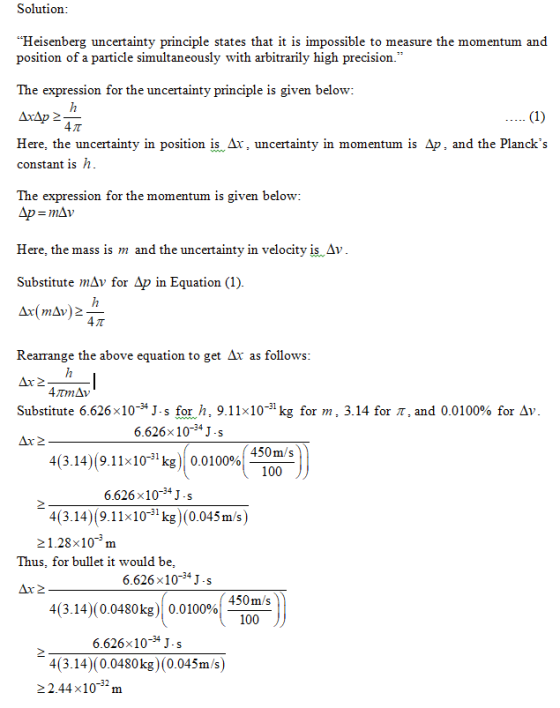
An electron and a 0.048 O-kg bullet each have a velocity of magnitude 450 m/s, accurate...
An electron and a 0.0380-kg bullet each have a velocity of magnitude 510 m/s, accurate to...
 An electron and a 0.0380-kg bullet each have a velocity of magnitude 510 m/s, accurate to within 0.0100%. Within what lower limit could we determine the position of each object along the direction of the velocity? electron bullet
An electron and a 0.0460-kg bullet each have a velocity of magnitude 490 m/s, accurate to...
An electron and a 0.0460-kg bullet each have a velocity of magnitude 490 m/s, accurate to within 0.0100%. Within what lower limit could we determine the position of each object along the direction of the velocity? electron __________mm bullet ____________m
Bullet A bullet is fired horizontally at 450 m/s [El from a gun that is 1.50...
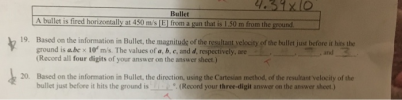 Bullet A bullet is fired horizontally at 450 m/s [El from a gun that is 1.50 m from the ground. 19. Based on the information in Bullet, the magnitude of the resultant yelocity of the bullet just before it hits the ground is a.be x 10 m/s. The values of a, b, c, and d, respectively, are (Record all four digits of your answer on the answer sheet.) ,, and 20. Based on the information in Bullet, the direction, using...
A 0.0260 kg bullet moving horizontally at 450 m/s embeds itself into an initially stationary 0.500...
 A 0.0260 kg bullet moving horizontally at 450 m/s embeds itself into an initially stationary 0.500 kg block (a) What is their velocity just after the collision? m/s (b) The bullet-embedded block slides 8.0 m on a horizontal surface with a 0.30 kinetic coefficient of friction. Now what is its velocity? my's (c) The bullet embedded block now strikes and sticks to a stationary 2.00 kg block. How far does this combination travel before stopping? חח Additional Materials Reading
A 2.00 kg object starts at the origin with an initial velocity of 3.00 m/s in...
A 2.00 kg object starts at the origin with an initial velocity of 3.00 m/s in the direction of 20.0° N from E. The object feels a constant force of 5.00 N in the direction of 55.0° N from E for 4.00 s. a) What is the magnitude and direction of the acceleration? b) What are the components of the acceleration? c) What are the components of the initial velocity? d) What are the components of the final velocity? e)...
PROBLEM 17,101 A 45-g bullet is fired with a velocity of 400 m/s at 0 =...
 PROBLEM 17,101 A 45-g bullet is fired with a velocity of 400 m/s at 0 = 30° into a 9-kg square panel of side b = 200 mm. Knowing that h=150 mm and that the panel is initially at rest, determine (a) the velocity of the center of the panel immediately after the bullet becomes embedded, (b) the impulsive reaction at A, assuming that the bullet becomes embedded in 2 ms.
A 10 g bullet traveling at 450 m/s strikes a 9.0 kg , 1.1-m-wide door at...
A 10 g bullet traveling at 450 m/s strikes a 9.0 kg , 1.1-m-wide door at the edge opposite the hinge. The bullet embeds itself in the door, causing the door to swing open. What is the angular velocity of the door just after impact? Express your answer to two significant figures and include the appropriate units.
A 5.00-g bullet moving with an initial speed of 450 m/s passes through a 1.00-kg block,...
 A 5.00-g bullet moving with an initial speed of 450 m/s passes through a 1.00-kg block, as shown in the figure. The block is initially at rest on a frictionless, horizontal surface and is connected to a spring that has a spring-force constant of 900 N/m. The block moves a distance d = 3.34 cm to the right after the collision. Note that the block only starts moving after the bullet has completely passed through the block. IWW d Round...
A 4.25-g bullet traveling horizontally with a velocity of magnitude 375 m/s is fired into a...
 A 4.25-g bullet traveling horizontally with a velocity of magnitude 375 m/s is fired into a wooden block with mass 1.10 kg, initially at rest on a level frictionless surface. The bullet passes through the block and emerges with its speed reduced to 126 m/s. Part A How fast is the block moving just after the bullet emerges from it? Express your answer in meters per second. IV A£¢ © 2 ? m/s Submit Request Answer Provide Feedback
An electron that has velocity v=(3x10^5 m/s) and moves along positive x direction through the uniform...
An electron that has velocity v=(3x10^5 m/s) and moves along positive x direction through the uniform magnetic field B=(0.8T) which is along the positive z direction. (a) Find the force on the electron (magnitude and direction). (e=1.6x10^-31 kg) (b) Calculate the radius of the electron's path in the magnetic field.
 An electron and a 0.0380-kg bullet each have a velocity of magnitude 510 m/s, accurate to within 0.0100%. Within what lower limit could we determine the position of each object along the direction of the velocity? electron bullet
 Bullet A bullet is fired horizontally at 450 m/s [El from a gun that is 1.50 m from the ground. 19. Based on the information in Bullet, the magnitude of the resultant yelocity of the bullet just before it hits the ground is a.be x 10 m/s. The values of a, b, c, and d, respectively, are (Record all four digits of your answer on the answer sheet.) ,, and 20. Based on the information in Bullet, the direction, using...
 A 0.0260 kg bullet moving horizontally at 450 m/s embeds itself into an initially stationary 0.500 kg block (a) What is their velocity just after the collision? m/s (b) The bullet-embedded block slides 8.0 m on a horizontal surface with a 0.30 kinetic coefficient of friction. Now what is its velocity? my's (c) The bullet embedded block now strikes and sticks to a stationary 2.00 kg block. How far does this combination travel before stopping? חח Additional Materials Reading
 PROBLEM 17,101 A 45-g bullet is fired with a velocity of 400 m/s at 0 = 30° into a 9-kg square panel of side b = 200 mm. Knowing that h=150 mm and that the panel is initially at rest, determine (a) the velocity of the center of the panel immediately after the bullet becomes embedded, (b) the impulsive reaction at A, assuming that the bullet becomes embedded in 2 ms.
 A 5.00-g bullet moving with an initial speed of 450 m/s passes through a 1.00-kg block, as shown in the figure. The block is initially at rest on a frictionless, horizontal surface and is connected to a spring that has a spring-force constant of 900 N/m. The block moves a distance d = 3.34 cm to the right after the collision. Note that the block only starts moving after the bullet has completely passed through the block. IWW d Round...
 A 4.25-g bullet traveling horizontally with a velocity of magnitude 375 m/s is fired into a wooden block with mass 1.10 kg, initially at rest on a level frictionless surface. The bullet passes through the block and emerges with its speed reduced to 126 m/s. Part A How fast is the block moving just after the bullet emerges from it? Express your answer in meters per second. IV A£¢ © 2 ? m/s Submit Request Answer Provide Feedback
Most questions answered within 3 hours.
-
Where is the error in this code sequence?
String s1 = "Hello";
String s2 = "ello";...
asked 11 months ago -
Financial data for Joel de Paris, Inc., for last year
follow:
Joel de Paris, Inc.
Balance...
asked 11 months ago -
Consider this reaction:
Al2(SO4)3 (aq)+ BaCl3
(aq) Al2Cl6 (aq)- +
3BaSO4(s) . What is the...
asked 11 months ago -
Suppose that Savneet is considering increasing her
recent random sample from 20 car rentals to 40...
asked 11 months ago -
Trucks arrive at an unloading terminal at an average rate of 120
per hour.
Trucks arrive...
asked 11 months ago -
Why are methanol and ethanol completely soluble in water while
octanol is not very little soluble....
asked 11 months ago -
A facilities manager at a university reads in a research report
that the mean amount of...
asked 11 months ago -
When the CuSO4 is rehydrated by adding water to the anhydrous
compound, is this an endothermic...
asked 11 months ago -
A ray of sunlight is passing from diamond into crown glass; the
angle of incidence is...
asked 11 months ago -
A block of mass 0.249 kg is placed on top of a light, vertical
spring of...
asked 11 months ago -
how do the kidneys compensate in the presences of acidosis
a) trigger hyperventilate
b) reserve acid...
asked 11 months ago -
Question 501 pts
The rental rate of capital to the firm increases. Which of the
following...
asked 11 months ago