
Homework Answers
Add Answer to:
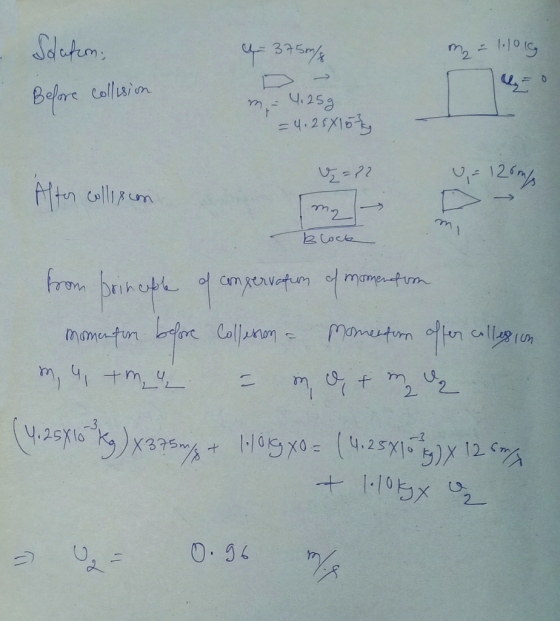
A 4.25-g bullet traveling horizontally with a velocity of magnitude 375 m/s is fired into a...
A 5.00 g bullet is fired horizontally at a speed of 276 m/s into a 1.50...
 A 5.00 g bullet is fired horizontally at a speed of 276 m/s into a 1.50 kg wooden block resting on a frictionless horizontal surface. Determine how fast the block will be moving if the bullet becomes imbedded in the block. Express your answer using appropriate mks units.
A 4.90-g bullet moving at 578 m/s strikes a 885-g wooden block
A 4.90-g bullet moving at 578 m/s strikes a 885-g wooden block at rest on a frictionless surface. The bullet emerges, traveling in the same direction with its speed reduced to 379 m/s. (a) What is the resulting speed of the block? (b) What is the impulse transferred from the bullet to the block? ((a) 1.10 m/s,(b)0.975 N s)
A 12.0-g bullet is fired horizontally into a 113-g wooden block that is initially at rest...
A 12.0-g bullet is fired horizontally into a 113-g wooden block that is initially at rest on a frictionless horizontal surface and connected to a spring having spring constant 159 N/m. The bullet becomes embedded in the block. If the bullet-block system compresses the spring by a maximum of 89.0 cm, what was the speed of the bullet at impact with the block? m/s
A 6.60 g bullet moving at 603 m/s strikes a 660 g wooden block at rest on a frictionless surface
A 6.60 g bullet moving at 603 m/s strikes a 660 g wooden block at rest on a frictionless surface. The bullet emerges, traveling in the same direction with its speed reduced to 457 m/s. (a) What is the resulting speed of the block? (b) What is the speed of the bullet-block center of mass?
Not A 5.00-g bullet moving with an initial speed of v 410 m/s is fired into...
 Not A 5.00-g bullet moving with an initial speed of v 410 m/s is fired into and passes through a 1.00-kg block as shown in the figure below. The block, initially at rest on a frictionless, horizontal surface, is connected to a spring with force constant 940 N/m. The block moves d-5.60 cm to the right after impact before being brought to rest by the spring (a) Find the speed at which the bullet emerges from the block 146 your-esponse...
A 12.0-g bullet is fired horizontally into a 115-g wooden block that is initially at rest...
A 12.0-g bullet is fired horizontally into a 115-g wooden block that is initially at rest on a frictionless horizontal surface and connected to a spring having spring constant 146 N/m. The bullet becomes embedded in the block. If the bullet-block system compresses the spring by a maximum of 88.5 cm, what was the speed of the bullet at impact with the block?
1. A bullet of mass m -25.0 g is fired into a stationary block of mass...
 1. A bullet of mass m -25.0 g is fired into a stationary block of mass m, -4.00 kg, which is suspended on a rope, as shown below. The bullet is initially traveling with velocity v. - 400 m/s, passes through the block and emerges with a final velocity horizontally Immediately after the impact the block travels upward with a velocity of 2.00 m's and reaches a vertical height, h before coming to rest. Determine the maximum height the block...
A 12.0-q bullet is fired horizontally into a 103-q wooden block that is initially at rest...
 A 12.0-q bullet is fired horizontally into a 103-q wooden block that is initially at rest on a frictionless horizontal surface and connected to a spring having spring constant 158 N/m. The bullet becomes the bullet-block system compresses the spring by a maximum of 81.5 cm, what was the speed of the bullet at impact with the block? embedded in the block. m/s
A 5.00-9 bullet moving with an initial speed of v. = 430 m/s is fired into...
 A 5.00-9 bullet moving with an initial speed of v. = 430 m/s is fired into and passes through a 1.00-kg block as shown in the figure below. The block, initially at rest on a frictionless, horizontal surface, is connected to a spring with force constant 910 N/m. The block moves d = 6.00 cm to the right after impact before being brought to rest by the spring. M (a) Find the speed at which the bullet emerges from the...
Constants A 14.7 g bullet traveling horizontally at 866 m/s passes through a tank containing 14.5...
 Constants A 14.7 g bullet traveling horizontally at 866 m/s passes through a tank containing 14.5 kg of water and emerges with a speed of 544 m/s Part A What is the maximum temperature increase that the water could have as a result of this event? AT 3337.047 C Submit Request Answer
 A 5.00 g bullet is fired horizontally at a speed of 276 m/s into a 1.50 kg wooden block resting on a frictionless horizontal surface. Determine how fast the block will be moving if the bullet becomes imbedded in the block. Express your answer using appropriate mks units.
 Not A 5.00-g bullet moving with an initial speed of v 410 m/s is fired into and passes through a 1.00-kg block as shown in the figure below. The block, initially at rest on a frictionless, horizontal surface, is connected to a spring with force constant 940 N/m. The block moves d-5.60 cm to the right after impact before being brought to rest by the spring (a) Find the speed at which the bullet emerges from the block 146 your-esponse...
 1. A bullet of mass m -25.0 g is fired into a stationary block of mass m, -4.00 kg, which is suspended on a rope, as shown below. The bullet is initially traveling with velocity v. - 400 m/s, passes through the block and emerges with a final velocity horizontally Immediately after the impact the block travels upward with a velocity of 2.00 m's and reaches a vertical height, h before coming to rest. Determine the maximum height the block...
 A 12.0-q bullet is fired horizontally into a 103-q wooden block that is initially at rest on a frictionless horizontal surface and connected to a spring having spring constant 158 N/m. The bullet becomes the bullet-block system compresses the spring by a maximum of 81.5 cm, what was the speed of the bullet at impact with the block? embedded in the block. m/s
 A 5.00-9 bullet moving with an initial speed of v. = 430 m/s is fired into and passes through a 1.00-kg block as shown in the figure below. The block, initially at rest on a frictionless, horizontal surface, is connected to a spring with force constant 910 N/m. The block moves d = 6.00 cm to the right after impact before being brought to rest by the spring. M (a) Find the speed at which the bullet emerges from the...
 Constants A 14.7 g bullet traveling horizontally at 866 m/s passes through a tank containing 14.5 kg of water and emerges with a speed of 544 m/s Part A What is the maximum temperature increase that the water could have as a result of this event? AT 3337.047 C Submit Request Answer
Most questions answered within 3 hours.
-
Where is the error in this code sequence?
String s1 = "Hello";
String s2 = "ello";...
asked 11 months ago -
Financial data for Joel de Paris, Inc., for last year
follow:
Joel de Paris, Inc.
Balance...
asked 11 months ago -
Consider this reaction:
Al2(SO4)3 (aq)+ BaCl3
(aq) Al2Cl6 (aq)- +
3BaSO4(s) . What is the...
asked 11 months ago -
Suppose that Savneet is considering increasing her
recent random sample from 20 car rentals to 40...
asked 11 months ago -
Trucks arrive at an unloading terminal at an average rate of 120
per hour.
Trucks arrive...
asked 11 months ago -
Why are methanol and ethanol completely soluble in water while
octanol is not very little soluble....
asked 11 months ago -
A facilities manager at a university reads in a research report
that the mean amount of...
asked 11 months ago -
When the CuSO4 is rehydrated by adding water to the anhydrous
compound, is this an endothermic...
asked 11 months ago -
A ray of sunlight is passing from diamond into crown glass; the
angle of incidence is...
asked 11 months ago -
A block of mass 0.249 kg is placed on top of a light, vertical
spring of...
asked 11 months ago -
how do the kidneys compensate in the presences of acidosis
a) trigger hyperventilate
b) reserve acid...
asked 11 months ago -
Question 501 pts
The rental rate of capital to the firm increases. Which of the
following...
asked 11 months ago