
Homework Answers
Add Answer to:
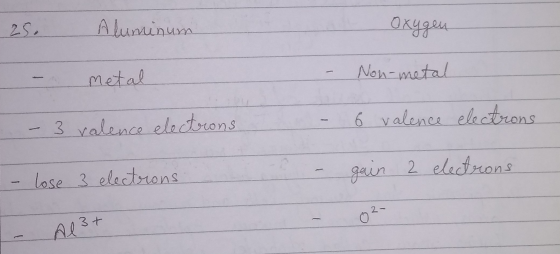
25. Consider the elements aluminum and oxygen. aluminum охудеn Identify each as a metal or a...
Which of the following pairs of elements are likely to form ionic compounds: A) helium and oxygen B) magnesium and chlorine C) chlorine and bromine D) potassium and sulfur E) sodium and potassium F) nitrogen and oxygen I believe the answ
Which of the following pairs of elements are likely to form ionic compounds: A) helium and oxygen B) magnesium and chlorine C) chlorine and bromine D) potassium and sulfur E) sodium and potassium F) nitrogen and oxygen I believe the answer is d and f Would appreciate a verification and as to why I might be wrong or right instead of a link saying what is an ionic compound thank you
8. Why does carbon contain only 4 valence electrons when it has 6 total electrons? 9.True...
 8. Why does carbon contain only 4 valence electrons when it has
6 total electrons?
9.True or False. Oxygen and sulfur have the same number of
valence electrons.
10. True or False. Beryllium and magnesium have the same number
of valence electrons.
11. True or False. Sodium and magnesium have the same number of
valence electrons.
12. What is the relationship between the number of valence
electrons and the column on the periodic table?
13. How is the number of...
8. Why does carbon contain only 4 valence electrons when it has
6 total electrons?
9.True or False. Oxygen and sulfur have the same number of
valence electrons.
10. True or False. Beryllium and magnesium have the same number
of valence electrons.
11. True or False. Sodium and magnesium have the same number of
valence electrons.
12. What is the relationship between the number of valence
electrons and the column on the periodic table?
13. How is the number of...
For each of the following, write the electron configuration for each element on the reactants side....
For each of the following, write the electron configuration for each element on the reactants side. Then write the electron configuration for the ions that would be formed when making the ionic compound product. (You may use noble gas core configurations) Example: Sodium and chlorine Na+Cl→Na1++Cl1- →NaCl 1s22s22p63s1 + 1s22s22p63s23p5 → 1s22s22p6 + 1s22s22p63s23p6 → NaCl Calcium and fluorine Potassium and sulfur Magnesium and oxygen Zinc and nitrogen Lithium and bromine 6. Iron(III) and chlorine 7. Nickel(II) and nitrogen 8....
Determine whether the following pairs of elements can form ionic compounds Manganese and chlorine fluorine and...
Determine whether the following pairs of elements can form ionic compounds Manganese and chlorine fluorine and sodium potassium and sulfur lithium and calcium sulfur and calcium nitrogen and iodine
Part A Which of the following pairs of elements are likely to form an ionic compound?...
 Part A Which of the following pairs of elements are likely to form an ionic compound? Check all that apply. sulfur and bromine O copper and chlorine potassium and oxygen zinc and magnesium nitrogen and phosphorus vanadium and neon Submit Request Answer
Material science class Suppose 1 at % of the following elements is added to aluminum (forming...
 Material science class
Suppose 1 at % of the following elements is added to aluminum (forming a separate alloy with each element) without exceeding the solubility limit. Which one of the following would be expected to give the higher strength alloy. Mn: Ga: Be; or Li? The Atomic and lonic Radii of Selected Elements Valence Element Aluminum Antimony Arsenic Barium Beryllium Bismuth Boron Bromine Cadmium Calcium Carbon Cerium Cesium Chlorine Chromium Cobalt Copper Fluorine Gallum Germanium Atomic Radius (A) 1.432...
Material science class
Suppose 1 at % of the following elements is added to aluminum (forming a separate alloy with each element) without exceeding the solubility limit. Which one of the following would be expected to give the higher strength alloy. Mn: Ga: Be; or Li? The Atomic and lonic Radii of Selected Elements Valence Element Aluminum Antimony Arsenic Barium Beryllium Bismuth Boron Bromine Cadmium Calcium Carbon Cerium Cesium Chlorine Chromium Cobalt Copper Fluorine Gallum Germanium Atomic Radius (A) 1.432...
Predicting ionic compounds formed by two elements Abde Decide whether each pair of elements in the...
 Predicting ionic compounds formed by two elements Abde Decide whether each pair of elements in the table below will form an ionic compound. If they will, write the empirical formula of the compound formed in the space provided. element #1 element #2 Forms ionic compound? empirical formula of ionic compound Da sulfur iodine yes no X 6 sodium fluorine yes no lithium bromine eyes no O sulfur sodium yes no
Hydrogen 1H 2- Atomic number He Helium - He Mass number First shell Element symbol- Electron-...
 Hydrogen 1H 2- Atomic number He Helium - He Mass number First shell Element symbol- Electron- distribution diagram Lithium Beryllium Carbon Boron 3B Oxygen Nitrogen en N Fluorine انار Neon Be 10 Ne Second shell Sodium 11 Na Aluminum AI Sulfur Magnesium 12Mg Chlorine Phosphorus Silicon 1 Si Argon Ar Third shell According to the section of the Periodic Table of Elements above, which element is most likely to have similar chemical properties to carbon Selected Answer: C. Phosphorus Answers:...
"ouTube Popular | Imported From Sa... 6. Which elements are considered alkali metals? A. He, Ne,...
 "ouTube Popular | Imported From Sa... 6. Which elements are considered alkali metals? A. He, Ne, Ar B. H, N, O C. F, CI, Br D. Na, K, Li 7. What is a cation? A. An atom that has lost electrons and forms a positive charge. B. An atom that has gained electrons and forms a negative charge. C. An atom that has gained protons and forms a positive charge. D. An atom that has lost protons and forms a...
Please answer the Question with explanation, to let me study it for EXAM. Ionic Bonding Activity In your group you will...
 Please answer the Question with explanation, to let me
study it for EXAM.
Ionic Bonding Activity In your group you will determine and demonstrate the formation of ionic compounds. Complete the table below by following these steps. The first one is done for you as an example. 1. Determine how many valence electrons are in each element. 2. Figure out how many electrons would be transferred from one atom to the other. Remember each element tends to gain or lose...
Please answer the Question with explanation, to let me
study it for EXAM.
Ionic Bonding Activity In your group you will determine and demonstrate the formation of ionic compounds. Complete the table below by following these steps. The first one is done for you as an example. 1. Determine how many valence electrons are in each element. 2. Figure out how many electrons would be transferred from one atom to the other. Remember each element tends to gain or lose...
 8. Why does carbon contain only 4 valence electrons when it has
6 total electrons?
9.True or False. Oxygen and sulfur have the same number of
valence electrons.
10. True or False. Beryllium and magnesium have the same number
of valence electrons.
11. True or False. Sodium and magnesium have the same number of
valence electrons.
12. What is the relationship between the number of valence
electrons and the column on the periodic table?
13. How is the number of...
8. Why does carbon contain only 4 valence electrons when it has
6 total electrons?
9.True or False. Oxygen and sulfur have the same number of
valence electrons.
10. True or False. Beryllium and magnesium have the same number
of valence electrons.
11. True or False. Sodium and magnesium have the same number of
valence electrons.
12. What is the relationship between the number of valence
electrons and the column on the periodic table?
13. How is the number of...
 Part A Which of the following pairs of elements are likely to form an ionic compound? Check all that apply. sulfur and bromine O copper and chlorine potassium and oxygen zinc and magnesium nitrogen and phosphorus vanadium and neon Submit Request Answer
 Material science class
Suppose 1 at % of the following elements is added to aluminum (forming a separate alloy with each element) without exceeding the solubility limit. Which one of the following would be expected to give the higher strength alloy. Mn: Ga: Be; or Li? The Atomic and lonic Radii of Selected Elements Valence Element Aluminum Antimony Arsenic Barium Beryllium Bismuth Boron Bromine Cadmium Calcium Carbon Cerium Cesium Chlorine Chromium Cobalt Copper Fluorine Gallum Germanium Atomic Radius (A) 1.432...
Material science class
Suppose 1 at % of the following elements is added to aluminum (forming a separate alloy with each element) without exceeding the solubility limit. Which one of the following would be expected to give the higher strength alloy. Mn: Ga: Be; or Li? The Atomic and lonic Radii of Selected Elements Valence Element Aluminum Antimony Arsenic Barium Beryllium Bismuth Boron Bromine Cadmium Calcium Carbon Cerium Cesium Chlorine Chromium Cobalt Copper Fluorine Gallum Germanium Atomic Radius (A) 1.432...
 Predicting ionic compounds formed by two elements Abde Decide whether each pair of elements in the table below will form an ionic compound. If they will, write the empirical formula of the compound formed in the space provided. element #1 element #2 Forms ionic compound? empirical formula of ionic compound Da sulfur iodine yes no X 6 sodium fluorine yes no lithium bromine eyes no O sulfur sodium yes no
 Hydrogen 1H 2- Atomic number He Helium - He Mass number First shell Element symbol- Electron- distribution diagram Lithium Beryllium Carbon Boron 3B Oxygen Nitrogen en N Fluorine انار Neon Be 10 Ne Second shell Sodium 11 Na Aluminum AI Sulfur Magnesium 12Mg Chlorine Phosphorus Silicon 1 Si Argon Ar Third shell According to the section of the Periodic Table of Elements above, which element is most likely to have similar chemical properties to carbon Selected Answer: C. Phosphorus Answers:...
 "ouTube Popular | Imported From Sa... 6. Which elements are considered alkali metals? A. He, Ne, Ar B. H, N, O C. F, CI, Br D. Na, K, Li 7. What is a cation? A. An atom that has lost electrons and forms a positive charge. B. An atom that has gained electrons and forms a negative charge. C. An atom that has gained protons and forms a positive charge. D. An atom that has lost protons and forms a...
 Please answer the Question with explanation, to let me
study it for EXAM.
Ionic Bonding Activity In your group you will determine and demonstrate the formation of ionic compounds. Complete the table below by following these steps. The first one is done for you as an example. 1. Determine how many valence electrons are in each element. 2. Figure out how many electrons would be transferred from one atom to the other. Remember each element tends to gain or lose...
Please answer the Question with explanation, to let me
study it for EXAM.
Ionic Bonding Activity In your group you will determine and demonstrate the formation of ionic compounds. Complete the table below by following these steps. The first one is done for you as an example. 1. Determine how many valence electrons are in each element. 2. Figure out how many electrons would be transferred from one atom to the other. Remember each element tends to gain or lose...
Most questions answered within 3 hours.
-
Where is the error in this code sequence?
String s1 = "Hello";
String s2 = "ello";...
asked 10 months ago -
Financial data for Joel de Paris, Inc., for last year
follow:
Joel de Paris, Inc.
Balance...
asked 10 months ago -
Consider this reaction:
Al2(SO4)3 (aq)+ BaCl3
(aq) Al2Cl6 (aq)- +
3BaSO4(s) . What is the...
asked 10 months ago -
Suppose that Savneet is considering increasing her
recent random sample from 20 car rentals to 40...
asked 10 months ago -
Trucks arrive at an unloading terminal at an average rate of 120
per hour.
Trucks arrive...
asked 10 months ago -
Why are methanol and ethanol completely soluble in water while
octanol is not very little soluble....
asked 10 months ago -
A facilities manager at a university reads in a research report
that the mean amount of...
asked 10 months ago -
When the CuSO4 is rehydrated by adding water to the anhydrous
compound, is this an endothermic...
asked 10 months ago -
A ray of sunlight is passing from diamond into crown glass; the
angle of incidence is...
asked 10 months ago -
A block of mass 0.249 kg is placed on top of a light, vertical
spring of...
asked 10 months ago -
how do the kidneys compensate in the presences of acidosis
a) trigger hyperventilate
b) reserve acid...
asked 10 months ago -
Question 501 pts
The rental rate of capital to the firm increases. Which of the
following...
asked 10 months ago