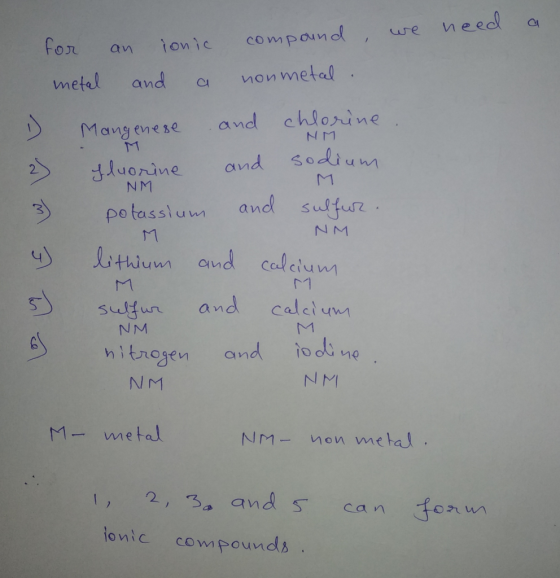
Determine whether the following pairs of elements can form ionic compounds Manganese and chlorine fluorine and...
Determine whether the following pairs of elements can form ionic compounds
Manganese and chlorine
fluorine and sodium
potassium and sulfur
lithium and calcium
sulfur and calcium
nitrogen and iodine
Homework Answers
Comment if any problem
Add Answer to:
Determine whether the following pairs of elements can form ionic
compounds
Manganese and chlorine
fluorine and...
Predicting ionic compounds formed by two elements Abde Decide whether each pair of elements in the...
 Predicting ionic compounds formed by two elements Abde Decide whether each pair of elements in the table below will form an ionic compound. If they will, write the empirical formula of the compound formed in the space provided. element #1 element #2 Forms ionic compound? empirical formula of ionic compound Da sulfur iodine yes no X 6 sodium fluorine yes no lithium bromine eyes no O sulfur sodium yes no
Which of the following pairs of elements are likely to form ionic compounds: A) helium and oxygen B) magnesium and chlorine C) chlorine and bromine D) potassium and sulfur E) sodium and potassium F) nitrogen and oxygen I believe the answ
Which of the following pairs of elements are likely to form ionic compounds: A) helium and oxygen B) magnesium and chlorine C) chlorine and bromine D) potassium and sulfur E) sodium and potassium F) nitrogen and oxygen I believe the answer is d and f Would appreciate a verification and as to why I might be wrong or right instead of a link saying what is an ionic compound thank you
25. Consider the elements aluminum and oxygen. aluminum охудеn Identify each as a metal or a...
 25. Consider the elements aluminum and oxygen. aluminum охудеn Identify each as a metal or a nonmetal. State the number of valence electrons for each, State the number of electrons that must be lost or gained for each to achieve an octet. Write the symbol, including its ionic charge, and type of each resulting ion. 26. Which of the following pairs of elements are likely to form an ionic compound? Why? Yes/No Why? lithium and chlorine Oxygen and bromine potassium...
Part A Which of the following pairs of elements are likely to form an ionic compound?...
 Part A Which of the following pairs of elements are likely to form an ionic compound? Check all that apply. sulfur and bromine O copper and chlorine potassium and oxygen zinc and magnesium nitrogen and phosphorus vanadium and neon Submit Request Answer
For each of the following, write the electron configuration for each element on the reactants side....
For each of the following, write the electron configuration for each element on the reactants side. Then write the electron configuration for the ions that would be formed when making the ionic compound product. (You may use noble gas core configurations) Example: Sodium and chlorine Na+Cl→Na1++Cl1- →NaCl 1s22s22p63s1 + 1s22s22p63s23p5 → 1s22s22p6 + 1s22s22p63s23p6 → NaCl Calcium and fluorine Potassium and sulfur Magnesium and oxygen Zinc and nitrogen Lithium and bromine 6. Iron(III) and chlorine 7. Nickel(II) and nitrogen 8....
Problem Page Decide whether each pair of elements in the table below will form an ionic...
Problem Page Decide whether each pair of elements in the table below will form an ionic compound. If they will, write the empirical formula and name of the compound formed in the spaces provided. element #1 element #2 Forms ionic compound? empirical formula of ionic compound name of ionic compound barium lithium yes no sulfur magnesium yes no sulfur fluorine yes no lithium sulfur yes no
Decide whether each pair of elements in the table below will form an ionic compound. If...
 Decide whether each pair of elements in the table below will form an ionic compound. If they will, write the empirical formula and name of the compound formed in the spaces provided. element #1 element #2 Forms ionic compound? empirical formula of ionic compound name of ionic compound x s ? iodine magnesium sodium calcium Dyes no O yes no O yes o no O yes no oxygen chlorine sodium oxygen
Decide whether each pair of elements in the table below will form an ionic compound. If...
 Decide whether each pair of elements in the table below will form an ionic compound. If they will, write the empirical formula of the compound formed in the space provided. Forms ionic empirical formula of lonic compound element #1 element #2 compound? chlorine oxygenv yes no cesium oxygen yes no cesium fluorine yes no cesium calcium yes no
5. The elements fluorine (F) and calcium (Ca) form the ionic compound calcium fluoride. a. When...
 5. The elements fluorine (F) and calcium (Ca) form the ionic compound calcium fluoride. a. When fluorine forms an ion, what is its charge? b. When calcium forms an ion, what is its charge? c. Write the empirical formula for the ionic compound formed by fluorine and calcium.
Decide whether each pair of elements in the table below will form an ionic compound. If...
 Decide whether each pair of elements in the table below will form an ionic compound. If they will, write the empirical formula and name of the compound formed in the spaces provided. element #1 element #2 Forms ionic compound? empirical formula of ionic | name of ionic compound compound x magnesium O yes O no 6 ? sulfur rubidium fluorine O yes O no sulfur rubidium O yes no magnesium fluorine O yes O no
 Predicting ionic compounds formed by two elements Abde Decide whether each pair of elements in the table below will form an ionic compound. If they will, write the empirical formula of the compound formed in the space provided. element #1 element #2 Forms ionic compound? empirical formula of ionic compound Da sulfur iodine yes no X 6 sodium fluorine yes no lithium bromine eyes no O sulfur sodium yes no
 25. Consider the elements aluminum and oxygen. aluminum охудеn Identify each as a metal or a nonmetal. State the number of valence electrons for each, State the number of electrons that must be lost or gained for each to achieve an octet. Write the symbol, including its ionic charge, and type of each resulting ion. 26. Which of the following pairs of elements are likely to form an ionic compound? Why? Yes/No Why? lithium and chlorine Oxygen and bromine potassium...
 Part A Which of the following pairs of elements are likely to form an ionic compound? Check all that apply. sulfur and bromine O copper and chlorine potassium and oxygen zinc and magnesium nitrogen and phosphorus vanadium and neon Submit Request Answer
 Decide whether each pair of elements in the table below will form an ionic compound. If they will, write the empirical formula and name of the compound formed in the spaces provided. element #1 element #2 Forms ionic compound? empirical formula of ionic compound name of ionic compound x s ? iodine magnesium sodium calcium Dyes no O yes no O yes o no O yes no oxygen chlorine sodium oxygen
 Decide whether each pair of elements in the table below will form an ionic compound. If they will, write the empirical formula of the compound formed in the space provided. Forms ionic empirical formula of lonic compound element #1 element #2 compound? chlorine oxygenv yes no cesium oxygen yes no cesium fluorine yes no cesium calcium yes no
 5. The elements fluorine (F) and calcium (Ca) form the ionic compound calcium fluoride. a. When fluorine forms an ion, what is its charge? b. When calcium forms an ion, what is its charge? c. Write the empirical formula for the ionic compound formed by fluorine and calcium.
 Decide whether each pair of elements in the table below will form an ionic compound. If they will, write the empirical formula and name of the compound formed in the spaces provided. element #1 element #2 Forms ionic compound? empirical formula of ionic | name of ionic compound compound x magnesium O yes O no 6 ? sulfur rubidium fluorine O yes O no sulfur rubidium O yes no magnesium fluorine O yes O no
Most questions answered within 3 hours.
-
Where is the error in this code sequence?
String s1 = "Hello";
String s2 = "ello";...
asked 10 months ago -
Financial data for Joel de Paris, Inc., for last year
follow:
Joel de Paris, Inc.
Balance...
asked 10 months ago -
Consider this reaction:
Al2(SO4)3 (aq)+ BaCl3
(aq) Al2Cl6 (aq)- +
3BaSO4(s) . What is the...
asked 10 months ago -
Suppose that Savneet is considering increasing her
recent random sample from 20 car rentals to 40...
asked 10 months ago -
Trucks arrive at an unloading terminal at an average rate of 120
per hour.
Trucks arrive...
asked 10 months ago -
Why are methanol and ethanol completely soluble in water while
octanol is not very little soluble....
asked 10 months ago -
A facilities manager at a university reads in a research report
that the mean amount of...
asked 10 months ago -
When the CuSO4 is rehydrated by adding water to the anhydrous
compound, is this an endothermic...
asked 10 months ago -
A ray of sunlight is passing from diamond into crown glass; the
angle of incidence is...
asked 10 months ago -
A block of mass 0.249 kg is placed on top of a light, vertical
spring of...
asked 10 months ago -
how do the kidneys compensate in the presences of acidosis
a) trigger hyperventilate
b) reserve acid...
asked 10 months ago -
Question 501 pts
The rental rate of capital to the firm increases. Which of the
following...
asked 10 months ago