What would happen if you mixed:(i)1mole of alkene and 1mole of bromine (ii)1mole of alkene and...
-
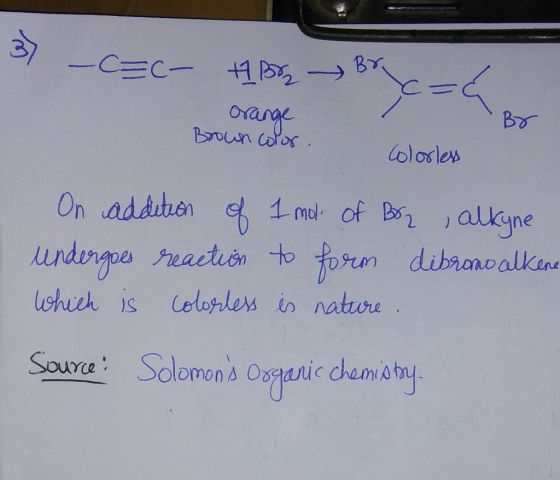
What would happen if you mixed:(i)1mole of alkene and 1mole of bromine (ii)1mole of alkene and 2 moles of bromine (iii) 1 mole of alkyne and 1 mole of bromine?
also pls site sources
Homework Answers

Add Answer to:
What would happen if you mixed:(i)1mole of alkene and 1mole of
bromine (ii)1mole of alkene and...
4. What would happen if you mixed: (i) 1 mole of alkene and 1 mole of...
 4. What would happen if you mixed: (i) 1 mole of alkene and 1 mole of bromine (ii) 1 mole of alkene and 2 moles of bromine (iii) 1 mole of alkyne and 1 mole of bromine?
Which alkene would you expect to have the lowest heat of hydrogenation? III IV I II...
 Which alkene would you expect to have the lowest heat of hydrogenation? III IV I II III IV Which pair does not represent a pair of resonance structures? and and and ШI IV and O I O II O III O IV All of these choices represent pairs of resonance structures.
Which terms from this list BEST describe the following compound? H-C=c- I. Alkane II. Alkene III....
 Which terms from this list BEST describe the following compound? H-C=c- I. Alkane II. Alkene III. Alkyne IV. Aromatic V. Saturated hydrocarbon VI. Unsaturated hydrocarbon I and V B. II and VI II and V C. III and VI D. E. III and V
what would be the major products of this HCl addition to an alkene? What would be...
 what would be the major products of this HCl addition to an
alkene?
What would be the major product(s) of this HCl addition to an alkene? HCI ? Br CI Br Br Br Br Br 1 II III IV V III IV I and 11 Il and Ill III and IV
what would be the major products of this HCl addition to an
alkene?
What would be the major product(s) of this HCl addition to an alkene? HCI ? Br CI Br Br Br Br Br 1 II III IV V III IV I and 11 Il and Ill III and IV
If there are some group I ions mixed in with group II ions together, 1. what...
If there are some group I ions mixed in with group II ions together, 1. what would happen when you follow the procedures of adding thioacetamide and heat in boiling water bath? (HInt: check the Ksp of group I ions with sulfide) 2. How would you separate the two groups of ions and identify the ions qualitatively? (Hint: some procedures are in the manual for groups I and II)
Which alkene would you expect to be most reactive toward acid-catalyzed hydration? CH_3=CHCH_2CH_3 I II III...
 Which alkene would you expect to be most reactive toward acid-catalyzed hydration? CH_3=CHCH_2CH_3 I II III IV All of these would be equally reactive.
What would be the major product of the following reaction? i. NaOCH ii. H30* ? you...
 What would be the major product of the following reaction? i. NaOCH ii. H30* ? you gi gaze lla I II III ОН О OH IV V Select one or more b. 11 c III DIV Dev
7. The addition of bromine to the alkene shown would give: H CH2CH CH3 H A....
 7. The addition of bromine to the alkene shown would give: H CH2CH CH3 H A. One meso compound B. One pair of enantiomers C. Two meso compounds D. Four stereoisomers [2 MARKS] 8. Which is the expected product of the reaction shown? Brz но но [2 MARKS] 6. What is the product of the reaction sequence shown? CH3 H CH3 H CH3 D CH3 OH CH3
all of them please!!!!! 12. What is the volume, in liters, of 12.0 moles of bromine?...
 all of them please!!!!!
12. What is the volume, in liters, of 12.0 moles of bromine? Bromine is a liquid at room temperature and has a density of 3.12 g/cm 13. Calculate the density of sulfur if you have 9.92x10² atoms in 2.51x10 L? UNITS 14. Calculate the number of hydrogen atoms in 0.252 ML of sulfuric acid. (D=1.02g/mL) 15. Indicate whether the following is true or false. If it is false, correct it to make it true. a. If...
all of them please!!!!!
12. What is the volume, in liters, of 12.0 moles of bromine? Bromine is a liquid at room temperature and has a density of 3.12 g/cm 13. Calculate the density of sulfur if you have 9.92x10² atoms in 2.51x10 L? UNITS 14. Calculate the number of hydrogen atoms in 0.252 ML of sulfuric acid. (D=1.02g/mL) 15. Indicate whether the following is true or false. If it is false, correct it to make it true. a. If...
I would like you to look at one of the remaining 8 (aluminum, bromine, cadmium, germanium,...
I would like you to look at one of the remaining 8 (aluminum, bromine, cadmium, germanium, lead, lithium, rubidium and tin) and evaluate the mineral using categories Including: Sources; Absorption, Transport, Storage and Excretion; Functions and Deficiency; Recommended intake, Toxicity and Assessment of Nutriture. Note: there may not be information available for particular items in the category, please note this on your assessment and provide references related to information that you attained for the categories.
 4. What would happen if you mixed: (i) 1 mole of alkene and 1 mole of bromine (ii) 1 mole of alkene and 2 moles of bromine (iii) 1 mole of alkyne and 1 mole of bromine?
 Which alkene would you expect to have the lowest heat of hydrogenation? III IV I II III IV Which pair does not represent a pair of resonance structures? and and and ШI IV and O I O II O III O IV All of these choices represent pairs of resonance structures.
 Which terms from this list BEST describe the following compound? H-C=c- I. Alkane II. Alkene III. Alkyne IV. Aromatic V. Saturated hydrocarbon VI. Unsaturated hydrocarbon I and V B. II and VI II and V C. III and VI D. E. III and V
 what would be the major products of this HCl addition to an
alkene?
What would be the major product(s) of this HCl addition to an alkene? HCI ? Br CI Br Br Br Br Br 1 II III IV V III IV I and 11 Il and Ill III and IV
what would be the major products of this HCl addition to an
alkene?
What would be the major product(s) of this HCl addition to an alkene? HCI ? Br CI Br Br Br Br Br 1 II III IV V III IV I and 11 Il and Ill III and IV
 Which alkene would you expect to be most reactive toward acid-catalyzed hydration? CH_3=CHCH_2CH_3 I II III IV All of these would be equally reactive.
 What would be the major product of the following reaction? i. NaOCH ii. H30* ? you gi gaze lla I II III ОН О OH IV V Select one or more b. 11 c III DIV Dev
 7. The addition of bromine to the alkene shown would give: H CH2CH CH3 H A. One meso compound B. One pair of enantiomers C. Two meso compounds D. Four stereoisomers [2 MARKS] 8. Which is the expected product of the reaction shown? Brz но но [2 MARKS] 6. What is the product of the reaction sequence shown? CH3 H CH3 H CH3 D CH3 OH CH3
 all of them please!!!!!
12. What is the volume, in liters, of 12.0 moles of bromine? Bromine is a liquid at room temperature and has a density of 3.12 g/cm 13. Calculate the density of sulfur if you have 9.92x10² atoms in 2.51x10 L? UNITS 14. Calculate the number of hydrogen atoms in 0.252 ML of sulfuric acid. (D=1.02g/mL) 15. Indicate whether the following is true or false. If it is false, correct it to make it true. a. If...
all of them please!!!!!
12. What is the volume, in liters, of 12.0 moles of bromine? Bromine is a liquid at room temperature and has a density of 3.12 g/cm 13. Calculate the density of sulfur if you have 9.92x10² atoms in 2.51x10 L? UNITS 14. Calculate the number of hydrogen atoms in 0.252 ML of sulfuric acid. (D=1.02g/mL) 15. Indicate whether the following is true or false. If it is false, correct it to make it true. a. If...
Most questions answered within 3 hours.
-
Where is the error in this code sequence?
String s1 = "Hello";
String s2 = "ello";...
asked 11 months ago -
Financial data for Joel de Paris, Inc., for last year
follow:
Joel de Paris, Inc.
Balance...
asked 11 months ago -
Consider this reaction:
Al2(SO4)3 (aq)+ BaCl3
(aq) Al2Cl6 (aq)- +
3BaSO4(s) . What is the...
asked 11 months ago -
Suppose that Savneet is considering increasing her
recent random sample from 20 car rentals to 40...
asked 11 months ago -
Trucks arrive at an unloading terminal at an average rate of 120
per hour.
Trucks arrive...
asked 11 months ago -
Why are methanol and ethanol completely soluble in water while
octanol is not very little soluble....
asked 11 months ago -
A facilities manager at a university reads in a research report
that the mean amount of...
asked 11 months ago -
When the CuSO4 is rehydrated by adding water to the anhydrous
compound, is this an endothermic...
asked 11 months ago -
A ray of sunlight is passing from diamond into crown glass; the
angle of incidence is...
asked 11 months ago -
A block of mass 0.249 kg is placed on top of a light, vertical
spring of...
asked 11 months ago -
how do the kidneys compensate in the presences of acidosis
a) trigger hyperventilate
b) reserve acid...
asked 11 months ago -
Question 501 pts
The rental rate of capital to the firm increases. Which of the
following...
asked 11 months ago