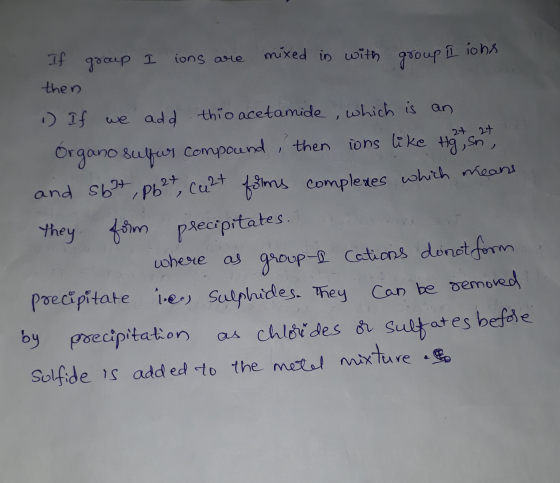
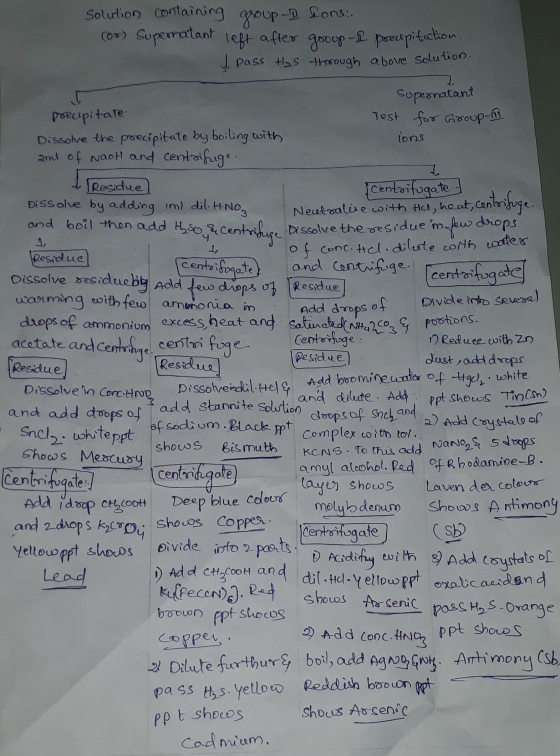
If there are some group I ions mixed in with group II ions together, 1. what...
If there are some group I ions mixed in with group II ions
together,
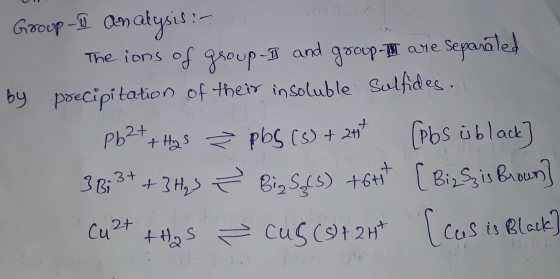
1. what would happen when you follow the procedures of adding
thioacetamide and heat in boiling water bath? (HInt: check the Ksp
of group I ions with sulfide)
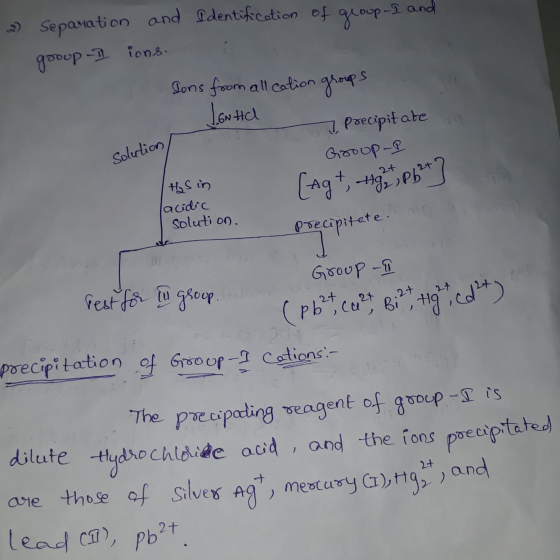
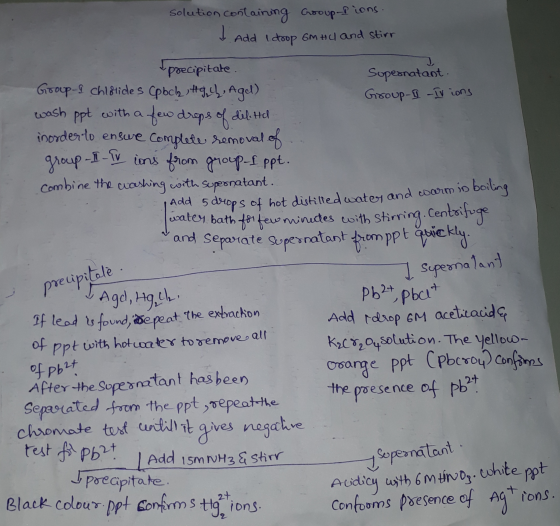
2. How would you separate the two groups of ions and identify the
ions qualitatively? (Hint: some procedures are in the manual for
groups I and II)
Homework Answers
![poecipitation of gooup I Cations - Agt + t > Agel(s) [Agel is white] Hg2+ + act – HgCl (s) [tigil is white) pott act a pbclcs](http://img.homeworklib.com/questions/e7fb6a50-e010-11eb-b076-b5ce1fb2be84.png?x-oss-process=image/resize,w_560)
Add Answer to:
If there are some group I ions mixed in with group II ions
together,
1. what...
4a. Considering the solubility rules for Group I metal carbonates, what are the possible outcomes when your sample...
 4a. Considering the solubility rules for Group I metal carbonates, what are the possible outcomes when your sample is mixed with water? b. What will happen to the carbonate in solution if you add a second solution that contains an alkaline carth metal? c. Considering the answer to 4b, what general type of reaction would you perform to determine the number of moles of one of the ions? d. Will you be able to measure the number of moles directly?...
What would happen if you mixed:(i)1mole of alkene and 1mole of bromine (ii)1mole of alkene and...
What would happen if you mixed:(i)1mole of alkene and 1mole of bromine (ii)1mole of alkene and 2 moles of bromine (iii) 1 mole of alkyne and 1 mole of bromine? also pls site sources
Pre-Lab for Qualitative Analysis of Silver Group I Cations Lab 1. What are the ions that...
 Pre-Lab for Qualitative Analysis of Silver Group I Cations Lab 1. What are the ions that are considered Group I cations? 2. Based on the Activities Series of Elements, explain why Group I ions would form precipitates when a strong, concentrated acid (such as HCI) is added to them. 3. Pby, and K Cro, will react with each other to form a precipitate if the concentrations are high enough. Write the complete, balanced equation for the reaction of Pbs and...
4. What would happen if you mixed: (i) 1 mole of alkene and 1 mole of...
 4. What would happen if you mixed: (i) 1 mole of alkene and 1 mole of bromine (ii) 1 mole of alkene and 2 moles of bromine (iii) 1 mole of alkyne and 1 mole of bromine?
I need help with the prelab and the flowchart. I’m totally clueless on the flowchart. For...
 I need help with the prelab and the flowchart. I’m totally
clueless on the flowchart.
For the prelab questions I have some answers but I don’t know
if they’re right. If they’re wrong, I would greatly appreciate an
explanation for the correct answer. I’m really trying to learn the
material but it’s hard now that classes are cancelled so I’m sorry
if these are dumb
1. PbCl ?
2. Ag+
3. ?
4. S1
Group 1, the Chloride Group BACKGROUND...
I need help with the prelab and the flowchart. I’m totally
clueless on the flowchart.
For the prelab questions I have some answers but I don’t know
if they’re right. If they’re wrong, I would greatly appreciate an
explanation for the correct answer. I’m really trying to learn the
material but it’s hard now that classes are cancelled so I’m sorry
if these are dumb
1. PbCl ?
2. Ag+
3. ?
4. S1
Group 1, the Chloride Group BACKGROUND...
I need help figuring out the flowchart and if I have the right answers for the...
 I need help figuring out the flowchart and if I have the right
answers for the prelab please and thank you!
Group I, the Chloride Group BACKGROUND The precipitating reagent for the chloride group is chloride ion in an acidic solution. Only three of the 18 metal ions form a precipitate with this reagent: silver ion (Ag'), mercury(I)ion (Hg). and lead ion (Pb). Since lead chloride is somewhat soluble, it is not completely precipitated here, and a low concentration of...
I need help figuring out the flowchart and if I have the right
answers for the prelab please and thank you!
Group I, the Chloride Group BACKGROUND The precipitating reagent for the chloride group is chloride ion in an acidic solution. Only three of the 18 metal ions form a precipitate with this reagent: silver ion (Ag'), mercury(I)ion (Hg). and lead ion (Pb). Since lead chloride is somewhat soluble, it is not completely precipitated here, and a low concentration of...
Question 7 0.77 pts Title q7a7 Which of the following pairs of species, when mixed together in water in proper ratios,...
 Question 7 0.77 pts Title q7a7 Which of the following pairs of species, when mixed together in water in proper ratios, would provide a buffer solution? Think each pair through very carefully in terms what species will form when they dissolve in water, and how they can then (potentially) react with water Refer to the table of strong acids/bases on the exam information sheet if you don't have them memorized yet. () KOH and NH4CI (ii)HCI and NH4CI (liI) NH3...
I concluded that my unknown was Pb2+. since yellow precipitate formed. can you help me answer...
 I concluded that my unknown was Pb2+. since yellow
precipitate formed. can you help me answer the questions for the
Known and unknown report
Qualitative Analysis: Group I Cations 10 ORECTIVES A Leam some chemistry of Group I cations, R Analyze an unknown for Group I cations. THEORY AND DISCUSSION Group I cations are precipitated as insoluble chlorides: Ag, Pb, Hg2 +Cr-AgCl, PbCh, HgCla The colors of the following species will be helpful in the analysis for Group I cations....
I concluded that my unknown was Pb2+. since yellow
precipitate formed. can you help me answer the questions for the
Known and unknown report
Qualitative Analysis: Group I Cations 10 ORECTIVES A Leam some chemistry of Group I cations, R Analyze an unknown for Group I cations. THEORY AND DISCUSSION Group I cations are precipitated as insoluble chlorides: Ag, Pb, Hg2 +Cr-AgCl, PbCh, HgCla The colors of the following species will be helpful in the analysis for Group I cations....
Why wouldnt a weak base, such as NH3, work just as well as KOH in (1)?...
 Why wouldnt a weak base, such as NH3, work just as well as KOH
in (1)?
2.2 Is the question I have. I figured out
2.1 already.
Below is relevant info. Thanks!
2. (1) Describe how adding a solution of KOH to the original sulfide precipitate results in the separa- tion of Sn4+ ion from the other Group W cations. (2) Why wouldn't a weak base, such as aque- ous NH3, work just as well as aqueous KOH in (1)?...
Why wouldnt a weak base, such as NH3, work just as well as KOH
in (1)?
2.2 Is the question I have. I figured out
2.1 already.
Below is relevant info. Thanks!
2. (1) Describe how adding a solution of KOH to the original sulfide precipitate results in the separa- tion of Sn4+ ion from the other Group W cations. (2) Why wouldn't a weak base, such as aque- ous NH3, work just as well as aqueous KOH in (1)?...
I really need some help with #1 and 2 and if you could also explain the...
 I really need some help with #1 and 2 and if you could
also explain the steps I would greatly appreciate it!
1. Complete and balance each equation. Write the complete and the net ionic equations. If no reaction occurs, write "NO REACTION". a. Lil (aq) + Bas (aq) → b. KCl (aq) + Cas (aq) → C. CrBr2 (aq) + Na2CO3 (aq) → d. NaOH (aq) + FeCl3 → 2. Write a molecular equation for the precipitation reaction that...
I really need some help with #1 and 2 and if you could
also explain the steps I would greatly appreciate it!
1. Complete and balance each equation. Write the complete and the net ionic equations. If no reaction occurs, write "NO REACTION". a. Lil (aq) + Bas (aq) → b. KCl (aq) + Cas (aq) → C. CrBr2 (aq) + Na2CO3 (aq) → d. NaOH (aq) + FeCl3 → 2. Write a molecular equation for the precipitation reaction that...
 4a. Considering the solubility rules for Group I metal carbonates, what are the possible outcomes when your sample is mixed with water? b. What will happen to the carbonate in solution if you add a second solution that contains an alkaline carth metal? c. Considering the answer to 4b, what general type of reaction would you perform to determine the number of moles of one of the ions? d. Will you be able to measure the number of moles directly?...
 Pre-Lab for Qualitative Analysis of Silver Group I Cations Lab 1. What are the ions that are considered Group I cations? 2. Based on the Activities Series of Elements, explain why Group I ions would form precipitates when a strong, concentrated acid (such as HCI) is added to them. 3. Pby, and K Cro, will react with each other to form a precipitate if the concentrations are high enough. Write the complete, balanced equation for the reaction of Pbs and...
 4. What would happen if you mixed: (i) 1 mole of alkene and 1 mole of bromine (ii) 1 mole of alkene and 2 moles of bromine (iii) 1 mole of alkyne and 1 mole of bromine?
 I need help with the prelab and the flowchart. I’m totally
clueless on the flowchart.
For the prelab questions I have some answers but I don’t know
if they’re right. If they’re wrong, I would greatly appreciate an
explanation for the correct answer. I’m really trying to learn the
material but it’s hard now that classes are cancelled so I’m sorry
if these are dumb
1. PbCl ?
2. Ag+
3. ?
4. S1
Group 1, the Chloride Group BACKGROUND...
I need help with the prelab and the flowchart. I’m totally
clueless on the flowchart.
For the prelab questions I have some answers but I don’t know
if they’re right. If they’re wrong, I would greatly appreciate an
explanation for the correct answer. I’m really trying to learn the
material but it’s hard now that classes are cancelled so I’m sorry
if these are dumb
1. PbCl ?
2. Ag+
3. ?
4. S1
Group 1, the Chloride Group BACKGROUND...
 I need help figuring out the flowchart and if I have the right
answers for the prelab please and thank you!
Group I, the Chloride Group BACKGROUND The precipitating reagent for the chloride group is chloride ion in an acidic solution. Only three of the 18 metal ions form a precipitate with this reagent: silver ion (Ag'), mercury(I)ion (Hg). and lead ion (Pb). Since lead chloride is somewhat soluble, it is not completely precipitated here, and a low concentration of...
I need help figuring out the flowchart and if I have the right
answers for the prelab please and thank you!
Group I, the Chloride Group BACKGROUND The precipitating reagent for the chloride group is chloride ion in an acidic solution. Only three of the 18 metal ions form a precipitate with this reagent: silver ion (Ag'), mercury(I)ion (Hg). and lead ion (Pb). Since lead chloride is somewhat soluble, it is not completely precipitated here, and a low concentration of...
 Question 7 0.77 pts Title q7a7 Which of the following pairs of species, when mixed together in water in proper ratios, would provide a buffer solution? Think each pair through very carefully in terms what species will form when they dissolve in water, and how they can then (potentially) react with water Refer to the table of strong acids/bases on the exam information sheet if you don't have them memorized yet. () KOH and NH4CI (ii)HCI and NH4CI (liI) NH3...
 I concluded that my unknown was Pb2+. since yellow
precipitate formed. can you help me answer the questions for the
Known and unknown report
Qualitative Analysis: Group I Cations 10 ORECTIVES A Leam some chemistry of Group I cations, R Analyze an unknown for Group I cations. THEORY AND DISCUSSION Group I cations are precipitated as insoluble chlorides: Ag, Pb, Hg2 +Cr-AgCl, PbCh, HgCla The colors of the following species will be helpful in the analysis for Group I cations....
I concluded that my unknown was Pb2+. since yellow
precipitate formed. can you help me answer the questions for the
Known and unknown report
Qualitative Analysis: Group I Cations 10 ORECTIVES A Leam some chemistry of Group I cations, R Analyze an unknown for Group I cations. THEORY AND DISCUSSION Group I cations are precipitated as insoluble chlorides: Ag, Pb, Hg2 +Cr-AgCl, PbCh, HgCla The colors of the following species will be helpful in the analysis for Group I cations....
 Why wouldnt a weak base, such as NH3, work just as well as KOH
in (1)?
2.2 Is the question I have. I figured out
2.1 already.
Below is relevant info. Thanks!
2. (1) Describe how adding a solution of KOH to the original sulfide precipitate results in the separa- tion of Sn4+ ion from the other Group W cations. (2) Why wouldn't a weak base, such as aque- ous NH3, work just as well as aqueous KOH in (1)?...
Why wouldnt a weak base, such as NH3, work just as well as KOH
in (1)?
2.2 Is the question I have. I figured out
2.1 already.
Below is relevant info. Thanks!
2. (1) Describe how adding a solution of KOH to the original sulfide precipitate results in the separa- tion of Sn4+ ion from the other Group W cations. (2) Why wouldn't a weak base, such as aque- ous NH3, work just as well as aqueous KOH in (1)?...
 I really need some help with #1 and 2 and if you could
also explain the steps I would greatly appreciate it!
1. Complete and balance each equation. Write the complete and the net ionic equations. If no reaction occurs, write "NO REACTION". a. Lil (aq) + Bas (aq) → b. KCl (aq) + Cas (aq) → C. CrBr2 (aq) + Na2CO3 (aq) → d. NaOH (aq) + FeCl3 → 2. Write a molecular equation for the precipitation reaction that...
I really need some help with #1 and 2 and if you could
also explain the steps I would greatly appreciate it!
1. Complete and balance each equation. Write the complete and the net ionic equations. If no reaction occurs, write "NO REACTION". a. Lil (aq) + Bas (aq) → b. KCl (aq) + Cas (aq) → C. CrBr2 (aq) + Na2CO3 (aq) → d. NaOH (aq) + FeCl3 → 2. Write a molecular equation for the precipitation reaction that...
Most questions answered within 3 hours.
-
Where is the error in this code sequence?
String s1 = "Hello";
String s2 = "ello";...
asked 10 months ago -
Financial data for Joel de Paris, Inc., for last year
follow:
Joel de Paris, Inc.
Balance...
asked 10 months ago -
Consider this reaction:
Al2(SO4)3 (aq)+ BaCl3
(aq) Al2Cl6 (aq)- +
3BaSO4(s) . What is the...
asked 10 months ago -
Suppose that Savneet is considering increasing her
recent random sample from 20 car rentals to 40...
asked 10 months ago -
Trucks arrive at an unloading terminal at an average rate of 120
per hour.
Trucks arrive...
asked 10 months ago -
Why are methanol and ethanol completely soluble in water while
octanol is not very little soluble....
asked 10 months ago -
A facilities manager at a university reads in a research report
that the mean amount of...
asked 10 months ago -
When the CuSO4 is rehydrated by adding water to the anhydrous
compound, is this an endothermic...
asked 10 months ago -
A ray of sunlight is passing from diamond into crown glass; the
angle of incidence is...
asked 10 months ago -
A block of mass 0.249 kg is placed on top of a light, vertical
spring of...
asked 10 months ago -
how do the kidneys compensate in the presences of acidosis
a) trigger hyperventilate
b) reserve acid...
asked 10 months ago -
Question 501 pts
The rental rate of capital to the firm increases. Which of the
following...
asked 10 months ago