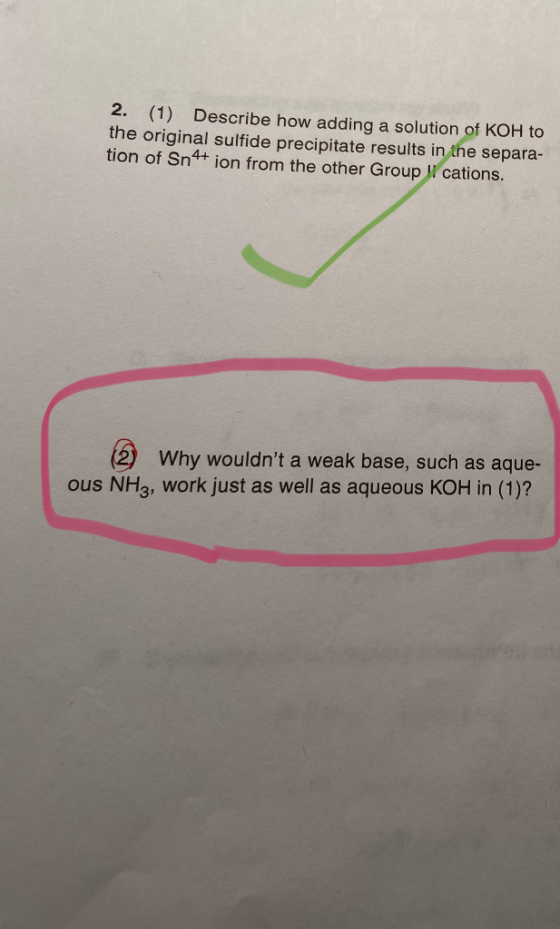
Why wouldnt a weak base, such as NH3, work just as well as KOH in (1)?
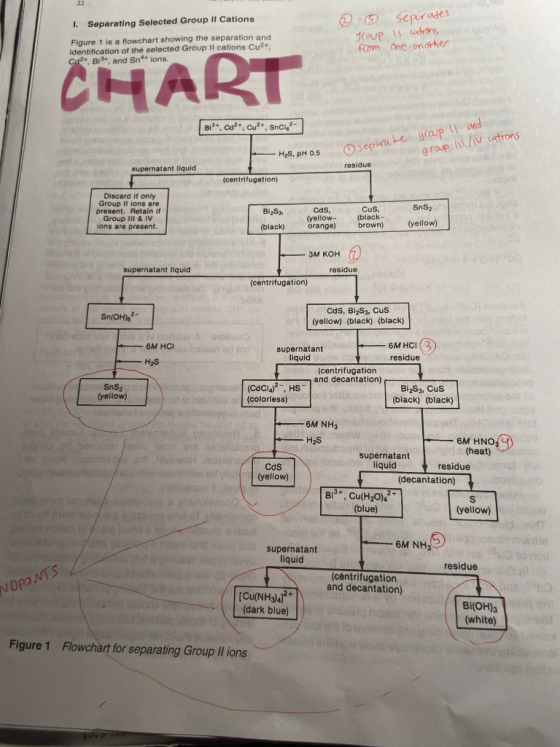
2.2 Is the question I have. I figured out 2.1 already.
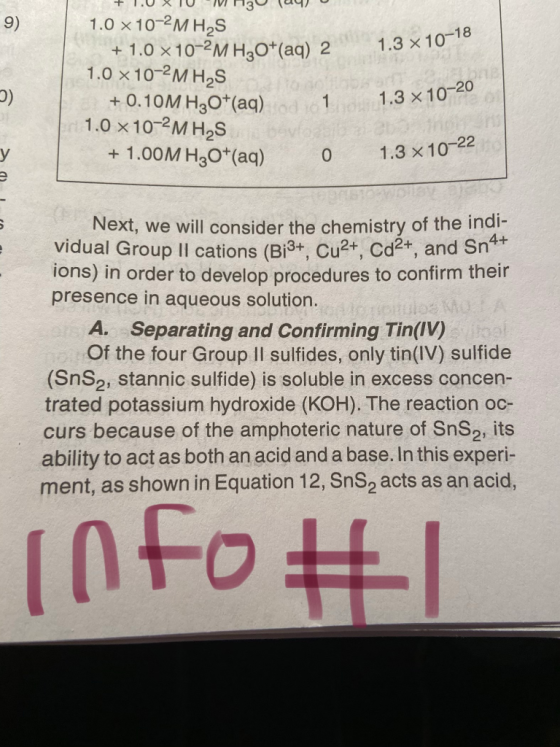
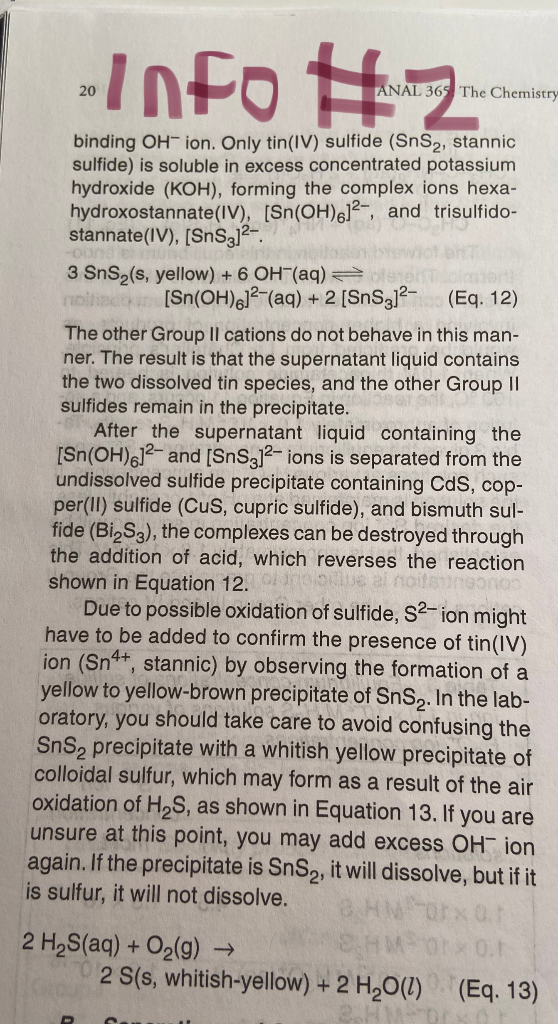
Below is relevant info. Thanks!
Homework Answers
Ammonia can't be used as KOH because unlike KOH ammonia does not form precipitate with Sn4+ and group II cations . Ammonia forms complexes with these cations which are soluble and hence addition of ammonia can't separate Sn2+ from group II cations
Add Answer to:
Why wouldnt a weak base, such as NH3, work just as well as KOH
in (1)?...
[24]Following questions are based on Experiment #17 "General ation unknown analysis The data and results provided...
 [24]Following questions are based on Experiment #17 "General ation unknown analysis The data and results provided pertain to a specific unknown analysis. Provide Answers to the following for this analysis 1 (a) To separate Qualitative Analytical (QA) Group I from the other groups tested in the general cation unknown you must add (b) The precipitate obtained in (a) above was centrifuged and the supernatant liquid decanted. The The warm test tube contained no precipitate. Based on this observation, provide the...
Group 1 Flowchart Use the following chemical facts to construct a flow chart for this lab:...
 Group 1 Flowchart Use the following chemical facts to construct a flow chart for this lab: 1 Group 1 cations are Ag, Hg, and Pb 2. AgH a and Pbare given to you in lab as their nitrates which are soluble in water (denoted by as) 3 AgHgand Pb are the only common ions that form a precipitate (denoted by with the Cl ion, presented as Hcl They all form white precipitates. 4. These Group 1 precipitates are separated from...
I need help figuring out the flowchart and if I have the right answers for the...
 I need help figuring out the flowchart and if I have the right
answers for the prelab please and thank you!
Group I, the Chloride Group BACKGROUND The precipitating reagent for the chloride group is chloride ion in an acidic solution. Only three of the 18 metal ions form a precipitate with this reagent: silver ion (Ag'), mercury(I)ion (Hg). and lead ion (Pb). Since lead chloride is somewhat soluble, it is not completely precipitated here, and a low concentration of...
I need help figuring out the flowchart and if I have the right
answers for the prelab please and thank you!
Group I, the Chloride Group BACKGROUND The precipitating reagent for the chloride group is chloride ion in an acidic solution. Only three of the 18 metal ions form a precipitate with this reagent: silver ion (Ag'), mercury(I)ion (Hg). and lead ion (Pb). Since lead chloride is somewhat soluble, it is not completely precipitated here, and a low concentration of...
I need help with the prelab and the flowchart. I’m totally clueless on the flowchart. For...
 I need help with the prelab and the flowchart. I’m totally
clueless on the flowchart.
For the prelab questions I have some answers but I don’t know
if they’re right. If they’re wrong, I would greatly appreciate an
explanation for the correct answer. I’m really trying to learn the
material but it’s hard now that classes are cancelled so I’m sorry
if these are dumb
1. PbCl ?
2. Ag+
3. ?
4. S1
Group 1, the Chloride Group BACKGROUND...
I need help with the prelab and the flowchart. I’m totally
clueless on the flowchart.
For the prelab questions I have some answers but I don’t know
if they’re right. If they’re wrong, I would greatly appreciate an
explanation for the correct answer. I’m really trying to learn the
material but it’s hard now that classes are cancelled so I’m sorry
if these are dumb
1. PbCl ?
2. Ag+
3. ?
4. S1
Group 1, the Chloride Group BACKGROUND...
I concluded that my unknown was Pb2+. since yellow precipitate formed. can you help me answer...
 I concluded that my unknown was Pb2+. since yellow
precipitate formed. can you help me answer the questions for the
Known and unknown report
Qualitative Analysis: Group I Cations 10 ORECTIVES A Leam some chemistry of Group I cations, R Analyze an unknown for Group I cations. THEORY AND DISCUSSION Group I cations are precipitated as insoluble chlorides: Ag, Pb, Hg2 +Cr-AgCl, PbCh, HgCla The colors of the following species will be helpful in the analysis for Group I cations....
I concluded that my unknown was Pb2+. since yellow
precipitate formed. can you help me answer the questions for the
Known and unknown report
Qualitative Analysis: Group I Cations 10 ORECTIVES A Leam some chemistry of Group I cations, R Analyze an unknown for Group I cations. THEORY AND DISCUSSION Group I cations are precipitated as insoluble chlorides: Ag, Pb, Hg2 +Cr-AgCl, PbCh, HgCla The colors of the following species will be helpful in the analysis for Group I cations....
43 Group II Cations Scheme Biº. Cu?, Sb 15 M NHOHNH, (Step 2) 0.3 M HCI...
 43 Group II Cations Scheme Biº. Cu?, Sb 15 M NHOHNH, (Step 2) 0.3 M HCI (Step 3) 1M CHCSNH (Step 4)/Centrifuge (Step 5) Discard solution after testing for completeness of precipitation "For the General Unknown only use the solution to test for Group Ications. BiSs. Cus, Sb S. SnS (Black Solid, Step 6) 1 1MNH.CI (Step 6) GM KOH, IM CHCSNH (Step 7) Centrifuge (Step B) Bi S. Cus (Solid, Step 9) Sb(OH). ( SOH). (Solution, Step 9) 6M...
1. If your original unknown is colorless, what ions are absent from your unknown? 2. If...
 1. If your original unknown is colorless, what ions are absent
from your unknown?
2. If you get no precipitate with just the 6 M NH3 in step B,
what ions are absent from your unknown?
pls help are my answers correct ty
17 Page 4 Aperiment 24. Qualitative Analysis Group III-NI, Mn, Fe, Al, Cr, Zn 1. PROCEDURES A. Observations of Samples. Obtain an unknown and record code. Observe color of unknown solution Common color correlations are: dark blue...
1. If your original unknown is colorless, what ions are absent
from your unknown?
2. If you get no precipitate with just the 6 M NH3 in step B,
what ions are absent from your unknown?
pls help are my answers correct ty
17 Page 4 Aperiment 24. Qualitative Analysis Group III-NI, Mn, Fe, Al, Cr, Zn 1. PROCEDURES A. Observations of Samples. Obtain an unknown and record code. Observe color of unknown solution Common color correlations are: dark blue...
if you can't answer all ,please don't answer 1) of the reactions below, which one is...
 if you can't answer all ,please don't answer
1) of the reactions below, which one is a decomposition reaction? A) Ca(NO3)2 + Na2S -- CdS +2NaNO3 B) NH4Cl- NH3 + HCI C) 2Mg + 02 - 2MgO D) 2N2 + 3H2 → 2NH3 E) 2CH4 + 402 - 2002 + 4H20 miches of - x 1? 2 2) Calculate the percentage by mass of ammonia in cisplatin, PtCl2/NH3 12. A) 12.53 B) 5.68 C) 18.09 D) 11.35 E) 4.67 3)...
if you can't answer all ,please don't answer
1) of the reactions below, which one is a decomposition reaction? A) Ca(NO3)2 + Na2S -- CdS +2NaNO3 B) NH4Cl- NH3 + HCI C) 2Mg + 02 - 2MgO D) 2N2 + 3H2 → 2NH3 E) 2CH4 + 402 - 2002 + 4H20 miches of - x 1? 2 2) Calculate the percentage by mass of ammonia in cisplatin, PtCl2/NH3 12. A) 12.53 B) 5.68 C) 18.09 D) 11.35 E) 4.67 3)...
Please help with solving Question 1 (A-C) Thank you! Unless otherwise specified in the problem, you...
 Please help with solving Question 1 (A-C) Thank you!
Unless otherwise specified in the problem, you may assume that all solutions are at 25°C. 1. 50.0 mL of a pH 6.00 carbonic acid buffer is titrated with 0.2857 M NaOH, requiring 17.47 mL to reach the second equivalence point. a. Calculate the molarity of carbonic acid and bicarbonate in the original buffer. Carbonic acid: Bicarbonate: b. Calculate the pH of the solution after a total of 100.0 mL of 0.2857...
Please help with solving Question 1 (A-C) Thank you!
Unless otherwise specified in the problem, you may assume that all solutions are at 25°C. 1. 50.0 mL of a pH 6.00 carbonic acid buffer is titrated with 0.2857 M NaOH, requiring 17.47 mL to reach the second equivalence point. a. Calculate the molarity of carbonic acid and bicarbonate in the original buffer. Carbonic acid: Bicarbonate: b. Calculate the pH of the solution after a total of 100.0 mL of 0.2857...
Convert playlist Diction QUESTIONS 1. (2 Points) Why is it essential to keep the diazonium salt...
 Convert playlist Diction QUESTIONS 1. (2 Points) Why is it essential to keep the diazonium salt at zero degrees while you are preparing the sodium 2-naphthoxide solution? 2. (2 Points) Would you need to use sodium carbonate for the diazotization of meta- nitroaniline? Explain your answer. 3. (2 Points) What would be the IUPAC name for the azo dye if you would have used p-chloroaniline instead of sulfanilic acid? Experiment 12 4. (4 Points) Calculate the theoretical yield for Orange...
 [24]Following questions are based on Experiment #17 "General ation unknown analysis The data and results provided pertain to a specific unknown analysis. Provide Answers to the following for this analysis 1 (a) To separate Qualitative Analytical (QA) Group I from the other groups tested in the general cation unknown you must add (b) The precipitate obtained in (a) above was centrifuged and the supernatant liquid decanted. The The warm test tube contained no precipitate. Based on this observation, provide the...
 Group 1 Flowchart Use the following chemical facts to construct a flow chart for this lab: 1 Group 1 cations are Ag, Hg, and Pb 2. AgH a and Pbare given to you in lab as their nitrates which are soluble in water (denoted by as) 3 AgHgand Pb are the only common ions that form a precipitate (denoted by with the Cl ion, presented as Hcl They all form white precipitates. 4. These Group 1 precipitates are separated from...
 I need help figuring out the flowchart and if I have the right
answers for the prelab please and thank you!
Group I, the Chloride Group BACKGROUND The precipitating reagent for the chloride group is chloride ion in an acidic solution. Only three of the 18 metal ions form a precipitate with this reagent: silver ion (Ag'), mercury(I)ion (Hg). and lead ion (Pb). Since lead chloride is somewhat soluble, it is not completely precipitated here, and a low concentration of...
I need help figuring out the flowchart and if I have the right
answers for the prelab please and thank you!
Group I, the Chloride Group BACKGROUND The precipitating reagent for the chloride group is chloride ion in an acidic solution. Only three of the 18 metal ions form a precipitate with this reagent: silver ion (Ag'), mercury(I)ion (Hg). and lead ion (Pb). Since lead chloride is somewhat soluble, it is not completely precipitated here, and a low concentration of...
 I need help with the prelab and the flowchart. I’m totally
clueless on the flowchart.
For the prelab questions I have some answers but I don’t know
if they’re right. If they’re wrong, I would greatly appreciate an
explanation for the correct answer. I’m really trying to learn the
material but it’s hard now that classes are cancelled so I’m sorry
if these are dumb
1. PbCl ?
2. Ag+
3. ?
4. S1
Group 1, the Chloride Group BACKGROUND...
I need help with the prelab and the flowchart. I’m totally
clueless on the flowchart.
For the prelab questions I have some answers but I don’t know
if they’re right. If they’re wrong, I would greatly appreciate an
explanation for the correct answer. I’m really trying to learn the
material but it’s hard now that classes are cancelled so I’m sorry
if these are dumb
1. PbCl ?
2. Ag+
3. ?
4. S1
Group 1, the Chloride Group BACKGROUND...
 I concluded that my unknown was Pb2+. since yellow
precipitate formed. can you help me answer the questions for the
Known and unknown report
Qualitative Analysis: Group I Cations 10 ORECTIVES A Leam some chemistry of Group I cations, R Analyze an unknown for Group I cations. THEORY AND DISCUSSION Group I cations are precipitated as insoluble chlorides: Ag, Pb, Hg2 +Cr-AgCl, PbCh, HgCla The colors of the following species will be helpful in the analysis for Group I cations....
I concluded that my unknown was Pb2+. since yellow
precipitate formed. can you help me answer the questions for the
Known and unknown report
Qualitative Analysis: Group I Cations 10 ORECTIVES A Leam some chemistry of Group I cations, R Analyze an unknown for Group I cations. THEORY AND DISCUSSION Group I cations are precipitated as insoluble chlorides: Ag, Pb, Hg2 +Cr-AgCl, PbCh, HgCla The colors of the following species will be helpful in the analysis for Group I cations....
 43 Group II Cations Scheme Biº. Cu?, Sb 15 M NHOHNH, (Step 2) 0.3 M HCI (Step 3) 1M CHCSNH (Step 4)/Centrifuge (Step 5) Discard solution after testing for completeness of precipitation "For the General Unknown only use the solution to test for Group Ications. BiSs. Cus, Sb S. SnS (Black Solid, Step 6) 1 1MNH.CI (Step 6) GM KOH, IM CHCSNH (Step 7) Centrifuge (Step B) Bi S. Cus (Solid, Step 9) Sb(OH). ( SOH). (Solution, Step 9) 6M...
 1. If your original unknown is colorless, what ions are absent
from your unknown?
2. If you get no precipitate with just the 6 M NH3 in step B,
what ions are absent from your unknown?
pls help are my answers correct ty
17 Page 4 Aperiment 24. Qualitative Analysis Group III-NI, Mn, Fe, Al, Cr, Zn 1. PROCEDURES A. Observations of Samples. Obtain an unknown and record code. Observe color of unknown solution Common color correlations are: dark blue...
1. If your original unknown is colorless, what ions are absent
from your unknown?
2. If you get no precipitate with just the 6 M NH3 in step B,
what ions are absent from your unknown?
pls help are my answers correct ty
17 Page 4 Aperiment 24. Qualitative Analysis Group III-NI, Mn, Fe, Al, Cr, Zn 1. PROCEDURES A. Observations of Samples. Obtain an unknown and record code. Observe color of unknown solution Common color correlations are: dark blue...
 if you can't answer all ,please don't answer
1) of the reactions below, which one is a decomposition reaction? A) Ca(NO3)2 + Na2S -- CdS +2NaNO3 B) NH4Cl- NH3 + HCI C) 2Mg + 02 - 2MgO D) 2N2 + 3H2 → 2NH3 E) 2CH4 + 402 - 2002 + 4H20 miches of - x 1? 2 2) Calculate the percentage by mass of ammonia in cisplatin, PtCl2/NH3 12. A) 12.53 B) 5.68 C) 18.09 D) 11.35 E) 4.67 3)...
if you can't answer all ,please don't answer
1) of the reactions below, which one is a decomposition reaction? A) Ca(NO3)2 + Na2S -- CdS +2NaNO3 B) NH4Cl- NH3 + HCI C) 2Mg + 02 - 2MgO D) 2N2 + 3H2 → 2NH3 E) 2CH4 + 402 - 2002 + 4H20 miches of - x 1? 2 2) Calculate the percentage by mass of ammonia in cisplatin, PtCl2/NH3 12. A) 12.53 B) 5.68 C) 18.09 D) 11.35 E) 4.67 3)...
 Please help with solving Question 1 (A-C) Thank you!
Unless otherwise specified in the problem, you may assume that all solutions are at 25°C. 1. 50.0 mL of a pH 6.00 carbonic acid buffer is titrated with 0.2857 M NaOH, requiring 17.47 mL to reach the second equivalence point. a. Calculate the molarity of carbonic acid and bicarbonate in the original buffer. Carbonic acid: Bicarbonate: b. Calculate the pH of the solution after a total of 100.0 mL of 0.2857...
Please help with solving Question 1 (A-C) Thank you!
Unless otherwise specified in the problem, you may assume that all solutions are at 25°C. 1. 50.0 mL of a pH 6.00 carbonic acid buffer is titrated with 0.2857 M NaOH, requiring 17.47 mL to reach the second equivalence point. a. Calculate the molarity of carbonic acid and bicarbonate in the original buffer. Carbonic acid: Bicarbonate: b. Calculate the pH of the solution after a total of 100.0 mL of 0.2857...
 Convert playlist Diction QUESTIONS 1. (2 Points) Why is it essential to keep the diazonium salt at zero degrees while you are preparing the sodium 2-naphthoxide solution? 2. (2 Points) Would you need to use sodium carbonate for the diazotization of meta- nitroaniline? Explain your answer. 3. (2 Points) What would be the IUPAC name for the azo dye if you would have used p-chloroaniline instead of sulfanilic acid? Experiment 12 4. (4 Points) Calculate the theoretical yield for Orange...
Most questions answered within 3 hours.
-
Where is the error in this code sequence?
String s1 = "Hello";
String s2 = "ello";...
asked 10 months ago -
Financial data for Joel de Paris, Inc., for last year
follow:
Joel de Paris, Inc.
Balance...
asked 10 months ago -
Consider this reaction:
Al2(SO4)3 (aq)+ BaCl3
(aq) Al2Cl6 (aq)- +
3BaSO4(s) . What is the...
asked 10 months ago -
Suppose that Savneet is considering increasing her
recent random sample from 20 car rentals to 40...
asked 10 months ago -
Trucks arrive at an unloading terminal at an average rate of 120
per hour.
Trucks arrive...
asked 10 months ago -
Why are methanol and ethanol completely soluble in water while
octanol is not very little soluble....
asked 10 months ago -
A facilities manager at a university reads in a research report
that the mean amount of...
asked 10 months ago -
When the CuSO4 is rehydrated by adding water to the anhydrous
compound, is this an endothermic...
asked 10 months ago -
A ray of sunlight is passing from diamond into crown glass; the
angle of incidence is...
asked 10 months ago -
A block of mass 0.249 kg is placed on top of a light, vertical
spring of...
asked 10 months ago -
how do the kidneys compensate in the presences of acidosis
a) trigger hyperventilate
b) reserve acid...
asked 10 months ago -
Question 501 pts
The rental rate of capital to the firm increases. Which of the
following...
asked 10 months ago