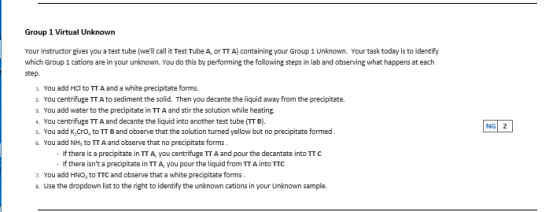
Group 1 Virtual Unknown Your Instructor gives you a test tube (we'll call it Test Tube A, or TT A) containing your Group 1 Unknown. Your task today is to identify which Group 1 cations are in your unknown. You do this by performing the following steps in lab and observing what happens at each step. i. You add HCl to TT A and a white precipitate forms You centrifuge T A to sediment the solid. Then you decante the liquid away from the precipitate. 2 3 You add water to the precipitate in TT A and stir the solution while heating. 4 You centrifuge TT A and decante the liquid into another test tube (TT B). You add K,Cro, to TT B and observe that the solution turned yellow but no precipitate formed NG 2 6 You add NH, to TT A and observe that no precipitate forms f there is a precipitate in TT A, you centrifuge TT A and pour the decantate into TT C If there isn't a precipitate in TT A, you pour the liquid from TT A into TTC 7. You add HNO, to TTC and observe that a white precipitate forms & Use the dropdown list to the right to identify the unknown cations in your Unknown sample.
Homework Answers
IN CASE OF ANY CONFUSION PLEASE FEEL FREE TO COMMENT DOWN AND
ASK AND DO RATE IF YOU FOUND THE ANSWER USEFUL, THANK YOU
PLEASE DO LEAVE A POSITIVE RATING, I WOULD BE HIGHLY MOTIVATED
Add Answer to:
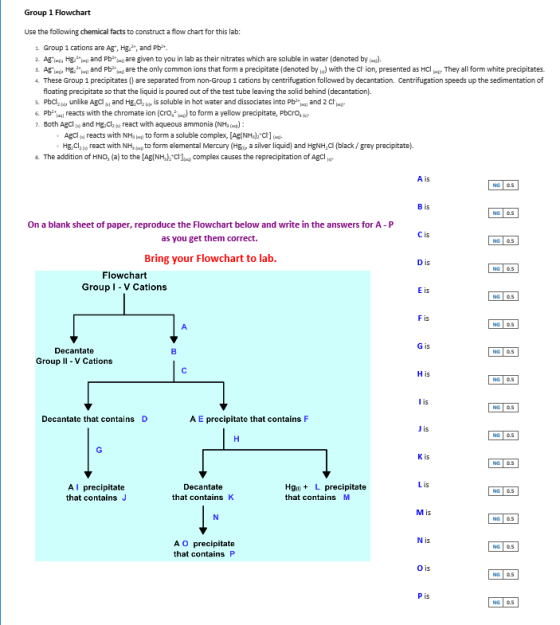
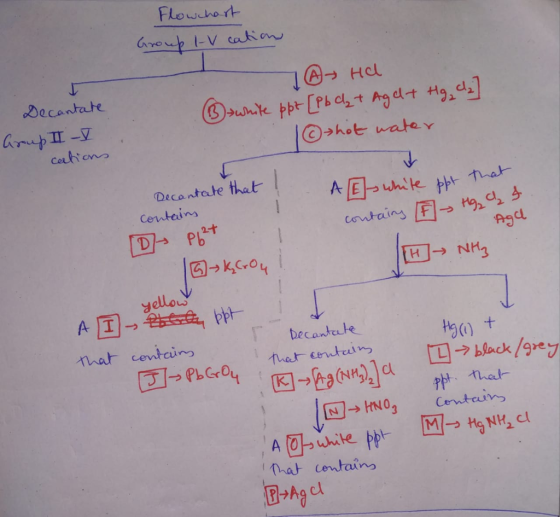
Group 1 Flowchart Use the following chemical facts to construct a flow chart for this lab:...
I need help figuring out the flowchart and if I have the right answers for the...
 I need help figuring out the flowchart and if I have the right
answers for the prelab please and thank you!
Group I, the Chloride Group BACKGROUND The precipitating reagent for the chloride group is chloride ion in an acidic solution. Only three of the 18 metal ions form a precipitate with this reagent: silver ion (Ag'), mercury(I)ion (Hg). and lead ion (Pb). Since lead chloride is somewhat soluble, it is not completely precipitated here, and a low concentration of...
I need help figuring out the flowchart and if I have the right
answers for the prelab please and thank you!
Group I, the Chloride Group BACKGROUND The precipitating reagent for the chloride group is chloride ion in an acidic solution. Only three of the 18 metal ions form a precipitate with this reagent: silver ion (Ag'), mercury(I)ion (Hg). and lead ion (Pb). Since lead chloride is somewhat soluble, it is not completely precipitated here, and a low concentration of...
I need help with the prelab and the flowchart. I’m totally clueless on the flowchart. For...
 I need help with the prelab and the flowchart. I’m totally
clueless on the flowchart.
For the prelab questions I have some answers but I don’t know
if they’re right. If they’re wrong, I would greatly appreciate an
explanation for the correct answer. I’m really trying to learn the
material but it’s hard now that classes are cancelled so I’m sorry
if these are dumb
1. PbCl ?
2. Ag+
3. ?
4. S1
Group 1, the Chloride Group BACKGROUND...
I need help with the prelab and the flowchart. I’m totally
clueless on the flowchart.
For the prelab questions I have some answers but I don’t know
if they’re right. If they’re wrong, I would greatly appreciate an
explanation for the correct answer. I’m really trying to learn the
material but it’s hard now that classes are cancelled so I’m sorry
if these are dumb
1. PbCl ?
2. Ag+
3. ?
4. S1
Group 1, the Chloride Group BACKGROUND...
QUESTION 1 The procedure for testing your unknown solution in this week's lab is identical to...
 QUESTION 1 The procedure for testing your unknown solution in this week's lab is identical to the procedure which you conducted in Week 1. The only difference is, of course, your Unknown Solution may or may not contain all of the ions which you tested for in Week 1. With that being said, please consider the following scenario: You enter the lab and obtain an Unknown Solution from the Stockroom. You begin testing the solution through the steps outlined in...
What is the chemical reaction taking place here? I thought it was Zn(CN)2 but it is...
 What is the chemical reaction taking place here? I thought it
was Zn(CN)2 but it is not a denim blue.
The Soluble Hydroxide Group: Analyze the Solution for the Presence of Znº and All 25. To test for All, add 10 drops of 6 M HNO, solution to Test Tube 5. Check the pH of the solution. If it is not acidic, add more 6 M HNO, dropwise until the solution becomes acidic. Add 6 M NH, solution dropwise until...
What is the chemical reaction taking place here? I thought it
was Zn(CN)2 but it is not a denim blue.
The Soluble Hydroxide Group: Analyze the Solution for the Presence of Znº and All 25. To test for All, add 10 drops of 6 M HNO, solution to Test Tube 5. Check the pH of the solution. If it is not acidic, add more 6 M HNO, dropwise until the solution becomes acidic. Add 6 M NH, solution dropwise until...
QUESTION 1 The procedure for testing your unknown solution in this week's lab is identical to the procedure which y...
 QUESTION 1 The procedure for testing your unknown solution in this week's lab is identical to the procedure which you conducted in Week 1. The only difference is, of course, your Unknown Solution may or may not contain all of the ions which you tested for in Week 1. With that being said, please consider the following scenario: You enter the lab and obtain an unknown Solution from the Stockroom. You begin testing the solution through the steps outlined in...
ANAL 364 The Chemisery and Qualiative Analysis of Cations Group Separaions and Separations of Group 1 Catioms 27 Po...
 ANAL 364 The Chemisery and Qualiative Analysis of Cations Group Separaions and Separations of Group 1 Catioms 27 Post-Laboratory Questions (Use the spaces provided for the answers and additional paper if necessary.) 1. What are the properties of the Group I, I1, and I cations that permit their separation by groups? (2) The precipitate was separated from the supernatant liquid in (1) and was found to be insoluble in hot water. The precipitate turned grey-black upon addition of 6M NH,...
Why wouldnt a weak base, such as NH3, work just as well as KOH in (1)?...
 Why wouldnt a weak base, such as NH3, work just as well as KOH
in (1)?
2.2 Is the question I have. I figured out
2.1 already.
Below is relevant info. Thanks!
2. (1) Describe how adding a solution of KOH to the original sulfide precipitate results in the separa- tion of Sn4+ ion from the other Group W cations. (2) Why wouldn't a weak base, such as aque- ous NH3, work just as well as aqueous KOH in (1)?...
Why wouldnt a weak base, such as NH3, work just as well as KOH
in (1)?
2.2 Is the question I have. I figured out
2.1 already.
Below is relevant info. Thanks!
2. (1) Describe how adding a solution of KOH to the original sulfide precipitate results in the separa- tion of Sn4+ ion from the other Group W cations. (2) Why wouldn't a weak base, such as aque- ous NH3, work just as well as aqueous KOH in (1)?...
EXPERIMENTAL PROCEDURE: GROUP I CATIONS Test a known solution that contains all 3 cations simultancously with...
 EXPERIMENTAL PROCEDURE: GROUP I CATIONS Test a known solution that contains all 3 cations simultancously with your unknown. Follow the same procedure (separately) for both the unknown and known solutions. Wear gloves during all procedures. STEP 1: Precipitation of Group I. To 10 drops (only!) of the solution to be analyzed, add 2 drops 6 M HCl. Stir well. Centrifuge and decant the solution (S1) from the ppt (P1). Treat the ppt Pl according to Step 2. (There is no...
[24]Following questions are based on Experiment #17 "General ation unknown analysis The data and results provided...
 [24]Following questions are based on Experiment #17 "General ation unknown analysis The data and results provided pertain to a specific unknown analysis. Provide Answers to the following for this analysis 1 (a) To separate Qualitative Analytical (QA) Group I from the other groups tested in the general cation unknown you must add (b) The precipitate obtained in (a) above was centrifuged and the supernatant liquid decanted. The The warm test tube contained no precipitate. Based on this observation, provide the...
I concluded that my unknown was Pb2+. since yellow precipitate formed. can you help me answer...
 I concluded that my unknown was Pb2+. since yellow
precipitate formed. can you help me answer the questions for the
Known and unknown report
Qualitative Analysis: Group I Cations 10 ORECTIVES A Leam some chemistry of Group I cations, R Analyze an unknown for Group I cations. THEORY AND DISCUSSION Group I cations are precipitated as insoluble chlorides: Ag, Pb, Hg2 +Cr-AgCl, PbCh, HgCla The colors of the following species will be helpful in the analysis for Group I cations....
I concluded that my unknown was Pb2+. since yellow
precipitate formed. can you help me answer the questions for the
Known and unknown report
Qualitative Analysis: Group I Cations 10 ORECTIVES A Leam some chemistry of Group I cations, R Analyze an unknown for Group I cations. THEORY AND DISCUSSION Group I cations are precipitated as insoluble chlorides: Ag, Pb, Hg2 +Cr-AgCl, PbCh, HgCla The colors of the following species will be helpful in the analysis for Group I cations....
 I need help figuring out the flowchart and if I have the right
answers for the prelab please and thank you!
Group I, the Chloride Group BACKGROUND The precipitating reagent for the chloride group is chloride ion in an acidic solution. Only three of the 18 metal ions form a precipitate with this reagent: silver ion (Ag'), mercury(I)ion (Hg). and lead ion (Pb). Since lead chloride is somewhat soluble, it is not completely precipitated here, and a low concentration of...
I need help figuring out the flowchart and if I have the right
answers for the prelab please and thank you!
Group I, the Chloride Group BACKGROUND The precipitating reagent for the chloride group is chloride ion in an acidic solution. Only three of the 18 metal ions form a precipitate with this reagent: silver ion (Ag'), mercury(I)ion (Hg). and lead ion (Pb). Since lead chloride is somewhat soluble, it is not completely precipitated here, and a low concentration of...
 I need help with the prelab and the flowchart. I’m totally
clueless on the flowchart.
For the prelab questions I have some answers but I don’t know
if they’re right. If they’re wrong, I would greatly appreciate an
explanation for the correct answer. I’m really trying to learn the
material but it’s hard now that classes are cancelled so I’m sorry
if these are dumb
1. PbCl ?
2. Ag+
3. ?
4. S1
Group 1, the Chloride Group BACKGROUND...
I need help with the prelab and the flowchart. I’m totally
clueless on the flowchart.
For the prelab questions I have some answers but I don’t know
if they’re right. If they’re wrong, I would greatly appreciate an
explanation for the correct answer. I’m really trying to learn the
material but it’s hard now that classes are cancelled so I’m sorry
if these are dumb
1. PbCl ?
2. Ag+
3. ?
4. S1
Group 1, the Chloride Group BACKGROUND...
 QUESTION 1 The procedure for testing your unknown solution in this week's lab is identical to the procedure which you conducted in Week 1. The only difference is, of course, your Unknown Solution may or may not contain all of the ions which you tested for in Week 1. With that being said, please consider the following scenario: You enter the lab and obtain an Unknown Solution from the Stockroom. You begin testing the solution through the steps outlined in...
 What is the chemical reaction taking place here? I thought it
was Zn(CN)2 but it is not a denim blue.
The Soluble Hydroxide Group: Analyze the Solution for the Presence of Znº and All 25. To test for All, add 10 drops of 6 M HNO, solution to Test Tube 5. Check the pH of the solution. If it is not acidic, add more 6 M HNO, dropwise until the solution becomes acidic. Add 6 M NH, solution dropwise until...
What is the chemical reaction taking place here? I thought it
was Zn(CN)2 but it is not a denim blue.
The Soluble Hydroxide Group: Analyze the Solution for the Presence of Znº and All 25. To test for All, add 10 drops of 6 M HNO, solution to Test Tube 5. Check the pH of the solution. If it is not acidic, add more 6 M HNO, dropwise until the solution becomes acidic. Add 6 M NH, solution dropwise until...
 QUESTION 1 The procedure for testing your unknown solution in this week's lab is identical to the procedure which you conducted in Week 1. The only difference is, of course, your Unknown Solution may or may not contain all of the ions which you tested for in Week 1. With that being said, please consider the following scenario: You enter the lab and obtain an unknown Solution from the Stockroom. You begin testing the solution through the steps outlined in...
 ANAL 364 The Chemisery and Qualiative Analysis of Cations Group Separaions and Separations of Group 1 Catioms 27 Post-Laboratory Questions (Use the spaces provided for the answers and additional paper if necessary.) 1. What are the properties of the Group I, I1, and I cations that permit their separation by groups? (2) The precipitate was separated from the supernatant liquid in (1) and was found to be insoluble in hot water. The precipitate turned grey-black upon addition of 6M NH,...
 Why wouldnt a weak base, such as NH3, work just as well as KOH
in (1)?
2.2 Is the question I have. I figured out
2.1 already.
Below is relevant info. Thanks!
2. (1) Describe how adding a solution of KOH to the original sulfide precipitate results in the separa- tion of Sn4+ ion from the other Group W cations. (2) Why wouldn't a weak base, such as aque- ous NH3, work just as well as aqueous KOH in (1)?...
Why wouldnt a weak base, such as NH3, work just as well as KOH
in (1)?
2.2 Is the question I have. I figured out
2.1 already.
Below is relevant info. Thanks!
2. (1) Describe how adding a solution of KOH to the original sulfide precipitate results in the separa- tion of Sn4+ ion from the other Group W cations. (2) Why wouldn't a weak base, such as aque- ous NH3, work just as well as aqueous KOH in (1)?...
 EXPERIMENTAL PROCEDURE: GROUP I CATIONS Test a known solution that contains all 3 cations simultancously with your unknown. Follow the same procedure (separately) for both the unknown and known solutions. Wear gloves during all procedures. STEP 1: Precipitation of Group I. To 10 drops (only!) of the solution to be analyzed, add 2 drops 6 M HCl. Stir well. Centrifuge and decant the solution (S1) from the ppt (P1). Treat the ppt Pl according to Step 2. (There is no...
 [24]Following questions are based on Experiment #17 "General ation unknown analysis The data and results provided pertain to a specific unknown analysis. Provide Answers to the following for this analysis 1 (a) To separate Qualitative Analytical (QA) Group I from the other groups tested in the general cation unknown you must add (b) The precipitate obtained in (a) above was centrifuged and the supernatant liquid decanted. The The warm test tube contained no precipitate. Based on this observation, provide the...
 I concluded that my unknown was Pb2+. since yellow
precipitate formed. can you help me answer the questions for the
Known and unknown report
Qualitative Analysis: Group I Cations 10 ORECTIVES A Leam some chemistry of Group I cations, R Analyze an unknown for Group I cations. THEORY AND DISCUSSION Group I cations are precipitated as insoluble chlorides: Ag, Pb, Hg2 +Cr-AgCl, PbCh, HgCla The colors of the following species will be helpful in the analysis for Group I cations....
I concluded that my unknown was Pb2+. since yellow
precipitate formed. can you help me answer the questions for the
Known and unknown report
Qualitative Analysis: Group I Cations 10 ORECTIVES A Leam some chemistry of Group I cations, R Analyze an unknown for Group I cations. THEORY AND DISCUSSION Group I cations are precipitated as insoluble chlorides: Ag, Pb, Hg2 +Cr-AgCl, PbCh, HgCla The colors of the following species will be helpful in the analysis for Group I cations....
Most questions answered within 3 hours.
-
Where is the error in this code sequence?
String s1 = "Hello";
String s2 = "ello";...
asked 10 months ago -
Financial data for Joel de Paris, Inc., for last year
follow:
Joel de Paris, Inc.
Balance...
asked 10 months ago -
Consider this reaction:
Al2(SO4)3 (aq)+ BaCl3
(aq) Al2Cl6 (aq)- +
3BaSO4(s) . What is the...
asked 10 months ago -
Suppose that Savneet is considering increasing her
recent random sample from 20 car rentals to 40...
asked 10 months ago -
Trucks arrive at an unloading terminal at an average rate of 120
per hour.
Trucks arrive...
asked 10 months ago -
Why are methanol and ethanol completely soluble in water while
octanol is not very little soluble....
asked 10 months ago -
A facilities manager at a university reads in a research report
that the mean amount of...
asked 10 months ago -
When the CuSO4 is rehydrated by adding water to the anhydrous
compound, is this an endothermic...
asked 10 months ago -
A ray of sunlight is passing from diamond into crown glass; the
angle of incidence is...
asked 10 months ago -
A block of mass 0.249 kg is placed on top of a light, vertical
spring of...
asked 10 months ago -
how do the kidneys compensate in the presences of acidosis
a) trigger hyperventilate
b) reserve acid...
asked 10 months ago -
Question 501 pts
The rental rate of capital to the firm increases. Which of the
following...
asked 10 months ago