
Homework Answers
All Three questions are based on the equation:
ΔG = ΔH - T*ΔS
1. b) +,-,-
Reason :
- ΔH is -ve because conversion from gas to liquid means heat is given out by the molecules.
- ΔS is -ve because conversion from gas to liquid leads to greater stability or orderliness in molecules. As orderliness increase, entropy (S) decrease
- ΔG is +ve since the process is taking place at a higher temperature(105 degree Celcius). From the equation you can understand that for -ve ΔH and -ve ΔS,at higher temperatures, ΔG is +ve. Also you can logically think that conversion of water vapour to liquid water is non-spontaneous above 100 degree celcius.Non spontaneous processes have +ve ΔG
2. e)-,-,-
Reason :
- ΔH is -ve because conversion from liquid to solid means heat is given out by the molecules.
- ΔS is -ve because conversion from liquid to solid leads to greater stability or orderliness in molecules. As orderliness increase, entropy (S) decrease
- ΔG is -ve since the process is taking place at a very low temperature(-5 degree Celcius). From the equation you can understand that for -ve ΔH and -ve ΔS,at lower temperatures, ΔG is -ve. Also you can logically think that conversion of water to ice is a spontaneous process below 0 degree celcius.Spontaneous processes have -ve ΔG
3. a)-,+,+
- ΔH is +ve because conversion from solid to liquid means heat is taken up by the molecules.
- ΔS is +ve because conversion from solid to liquid leads to greater disorderliness of molecules. As disorderliness increase, entropy (S) increase.
- Conversion of ice to water is a spontaneous process above 0 degree celcius.Spontaneous processes have -ve ΔG
Add Answer to:
1. For the process H2O(g) → H2O(l) at 105°C the signs on AG, AH, and AS...
2) The heat of fusion of ice is 333 J/g. For the process H2O(s) + H2O(1)...
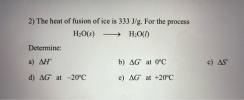 2) The heat of fusion of ice is 333 J/g. For the process H2O(s) + H2O(1) Determine: a) AH b) AGⓇ at 0°C d) AG at -20°C e) AGⓇ at +20°C c) AS
1. Calculate AG°for the following reaction at 25°C using AG ° = AH ° - TAS°...
 1. Calculate AG°for the following reaction at 25°C using AG ° = AH ° - TAS° Fe2O3 (s) + 3 H2(g) → 2 Fe (s) + 3 H2O (1) 2. Calculate AG ° for the same reaction using AG°f values Fe2O3 (s) 3 H2(g) → 2 Fe (s) + + 3 H20 (1) + 3. Calculate AGº of the following reaction: 2C (s) H 2 (g) → C2H 2 (g) Use Hess' Law, AG° = AG°1 + AG°2 + AG°3...
D 606 K E) 171 K 7. Predict the signs of AH, AS, and AG for...
 D 606 K E) 171 K 7. Predict the signs of AH, AS, and AG for the combustion of hydrogen gas at 25°C. 2 H20() 2 H2)+ O2(9) A) AH <0, AS <0, AG < 0 B) AH> 0, AS < 0, AG> 0 C) AH> 0, AS < 0, AG < 0 D) AH< 0, AS> 0, AG < 0 E) AH < 0, AS> 0, AG < 0
For which process will AH° and AG be expected to be most similar? 2Al(s) + Fe2O3(s)...
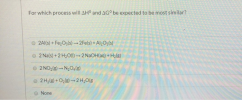 For which process will AH° and AG be expected to be most similar? 2Al(s) + Fe2O3(s) — 2Fe(s) + Al2O3(s) 2 Na(s) + 2 H2O(l) — 2NaOH(aq) + H2(g) OZN021312046 2 NO2(g) → N,04() 2H2(g) + O2(g) → 2 H2018 None
(9) A spontaneous process has the change of free energy (a) AG > 0 (b) AG <0 (c) AG = 0 (d) AH >0 and AS &...
 (9) A spontaneous process has the change of free energy (a) AG > 0 (b) AG <0 (c) AG = 0 (d) AH >0 and AS <0 (10) A chemical reaction has AH = 10 kJ, AS = 50 J/K at temperature T = 300 K, the reaction AG = (a) 5000 (b)-5000 (c) 10000 (d) 50 (11) For reaction : Ag (s) + 1/2 Cl2 (g) = Agt (aq) + CI+ (aq), the standard free energy of formation: AGE"...
1. Calculate AS, AH and AG for the following spontaneous (irreversible) process (with 3.0 mol of...
 1. Calculate AS, AH and AG for the following spontaneous (irreversible) process (with 3.0 mol of water at 1 atm). H2O (liquid, -15 °C) → H2O (solid, -15 °C) It is known that the heat of fusion of water at 0 °C is 1436 cal/mol; the heat capacity of liquid water is 18.0 cal/mol, the heat of capacity of ice is 8.7 cal/mol. H2O (liquid, -10 °C) → H2O (liquid, 0 °C). HO (liquid, -15°C) H.O(solid, -15°C) Process (1) Process...
1. Calculate AS, AH and AG for the following spontaneous (irreversible) process (with 3.0 mol of water at 1 atm)....
 1. Calculate AS, AH and AG for the following spontaneous (irreversible) process (with 3.0 mol of water at 1 atm). H2O (liquid, -15 °C) → H2O (solid, -15 °C) It is known that the heat of fusion of water at 0 °C is 1436 cal/mol; the heat capacity of liquid water is 18.0 cal/mol, the heat of capacity of ice is 8.7 cal/mol. H2O (liquid, -10 °C) → H2O (liquid, 0 °C). HOC -130 HO -15 To calculate AS, AH...
Gibbs free energy change AG is defined as AG= AH-TAS. For a spontaneous process, AG<0. For...
 Gibbs free energy change AG is defined as AG= AH-TAS. For a spontaneous process, AG<0. For a. reversible reaction at equilibrium, AG = 0. The equilibrium constant K of the reversible reaction is relate- AG"=-RTIn(K). Symbol 40" refers to thermodynamics standard condition: 298 K and 1 atm. Exercise:consider the following reaction: bo:pfoiex 2 HNO:(aq)+NO(g)- 3 NO2(g) + H2O(I) AH=+136.5 kJ; AS = +287.5 J/K a. Below what temperature does the following reaction becomes nonspontaneous? niliod sis anotsole s ob io...
AG°= AH-TAS AG=AGº+RTinQ where R=8.314 J/mol K 1. Calculate AGº for the following reaction at 25 °C if AH°= -1854 kJ...
 AG°= AH-TAS AG=AGº+RTinQ where R=8.314 J/mol K 1. Calculate AGº for the following reaction at 25 °C if AH°= -1854 kJ/mol; AS°= -236 J/mol K CH-COCH3(g) + 402(g) → 3C02(g) + 3H2O(1) 2. NH.NO, dissolving in water is a spontaneous process. As it dissolves, the temperature of the solution decreases. Based on this, what must the signs (positive or negative) of AG, AH, and AS be?
298.15K AH HO (1) -285.8 H2O(g) -241.8 4,6° Ch -237.1 -228.6 Sº Go Go 70.0 75.3...
 298.15K AH HO (1) -285.8 H2O(g) -241.8 4,6° Ch -237.1 -228.6 Sº Go Go 70.0 75.3 188.8 33.6 a) (1 pt) Calculate Acondensation Gº in J) for the condensation of water vapor at 25°C and 1 bar pressure. b) (1 pt) Is this process spontaneous under these conditions? c) (2 pts) Calculate Kp at 25°C. d) (15 pts) Use the Gibbs-Helmholtz equation AG d ) = -AH°(T) T 12 to calculate Acondensation Gº (in J) for the condensation of water...
 2) The heat of fusion of ice is 333 J/g. For the process H2O(s) + H2O(1) Determine: a) AH b) AGⓇ at 0°C d) AG at -20°C e) AGⓇ at +20°C c) AS
 1. Calculate AG°for the following reaction at 25°C using AG ° = AH ° - TAS° Fe2O3 (s) + 3 H2(g) → 2 Fe (s) + 3 H2O (1) 2. Calculate AG ° for the same reaction using AG°f values Fe2O3 (s) 3 H2(g) → 2 Fe (s) + + 3 H20 (1) + 3. Calculate AGº of the following reaction: 2C (s) H 2 (g) → C2H 2 (g) Use Hess' Law, AG° = AG°1 + AG°2 + AG°3...
 D 606 K E) 171 K 7. Predict the signs of AH, AS, and AG for the combustion of hydrogen gas at 25°C. 2 H20() 2 H2)+ O2(9) A) AH <0, AS <0, AG < 0 B) AH> 0, AS < 0, AG> 0 C) AH> 0, AS < 0, AG < 0 D) AH< 0, AS> 0, AG < 0 E) AH < 0, AS> 0, AG < 0
 For which process will AH° and AG be expected to be most similar? 2Al(s) + Fe2O3(s) — 2Fe(s) + Al2O3(s) 2 Na(s) + 2 H2O(l) — 2NaOH(aq) + H2(g) OZN021312046 2 NO2(g) → N,04() 2H2(g) + O2(g) → 2 H2018 None
 (9) A spontaneous process has the change of free energy (a) AG > 0 (b) AG <0 (c) AG = 0 (d) AH >0 and AS <0 (10) A chemical reaction has AH = 10 kJ, AS = 50 J/K at temperature T = 300 K, the reaction AG = (a) 5000 (b)-5000 (c) 10000 (d) 50 (11) For reaction : Ag (s) + 1/2 Cl2 (g) = Agt (aq) + CI+ (aq), the standard free energy of formation: AGE"...
 1. Calculate AS, AH and AG for the following spontaneous (irreversible) process (with 3.0 mol of water at 1 atm). H2O (liquid, -15 °C) → H2O (solid, -15 °C) It is known that the heat of fusion of water at 0 °C is 1436 cal/mol; the heat capacity of liquid water is 18.0 cal/mol, the heat of capacity of ice is 8.7 cal/mol. H2O (liquid, -10 °C) → H2O (liquid, 0 °C). HO (liquid, -15°C) H.O(solid, -15°C) Process (1) Process...
 1. Calculate AS, AH and AG for the following spontaneous (irreversible) process (with 3.0 mol of water at 1 atm). H2O (liquid, -15 °C) → H2O (solid, -15 °C) It is known that the heat of fusion of water at 0 °C is 1436 cal/mol; the heat capacity of liquid water is 18.0 cal/mol, the heat of capacity of ice is 8.7 cal/mol. H2O (liquid, -10 °C) → H2O (liquid, 0 °C). HOC -130 HO -15 To calculate AS, AH...
 Gibbs free energy change AG is defined as AG= AH-TAS. For a spontaneous process, AG<0. For a. reversible reaction at equilibrium, AG = 0. The equilibrium constant K of the reversible reaction is relate- AG"=-RTIn(K). Symbol 40" refers to thermodynamics standard condition: 298 K and 1 atm. Exercise:consider the following reaction: bo:pfoiex 2 HNO:(aq)+NO(g)- 3 NO2(g) + H2O(I) AH=+136.5 kJ; AS = +287.5 J/K a. Below what temperature does the following reaction becomes nonspontaneous? niliod sis anotsole s ob io...
 AG°= AH-TAS AG=AGº+RTinQ where R=8.314 J/mol K 1. Calculate AGº for the following reaction at 25 °C if AH°= -1854 kJ/mol; AS°= -236 J/mol K CH-COCH3(g) + 402(g) → 3C02(g) + 3H2O(1) 2. NH.NO, dissolving in water is a spontaneous process. As it dissolves, the temperature of the solution decreases. Based on this, what must the signs (positive or negative) of AG, AH, and AS be?
 298.15K AH HO (1) -285.8 H2O(g) -241.8 4,6° Ch -237.1 -228.6 Sº Go Go 70.0 75.3 188.8 33.6 a) (1 pt) Calculate Acondensation Gº in J) for the condensation of water vapor at 25°C and 1 bar pressure. b) (1 pt) Is this process spontaneous under these conditions? c) (2 pts) Calculate Kp at 25°C. d) (15 pts) Use the Gibbs-Helmholtz equation AG d ) = -AH°(T) T 12 to calculate Acondensation Gº (in J) for the condensation of water...
Most questions answered within 3 hours.
-
Where is the error in this code sequence?
String s1 = "Hello";
String s2 = "ello";...
asked 11 months ago -
Financial data for Joel de Paris, Inc., for last year
follow:
Joel de Paris, Inc.
Balance...
asked 11 months ago -
Consider this reaction:
Al2(SO4)3 (aq)+ BaCl3
(aq) Al2Cl6 (aq)- +
3BaSO4(s) . What is the...
asked 11 months ago -
Suppose that Savneet is considering increasing her
recent random sample from 20 car rentals to 40...
asked 11 months ago -
Trucks arrive at an unloading terminal at an average rate of 120
per hour.
Trucks arrive...
asked 11 months ago -
Why are methanol and ethanol completely soluble in water while
octanol is not very little soluble....
asked 11 months ago -
A facilities manager at a university reads in a research report
that the mean amount of...
asked 11 months ago -
When the CuSO4 is rehydrated by adding water to the anhydrous
compound, is this an endothermic...
asked 11 months ago -
A ray of sunlight is passing from diamond into crown glass; the
angle of incidence is...
asked 11 months ago -
A block of mass 0.249 kg is placed on top of a light, vertical
spring of...
asked 11 months ago -
how do the kidneys compensate in the presences of acidosis
a) trigger hyperventilate
b) reserve acid...
asked 11 months ago -
Question 501 pts
The rental rate of capital to the firm increases. Which of the
following...
asked 11 months ago