
Homework Answers
Add Answer to:
A pair of speakers separated by distance d = 0.680 m are driven by the same...
A pair of speakers separated by distance d = 0.680 m are driven by the same oscillator at a frequency of 677 Hz. An obs...
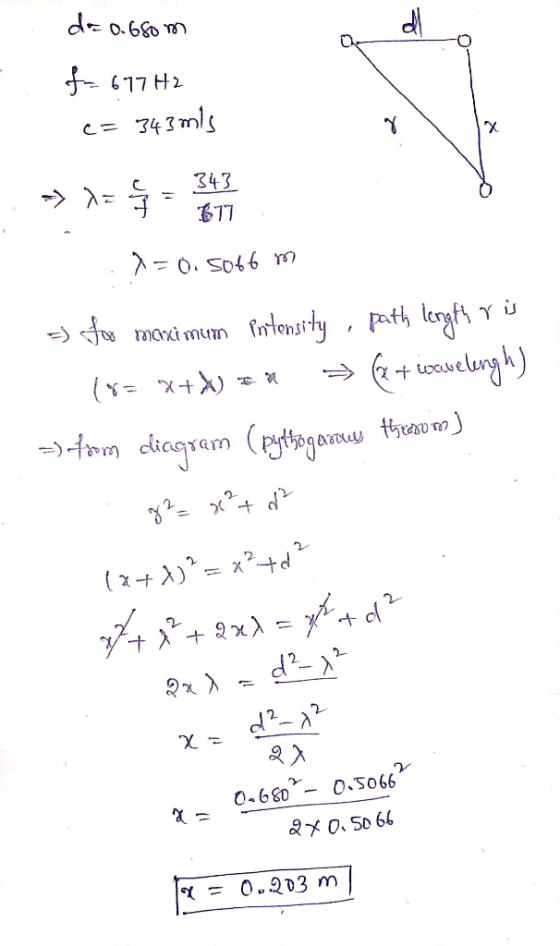
 A pair of speakers separated by distance d = 0.680 m are driven by the same oscillator at a frequency of 677 Hz. An observer originally positioned at one of the speakers begins to walk along a line perpendicular to the line joining the speakers as in the figure below. (Use v = 343 m/s.) (a) How far must the observer walk before reaching a relative maximum in intensity? m (b) How far will the observer be from the speaker...
A pair of speakers, placed 3m apart, are driven by the same oscillator with a frequency...
 A pair of speakers, placed 3m apart, are driven by the same oscillator with a frequency of 1.3 kHz. A listener is originally at a point O equidistant from the two speakers and 8m from the center of the line joining them. The listener then moves to a point P 0.35m away where the line OP is parallel to that joining the speakers. At P, the listener encounters the first minimum of sound intensity. Calculate the speed of sound. A...
A pair of speakers, placed 3m apart, are driven by the same oscillator with a frequency...
 A pair of speakers, placed 3m apart, are driven by the same oscillator with a frequency of 1.3 kHz. A listener is originally at a point O equidistant from the two speakers and 8m from the center of the line joining them. The listener then moves to a point P 0.35m away where the line OP is parallel to that joining the speakers. At P, the listener encounters the first minimum of sound intensity. Calculate the speed of sound.
A pair of speakers, placed 3m apart, are driven by the same oscillator with a frequency...
A pair of speakers, placed 3m apart, are driven by the same oscillator with a frequency of 1.3 kHz. A listener is originally at a point O equidistant from the two speakers and 8m from the center of the line joining them. The listener then moves to a point P 0.35m away where the line OP is parallel to that joining the speakers. At P, the listener encounters the first minimum of sound intensity. Calculate the speed of sound.
1. Two identical loudspeakers are driven by the same oscillator at frequency 480 Hz. They are...
 1. Two identical loudspeakers are driven by the same oscillator at frequency 480 Hz. They are located on the ground a distance of 4.0 m from each other. Starting far from the speakers, a man walks straight toward the right-hand speaker as shown. How many maxima does the man walk through and at what distances from the speaker are the maxima? Speaker 1 Speaker 2 Observer
You are standing a distance d (2m) directly in front of one of two identical speakers, being driven by the same signal generator, that are a distance h (5m) apart. You walk in the positive direction s...
 You are standing a distance d
(2m) directly in front of one of two identical speakers, being
driven by the same signal generator, that are a distance h (5m)
apart. You walk in the positive direction starting at y=0 m, along
a line parallel to the line joining the two speakers. The speed of
sound is 340 m/s and the frequency is 170 HZ. As you walk, how many
times and where will you hear a maximum sound?
PROBLEM You...
You are standing a distance d
(2m) directly in front of one of two identical speakers, being
driven by the same signal generator, that are a distance h (5m)
apart. You walk in the positive direction starting at y=0 m, along
a line parallel to the line joining the two speakers. The speed of
sound is 340 m/s and the frequency is 170 HZ. As you walk, how many
times and where will you hear a maximum sound?
PROBLEM You...
Two small speakers are separated by a distance of 6 cm, as shown. The speakers are...
Two small speakers are separated by a distance of 6 cm, as shown. The speakers are driven in phase with a sine wave signal of frequency 11 kHz. A small microphone is placed a distance 1.2 m away from the speakers on the axis running through the middle of the two speakers, and the microphone is then moved perpendicular to the axis. Where does the microphone record the first minimum of the interference pattern from the speakers as measured from...
The two speakers of a boom box are 32.2 cm apart. A single oscillator makes the...
The two speakers of a boom box are 32.2 cm apart. A single oscillator makes the speakers vibrate in phase at a frequency of 1.88 kHz. At what angles, measured from the perpendicular bisector of the line joining the speakers, would a distant observer hear maximum sound intensity? (Take the speed of sound as 340 m/s. Consider nonnegative angles only. Enter your answers from smallest to largest. Enter NONE in any unused answer blanks.)
6-1 Two speakers emit sound waves with frequency 4.27 kHz s pts by the same oscillator...
 6-1 Two speakers emit sound waves with frequency 4.27 kHz s pts by the same oscillator so that they are in phase with each other. I place the They are driven speakers side-by-side, and I stand across the room from them. If someone moves one of the speakers towards me, I hear the total intensity drop and then rise again. How far had they moved the speaker at the point whereI heard a minimum intensity due to destructive interference of...
Two speakers, which are separated by a distance d, produce sound waves with the same amplitude,...
 Two speakers, which are separated by a distance d,
produce sound waves with the same amplitude, phase and frequency.
The frequency of the sound is 570 Hz. You stand a distance of 3.50
m directly in front of the left speaker, on the dashed line shown
in the diagram. Assume the speed of sound to be 340 m/s. What is
the smallest possible value of d so that you hear no sound
because of destructive interference?
Two speakers, which are separated by a distance d,
produce sound waves with the same amplitude, phase and frequency.
The frequency of the sound is 570 Hz. You stand a distance of 3.50
m directly in front of the left speaker, on the dashed line shown
in the diagram. Assume the speed of sound to be 340 m/s. What is
the smallest possible value of d so that you hear no sound
because of destructive interference?
 A pair of speakers separated by distance d = 0.680 m are driven by the same oscillator at a frequency of 677 Hz. An observer originally positioned at one of the speakers begins to walk along a line perpendicular to the line joining the speakers as in the figure below. (Use v = 343 m/s.) (a) How far must the observer walk before reaching a relative maximum in intensity? m (b) How far will the observer be from the speaker...
 A pair of speakers, placed 3m apart, are driven by the same oscillator with a frequency of 1.3 kHz. A listener is originally at a point O equidistant from the two speakers and 8m from the center of the line joining them. The listener then moves to a point P 0.35m away where the line OP is parallel to that joining the speakers. At P, the listener encounters the first minimum of sound intensity. Calculate the speed of sound. A...
 A pair of speakers, placed 3m apart, are driven by the same oscillator with a frequency of 1.3 kHz. A listener is originally at a point O equidistant from the two speakers and 8m from the center of the line joining them. The listener then moves to a point P 0.35m away where the line OP is parallel to that joining the speakers. At P, the listener encounters the first minimum of sound intensity. Calculate the speed of sound.
 1. Two identical loudspeakers are driven by the same oscillator at frequency 480 Hz. They are located on the ground a distance of 4.0 m from each other. Starting far from the speakers, a man walks straight toward the right-hand speaker as shown. How many maxima does the man walk through and at what distances from the speaker are the maxima? Speaker 1 Speaker 2 Observer
 You are standing a distance d
(2m) directly in front of one of two identical speakers, being
driven by the same signal generator, that are a distance h (5m)
apart. You walk in the positive direction starting at y=0 m, along
a line parallel to the line joining the two speakers. The speed of
sound is 340 m/s and the frequency is 170 HZ. As you walk, how many
times and where will you hear a maximum sound?
PROBLEM You...
You are standing a distance d
(2m) directly in front of one of two identical speakers, being
driven by the same signal generator, that are a distance h (5m)
apart. You walk in the positive direction starting at y=0 m, along
a line parallel to the line joining the two speakers. The speed of
sound is 340 m/s and the frequency is 170 HZ. As you walk, how many
times and where will you hear a maximum sound?
PROBLEM You...
 6-1 Two speakers emit sound waves with frequency 4.27 kHz s pts by the same oscillator so that they are in phase with each other. I place the They are driven speakers side-by-side, and I stand across the room from them. If someone moves one of the speakers towards me, I hear the total intensity drop and then rise again. How far had they moved the speaker at the point whereI heard a minimum intensity due to destructive interference of...
 Two speakers, which are separated by a distance d,
produce sound waves with the same amplitude, phase and frequency.
The frequency of the sound is 570 Hz. You stand a distance of 3.50
m directly in front of the left speaker, on the dashed line shown
in the diagram. Assume the speed of sound to be 340 m/s. What is
the smallest possible value of d so that you hear no sound
because of destructive interference?
Two speakers, which are separated by a distance d,
produce sound waves with the same amplitude, phase and frequency.
The frequency of the sound is 570 Hz. You stand a distance of 3.50
m directly in front of the left speaker, on the dashed line shown
in the diagram. Assume the speed of sound to be 340 m/s. What is
the smallest possible value of d so that you hear no sound
because of destructive interference?
Most questions answered within 3 hours.
-
Where is the error in this code sequence?
String s1 = "Hello";
String s2 = "ello";...
asked 11 months ago -
Financial data for Joel de Paris, Inc., for last year
follow:
Joel de Paris, Inc.
Balance...
asked 11 months ago -
Consider this reaction:
Al2(SO4)3 (aq)+ BaCl3
(aq) Al2Cl6 (aq)- +
3BaSO4(s) . What is the...
asked 11 months ago -
Suppose that Savneet is considering increasing her
recent random sample from 20 car rentals to 40...
asked 11 months ago -
Trucks arrive at an unloading terminal at an average rate of 120
per hour.
Trucks arrive...
asked 11 months ago -
Why are methanol and ethanol completely soluble in water while
octanol is not very little soluble....
asked 11 months ago -
A facilities manager at a university reads in a research report
that the mean amount of...
asked 11 months ago -
When the CuSO4 is rehydrated by adding water to the anhydrous
compound, is this an endothermic...
asked 11 months ago -
A ray of sunlight is passing from diamond into crown glass; the
angle of incidence is...
asked 11 months ago -
A block of mass 0.249 kg is placed on top of a light, vertical
spring of...
asked 11 months ago -
how do the kidneys compensate in the presences of acidosis
a) trigger hyperventilate
b) reserve acid...
asked 11 months ago -
Question 501 pts
The rental rate of capital to the firm increases. Which of the
following...
asked 11 months ago