Please help me with all three parts!
Homework Answers


Add Answer to:
Please help me with all three parts!
Consider a round parallel plate capacitor consisting of two...
Consider a round parallel plate capacitor consisting of two circular metal plates of radius, R =...
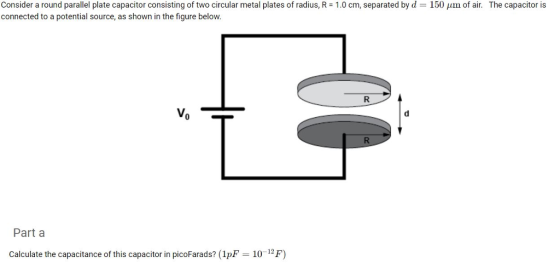
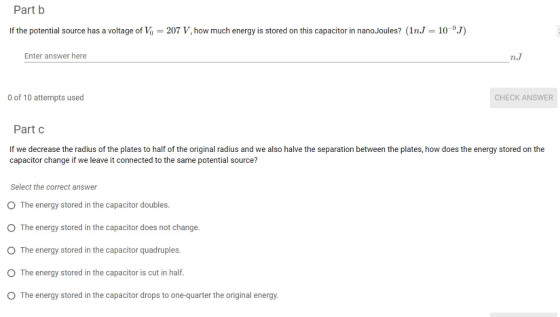
 Consider a round parallel plate capacitor consisting of two circular metal plates of radius, R = 1.0 cm, separated by d = 150 μm of air. The capacitor is connected to a potential source, as shown in the figure below. Part a Calculate the capacitance of this capacitor in picoFarads? (1pF 10-12F) pF Enter answer here Part b If the potential source has a voltage of Vo 335 V, how much energy is stored on this capacitor in nanoJoules? (1nJ...
Question 13 This question contains multiple parts. Make sure to read all the instructions and answer...
 Question 13 This question contains multiple parts. Make sure to read all the instructions and answer each part Consider a round parallel plate capacitor consisting of two circular metal plates of radius, R-1.0 cm, separated by d = 150 μm of air. The capacitor is connected to a potential source, as shown in the figure below. Part a Calculate the capacitance of this capacitor in picoFarads? (1pF 10-12 F) Part b If the potential source has a voltage of Vo...
Hor gnetism- Paddock (WI19) Kudu Consider a round parallel plate capacitor consisting of two circular metal...
 Hor gnetism- Paddock (WI19) Kudu Consider a round parallel plate capacitor consisting of two circular metal plates of radius, R 1.0cm, separated by d 150 μιη of air. The capacitor is connected to a potential source, as shown in the figure below. Part a Calculate the capacitance of this capacitor in picoFarads?(1pF 10 1F) 6 8 i eduwet apps blackboard content content rapp er jsp?course, ide 33546 1&displayNa me. Kud &hrer, https%3A0Okuducor aoooooo, en sa 01 16074aman Ar D Comment...
A parallel plate capacitor consists of two circular metal plates of radius, R, separated by d...
 A parallel plate capacitor consists of two circular metal plates of radius, R, separated by d = 150 μm of air. The capacitor is connected to a Vo 10 V potential source, as shown in the figure below. This results in 111 nC of charge being stored on each plate. If the radius of the plate is doubled while leaving the capacitor connected to the same potential source, what is the new amount of charge stored on each plate?
A parallel-plate vacuum capacitor has 9.22 J of energy stored in it. The separation between the...
A parallel-plate vacuum capacitor has 9.22 J of energy stored in it. The separation between the plates is 2.00 mm . If the separation is decreased to 1.25 mm , Part A what is the energy now stored if the capacitor was disconnected from the potential source before the separation of the plates was changed? Part B What is the energy now stored if the capacitor remained connected to the potential source while the separation of the plates was changed?
A capacitor consisting of two concentric spheres of radius R1 and R2 = 2.00·R1 has a capacitance of C...
A capacitor consisting of two concentric spheres of radius R1 and R2 = 2.00·R1 has a capacitance of C = 5.00 picoFarads and is charged to a potential difference of 80.0 Volts. a)Calculate the energy stored in the capacitor. b)Calculate the charge on this capacitor, when the electrical energy stored is 27.7·10-8Joules. c)If the radius of the outer sphere is increased by a factor of 3.00 while keeping the charge on the plates constant, by what factor does the stored energy change?
A parallel plate capacitor consists of two circular metal plates of radius, R, separated by d...
 A parallel plate capacitor consists of two circular metal plates of radius, R, separated by d -150 um of air. The capacitor is connected to a Vo- 10 V potential source, as shown in the figure below. This results in 167 nC of charge being stored on each plate. If the radius of the plate is doubled while leaving the capacitor connected to the same potential source, what is the new amount of charge stored on each plate?
A parallel plate capacitor consists of two circular metal plates of radius, R, separated by d...
 A parallel plate capacitor consists of two circular metal plates of radius, R, separated by d 150 um of air. The capacitor is connected to a Vo 10 V potential source, as shown in the figure below. This results in 202 nC of charge being stored on each plate. If the radius of the plate is doubled while leaving the capacitor connected to the same potential source, what is the new amount of charge stored on each plate?
A parallel plate capacitor is comprised of two metal plates with area A and separated by...
 A parallel plate capacitor is comprised of two metal plates with area A and separated by distance d. This parallel plate capacitor is connected to a battery with voltage AVo. Your answer should depend on A, d, ΔVo, and any other physical constants a. Determine the charge stored on the plates of the capacitor and the energy stored in the capacitor b. Determine the strength of the electric field between the plates of the capacitor c. An experimenter has five...
explain why please A parallel-plate capacitor is made of two conducting plates of area A separated...
 explain why please
A parallel-plate capacitor is made of two conducting plates of area A separated by a distance d. The capacitor carries a charge Q and is initially connected to a battery that maintains a constant potential difference between the plates. The battery is then disconnected from the plates and the separation between the plates is doubled. ) Which of the following remains constant? Voltage across the capacitor Capacitance of the capacitor Charge on the capacitor Submit (Survey Question)...
explain why please
A parallel-plate capacitor is made of two conducting plates of area A separated by a distance d. The capacitor carries a charge Q and is initially connected to a battery that maintains a constant potential difference between the plates. The battery is then disconnected from the plates and the separation between the plates is doubled. ) Which of the following remains constant? Voltage across the capacitor Capacitance of the capacitor Charge on the capacitor Submit (Survey Question)...
 Consider a round parallel plate capacitor consisting of two circular metal plates of radius, R = 1.0 cm, separated by d = 150 μm of air. The capacitor is connected to a potential source, as shown in the figure below. Part a Calculate the capacitance of this capacitor in picoFarads? (1pF 10-12F) pF Enter answer here Part b If the potential source has a voltage of Vo 335 V, how much energy is stored on this capacitor in nanoJoules? (1nJ...
 Question 13 This question contains multiple parts. Make sure to read all the instructions and answer each part Consider a round parallel plate capacitor consisting of two circular metal plates of radius, R-1.0 cm, separated by d = 150 μm of air. The capacitor is connected to a potential source, as shown in the figure below. Part a Calculate the capacitance of this capacitor in picoFarads? (1pF 10-12 F) Part b If the potential source has a voltage of Vo...
 Hor gnetism- Paddock (WI19) Kudu Consider a round parallel plate capacitor consisting of two circular metal plates of radius, R 1.0cm, separated by d 150 μιη of air. The capacitor is connected to a potential source, as shown in the figure below. Part a Calculate the capacitance of this capacitor in picoFarads?(1pF 10 1F) 6 8 i eduwet apps blackboard content content rapp er jsp?course, ide 33546 1&displayNa me. Kud &hrer, https%3A0Okuducor aoooooo, en sa 01 16074aman Ar D Comment...
 A parallel plate capacitor consists of two circular metal plates of radius, R, separated by d = 150 μm of air. The capacitor is connected to a Vo 10 V potential source, as shown in the figure below. This results in 111 nC of charge being stored on each plate. If the radius of the plate is doubled while leaving the capacitor connected to the same potential source, what is the new amount of charge stored on each plate?
 A parallel plate capacitor consists of two circular metal plates of radius, R, separated by d -150 um of air. The capacitor is connected to a Vo- 10 V potential source, as shown in the figure below. This results in 167 nC of charge being stored on each plate. If the radius of the plate is doubled while leaving the capacitor connected to the same potential source, what is the new amount of charge stored on each plate?
 A parallel plate capacitor consists of two circular metal plates of radius, R, separated by d 150 um of air. The capacitor is connected to a Vo 10 V potential source, as shown in the figure below. This results in 202 nC of charge being stored on each plate. If the radius of the plate is doubled while leaving the capacitor connected to the same potential source, what is the new amount of charge stored on each plate?
 A parallel plate capacitor is comprised of two metal plates with area A and separated by distance d. This parallel plate capacitor is connected to a battery with voltage AVo. Your answer should depend on A, d, ΔVo, and any other physical constants a. Determine the charge stored on the plates of the capacitor and the energy stored in the capacitor b. Determine the strength of the electric field between the plates of the capacitor c. An experimenter has five...
 explain why please
A parallel-plate capacitor is made of two conducting plates of area A separated by a distance d. The capacitor carries a charge Q and is initially connected to a battery that maintains a constant potential difference between the plates. The battery is then disconnected from the plates and the separation between the plates is doubled. ) Which of the following remains constant? Voltage across the capacitor Capacitance of the capacitor Charge on the capacitor Submit (Survey Question)...
explain why please
A parallel-plate capacitor is made of two conducting plates of area A separated by a distance d. The capacitor carries a charge Q and is initially connected to a battery that maintains a constant potential difference between the plates. The battery is then disconnected from the plates and the separation between the plates is doubled. ) Which of the following remains constant? Voltage across the capacitor Capacitance of the capacitor Charge on the capacitor Submit (Survey Question)...
Most questions answered within 3 hours.
-
Where is the error in this code sequence?
String s1 = "Hello";
String s2 = "ello";...
asked 10 months ago -
Financial data for Joel de Paris, Inc., for last year
follow:
Joel de Paris, Inc.
Balance...
asked 10 months ago -
Consider this reaction:
Al2(SO4)3 (aq)+ BaCl3
(aq) Al2Cl6 (aq)- +
3BaSO4(s) . What is the...
asked 10 months ago -
Suppose that Savneet is considering increasing her
recent random sample from 20 car rentals to 40...
asked 10 months ago -
Trucks arrive at an unloading terminal at an average rate of 120
per hour.
Trucks arrive...
asked 10 months ago -
Why are methanol and ethanol completely soluble in water while
octanol is not very little soluble....
asked 10 months ago -
A facilities manager at a university reads in a research report
that the mean amount of...
asked 10 months ago -
When the CuSO4 is rehydrated by adding water to the anhydrous
compound, is this an endothermic...
asked 10 months ago -
A ray of sunlight is passing from diamond into crown glass; the
angle of incidence is...
asked 10 months ago -
A block of mass 0.249 kg is placed on top of a light, vertical
spring of...
asked 10 months ago -
how do the kidneys compensate in the presences of acidosis
a) trigger hyperventilate
b) reserve acid...
asked 10 months ago -
Question 501 pts
The rental rate of capital to the firm increases. Which of the
following...
asked 10 months ago