Michael Jones is interested in buying the stock of First National Bank. While the bank's management...
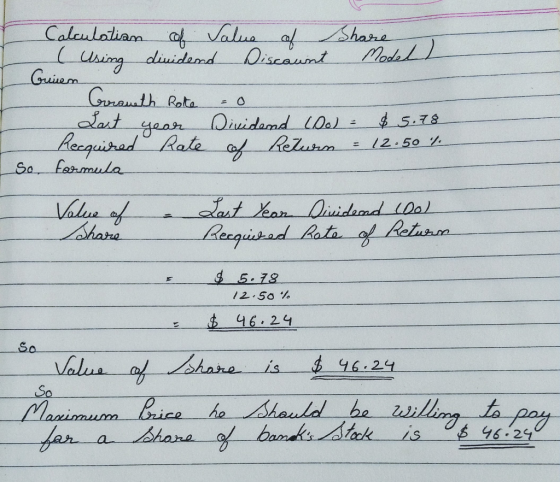
Michael Jones is interested in buying the stock of First National Bank. While the bank's management expects no growth in the near future, Michael is attracted by the dividend income. Last year the bank paid a dividend of $5.78. If Michael requires a return of 12.5 percent on such stocks, what is the maximum price he should be willing to pay for a share of the bank’s stock?
Homework Answers
Add Answer to:
Michael Jones is interested in buying the stock of First
National Bank. While the bank's management...
Jason Allen is interested in buying the stock of First National Bank. While the bank's management...
Jason Allen is interested in buying the stock of First National Bank. While the bank's management expects no growth in the near future, Jason is attracted by the dividend income. Last year the bank paid a dividend of $6.16. If Jason requires a return of 11.0 percent on such stocks, what is the maximum price he should be willing to pay for a share of the bank’s stock?
Problem 8.5 Fresno Corp. is a fast-growing company whose management that expects to grow at a...
Problem 8.5 Fresno Corp. is a fast-growing company whose management that expects to grow at a rate of 29 percent over the next two years and then to slow to a growth rate of 12 percent for the following three years. The required rate of return is 14 percent. If the last dividend paid by the company was $2.15. What is the dividend for 1st year? (Round answer to 3 decimal places, e.g. 15.250.) D1 $ LINK TO TEXT What...
Rhea Kirby owns shares in Ryoko Corp. Currently, the market price of the stock is $36. 34. Management expects divi...
 Rhea Kirby owns shares in Ryoko Corp. Currently, the market price of the stock is $36. 34. Management expects dividends to grow at a constant rate of 6 percent for the foreseeable future. Its last dividend was $3.25. Rhea' s required rate of return for such stocks is 16 percent. She wants to find out whether she should sell her shares or add to her holdings. $34.45, sell overpriced $32.5, buy underpriced $34.45, buy underpriced $32.5, sell overpriced You are...
Fifth National Bank just issued some new preferred stock. The issue will pay an annual dividend...
Fifth National Bank just issued some new preferred stock. The issue will pay an annual dividend of $17 in perpetuity, beginning 6 years from now. If the market requires a return of 3.1 percent on this investment, how much does a share of preferred stock cost today? (Do not round intermediate calculations and round your answer to 2 decimal places, e.g., 32.16.) Stock price $
Fifth National Bank just issued some new preferred stock. The issue will pay an annual dividend...
 Fifth National Bank just issued some new preferred stock. The issue will pay an annual dividend of $12 in perpetuity, beginning 17 years from now. If the market requires a return of 4.2 percent on this investment, how much does a share of preferred stock cost today? (Do not round intermediate calculations and round your answer to 2 decimal places, e.g., 32.16.) Stock price
Fifth National Bank just issued some new preferred stock. The issue will pay an annual dividend...
 Fifth National Bank just issued some new preferred stock. The issue will pay an annual dividend of $10 in perpetuity, beginning 15 years from now. If the market requires a return of 4 percent on this investment, how much does a share of preferred stock cost today? (Do not round intermediate calculations and round your answer to 2 decimal places, e.g., 32.16.) Stock price
Fifth National Bank just issued some new preferred stock. The issue will pay an annual dividend...
Fifth National Bank just issued some new preferred stock. The issue will pay an annual dividend of $22 in perpetuity, beginning 11 years from now. If the market requires a return of 3.6 percent on this investment, how much does a share of preferred stock cost today? (Do not round intermediate calculations and round your answer to 2 decimal places, e.g., 32.16.) Please provide as many details as possible on formulas and calculations (Excel preferred).Thank you.
You are interested in purchasing the common stock of Azure Corporation. The firm recently paid a...
 You are interested in purchasing the common stock of Azure Corporation. The firm recently paid a dividend of $3.00 per share. It expects its earnings and hence its dividends—to grow at a rate of 6.1% for the foreseeable future. Currently, similar-risk stocks have required returns of 9.6%. a. Given the preceding data, calculate the present value of this security. Use the constant-growth dividend model (Equation 8.8) to find the stock value. b. One year later, your broker offers to sell...
The cost of issuing new common stock is calculated the same way as the cost of...
 The cost of issuing new common stock is calculated the same way as the cost of raising equity capital from retained earnings. True: The cost of retained earnings and the cost of new common stock are calculated in the same manner, except that the cost of retained earnings is based on the firm's existing common equity, while the cost of new common stock is based on the value of the firm's share price net of its flotation cost. False: Flotation...
The cost of issuing new common stock is calculated the same way as the cost of raising equity capital from retained ear...
 The cost of issuing new common stock is calculated the same way as the cost of raising equity capital from retained earnings. True: The cost of retained earnings and the cost of new common stock are calculated in the same manner, except that the cost of retained earnings is based on the firm's existing common equity, while the cost of new common stock is based on the value of the firm's share price net of its flotation cost. False: Flotation...
 Rhea Kirby owns shares in Ryoko Corp. Currently, the market price of the stock is $36. 34. Management expects dividends to grow at a constant rate of 6 percent for the foreseeable future. Its last dividend was $3.25. Rhea' s required rate of return for such stocks is 16 percent. She wants to find out whether she should sell her shares or add to her holdings. $34.45, sell overpriced $32.5, buy underpriced $34.45, buy underpriced $32.5, sell overpriced You are...
 Fifth National Bank just issued some new preferred stock. The issue will pay an annual dividend of $12 in perpetuity, beginning 17 years from now. If the market requires a return of 4.2 percent on this investment, how much does a share of preferred stock cost today? (Do not round intermediate calculations and round your answer to 2 decimal places, e.g., 32.16.) Stock price
 Fifth National Bank just issued some new preferred stock. The issue will pay an annual dividend of $10 in perpetuity, beginning 15 years from now. If the market requires a return of 4 percent on this investment, how much does a share of preferred stock cost today? (Do not round intermediate calculations and round your answer to 2 decimal places, e.g., 32.16.) Stock price
 You are interested in purchasing the common stock of Azure Corporation. The firm recently paid a dividend of $3.00 per share. It expects its earnings and hence its dividends—to grow at a rate of 6.1% for the foreseeable future. Currently, similar-risk stocks have required returns of 9.6%. a. Given the preceding data, calculate the present value of this security. Use the constant-growth dividend model (Equation 8.8) to find the stock value. b. One year later, your broker offers to sell...
 The cost of issuing new common stock is calculated the same way as the cost of raising equity capital from retained earnings. True: The cost of retained earnings and the cost of new common stock are calculated in the same manner, except that the cost of retained earnings is based on the firm's existing common equity, while the cost of new common stock is based on the value of the firm's share price net of its flotation cost. False: Flotation...
 The cost of issuing new common stock is calculated the same way as the cost of raising equity capital from retained earnings. True: The cost of retained earnings and the cost of new common stock are calculated in the same manner, except that the cost of retained earnings is based on the firm's existing common equity, while the cost of new common stock is based on the value of the firm's share price net of its flotation cost. False: Flotation...
Most questions answered within 3 hours.
-
Where is the error in this code sequence?
String s1 = "Hello";
String s2 = "ello";...
asked 11 months ago -
Financial data for Joel de Paris, Inc., for last year
follow:
Joel de Paris, Inc.
Balance...
asked 11 months ago -
Consider this reaction:
Al2(SO4)3 (aq)+ BaCl3
(aq) Al2Cl6 (aq)- +
3BaSO4(s) . What is the...
asked 11 months ago -
Suppose that Savneet is considering increasing her
recent random sample from 20 car rentals to 40...
asked 11 months ago -
Trucks arrive at an unloading terminal at an average rate of 120
per hour.
Trucks arrive...
asked 11 months ago -
Why are methanol and ethanol completely soluble in water while
octanol is not very little soluble....
asked 11 months ago -
A facilities manager at a university reads in a research report
that the mean amount of...
asked 11 months ago -
When the CuSO4 is rehydrated by adding water to the anhydrous
compound, is this an endothermic...
asked 11 months ago -
A ray of sunlight is passing from diamond into crown glass; the
angle of incidence is...
asked 11 months ago -
A block of mass 0.249 kg is placed on top of a light, vertical
spring of...
asked 11 months ago -
how do the kidneys compensate in the presences of acidosis
a) trigger hyperventilate
b) reserve acid...
asked 11 months ago -
Question 501 pts
The rental rate of capital to the firm increases. Which of the
following...
asked 11 months ago