In lab I performed two strong base/weak acid titrations with two different analytes. I also performed...
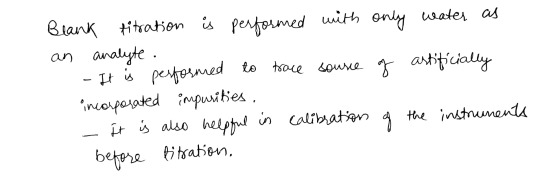
In lab I performed two strong base/weak acid titrations with two different analytes. I also performed a blank titration with only water as the analyte. What was the point of the blank titration?
Homework Answers
Add Answer to:
In lab I performed two strong base/weak acid titrations with two
different analytes. I also performed...
9. Acid-Base Titrations Acid-Base titrations are performed to determine the concentration of an acid or base...
 9. Acid-Base Titrations Acid-Base titrations are performed to determine the concentration of an acid or base in a solution When the number of moles of in an acid is equal to the moles of in the base, water is formed and no acid or base is left unreacted. The solution has a pH of 7 and is called neutral. In an acid-base titration we use this concept to find out the concentration of an acid by adding base until all...
It's a weak acid strong base titration Experiment 4: Identification of an unknown acid by titration...
 It's a weak acid strong base titration
Experiment 4: Identification of an unknown acid by titration Page 2 of 15 Background In this experiment, you will use both qualitative and quantitative properties to determine an unknown acid's identity and concentration. To do this analysis, you will perform a titration of your unknown acid sample-specifically a potentiometric titration where you use a pH meter and record pH values during the titration, combined with a visual titration using a color indi- cator...
It's a weak acid strong base titration
Experiment 4: Identification of an unknown acid by titration Page 2 of 15 Background In this experiment, you will use both qualitative and quantitative properties to determine an unknown acid's identity and concentration. To do this analysis, you will perform a titration of your unknown acid sample-specifically a potentiometric titration where you use a pH meter and record pH values during the titration, combined with a visual titration using a color indi- cator...
In the titration of a strong acid (the analyte) with a strong base (the titrant), what...
In the titration of a strong acid (the analyte) with a strong base (the titrant), what type of pH problem must be solved if the titration is stopped at any point before the equivalence point? a. buffer b. Kw expression c. weak acid d. weak base e. strong acid f. strong base
In Lab 9, students performed acid-base titrations. Redox reactions can also be used in titrations. An...
 In Lab 9, students performed acid-base titrations. Redox
reactions can also be used in titrations. An example is the
titration of ascorbic acid
(H2C6H6O6) in lemon
juice using triiodide (I3− ). A starch
indicator will turn the solution blue-black at the endpoint. The
half-reactions involved are shown below.
C6H6O6 + 2 H+ + 2
e−
→
H2C6H6O6
+0.06 V
I3− + 2
e−
→
3 I−
+0.53 V
(a) What is the net redox reaction that occurs? (Use the lowest...
In Lab 9, students performed acid-base titrations. Redox
reactions can also be used in titrations. An example is the
titration of ascorbic acid
(H2C6H6O6) in lemon
juice using triiodide (I3− ). A starch
indicator will turn the solution blue-black at the endpoint. The
half-reactions involved are shown below.
C6H6O6 + 2 H+ + 2
e−
→
H2C6H6O6
+0.06 V
I3− + 2
e−
→
3 I−
+0.53 V
(a) What is the net redox reaction that occurs? (Use the lowest...
Question: In the figure below, titration curves for strong acid with strong base and weak acid...
 Question: In the figure below, titration curves for strong acid
with strong base and weak acid with strong base are shown. Compare
the shapes of these curves early in the titration for three
different cases: titration of a strong acid, titration of a weak
acid with a lower pKa, and titration of a weak acid with a higher
pKa. Discuss with the class why the titration curve for weak acids
increase more rapidly early in the titration than do stronger...
Question: In the figure below, titration curves for strong acid
with strong base and weak acid with strong base are shown. Compare
the shapes of these curves early in the titration for three
different cases: titration of a strong acid, titration of a weak
acid with a lower pKa, and titration of a weak acid with a higher
pKa. Discuss with the class why the titration curve for weak acids
increase more rapidly early in the titration than do stronger...
To learn about titration types and how to calculate pH at different points of titration. In an acid-base titration, a...
 To learn about titration types
and how to calculate pH at different points of titration. In an
acid-base titration, a titrant (solution of a base or acid) is
added slowly to an analyte (solution of an acid or base). The
titration is often monitored using a pH meter. A plot of pH as a
function of the volume of titrant added is called a pH titration
curve. Prior to the titration, the pH is determined by the
concentration of the...
To learn about titration types
and how to calculate pH at different points of titration. In an
acid-base titration, a titrant (solution of a base or acid) is
added slowly to an analyte (solution of an acid or base). The
titration is often monitored using a pH meter. A plot of pH as a
function of the volume of titrant added is called a pH titration
curve. Prior to the titration, the pH is determined by the
concentration of the...
In a strong base/weak acid titration: titrant: NaOH analyte: H3PO4 solution There should be three equivalence...
In a strong base/weak acid titration: titrant: NaOH analyte: H3PO4 solution There should be three equivalence points since there are three protons transferred...why does my titration curve only show two?
Weak Acid-Strong Base Titration Date Nanse PRE-LAB OUESTIONS 1 Calculate the molarity of a NaOH solution...
 Weak Acid-Strong Base Titration Date Nanse PRE-LAB OUESTIONS 1 Calculate the molarity of a NaOH solution that was used to titrate 1.2 g of potassium acid phthalate if 37.50 ml of the base were reauired to get to the end point of the titration. 2 It takes 12.45 ml. of a 0.500 M NaOH solution larity of the acid to titrate 30.0 mL of acetic acid. What is the mo- 3. Using the titration curve below, calculate the K, of...
Weak-Acid Strong-Base Titrations. These next questions relate to a 25 mL aliquot of 0.35 M acetic acid (Ka = 1.77 x...
 Weak-Acid Strong-Base Titrations. These next questions relate to a 25 mL aliquot of 0.35 M acetic acid (Ka = 1.77 x 10) that is titrated with 0.20 M potassium hydroxide (KOH). (f) What is the pH of the acetic acid solution before the titration begins? (g) What is the pH after 14 mL of 0.20 M KOH has been added to the solution? Use the Henderson-Hasselbalch equation. (h) What is the pH at the equivalence point?
Titrations. Determine if the equivalence point (from the acid/base titration curve) will be equal to pH...
Titrations. Determine if the equivalence point (from the acid/base titration curve) will be equal to pH 7, will be lower than pH 7, or will be greater than pH 7 in the solutions below. Strong acid/strong base Weak acid/strong base Strong base/weak acid Rank the acids in order of increasing acidity: H2O, H2S, H2Se H3PO4, H2PO2, H3PO5
 9. Acid-Base Titrations Acid-Base titrations are performed to determine the concentration of an acid or base in a solution When the number of moles of in an acid is equal to the moles of in the base, water is formed and no acid or base is left unreacted. The solution has a pH of 7 and is called neutral. In an acid-base titration we use this concept to find out the concentration of an acid by adding base until all...
 It's a weak acid strong base titration
Experiment 4: Identification of an unknown acid by titration Page 2 of 15 Background In this experiment, you will use both qualitative and quantitative properties to determine an unknown acid's identity and concentration. To do this analysis, you will perform a titration of your unknown acid sample-specifically a potentiometric titration where you use a pH meter and record pH values during the titration, combined with a visual titration using a color indi- cator...
It's a weak acid strong base titration
Experiment 4: Identification of an unknown acid by titration Page 2 of 15 Background In this experiment, you will use both qualitative and quantitative properties to determine an unknown acid's identity and concentration. To do this analysis, you will perform a titration of your unknown acid sample-specifically a potentiometric titration where you use a pH meter and record pH values during the titration, combined with a visual titration using a color indi- cator...
 In Lab 9, students performed acid-base titrations. Redox
reactions can also be used in titrations. An example is the
titration of ascorbic acid
(H2C6H6O6) in lemon
juice using triiodide (I3− ). A starch
indicator will turn the solution blue-black at the endpoint. The
half-reactions involved are shown below.
C6H6O6 + 2 H+ + 2
e−
→
H2C6H6O6
+0.06 V
I3− + 2
e−
→
3 I−
+0.53 V
(a) What is the net redox reaction that occurs? (Use the lowest...
In Lab 9, students performed acid-base titrations. Redox
reactions can also be used in titrations. An example is the
titration of ascorbic acid
(H2C6H6O6) in lemon
juice using triiodide (I3− ). A starch
indicator will turn the solution blue-black at the endpoint. The
half-reactions involved are shown below.
C6H6O6 + 2 H+ + 2
e−
→
H2C6H6O6
+0.06 V
I3− + 2
e−
→
3 I−
+0.53 V
(a) What is the net redox reaction that occurs? (Use the lowest...
 Question: In the figure below, titration curves for strong acid
with strong base and weak acid with strong base are shown. Compare
the shapes of these curves early in the titration for three
different cases: titration of a strong acid, titration of a weak
acid with a lower pKa, and titration of a weak acid with a higher
pKa. Discuss with the class why the titration curve for weak acids
increase more rapidly early in the titration than do stronger...
Question: In the figure below, titration curves for strong acid
with strong base and weak acid with strong base are shown. Compare
the shapes of these curves early in the titration for three
different cases: titration of a strong acid, titration of a weak
acid with a lower pKa, and titration of a weak acid with a higher
pKa. Discuss with the class why the titration curve for weak acids
increase more rapidly early in the titration than do stronger...
 To learn about titration types
and how to calculate pH at different points of titration. In an
acid-base titration, a titrant (solution of a base or acid) is
added slowly to an analyte (solution of an acid or base). The
titration is often monitored using a pH meter. A plot of pH as a
function of the volume of titrant added is called a pH titration
curve. Prior to the titration, the pH is determined by the
concentration of the...
To learn about titration types
and how to calculate pH at different points of titration. In an
acid-base titration, a titrant (solution of a base or acid) is
added slowly to an analyte (solution of an acid or base). The
titration is often monitored using a pH meter. A plot of pH as a
function of the volume of titrant added is called a pH titration
curve. Prior to the titration, the pH is determined by the
concentration of the...
 Weak Acid-Strong Base Titration Date Nanse PRE-LAB OUESTIONS 1 Calculate the molarity of a NaOH solution that was used to titrate 1.2 g of potassium acid phthalate if 37.50 ml of the base were reauired to get to the end point of the titration. 2 It takes 12.45 ml. of a 0.500 M NaOH solution larity of the acid to titrate 30.0 mL of acetic acid. What is the mo- 3. Using the titration curve below, calculate the K, of...
 Weak-Acid Strong-Base Titrations. These next questions relate to a 25 mL aliquot of 0.35 M acetic acid (Ka = 1.77 x 10) that is titrated with 0.20 M potassium hydroxide (KOH). (f) What is the pH of the acetic acid solution before the titration begins? (g) What is the pH after 14 mL of 0.20 M KOH has been added to the solution? Use the Henderson-Hasselbalch equation. (h) What is the pH at the equivalence point?
Most questions answered within 3 hours.
-
Where is the error in this code sequence?
String s1 = "Hello";
String s2 = "ello";...
asked 10 months ago -
Financial data for Joel de Paris, Inc., for last year
follow:
Joel de Paris, Inc.
Balance...
asked 10 months ago -
Consider this reaction:
Al2(SO4)3 (aq)+ BaCl3
(aq) Al2Cl6 (aq)- +
3BaSO4(s) . What is the...
asked 10 months ago -
Suppose that Savneet is considering increasing her
recent random sample from 20 car rentals to 40...
asked 10 months ago -
Trucks arrive at an unloading terminal at an average rate of 120
per hour.
Trucks arrive...
asked 10 months ago -
Why are methanol and ethanol completely soluble in water while
octanol is not very little soluble....
asked 10 months ago -
A facilities manager at a university reads in a research report
that the mean amount of...
asked 10 months ago -
When the CuSO4 is rehydrated by adding water to the anhydrous
compound, is this an endothermic...
asked 10 months ago -
A ray of sunlight is passing from diamond into crown glass; the
angle of incidence is...
asked 10 months ago -
A block of mass 0.249 kg is placed on top of a light, vertical
spring of...
asked 10 months ago -
how do the kidneys compensate in the presences of acidosis
a) trigger hyperventilate
b) reserve acid...
asked 10 months ago -
Question 501 pts
The rental rate of capital to the firm increases. Which of the
following...
asked 10 months ago