
 Please help with 5 and 6
Homework Answers
| Question 5 (a): | ||||||
| Step 1: | ||||||
| Calculation of Equivalent Annual Annuity of Projects B and D | ||||||
| Year | Project B | Project D | ||||
| Cash Flows | Discount Rate @10% | Discounted Cash flows | Cash Flows | Discount Rate @10% | Discounted Cash flows | |
| 0 | -1000 | 1 | -1000 | -1000 | 1 | -1000 |
| 1 | 300 | 0.909090909 | 272.7272727 | 600 | 0.909090909 | 545.4545455 |
| 2 | 400 | 0.826446281 | 330.5785124 | 800 | 0.826446281 | 661.1570248 |
| 3 | 500 | 0.751314801 | 375.6574005 | |||
| 4 | 600 | 0.683013455 | 409.8080732 | |||
| NPV | 388.7713 | 206.6116 | ||||
| Equivalent Annual Annuity of Project B = NPV / Annuity Discount Factor | ||||||
| = 388.7713 / 4.16985446 | ||||||
| = 93.23 | ||||||
| Equivalent Annual Annuity of Project D = NPV / Annuity Discount Factor | ||||||
| = 206.6116 /2.73553719 | ||||||
| = 75.53 | ||||||
| Step 2: | ||||||
| Calculation of NPV of Projects B and D using Replacement Chain Method | ||||||
| In this case project B should be repeated 3 times and project D for 5 times | ||||||
| So that projects will have equal life | ||||||
| Year | Project B | Project D | ||||
| Cash Flows | Discount Rate @10% | Discounted Cash flows | Cash Flows | Discount Rate @10% | Discounted Cash flows | |
| 0 | -1000 | 1 | -1000 | -1000 | 1 | -1000 |
| 1 | 300 | 0.909090909 | 272.7272727 | 600 | 0.909090909 | 545.4545455 |
| 2 | 400 | 0.826446281 | 330.5785124 | 800 | 0.826446281 | 661.1570248 |
| 3 | 500 | 0.751314801 | 375.6574005 | -1000 | 0.751314801 | -751.3148009 |
| 4 | 600 | 0.683013455 | 409.8080732 | 600 | 0.683013455 | 409.8080732 |
| 5 | -1000 | 0.620921323 | -620.9213231 | 800 | 0.620921323 | 496.7370584 |
| 6 | 300 | 0.56447393 | 169.342179 | -1000 | 0.56447393 | -564.4739301 |
| 7 | 400 | 0.513158118 | 205.2632473 | 600 | 0.513158118 | 307.8948709 |
| 8 | 500 | 0.46650738 | 233.2536901 | 800 | 0.46650738 | 373.2059042 |
| 9 | 600 | 0.424097618 | 254.458571 | -1000 | 0.424097618 | -424.0976184 |
| 10 | -1000 | 0.385543289 | -385.5432894 | 600 | 0.385543289 | 231.3259737 |
| 11 | 300 | 0.350493899 | 105.1481698 | 800 | 0.350493899 | 280.3951196 |
| 12 | 400 | 0.318630818 | 127.4523271 | -1000 | 0.318630818 | -318.6308177 |
| 13 | 500 | 0.28966438 | 144.8321899 | 600 | 0.28966438 | 173.7986278 |
| 14 | 600 | 0.263331254 | 157.9987526 | 800 | 0.263331254 | 210.6650034 |
| NPV | 780.0557731 | 631.9250345 | ||||
| Step 3: | ||||||
| Project B | Project D | |||||
| WACC | 10% | 10% | ||||
| Equivalent Annual Annuity | 93.23 | 75.53 | ||||
| Replacement Chain (RC) NPV | 780.06 | 631.93 | ||||
Question 5b:
Project B should be selected as Equivalent Annual Annuity and Replacement Chain (RC) NPV for Project B is higher than Project D
| Step 1: | ||||||||||||
| Year | Project A | Project B | Project C | Project D | ||||||||
| Cash Flows | Discount Rate @10% | Discounted Cash flows | Cash Flows | Discount Rate @10% | Discounted Cash flows | Cash Flows | Discount Rate @10% | Discounted Cash flows | Cash Flows | Discount Rate @10% | Discounted Cash flows | |
| 0 | -1000 | 1 | -1000 | -1000 | 1 | -1000 | -1000 | 1 | -1000 | -1000 | 1 | -1000 |
| 1 | 1000 | 0.909090909 | 909.0909091 | 300 | 0.909090909 | 272.7272727 | 550 | 0.909090909 | 500 | 600 | 0.909090909 | 545.4545455 |
| 2 | 0.826446281 | 0 | 400 | 0.826446281 | 330.5785124 | 450 | 0.826446281 | 371.9008264 | 800 | 0.826446281 | 661.1570248 | |
| 3 | 0.751314801 | 0 | 500 | 0.751314801 | 375.6574005 | 350 | 0.751314801 | 262.9601803 | ||||
| 4 | 0.683013455 | 0 | 600 | 0.683013455 | 409.8080732 | 250 | 0.683013455 | 170.7533638 | ||||
| NPV | -90.9091 | 388.7713 | 305.6144 | 206.6116 | ||||||||
| Step 2: | ||||||||||||
| Equivalent Annual Annuity of Project A = NPV / Annuity Discount Factor | ||||||||||||
| = -90.9091 /1.909091 | ||||||||||||
| = -47.14 | ||||||||||||
| Equivalent Annual Annuity of Project B = NPV / Annuity Discount Factor | ||||||||||||
| = 388.7713 / 4.16985446 | ||||||||||||
| = 93.23 | ||||||||||||
| Equivalent Annual Annuity of Project C = NPV / Annuity Discount Factor | ||||||||||||
| = 305.6144 /4.16985446 | ||||||||||||
| = 73.29 | ||||||||||||
| Equivalent Annual Annuity of Project D = NPV / Annuity Discount Factor | ||||||||||||
| = 206.6116 /2.73553719 | ||||||||||||
| = 75.53 | ||||||||||||
| Step 3: | ||||||||||||
| Project B and C has higher NPV hence these should be selected based on NPV rule | ||||||||||||
| Project B and D has higher Equivalent Annual Annuity is higher hence these should be selected based on EAA rule | ||||||||||||
Add Answer to:
Please help with 5 and 6
Use the following table to answer questions 1 – 6....
Please help me solve 4-8 Use the following table to answer questions 1 – 6. The...
 Please help me solve 4-8
Use the following table to answer questions 1 – 6. The wacc is 10% for all projects in this table. Year Project A -1,000 1,000 Project B -1,000 300 400 500 600 Project C -1,000 550 450 350 250 Project D -1,000 600 800 1. Compute the Net Present Value (NPV), Internal Rate of Return (IRR), Profitability Index (PI), and Payback Period (PB) for each project: Project A Project B Project C Project D WACC...
Please help me solve 4-8
Use the following table to answer questions 1 – 6. The wacc is 10% for all projects in this table. Year Project A -1,000 1,000 Project B -1,000 300 400 500 600 Project C -1,000 550 450 350 250 Project D -1,000 600 800 1. Compute the Net Present Value (NPV), Internal Rate of Return (IRR), Profitability Index (PI), and Payback Period (PB) for each project: Project A Project B Project C Project D WACC...
Please answer questions 10-15. 10) If you have $10,000 to invest and you evaluate two mutually...
 Please answer questions 10-15.
10) If you have $10,000 to invest and you evaluate two mutually exclusive projects each requiring $10,000 of capital and both have positive NPV's should you invest in both. 10b) Are these projects independent? 11) Define IRR. 12) A project has the following cash flow and WACC data. What is the project's IRR? WACC: 11.00% Year Cash flows 0 $1,000 1 $450 2 $450 3 $450 12b) What is the MIRR? 13) Calculate the IRR WACC:...
Please answer questions 10-15.
10) If you have $10,000 to invest and you evaluate two mutually exclusive projects each requiring $10,000 of capital and both have positive NPV's should you invest in both. 10b) Are these projects independent? 11) Define IRR. 12) A project has the following cash flow and WACC data. What is the project's IRR? WACC: 11.00% Year Cash flows 0 $1,000 1 $450 2 $450 3 $450 12b) What is the MIRR? 13) Calculate the IRR WACC:...
13. Problem 12.13 (Unequal Lives) eBook Haley's Crockett Designs Inc. is considering two mutually exclusive projects....
 13. Problem 12.13 (Unequal Lives) eBook Haley's Crockett Designs Inc. is considering two mutually exclusive projects. Both projects require an initial investment of $11,000 and are typical average-risk projects for the firm. Project A has an expected life of 2 years with after-tax cash inflows of $6,000 and $10,000 at the end of Years 1 and 2, respectively. Project B has an expected life of 4 years with after-tax cash inflows of $5,000 at the end of each of the...
s. Understanding the NPV profile Aa Aa If an independent project with conventional, or normal, cash flows is being...
 s. Understanding the NPV profile Aa Aa If an independent project with conventional, or normal, cash flows is being analyzed, the net present value (NPV) and internal rate of return (IRR) methods agree. Projects W and X are mutually exclusive projects. Their cash flows and NPV profiles are shown as follows. NPV (Dollars) Year Project W Project x 800 0 - $1,500 -$1,000 $200 $350 600 Project X 2 $350 $500 $400 $600 400 4 $600 $750 Project W 200...
A firm with a WACC of 10% is considering the following mutually exclusive projects: 0 1...
A firm with a WACC of 10% is considering the following mutually exclusive projects: 0 1 2 3 4 5 Project 1 -$450 $40 $40 $40 $165 $165 Project 2 -$450 $350 $350 $110 $110 $110 Which project would you recommend? Select the correct answer. a. Both Projects 1 and 2, since both projects have IRR's > 0. b. Project 2, since the NPV2 > NPV1. c. Neither Project 1 nor 2, since each project's NPV < 0. d. Project...
NPV and Uher nvestment CrNErTa For Problems 1-4, use a 5% discount rate and the following...
 NPV and Uher nvestment CrNErTa For Problems 1-4, use a 5% discount rate and the following cash flows for projects A and B.: A: (-$2000, $500, $600, $700, $800) B: -$2000, $950, $850, $400, $300) 3. If A and B are mutually exclusive and the required rate of return is 5%, which should be ассеpted? 4. If the discount rate is 12%, and A and B are mutually exclusive, which project should be ассеpted? You can borrow $8,000, to be...
If an independent project with conventional, or normal, cash flows is being analyzed, the net present...
 If an independent project with conventional, or normal, cash flows is being analyzed, the net present value (NPV) and internal rate of return (IRR) methods agree. Projects W and X are mutually exclusive projects. Their cash flows and NPV profiles are shown as follows. NPV (Dollars) 800 0 -$1,00 Year Project W -$1,000 1 $200 2 $350 $400 $600 Project x -$1,500 $350 $500 $600 $750 Project X Project W If the weighted average cost of capital (WACC) for each...
If the projects were independent, which project(s) would be accepted according to the IRR method? a)...
 If the projects were independent, which project(s) would be
accepted according to the IRR method?
a) Neither
b) Project A
c) Project B
d) Both Projects A or B
If the projects were mutually exclusive, which project(s) would
be accepted according to the IRR method?
a) Neither
b) Project A
c) Project B
d) Both Projects A or B
The reason is
a) TheNPV and IRR approaches use the same reinvestment rate
assumption and so both approaches reach the same...
If the projects were independent, which project(s) would be
accepted according to the IRR method?
a) Neither
b) Project A
c) Project B
d) Both Projects A or B
If the projects were mutually exclusive, which project(s) would
be accepted according to the IRR method?
a) Neither
b) Project A
c) Project B
d) Both Projects A or B
The reason is
a) TheNPV and IRR approaches use the same reinvestment rate
assumption and so both approaches reach the same...
KEY TERMS Define the following terms: a. Capital budgeting; strategic business plan b. Net present value...
 KEY TERMS Define the following terms: a. Capital budgeting; strategic business plan b. Net present value (NPV) c. Internal rate of return (IRR) d. NPV profile; crossover rate e. Mutually exclusive projects; independent projects f. Nonnormal cash flows; normal cash flows; multiple IRRS g. Modified internal rate of return (MIRR) h. Payback period; discounted payback CAPITAL BUDGETING CRITERIA You must analyze two projects, X and Y. Each project costs $10,000, and the firm's WACC is 12%. The expected cash flows...
A firm with a WACC of 10% is considering the following mutually exclusive projects: 1 2...
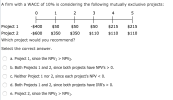 A firm with a WACC of 10% is considering the following mutually exclusive projects: 1 2 - 4 5 $50 $215 $215 Project 1 -$400 $50 $50 Project 2 -$600 $350 $350 Which project would you recommend? $110 $110 $110 Select the correct answer. O 10 10 O O a. Project 1, since the NPV1 > NPV2 b. Both Projects 1 and 2, since both projects have NPV's > 0. c. Neither Project 1 nor 2, since each project's NPV...
 Please help me solve 4-8
Use the following table to answer questions 1 – 6. The wacc is 10% for all projects in this table. Year Project A -1,000 1,000 Project B -1,000 300 400 500 600 Project C -1,000 550 450 350 250 Project D -1,000 600 800 1. Compute the Net Present Value (NPV), Internal Rate of Return (IRR), Profitability Index (PI), and Payback Period (PB) for each project: Project A Project B Project C Project D WACC...
Please help me solve 4-8
Use the following table to answer questions 1 – 6. The wacc is 10% for all projects in this table. Year Project A -1,000 1,000 Project B -1,000 300 400 500 600 Project C -1,000 550 450 350 250 Project D -1,000 600 800 1. Compute the Net Present Value (NPV), Internal Rate of Return (IRR), Profitability Index (PI), and Payback Period (PB) for each project: Project A Project B Project C Project D WACC...
 Please answer questions 10-15.
10) If you have $10,000 to invest and you evaluate two mutually exclusive projects each requiring $10,000 of capital and both have positive NPV's should you invest in both. 10b) Are these projects independent? 11) Define IRR. 12) A project has the following cash flow and WACC data. What is the project's IRR? WACC: 11.00% Year Cash flows 0 $1,000 1 $450 2 $450 3 $450 12b) What is the MIRR? 13) Calculate the IRR WACC:...
Please answer questions 10-15.
10) If you have $10,000 to invest and you evaluate two mutually exclusive projects each requiring $10,000 of capital and both have positive NPV's should you invest in both. 10b) Are these projects independent? 11) Define IRR. 12) A project has the following cash flow and WACC data. What is the project's IRR? WACC: 11.00% Year Cash flows 0 $1,000 1 $450 2 $450 3 $450 12b) What is the MIRR? 13) Calculate the IRR WACC:...
 13. Problem 12.13 (Unequal Lives) eBook Haley's Crockett Designs Inc. is considering two mutually exclusive projects. Both projects require an initial investment of $11,000 and are typical average-risk projects for the firm. Project A has an expected life of 2 years with after-tax cash inflows of $6,000 and $10,000 at the end of Years 1 and 2, respectively. Project B has an expected life of 4 years with after-tax cash inflows of $5,000 at the end of each of the...
 s. Understanding the NPV profile Aa Aa If an independent project with conventional, or normal, cash flows is being analyzed, the net present value (NPV) and internal rate of return (IRR) methods agree. Projects W and X are mutually exclusive projects. Their cash flows and NPV profiles are shown as follows. NPV (Dollars) Year Project W Project x 800 0 - $1,500 -$1,000 $200 $350 600 Project X 2 $350 $500 $400 $600 400 4 $600 $750 Project W 200...
 NPV and Uher nvestment CrNErTa For Problems 1-4, use a 5% discount rate and the following cash flows for projects A and B.: A: (-$2000, $500, $600, $700, $800) B: -$2000, $950, $850, $400, $300) 3. If A and B are mutually exclusive and the required rate of return is 5%, which should be ассеpted? 4. If the discount rate is 12%, and A and B are mutually exclusive, which project should be ассеpted? You can borrow $8,000, to be...
 If an independent project with conventional, or normal, cash flows is being analyzed, the net present value (NPV) and internal rate of return (IRR) methods agree. Projects W and X are mutually exclusive projects. Their cash flows and NPV profiles are shown as follows. NPV (Dollars) 800 0 -$1,00 Year Project W -$1,000 1 $200 2 $350 $400 $600 Project x -$1,500 $350 $500 $600 $750 Project X Project W If the weighted average cost of capital (WACC) for each...
 If the projects were independent, which project(s) would be
accepted according to the IRR method?
a) Neither
b) Project A
c) Project B
d) Both Projects A or B
If the projects were mutually exclusive, which project(s) would
be accepted according to the IRR method?
a) Neither
b) Project A
c) Project B
d) Both Projects A or B
The reason is
a) TheNPV and IRR approaches use the same reinvestment rate
assumption and so both approaches reach the same...
If the projects were independent, which project(s) would be
accepted according to the IRR method?
a) Neither
b) Project A
c) Project B
d) Both Projects A or B
If the projects were mutually exclusive, which project(s) would
be accepted according to the IRR method?
a) Neither
b) Project A
c) Project B
d) Both Projects A or B
The reason is
a) TheNPV and IRR approaches use the same reinvestment rate
assumption and so both approaches reach the same...
 KEY TERMS Define the following terms: a. Capital budgeting; strategic business plan b. Net present value (NPV) c. Internal rate of return (IRR) d. NPV profile; crossover rate e. Mutually exclusive projects; independent projects f. Nonnormal cash flows; normal cash flows; multiple IRRS g. Modified internal rate of return (MIRR) h. Payback period; discounted payback CAPITAL BUDGETING CRITERIA You must analyze two projects, X and Y. Each project costs $10,000, and the firm's WACC is 12%. The expected cash flows...
 A firm with a WACC of 10% is considering the following mutually exclusive projects: 1 2 - 4 5 $50 $215 $215 Project 1 -$400 $50 $50 Project 2 -$600 $350 $350 Which project would you recommend? $110 $110 $110 Select the correct answer. O 10 10 O O a. Project 1, since the NPV1 > NPV2 b. Both Projects 1 and 2, since both projects have NPV's > 0. c. Neither Project 1 nor 2, since each project's NPV...
Most questions answered within 3 hours.
-
Where is the error in this code sequence?
String s1 = "Hello";
String s2 = "ello";...
asked 10 months ago -
Financial data for Joel de Paris, Inc., for last year
follow:
Joel de Paris, Inc.
Balance...
asked 10 months ago -
Consider this reaction:
Al2(SO4)3 (aq)+ BaCl3
(aq) Al2Cl6 (aq)- +
3BaSO4(s) . What is the...
asked 10 months ago -
Suppose that Savneet is considering increasing her
recent random sample from 20 car rentals to 40...
asked 10 months ago -
Trucks arrive at an unloading terminal at an average rate of 120
per hour.
Trucks arrive...
asked 10 months ago -
Why are methanol and ethanol completely soluble in water while
octanol is not very little soluble....
asked 10 months ago -
A facilities manager at a university reads in a research report
that the mean amount of...
asked 10 months ago -
When the CuSO4 is rehydrated by adding water to the anhydrous
compound, is this an endothermic...
asked 10 months ago -
A ray of sunlight is passing from diamond into crown glass; the
angle of incidence is...
asked 10 months ago -
A block of mass 0.249 kg is placed on top of a light, vertical
spring of...
asked 10 months ago -
how do the kidneys compensate in the presences of acidosis
a) trigger hyperventilate
b) reserve acid...
asked 10 months ago -
Question 501 pts
The rental rate of capital to the firm increases. Which of the
following...
asked 10 months ago