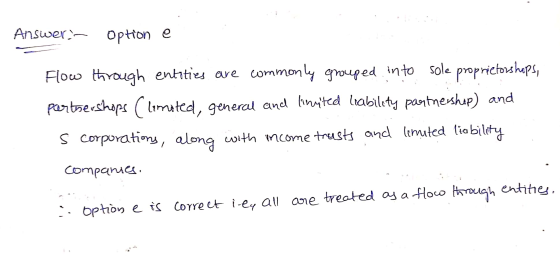
which of the following entities is not considered a foow-through entity? a. limited partnership b. s...
Homework Answers
Add Answer to:
which of the following entities is not considered a foow-through
entity?
a. limited partnership
b. s...
Which of the following entities is not considered a flow-through entity? Group of answer choices C...
Which of the following entities is not considered a flow-through entity? Group of answer choices C corporation. S corporation. Limited liability company (LLC). Partnership.
TB MC Qu. 04-46 Generally, which of the following... Generally, which of the following flow-through entities...
 TB MC Qu. 04-46 Generally, which of the following... Generally, which of the following flow-through entities can elect to be treated as a C corporation? Multiple Choice Limited partnership. Limited liability company. General partnership. All of these choices are correct.
Which legal entity is paired with the owner(s) that do not have limited liability for the entity’s debts? A. LLC - LLC m...
Which legal entity is paired with the owner(s) that do not have limited liability for the entity’s debts? A. LLC - LLC member-mangers B. Corporation – Shareholders C. General Partnership – Partner D. Limited Partnership - General partner E. Both Corporation - Corporation and Limited Partnership - General partner.
WHICH OF THE FOLLOWING ENTITIES IS REQUIRED TO FILE AN ELECTION TO TAKE ADVANTAGE OF PASS...
WHICH OF THE FOLLOWING ENTITIES IS REQUIRED TO FILE AN ELECTION TO TAKE ADVANTAGE OF PASS THROUGH TAX TREATMENT LIMITED LIABILITY COMPANY LIMITED LIABILITY LIMITED PARTNERSHIP LIMITED PARTNERSHIP S CORPORATION
how sole proprietorship different from other business entities? how LLC different from other business entities? how...
how sole proprietorship different from other business entities? how LLC different from other business entities? how general partnership different from other business entities? how limited partnership different from other business entities? how limited liability partnership different from other business entities? how limited liability limited partnership different from other business entities? how s-corporation different from other business entities? how c-corporation different from other business entities? how non profit corporation different from other business entities?
Compare the characteristics of a general partnership, limited partnership, regular C corporation, subchapter S corporation, and...
Compare the characteristics of a general partnership, limited partnership, regular C corporation, subchapter S corporation, and limited liability company on the issues of: (1) formation (what documents are needed to create each); (2) liability; and (3) taxation. What are retained earnings? How are they treated tax-wise? What types of business organization(s) can utilized the financial planning tool of retained earnings?
Jada is starting a restaurant. To limit her personal liability for the business's debts, Jada could...
Jada is starting a restaurant. To limit her personal liability for the business's debts, Jada could form a (a) corporation (b) limited liability company (c) general partnership (d) both choices (a) and (b) are correct (e) all of the above Barry Jones and Anne Smith co-own a bowling alley called "Lake City Lanes". No documents related to the formation or operation of the business has ever been filed in either the Country Clerk's Office or in the NYS Department of...
C corporations are not pass through entities like S corporations or LLC's. C corporations are subject...
C corporations are not pass through entities like S corporations or LLC's. C corporations are subject to the double taxation concept on corporate earnings. This is where corporate earnings are taxed at both the entity level and a second time when the earnings are distributed to shareholders in the form of dividends. Let's discuss this double taxation for a moment and put some numbers to it. Let's say that a C corporation has $1,000,000 in taxable income. Under the new...
Compare the characteristics of a general partnership, limited partnership, regular C corporation,...
Compare the characteristics of a general partnership, limited partnership, regular C corporation, subchapter S corporation, and limited liability company on the issues of: (1) formation (what documents are needed to create each); (2) liability; and (3) taxation. What are retained earnings? How are they treated tax-wise? What types of business organization(s) can utilized the financial planning tool of retained earnings?
1. Which of the following statements is true? A. An advantage of a partnership is limited...
1. Which of the following statements is true? A. An advantage of a partnership is limited life. B. An advantage to a partnership is unlimited liability. C. A disadvantage of a partnership is that it is difficult to transfer ownership. D. A disadvantage to a partnership is double taxation. 2. Which of the following statements is true? A. A disadvantage of a corporation is limited liability. B. An advantage of a corporation is double taxation. C. An advantage of a...
 TB MC Qu. 04-46 Generally, which of the following... Generally, which of the following flow-through entities can elect to be treated as a C corporation? Multiple Choice Limited partnership. Limited liability company. General partnership. All of these choices are correct.
Most questions answered within 3 hours.
-
Where is the error in this code sequence?
String s1 = "Hello";
String s2 = "ello";...
asked 11 months ago -
Financial data for Joel de Paris, Inc., for last year
follow:
Joel de Paris, Inc.
Balance...
asked 11 months ago -
Consider this reaction:
Al2(SO4)3 (aq)+ BaCl3
(aq) Al2Cl6 (aq)- +
3BaSO4(s) . What is the...
asked 11 months ago -
Suppose that Savneet is considering increasing her
recent random sample from 20 car rentals to 40...
asked 11 months ago -
Trucks arrive at an unloading terminal at an average rate of 120
per hour.
Trucks arrive...
asked 11 months ago -
Why are methanol and ethanol completely soluble in water while
octanol is not very little soluble....
asked 11 months ago -
A facilities manager at a university reads in a research report
that the mean amount of...
asked 11 months ago -
When the CuSO4 is rehydrated by adding water to the anhydrous
compound, is this an endothermic...
asked 11 months ago -
A ray of sunlight is passing from diamond into crown glass; the
angle of incidence is...
asked 11 months ago -
A block of mass 0.249 kg is placed on top of a light, vertical
spring of...
asked 11 months ago -
how do the kidneys compensate in the presences of acidosis
a) trigger hyperventilate
b) reserve acid...
asked 11 months ago -
Question 501 pts
The rental rate of capital to the firm increases. Which of the
following...
asked 11 months ago