Please help me answer the following questions given the data that I obtained, and please type your answer showing step by step calculations and formulas please
Experiment 2: Conservation of Heat Energy – Analysis and Discussion
Based on your experimental results, please answer the following questions:
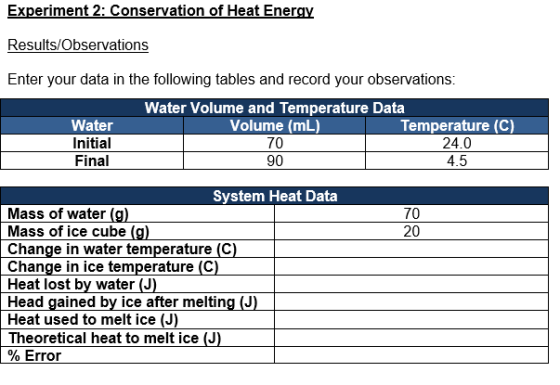
- Given the initial and final volumes of the experiment, determine the initial mass of the water and the mass of the ice cube. Show your work. Record your answer in the table above.
- Given the initial and final temperatures, calculate the change in temperature of the water and ice after it melted. Show your work. Record your answer in the table above.
- Calculate the heat lost by the water and gained by the ice cube after it melted. Show your work. Record your answer in the table above.
- Use the conservation of energy to determine the amount of heat energy that it took to melt the ice. Show your work. Record your answer in the table above.
- It takes 334 J of heat energy to melt 1 g of ice (this is called the latent heat of fusion). Use this to predict the amount of energy it should take to melt your ice cube. Show your work. Record your answer in the table above.
- Compare this theoretical value to the value you calculated in Post-Lab Question 3 with a percent error calculation. Show your work. Record your answer in the table above.
Homework Answers
Mass of water = 70 ml = 70 g
mass of ice = final volume of water - initial volume water = 90 - 70 = 20 mL or 20 g
---------------------------------------------------------------------------------------------------------------------------
Change in water temperature = final - initial = 4.5 - 24 = -19.5 oC
--------------------------------------------------------------------------------------------------------------
Heat lost by water
Q = 70 g * 4.18 J / g oC * ( -19.5)
Q = - 5705.7 J ( the negative sign tells us that heat is lost)
--------------------------------------------------------------------------------------
Heat gained by ice. ( You did not mention initial temperature of ice)
here is the formula to find the heat gained by ice
Q1 = mass of ice * 4.18 * ( Tfinal - Tinitial )
after this, amount of heat required to melt the ice (Q2)
Q + Q1 + Q2 = 0
you have Q, Q1, solve for Q2
Add Answer to:
Please help me answer the following questions given the data
that I obtained, and please type...
Can anyone tell me if my calculations are correct? Water Volume and Temperature Data Water Volume...
Can anyone tell me if my calculations are correct? Water Volume and Temperature Data Water Volume (mL) Temperature (C) Initial 70mL 28.0oC Final 95mL 2.0oC System Heat Data Mass of water (g) 70.0g Mass of ice cube (g) 23.0g Change in water temperature (C) 26.0Co Change in ice temperature (C) 2.0Co Heat lost by water (J) 7618.5J Heat gained by ice after melting (J) 95.827J Heat used to melt ice (J) 7522.7Jsigfig Theoretical heat to melt ice (J) 7656.9J sigfig...
PROCEDURE Use the 100 mL graduated cylinder to measure and pour 70 mL of room-temperature tap...
PROCEDURE Use the 100 mL graduated cylinder to measure and pour 70 mL of room-temperature tap water into a dry StyrofoamTM cup. Record the exact volume in Table 2 on the Experiment 1 Data Sheet. Place the filled cup inside the second cup to increase the insulation temperature. Place and hold the thermometer in the center of the water. Use a timer to time 30 seconds, then measure the initial temperature of the water (Figure 4). Record the value in...
Please help me solve the following 3 questions based upon the results that I obtained, please....
 Please help me solve the following 3 questions based upon the
results that I obtained, please. Provide formulas and step by step
calculations and your reasoning. Please type answer.
Experiment 3: Specific Heat Results/Observations Enter your data in the following table and record your observations Water Object Water AT Object AT Water I-Ti- Object Ti Object Mass Water Ti Test Object Steel bolt TI-Ti mass (9) (g) 27.0 15.5 21.0 5.5 21.215 Experiment 3: Specific He at- Analysis and Discussion...
Please help me solve the following 3 questions based upon the
results that I obtained, please. Provide formulas and step by step
calculations and your reasoning. Please type answer.
Experiment 3: Specific Heat Results/Observations Enter your data in the following table and record your observations Water Object Water AT Object AT Water I-Ti- Object Ti Object Mass Water Ti Test Object Steel bolt TI-Ti mass (9) (g) 27.0 15.5 21.0 5.5 21.215 Experiment 3: Specific He at- Analysis and Discussion...
PLEASE SHOW ALL YOUR WORK CLEARLY, AND EXPLAIN YOUR PROCESS. DATA: Initial mass of cup with...
PLEASE SHOW ALL YOUR WORK CLEARLY, AND EXPLAIN YOUR PROCESS. DATA: Initial mass of cup with water = 99.69 g Final mass of cup with water = 150.89 g Initial temperature of water = 41 °C Final temperature of water = 4.4 °C Analysis a) Determine the mass of the ice that has melted. b) Determine the variation of the water temperature (ΔT). c) Calculate the energy (in J) released by 100 g of water when it cooled by ΔT....
To cool her 0.200 kg cup of 75.0 C hot chocolate (mostly water), Heidi drops a...
To cool her 0.200 kg cup of 75.0 C hot chocolate (mostly water), Heidi drops a 29,.97 g ice cube at 0 C into her insulated cup. After the ice cube melts, the temperature of the hot chocolate comes down to 54.8 C. a. How much energy was lost by the hot chocolate? The specific heat capacity of water is 1 cal/g C b. How much energy was gained by the ice cube just to melt to 0 C water?...
1. Given the initial and final volumes of the experiment, determine the initial mass of the...
1. Given the initial and final volumes of the experiment, determine the initial mass of the water and the mass of the ice cube. Show your work. Record your answer in the table above. initial temp of water before ice 28 deg C final temp after ice cube melts 2 deg C initial volume 70mL final volume after ice melts 95mL mass of water = 70mL = 70mg = 0.07g using energy conservation Q = mw(cw)(delta T) How do i...
Initial mass of ice = 150.89 g Final mass of ice = 99.69 g Initial temperature...
Initial mass of ice = 150.89 g Final mass of ice = 99.69 g Initial temperature of water = 42 °C Final temperature of water = 0.4 °C Determine the mass of the ice that has melted. Determine the variation of the water temperature (ΔT). a) Calculate the energy (in J) released by 100 g of water when it cooled by ΔT. The specific heat capacity(c) of water is 4.18 J/(g°C). Use the formula Q = mcΔT and the mass...
Part C: Energy in Changes of State: CI. Mass of empty calorimeter cup with lid 6-835...
 Part C: Energy in Changes of State: CI. Mass of empty calorimeter cup with lid 6-835 107.15 C2. Mass of calorimeter with lid + water C3. Final water temperature Initial water temperature C4. Mass of calorimeter with lid + water + melted ice 135.648 Calculations: CS. Mass of water C6. Temperature change (AT) C7. Calories lost by water Calories used to melt ice C8. Mass of ice that melted C9. Heat of fusion (calories to melt 1 g of ice)...
Please help me thorough explanations, formulas, and step by step calculations, for the questions given my...
 Please help me thorough explanations, formulas, and step by step
calculations, for the questions given my results please.
The heat lost by the hot bolt is equal to the heat gained by
the water in the calorimeter. Use the equations provided in the
eScience manual and what you know about heat to solve for the
specific heat of the steel. Show your work.
What is the specific heat of steel from Table 1 in the eScience
manual? The specific heat...
Please help me thorough explanations, formulas, and step by step
calculations, for the questions given my results please.
The heat lost by the hot bolt is equal to the heat gained by
the water in the calorimeter. Use the equations provided in the
eScience manual and what you know about heat to solve for the
specific heat of the steel. Show your work.
What is the specific heat of steel from Table 1 in the eScience
manual? The specific heat...
how do I do the calculations? please be very detailed, thank you? Molar Heat of Fusion of Ice-Sample Worksheet Data:...
 how do I do the calculations? please be very detailed, thank
you?
Molar Heat of Fusion of Ice-Sample Worksheet Data: Mass of cup 5,50 g 155.50 g Mass of cup plus warm water 30.5 Initial temperature of "warm" water 0.0 C Initial temperature of ice 18.5 C Final temperature of the "mixture" 175.50 g Mass of cup plus "mixture" Results: Mass warm water Mass ice Temperature change of "warm" body Temperature change of "cool" body Heat energy lost by "warm"...
how do I do the calculations? please be very detailed, thank
you?
Molar Heat of Fusion of Ice-Sample Worksheet Data: Mass of cup 5,50 g 155.50 g Mass of cup plus warm water 30.5 Initial temperature of "warm" water 0.0 C Initial temperature of ice 18.5 C Final temperature of the "mixture" 175.50 g Mass of cup plus "mixture" Results: Mass warm water Mass ice Temperature change of "warm" body Temperature change of "cool" body Heat energy lost by "warm"...
 Please help me solve the following 3 questions based upon the
results that I obtained, please. Provide formulas and step by step
calculations and your reasoning. Please type answer.
Experiment 3: Specific Heat Results/Observations Enter your data in the following table and record your observations Water Object Water AT Object AT Water I-Ti- Object Ti Object Mass Water Ti Test Object Steel bolt TI-Ti mass (9) (g) 27.0 15.5 21.0 5.5 21.215 Experiment 3: Specific He at- Analysis and Discussion...
Please help me solve the following 3 questions based upon the
results that I obtained, please. Provide formulas and step by step
calculations and your reasoning. Please type answer.
Experiment 3: Specific Heat Results/Observations Enter your data in the following table and record your observations Water Object Water AT Object AT Water I-Ti- Object Ti Object Mass Water Ti Test Object Steel bolt TI-Ti mass (9) (g) 27.0 15.5 21.0 5.5 21.215 Experiment 3: Specific He at- Analysis and Discussion...
 Part C: Energy in Changes of State: CI. Mass of empty calorimeter cup with lid 6-835 107.15 C2. Mass of calorimeter with lid + water C3. Final water temperature Initial water temperature C4. Mass of calorimeter with lid + water + melted ice 135.648 Calculations: CS. Mass of water C6. Temperature change (AT) C7. Calories lost by water Calories used to melt ice C8. Mass of ice that melted C9. Heat of fusion (calories to melt 1 g of ice)...
 Please help me thorough explanations, formulas, and step by step
calculations, for the questions given my results please.
The heat lost by the hot bolt is equal to the heat gained by
the water in the calorimeter. Use the equations provided in the
eScience manual and what you know about heat to solve for the
specific heat of the steel. Show your work.
What is the specific heat of steel from Table 1 in the eScience
manual? The specific heat...
Please help me thorough explanations, formulas, and step by step
calculations, for the questions given my results please.
The heat lost by the hot bolt is equal to the heat gained by
the water in the calorimeter. Use the equations provided in the
eScience manual and what you know about heat to solve for the
specific heat of the steel. Show your work.
What is the specific heat of steel from Table 1 in the eScience
manual? The specific heat...
 how do I do the calculations? please be very detailed, thank
you?
Molar Heat of Fusion of Ice-Sample Worksheet Data: Mass of cup 5,50 g 155.50 g Mass of cup plus warm water 30.5 Initial temperature of "warm" water 0.0 C Initial temperature of ice 18.5 C Final temperature of the "mixture" 175.50 g Mass of cup plus "mixture" Results: Mass warm water Mass ice Temperature change of "warm" body Temperature change of "cool" body Heat energy lost by "warm"...
how do I do the calculations? please be very detailed, thank
you?
Molar Heat of Fusion of Ice-Sample Worksheet Data: Mass of cup 5,50 g 155.50 g Mass of cup plus warm water 30.5 Initial temperature of "warm" water 0.0 C Initial temperature of ice 18.5 C Final temperature of the "mixture" 175.50 g Mass of cup plus "mixture" Results: Mass warm water Mass ice Temperature change of "warm" body Temperature change of "cool" body Heat energy lost by "warm"...
Most questions answered within 3 hours.
-
Where is the error in this code sequence?
String s1 = "Hello";
String s2 = "ello";...
asked 10 months ago -
Financial data for Joel de Paris, Inc., for last year
follow:
Joel de Paris, Inc.
Balance...
asked 10 months ago -
Consider this reaction:
Al2(SO4)3 (aq)+ BaCl3
(aq) Al2Cl6 (aq)- +
3BaSO4(s) . What is the...
asked 10 months ago -
Suppose that Savneet is considering increasing her
recent random sample from 20 car rentals to 40...
asked 10 months ago -
Trucks arrive at an unloading terminal at an average rate of 120
per hour.
Trucks arrive...
asked 10 months ago -
Why are methanol and ethanol completely soluble in water while
octanol is not very little soluble....
asked 10 months ago -
A facilities manager at a university reads in a research report
that the mean amount of...
asked 10 months ago -
When the CuSO4 is rehydrated by adding water to the anhydrous
compound, is this an endothermic...
asked 10 months ago -
A ray of sunlight is passing from diamond into crown glass; the
angle of incidence is...
asked 10 months ago -
A block of mass 0.249 kg is placed on top of a light, vertical
spring of...
asked 10 months ago -
how do the kidneys compensate in the presences of acidosis
a) trigger hyperventilate
b) reserve acid...
asked 10 months ago -
Question 501 pts
The rental rate of capital to the firm increases. Which of the
following...
asked 10 months ago