PROCEDURE Use the 100 mL graduated cylinder to measure and pour 70 mL of room-temperature tap...
PROCEDURE
-
Use the 100 mL graduated cylinder to measure and pour 70 mL of room-temperature tap water into a dry StyrofoamTM cup. Record the exact volume in Table 2 on the Experiment 1 Data Sheet.
-
Place the filled cup inside the second cup to increase the insulation temperature.
-
Place and hold the thermometer in the center of the water. Use a timer to time 30 seconds, then measure the initial temperature of the water (Figure 4). Record the value in Table 2 on the
Data Sheet.
-
Place one ice cube on a surface or in a sink, and allow it to start melting. As soon as it starts to melt, wipe off the excess water with a paper towel and place the ice cube in the filled cup.
-
Gently and continuously stir the contents with the thermometer until all of the ice melts.
-
Once the ice completely melts, use the timer to monitor the temperature for 2 minutes. After 2 minutes, record the final temperature of the water in Table 2 on the Data Sheet.
-
Remove the thermometer, and carefully pour the water back into the 100 mL graduated cylinder. Measure and record the final volume in Table 2 on the Data Sheet.
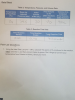
Water:
Initial Temperature- 21 degrees C
Final Temperature- 2 degrees C
Initial Volume- 70 mL
Final Volume- 95 mL
With this information... fill out the table below:
(Instructions on how to do so please!)
|
Mass of water (g) = |
|
|
Change in Water Temperature (ΔoC) = |
|
|
Heat Lost by Water (J) = |
|
|
Mass of Ice Cube (g) = |
|
|
Change in Ice Temperature (ΔoC) = |
|
|
Heat Gained by Ice After Melted (J) = |
|
|
Heat Used to Melt Ice (J) = |
|
|
Theoretical Heat to Melt Ice (J) = |
|
|
% Error = |
Homework Answers


If you still have any query feel free to ask in the comments. If you like my work please give me a Thumbs up.
Add Answer to:
PROCEDURE
Use the 100 mL graduated cylinder to measure and pour 70 mL of
room-temperature tap...
Fill the graduated cylinder with hot tap water and let stand for one minute. Pour water into the sink. Measure 70 mL of...
Fill the graduated cylinder with hot tap water and let stand for one minute. Pour water into the sink. Measure 70 mL of hot water. Pour the water into the foam cup. Measure the temperature of the water. Add an ice cube to the cup of water. Gently swirl the cup. Measure the temperature of the water as soon as the ice cube has completely melted. Pour the water into the graduated cylinder and measure the volume. The initial temperature...
Fill the graduated cylinder with hot tap water and let stand for one minute. Pour water...
Fill the graduated cylinder with hot tap water and let stand for one minute. Pour water into the sink. Measure 70 mL of hot water. Pour the water into the foam cup. Measure the temperature of the water. Add an ice cube to the cup of water. Gently swirl the cup. Measure the temperature of the water as soon as the ice cube has completely melted. Pour the water into the graduated cylinder and measure the volume. The initial temperature...
Use the 100 mL graduated cylinder to measure and pour 50 mL of distilled water into Beaker 1. Use the 100 mL graduated c...
Use the 100 mL graduated cylinder to measure and pour 50 mL of distilled water into Beaker 1. Use the 100 mL graduated cylinder to measure and pour 48 mL of distilled water into Beaker 2. Use the 10 mL gradated cylinder to measure and pour 1 mL of saturated sodium bicarbonate solution into Beaker 1. Then, add 2 drops of phenol red to Beaker 1. Gently mix the solution. Use the straw to blow bubbles into Beaker 1. Start...
Can anyone tell me if my calculations are correct? Water Volume and Temperature Data Water Volume...
Can anyone tell me if my calculations are correct? Water Volume and Temperature Data Water Volume (mL) Temperature (C) Initial 70mL 28.0oC Final 95mL 2.0oC System Heat Data Mass of water (g) 70.0g Mass of ice cube (g) 23.0g Change in water temperature (C) 26.0Co Change in ice temperature (C) 2.0Co Heat lost by water (J) 7618.5J Heat gained by ice after melting (J) 95.827J Heat used to melt ice (J) 7522.7Jsigfig Theoretical heat to melt ice (J) 7656.9J sigfig...
Please help me answer the following questions given the data that I obtained, and please type...
 Please help me answer the following questions given the data
that I obtained, and please type your answer showing step by step
calculations and formulas please
Experiment 2: Conservation of Heat Energy – Analysis and
Discussion
Based on your experimental results, please answer the
following questions:
Given the initial and final volumes of the experiment,
determine the initial mass of the water and the mass of the ice
cube. Show your work. Record your answer in the table above.
Given...
Please help me answer the following questions given the data
that I obtained, and please type your answer showing step by step
calculations and formulas please
Experiment 2: Conservation of Heat Energy – Analysis and
Discussion
Based on your experimental results, please answer the
following questions:
Given the initial and final volumes of the experiment,
determine the initial mass of the water and the mass of the ice
cube. Show your work. Record your answer in the table above.
Given...
Materials 10 mL Vegetable Oil "Water Labware 10 mL Graduated Cylinder 100 mL Graduated Cylinder N...
 thanks
Materials 10 mL Vegetable Oil "Water Labware 10 mL Graduated Cylinder 100 mL Graduated Cylinder Note: You must provide the materials listed in red. EXPERIMENT 1: ECOLOGICAL INTERACTIONS In this experiment, you will demonstrate how substances accumulate in trophic levels through biomagnification PROCEDURE 9 mL of water into the 10 ml graduated cylinder. The graduated cylinder represents a primary producer. □ 2. Add 1 mL f oil to the 10 ml graduated cylinder containing the water. Note that the...
thanks
Materials 10 mL Vegetable Oil "Water Labware 10 mL Graduated Cylinder 100 mL Graduated Cylinder Note: You must provide the materials listed in red. EXPERIMENT 1: ECOLOGICAL INTERACTIONS In this experiment, you will demonstrate how substances accumulate in trophic levels through biomagnification PROCEDURE 9 mL of water into the 10 ml graduated cylinder. The graduated cylinder represents a primary producer. □ 2. Add 1 mL f oil to the 10 ml graduated cylinder containing the water. Note that the...
One practical way is suggested to measure the heat of melting for ice. Place a block...
One practical way is suggested to measure the heat of melting for ice. Place a block of ice of mass mi initially at temperature Tice,i=0∘C into water of mass mw and initial temperature Tw. Let the ice melt, and the ice water and the water come to thermal equilibrium with final temperature Tf. Assuming no energy loss to the environment find the heat of melting. Express your answer in terms of specific heat of water cw, mw, Tw, Tf, and...
fill in the blanks in the tables first run (100 mL water) second run (70 mL...
fill in the blanks in the tables first run (100 mL water) second run (70 mL water) third run (50 mL water) mass of MgSO4 (g) 8 8 8 volume of water (mL) 100 70 50 mass of final soln (g) 108.2553 77.9995 59.5059 TI, initial temperature of water (°C) 25 25 25 TF, final temperature of water (°C) 38.5 44.3 52.0 ∆T (°C) +13.5 +19.3 +27 heat absorbed by the solution (J) heat produced by the reaction (J) ∆Hrxn...
ACTIVITY ACTIVITY 2 A Determining the Densities of Solutions 1. Weigh an empty 50-ml graduated cylinder....
 ACTIVITY ACTIVITY 2 A Determining the Densities of Solutions 1. Weigh an empty 50-ml graduated cylinder. Record the mass in Data Table 2. 2. Add 5 mL of water (0% sucrose) to the 50-ml graduated cylinder. Use the pipet to add or remove small quantities of liquid so that the water is exactly at the 5-mL mark. 3. Record the Mass of Solution + Graduated Cylinder in Data Table 2. 4. Add more water until the cylinder contains 10 mL...
Data Sheet Table 2: Temperature, Pressure, and Volume Data Temperature of Tap Water (°C) Room (or...
 Data Sheet Table 2: Temperature, Pressure, and Volume Data Temperature of Tap Water (°C) Room (or regional) Pressure (atm) Initial Volume of Air (mL) Final Volume of Air (after reaction) (mL) Volume of O2 Collected (Final Volume - Initial Volume) 24 29.5 TO 40mL Table 3: Reaction Time Data Time Reaction Started Time Reaction Ended Total Reaction Time 0,00 0.40 40 SECONDS Post-Lab Questions 1. Using the Ideal Gas Law (PV = nRT), calculate the grams of Oz produced in...
 Please help me answer the following questions given the data
that I obtained, and please type your answer showing step by step
calculations and formulas please
Experiment 2: Conservation of Heat Energy – Analysis and
Discussion
Based on your experimental results, please answer the
following questions:
Given the initial and final volumes of the experiment,
determine the initial mass of the water and the mass of the ice
cube. Show your work. Record your answer in the table above.
Given...
Please help me answer the following questions given the data
that I obtained, and please type your answer showing step by step
calculations and formulas please
Experiment 2: Conservation of Heat Energy – Analysis and
Discussion
Based on your experimental results, please answer the
following questions:
Given the initial and final volumes of the experiment,
determine the initial mass of the water and the mass of the ice
cube. Show your work. Record your answer in the table above.
Given...
 thanks
Materials 10 mL Vegetable Oil "Water Labware 10 mL Graduated Cylinder 100 mL Graduated Cylinder Note: You must provide the materials listed in red. EXPERIMENT 1: ECOLOGICAL INTERACTIONS In this experiment, you will demonstrate how substances accumulate in trophic levels through biomagnification PROCEDURE 9 mL of water into the 10 ml graduated cylinder. The graduated cylinder represents a primary producer. □ 2. Add 1 mL f oil to the 10 ml graduated cylinder containing the water. Note that the...
thanks
Materials 10 mL Vegetable Oil "Water Labware 10 mL Graduated Cylinder 100 mL Graduated Cylinder Note: You must provide the materials listed in red. EXPERIMENT 1: ECOLOGICAL INTERACTIONS In this experiment, you will demonstrate how substances accumulate in trophic levels through biomagnification PROCEDURE 9 mL of water into the 10 ml graduated cylinder. The graduated cylinder represents a primary producer. □ 2. Add 1 mL f oil to the 10 ml graduated cylinder containing the water. Note that the...
 ACTIVITY ACTIVITY 2 A Determining the Densities of Solutions 1. Weigh an empty 50-ml graduated cylinder. Record the mass in Data Table 2. 2. Add 5 mL of water (0% sucrose) to the 50-ml graduated cylinder. Use the pipet to add or remove small quantities of liquid so that the water is exactly at the 5-mL mark. 3. Record the Mass of Solution + Graduated Cylinder in Data Table 2. 4. Add more water until the cylinder contains 10 mL...
 Data Sheet Table 2: Temperature, Pressure, and Volume Data Temperature of Tap Water (°C) Room (or regional) Pressure (atm) Initial Volume of Air (mL) Final Volume of Air (after reaction) (mL) Volume of O2 Collected (Final Volume - Initial Volume) 24 29.5 TO 40mL Table 3: Reaction Time Data Time Reaction Started Time Reaction Ended Total Reaction Time 0,00 0.40 40 SECONDS Post-Lab Questions 1. Using the Ideal Gas Law (PV = nRT), calculate the grams of Oz produced in...
Most questions answered within 3 hours.
-
Where is the error in this code sequence?
String s1 = "Hello";
String s2 = "ello";...
asked 11 months ago -
Financial data for Joel de Paris, Inc., for last year
follow:
Joel de Paris, Inc.
Balance...
asked 11 months ago -
Consider this reaction:
Al2(SO4)3 (aq)+ BaCl3
(aq) Al2Cl6 (aq)- +
3BaSO4(s) . What is the...
asked 11 months ago -
Suppose that Savneet is considering increasing her
recent random sample from 20 car rentals to 40...
asked 11 months ago -
Trucks arrive at an unloading terminal at an average rate of 120
per hour.
Trucks arrive...
asked 11 months ago -
Why are methanol and ethanol completely soluble in water while
octanol is not very little soluble....
asked 11 months ago -
A facilities manager at a university reads in a research report
that the mean amount of...
asked 11 months ago -
When the CuSO4 is rehydrated by adding water to the anhydrous
compound, is this an endothermic...
asked 11 months ago -
A ray of sunlight is passing from diamond into crown glass; the
angle of incidence is...
asked 11 months ago -
A block of mass 0.249 kg is placed on top of a light, vertical
spring of...
asked 11 months ago -
how do the kidneys compensate in the presences of acidosis
a) trigger hyperventilate
b) reserve acid...
asked 11 months ago -
Question 501 pts
The rental rate of capital to the firm increases. Which of the
following...
asked 11 months ago