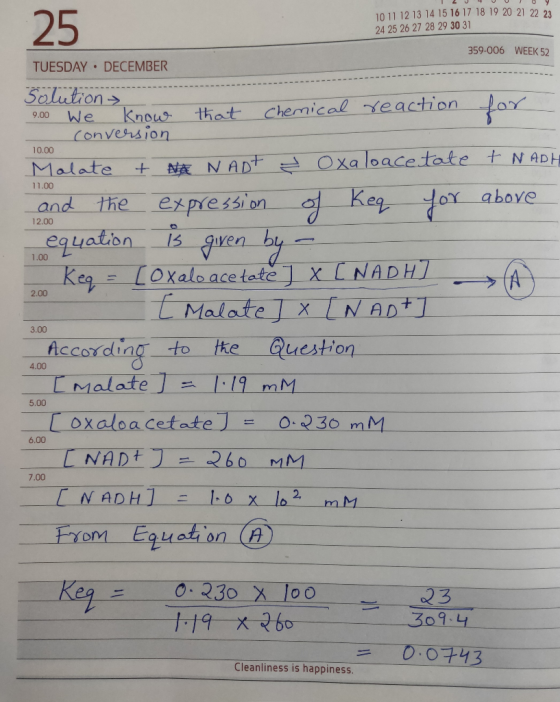
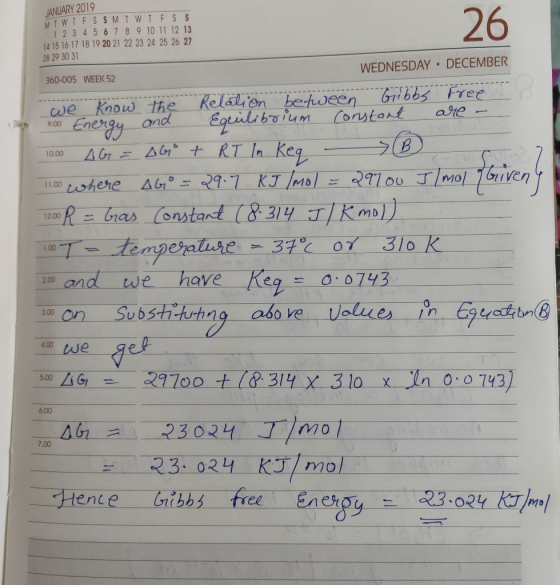
Consider the malate dehydrogenase reaction from the citric acid cycle. Given the listed concentrations, calculate the free energy change for this reaction at energy change for this reaction at 37.0 ∘ C (310 K). Δ G ∘ ′ for the reaction is + 29.7 kJ/mol . Assume that the reaction occurs at pH 7.

thank you
Homework Answers
Add Answer to:
Consider the malate dehydrogenase reaction from the citric acid
cycle. Given the listed concentrations, calculate the...
Consider the malate dehydrogenase reaction from the citric acid cycle. Given the listed concentrations, calculate the...
 Consider the malate dehydrogenase reaction from the citric acid cycle. Given the listed concentrations, calculate the free energy change for this reaction at energy change for this reaction at 37.0°C (310 K), AG'' for the reaction is +29.7 kJ/mol. Assume that the reaction occurs at pH 7. (malate) = 1.33 mm [oxaloacetate] = 0.200 mm [NAD) - 440 mm [NADH) - 180 mM AG: 36.9 KJ-mol-
Consider the malate dehydrogenase reaction from the citric acid cycle. Given the listed concentrations, calculate the...
 Consider the malate dehydrogenase reaction from the citric acid cycle. Given the listed concentrations, calculate the free energy change for this reaction at energy change for this reaction at 37.0°C (310 K). AG' for the reaction is +29.7 kJ/mol. Assume that the reaction occurs at pH 7. [malate) = 1.43 mm [oxaloacetate) = 0.150 mM [NAD+] = 220 mm [NADH] = 88 mm kJ.mol-1 AG:
The reaction catalyzed by malate dehydrogenase, Malate + NAD+ → oxaloacetate + NADH + H+ has...
The reaction catalyzed by malate dehydrogenase, Malate + NAD+ → oxaloacetate + NADH + H+ has a ΔG°′ value of +29.7 kJ · mol−1. (a) Would this reaction occur spontaneously in a cell? (b) How does the citrate synthase reaction (described in Problem 7) promote the malate dehydrogenase reac- tion in the cell? What is the overall change in free energy for the two reactions? 7. Citrate synthase catalyzes the reaction Oxaloacetate + acetyl-CoA → citrate + HS-CoA The standard...
In the citric acid cycle, malate is dehydrogenated to oxaloacetate in a highly endergonic reaction with...
In the citric acid cycle, malate is dehydrogenated to oxaloacetate in a highly endergonic reaction with a ΔG’o of +30 kJ mol-1: L‐malate + NAD+ ⇌ oxaloacetate + NADH + H+ A. Calculate the equilibrium constant K’eq of this reaction. What is the implication of this result? B. Let us suppose that you have gathered two sets of data concerning the malate dehydrogenase reaction: (a) From one set of data obtained from three different model systems (rat, mouse and pig)...
QUESTION 8 Consider the reaction: Malate + NAD → Oxaloacetate + NADH (AG'º = +29.7 kJ/mol)...
 QUESTION 8 Consider the reaction: Malate + NAD → Oxaloacetate + NADH (AG'º = +29.7 kJ/mol) A cell at 25°C has the following concentrations of these compounds: malate = 0.5 mm oxaloacetate=0.00002 mM • NAD = 1 mM NADH = 0.04 mm . Is the reaction spontaneous? QUESTION 9 Consider the reaction: 1,3-Bisphosphoglycerate (1,3-BPG) + ADP→ 3-Phosphoglycerate (3-PG) + ATP (AG' = -18.9 kJ/mol) A cell at 25°C has the following concentrations of these compounds: 1,3-BPG = 0.003 Mm ADP...
Draw the product of the citric acid cycle reaction for which malate is a reactant. Be...
Draw the product of the citric acid cycle reaction for which malate is a reactant. Be sure to include charge on atoms at At pH 7
Consider the fructose-1,6-bisphosphatase reaction. Calculate the free energy change if the ratio of the concentrations of...
 Consider the fructose-1,6-bisphosphatase reaction. Calculate the free energy change if the ratio of the concentrations of the products to the concentrations of the reactants is 20.9 and the temperature is 37.0 °C? AG'for the reaction is -16.7 kJ/mol. AG= AG= kJ/mol
3. The Key for the reaction catalyzed by malate dehydrogenase is 5.45 x 10⁻⁶. What is...
 3. The Key for the reaction catalyzed by malate dehydrogenase is 5.45 x 10⁻⁶. What is the standard state free energy change (AG) for this reaction at 25°C? 4. For the oxidation of succinate to fumarate in the TCA Cycle, the change in standard reduction potential (A£.') is -0.03V. What is standard state free energy change (AG) for this reaction? Round your answer to one decimal place.
not sure about reaction 3 and 4 acetyl-CoA COA The reactions of the citric acid cycle...
 not sure about reaction 3 and 4
acetyl-CoA COA The reactions of the citric acid cycle are shown in the figure Reactions 1, 3, and 4 are regulation points in the citric acid cycle. 1 citrate oxaloacetate 1 synthase citrate NADH + NAD malate dehydrogenase aconitase 2 malate Which of the molecules inhibits reaction 1? Isocitrate HO 17 fumarase NAD socitrate 3 dehydrogenase S D NADP ADP ОАТР O citrate synthase fumarate FADHI succinate co-ketoglutarate dehydrogenase ci-ketoglutarate NAD dehydrogenase +...
not sure about reaction 3 and 4
acetyl-CoA COA The reactions of the citric acid cycle are shown in the figure Reactions 1, 3, and 4 are regulation points in the citric acid cycle. 1 citrate oxaloacetate 1 synthase citrate NADH + NAD malate dehydrogenase aconitase 2 malate Which of the molecules inhibits reaction 1? Isocitrate HO 17 fumarase NAD socitrate 3 dehydrogenase S D NADP ADP ОАТР O citrate synthase fumarate FADHI succinate co-ketoglutarate dehydrogenase ci-ketoglutarate NAD dehydrogenase +...
Electron transport chain. The enzyme succinate dehydrogenase is part of the citric acid cycle (Fig. 17.15)...
Electron transport chain. The enzyme succinate dehydrogenase is part of the citric acid cycle (Fig. 17.15) and the electron transport chain (Fig. 18.6). Calculate the free energy (ΔG) of the reaction catalyzed by succinate dehydrogenase under physiological conditions: 2 mM succinate, 0.5 mM fumarate, 2 mM FAD, and 0.2 mM FADH2. [Recall that ΔG = -n F ΔEo. See Table 18.1 for the relevant standard reduction potential (ΔEo).]
 Consider the malate dehydrogenase reaction from the citric acid cycle. Given the listed concentrations, calculate the free energy change for this reaction at energy change for this reaction at 37.0°C (310 K), AG'' for the reaction is +29.7 kJ/mol. Assume that the reaction occurs at pH 7. (malate) = 1.33 mm [oxaloacetate] = 0.200 mm [NAD) - 440 mm [NADH) - 180 mM AG: 36.9 KJ-mol-
 Consider the malate dehydrogenase reaction from the citric acid cycle. Given the listed concentrations, calculate the free energy change for this reaction at energy change for this reaction at 37.0°C (310 K). AG' for the reaction is +29.7 kJ/mol. Assume that the reaction occurs at pH 7. [malate) = 1.43 mm [oxaloacetate) = 0.150 mM [NAD+] = 220 mm [NADH] = 88 mm kJ.mol-1 AG:
 QUESTION 8 Consider the reaction: Malate + NAD → Oxaloacetate + NADH (AG'º = +29.7 kJ/mol) A cell at 25°C has the following concentrations of these compounds: malate = 0.5 mm oxaloacetate=0.00002 mM • NAD = 1 mM NADH = 0.04 mm . Is the reaction spontaneous? QUESTION 9 Consider the reaction: 1,3-Bisphosphoglycerate (1,3-BPG) + ADP→ 3-Phosphoglycerate (3-PG) + ATP (AG' = -18.9 kJ/mol) A cell at 25°C has the following concentrations of these compounds: 1,3-BPG = 0.003 Mm ADP...
 Consider the fructose-1,6-bisphosphatase reaction. Calculate the free energy change if the ratio of the concentrations of the products to the concentrations of the reactants is 20.9 and the temperature is 37.0 °C? AG'for the reaction is -16.7 kJ/mol. AG= AG= kJ/mol
 3. The Key for the reaction catalyzed by malate dehydrogenase is 5.45 x 10⁻⁶. What is the standard state free energy change (AG) for this reaction at 25°C? 4. For the oxidation of succinate to fumarate in the TCA Cycle, the change in standard reduction potential (A£.') is -0.03V. What is standard state free energy change (AG) for this reaction? Round your answer to one decimal place.
 not sure about reaction 3 and 4
acetyl-CoA COA The reactions of the citric acid cycle are shown in the figure Reactions 1, 3, and 4 are regulation points in the citric acid cycle. 1 citrate oxaloacetate 1 synthase citrate NADH + NAD malate dehydrogenase aconitase 2 malate Which of the molecules inhibits reaction 1? Isocitrate HO 17 fumarase NAD socitrate 3 dehydrogenase S D NADP ADP ОАТР O citrate synthase fumarate FADHI succinate co-ketoglutarate dehydrogenase ci-ketoglutarate NAD dehydrogenase +...
not sure about reaction 3 and 4
acetyl-CoA COA The reactions of the citric acid cycle are shown in the figure Reactions 1, 3, and 4 are regulation points in the citric acid cycle. 1 citrate oxaloacetate 1 synthase citrate NADH + NAD malate dehydrogenase aconitase 2 malate Which of the molecules inhibits reaction 1? Isocitrate HO 17 fumarase NAD socitrate 3 dehydrogenase S D NADP ADP ОАТР O citrate synthase fumarate FADHI succinate co-ketoglutarate dehydrogenase ci-ketoglutarate NAD dehydrogenase +...
Most questions answered within 3 hours.
-
Where is the error in this code sequence?
String s1 = "Hello";
String s2 = "ello";...
asked 10 months ago -
Financial data for Joel de Paris, Inc., for last year
follow:
Joel de Paris, Inc.
Balance...
asked 10 months ago -
Consider this reaction:
Al2(SO4)3 (aq)+ BaCl3
(aq) Al2Cl6 (aq)- +
3BaSO4(s) . What is the...
asked 10 months ago -
Suppose that Savneet is considering increasing her
recent random sample from 20 car rentals to 40...
asked 10 months ago -
Trucks arrive at an unloading terminal at an average rate of 120
per hour.
Trucks arrive...
asked 10 months ago -
Why are methanol and ethanol completely soluble in water while
octanol is not very little soluble....
asked 10 months ago -
A facilities manager at a university reads in a research report
that the mean amount of...
asked 10 months ago -
When the CuSO4 is rehydrated by adding water to the anhydrous
compound, is this an endothermic...
asked 10 months ago -
A ray of sunlight is passing from diamond into crown glass; the
angle of incidence is...
asked 10 months ago -
A block of mass 0.249 kg is placed on top of a light, vertical
spring of...
asked 10 months ago -
how do the kidneys compensate in the presences of acidosis
a) trigger hyperventilate
b) reserve acid...
asked 10 months ago -
Question 501 pts
The rental rate of capital to the firm increases. Which of the
following...
asked 10 months ago