
Homework Answers
Teratogens are the agents that cross the placenta and cause permanent functional and structural alteration for an organism in the fetal or embryonic stage
The option Teratogens is a correct answer.
Add Answer to:
Which of the following is not a genetic disorder? O Sickle Cell Disease O Tays Sachs...
QUESTION 4 Which of the following is a dominant disorder? sickle-cell disease PKU Huntington's disease cystic...
QUESTION 4 Which of the following is a dominant disorder? sickle-cell disease PKU Huntington's disease cystic fibrosis 2 points QUESTION 5 Nucleotides are the building blocks of cells both DNA and RNA RNA only DNA only 2 points QUESTION 6 The anitcodon is found on mRNA rRNA miRNA tRNA
Map a nursing care plan/clinical pathway for a patient with a specific genetic disorder (e.g., sickle...
Map a nursing care plan/clinical pathway for a patient with a specific genetic disorder (e.g., sickle cell disease, hemophilia, cystic fibrosis, Huntington disease). Prepare to discuss your care plan and rationales following a minimum of three nursing diagnosis for the disease specified.
Question 7 0/0.5 Which of the following genetic disorders involves entire chromosomes? Cystic Fibrosis Huntington's Disease...
 Question 7 0/0.5 Which of the following genetic disorders involves entire chromosomes? Cystic Fibrosis Huntington's Disease Sickle Cell Disease Down Syndrome Phenylketonuria
please help 6. How can a missense mutation-such as in sickle cell disease-result in a protein...
 please help
6. How can a missense mutation-such as in sickle cell disease-result in a protein that has an abnormal structure? Some of these mutations are lethal or cause serious disease, such as cystic fibrosis and sickle cell disease. Many of these point mutations that cause genetic disorders occur as a result of errors in DNA replication or crossing over. 7. What will be the consequence if a single base is deleted from the coding region of a gene?
please help
6. How can a missense mutation-such as in sickle cell disease-result in a protein that has an abnormal structure? Some of these mutations are lethal or cause serious disease, such as cystic fibrosis and sickle cell disease. Many of these point mutations that cause genetic disorders occur as a result of errors in DNA replication or crossing over. 7. What will be the consequence if a single base is deleted from the coding region of a gene?
6.Tay-Sachs disease is an autosomal recessive disorder that causes degeneration of nerve tissue in infants. Infants...
6.Tay-Sachs disease is an autosomal recessive disorder that causes degeneration of nerve tissue in infants. Infants with Tay-Sachs disease develop blindness, paralysis, and die at an early age. The gene for this disorder is located on chromosome 15. Sickle cell anemia is another autosomal recessive disorder. A person who is homozygous recessive for the sickle cell allele will have an abnormal hemoglobin protein which causes the red blood cells to have a sickle shape. The misshapen blood cells block capillaries...
classify the genetic disorder as single-gene or Chromosomal Huntington Disease Duchenne Muscular Distrophy Down Syn...
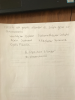 classify the genetic disorder as single-gene or Chromosomal Huntington Disease Duchenne Muscular Distrophy Down Syndrome Klinefelter syndrome Cystic Fibrosis A single-Gene disorder B. Chromosomal
3. Sickle-cell disease is a genetic condition caused by an autosomal recessive allele which al- fects...
 3. Sickle-cell disease is a genetic condition caused by an autosomal recessive allele which al- fects one in every 500 African American children born in the U.S. One in every ten African Americans is a carrier for the recessive allels. Although sickle cell disease is caused by a single human gene, it is expressed through many different effects throughout the body. The presence of a recessive sickle-cell allele in humans causes the red blood cells to produce abnormal hemoglobin protein...
2. Tay-Sachs disease is a genetic disorder caused by a mutation on chromosome 15 that is believed...
 Conditional probability
please follow the comment
2. Tay-Sachs disease is a genetic disorder caused by a mutation on chromosome 15 that is believed to occur in roughly 1 in 320000 babies in the U.S. As part of a cutting-edge genomics company, you've designed a new test for Tay-Sachs that is 99.2% accurate (ie, gives a positive result) in those babies that have the disorder, and 97% accurate (i.e. gives a negative result) in babies that don't have the disorder. Suppose...
Conditional probability
please follow the comment
2. Tay-Sachs disease is a genetic disorder caused by a mutation on chromosome 15 that is believed to occur in roughly 1 in 320000 babies in the U.S. As part of a cutting-edge genomics company, you've designed a new test for Tay-Sachs that is 99.2% accurate (ie, gives a positive result) in those babies that have the disorder, and 97% accurate (i.e. gives a negative result) in babies that don't have the disorder. Suppose...
Question 12 1 pts Which of the following incorrectly identifies the mode of inheritance for the...
 Question 12 1 pts Which of the following incorrectly identifies the mode of inheritance for the given genetic disease? Sickle cell disease - autosomal recessive O Cystic fibrosis - autosomal recessive O Huntington disease - autosowdal dominant 0 Thalassemia - autosomal recessive Hereditary hemochromatosis - autosomal dominant
Sickle cell anemia is a genetic disorder that causes red blood cells to take on an...
Sickle cell anemia is a genetic disorder that causes red blood cells to take on an abnormal, crescent shape. This inherited disorder is the result of a single base change from A to T. This changes the amino acid glutamic acid to valine at position six of the hemoglobin protein. Based on this information, sickle cell anemia results from a(n) ________ mutation. substitution mutation deletion mutation insertion mutation silent mutation
 Question 7 0/0.5 Which of the following genetic disorders involves entire chromosomes? Cystic Fibrosis Huntington's Disease Sickle Cell Disease Down Syndrome Phenylketonuria
 please help
6. How can a missense mutation-such as in sickle cell disease-result in a protein that has an abnormal structure? Some of these mutations are lethal or cause serious disease, such as cystic fibrosis and sickle cell disease. Many of these point mutations that cause genetic disorders occur as a result of errors in DNA replication or crossing over. 7. What will be the consequence if a single base is deleted from the coding region of a gene?
please help
6. How can a missense mutation-such as in sickle cell disease-result in a protein that has an abnormal structure? Some of these mutations are lethal or cause serious disease, such as cystic fibrosis and sickle cell disease. Many of these point mutations that cause genetic disorders occur as a result of errors in DNA replication or crossing over. 7. What will be the consequence if a single base is deleted from the coding region of a gene?
 classify the genetic disorder as single-gene or Chromosomal Huntington Disease Duchenne Muscular Distrophy Down Syndrome Klinefelter syndrome Cystic Fibrosis A single-Gene disorder B. Chromosomal
 3. Sickle-cell disease is a genetic condition caused by an autosomal recessive allele which al- fects one in every 500 African American children born in the U.S. One in every ten African Americans is a carrier for the recessive allels. Although sickle cell disease is caused by a single human gene, it is expressed through many different effects throughout the body. The presence of a recessive sickle-cell allele in humans causes the red blood cells to produce abnormal hemoglobin protein...
 Conditional probability
please follow the comment
2. Tay-Sachs disease is a genetic disorder caused by a mutation on chromosome 15 that is believed to occur in roughly 1 in 320000 babies in the U.S. As part of a cutting-edge genomics company, you've designed a new test for Tay-Sachs that is 99.2% accurate (ie, gives a positive result) in those babies that have the disorder, and 97% accurate (i.e. gives a negative result) in babies that don't have the disorder. Suppose...
Conditional probability
please follow the comment
2. Tay-Sachs disease is a genetic disorder caused by a mutation on chromosome 15 that is believed to occur in roughly 1 in 320000 babies in the U.S. As part of a cutting-edge genomics company, you've designed a new test for Tay-Sachs that is 99.2% accurate (ie, gives a positive result) in those babies that have the disorder, and 97% accurate (i.e. gives a negative result) in babies that don't have the disorder. Suppose...
 Question 12 1 pts Which of the following incorrectly identifies the mode of inheritance for the given genetic disease? Sickle cell disease - autosomal recessive O Cystic fibrosis - autosomal recessive O Huntington disease - autosowdal dominant 0 Thalassemia - autosomal recessive Hereditary hemochromatosis - autosomal dominant
Most questions answered within 3 hours.
-
Where is the error in this code sequence?
String s1 = "Hello";
String s2 = "ello";...
asked 11 months ago -
Financial data for Joel de Paris, Inc., for last year
follow:
Joel de Paris, Inc.
Balance...
asked 11 months ago -
Consider this reaction:
Al2(SO4)3 (aq)+ BaCl3
(aq) Al2Cl6 (aq)- +
3BaSO4(s) . What is the...
asked 11 months ago -
Suppose that Savneet is considering increasing her
recent random sample from 20 car rentals to 40...
asked 11 months ago -
Trucks arrive at an unloading terminal at an average rate of 120
per hour.
Trucks arrive...
asked 11 months ago -
Why are methanol and ethanol completely soluble in water while
octanol is not very little soluble....
asked 11 months ago -
A facilities manager at a university reads in a research report
that the mean amount of...
asked 11 months ago -
When the CuSO4 is rehydrated by adding water to the anhydrous
compound, is this an endothermic...
asked 11 months ago -
A ray of sunlight is passing from diamond into crown glass; the
angle of incidence is...
asked 11 months ago -
A block of mass 0.249 kg is placed on top of a light, vertical
spring of...
asked 11 months ago -
how do the kidneys compensate in the presences of acidosis
a) trigger hyperventilate
b) reserve acid...
asked 11 months ago -
Question 501 pts
The rental rate of capital to the firm increases. Which of the
following...
asked 11 months ago