Why the price level decreases when the economy fall in liquidity trap?
Why the price level decreases when the economy fall in liquidity trap?
Homework Answers
ANSWER: The liquidity trap refers to a situation in wherein the savings rates are high and current interest rates are low, rendering monetary policy ineffective. In a liquidity trap, consumers prefer to avoid bonds and keep their funds in savings as they believe that interest rates will soon increase. As a result a rise in the money supply will fail to increase spending and investment because rate of interest can't fall any further. Thus consequently price level decreases in the economy.
Add Answer to:
Why the price level decreases when the economy fall in
liquidity trap?
what is the best policy it has to be applied when the economy falls in liquidity...
what is the best policy it has to be applied when the economy falls in liquidity trap and price level decreases? explain with figure.
Under what condition does a liquidity trap occur? Illustrate a liquidity trap using IS-LM. b) What...
Under what condition does a liquidity trap occur? Illustrate a liquidity trap using IS-LM. b) What policy measure would you suggest to help get an economy out of a liquidity trap? Show how this policy works using IS-LM.
and the only effective If an economy is in a liquidity trap, then the nominal interest...
 and the only effective If an economy is in a liquidity trap, then the nominal interest rate is _ policy that can be used to stimulate the economy is - high and rising; expansionary monetary policy high and rising; expansionary fiscal policy zero or negative; expansionary fiscal policy zero or negative; expansionary monetary policy high and rising; contractionary monetary policy
Explain why the expansionary monetary policy becomes ineffective during a liquidity trap? Suppose the government takes...
Explain why the expansionary monetary policy becomes ineffective during a liquidity trap? Suppose the government takes an expansionary fiscal policy by increasing its expenditure on military equipment. Here, would an expansionary fiscal policy be more effective than expansionary monetary policy to escape a liquidity trap?
According to Keynesian economics, if there are unutilized resources in the economy and aggregate demand decreases
According to Keynesian economics, if there are unutilized resources in the economy and aggregate demand decreases 1) real GDP will rise and price level will fall. 2) real GDP will fall and price level will remain constant. 3) real GDP will rise and price level will remain constant. 4) real GDP will rise and price level will rise.
The liquidity levels of bonds decreases and the profitable business opportunities in the economy decrease. In...
 The liquidity levels of bonds decreases and the profitable business opportunities in the economy decrease. In the market for bonds, we expect that the demand curve should shift and the supply curve should shift left:left left:right right:left right:right
The income effect of inflation implies that when: A) the price level decreases, the income held...
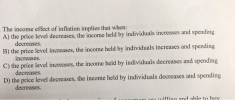 The income effect of inflation implies that when: A) the price level decreases, the income held by individuals increases and spending decreases. B) the price level increases, the income held by individuals increases and spending increases. C) the price level increases, the income held by individuals decreases and spending decreases. D) the price level decreases, the income held by individuals decreases and spending decreases. oro willina and ahle to huy
which of the following is false about a liquidity trap situation? a- quanitive easing may be...
which of the following is false about a liquidity trap situation? a- quanitive easing may be able to affect long term interest rates even when the fed is unable to apprecialbe lower short term interest rates b- the fed cannot easily reduce the fed funds interest rate. c- quanitive easing might be a more effetive strategy to stimulate the economy than buying short term government securities. d- the fed can lower both short term and long term interest rates by...
Question 4 0.2 pts When a liquidity trap situation exists, the most appropriate policy to increase...
 Question 4 0.2 pts When a liquidity trap situation exists, the most appropriate policy to increase output would be: a central bank purchase of bonds. an increase in government spending. O an increase in taxes. a central bank sale of bonds. a decrease in government spending.
When there is deflation in the economy: a) the general price level becomes negative b) the...
When there is deflation in the economy: a) the general price level becomes negative b) the general price level falls c) the general price level increases d) the inflation rate falls
 and the only effective If an economy is in a liquidity trap, then the nominal interest rate is _ policy that can be used to stimulate the economy is - high and rising; expansionary monetary policy high and rising; expansionary fiscal policy zero or negative; expansionary fiscal policy zero or negative; expansionary monetary policy high and rising; contractionary monetary policy
 The liquidity levels of bonds decreases and the profitable business opportunities in the economy decrease. In the market for bonds, we expect that the demand curve should shift and the supply curve should shift left:left left:right right:left right:right
 The income effect of inflation implies that when: A) the price level decreases, the income held by individuals increases and spending decreases. B) the price level increases, the income held by individuals increases and spending increases. C) the price level increases, the income held by individuals decreases and spending decreases. D) the price level decreases, the income held by individuals decreases and spending decreases. oro willina and ahle to huy
 Question 4 0.2 pts When a liquidity trap situation exists, the most appropriate policy to increase output would be: a central bank purchase of bonds. an increase in government spending. O an increase in taxes. a central bank sale of bonds. a decrease in government spending.
Most questions answered within 3 hours.
-
Where is the error in this code sequence?
String s1 = "Hello";
String s2 = "ello";...
asked 10 months ago -
Financial data for Joel de Paris, Inc., for last year
follow:
Joel de Paris, Inc.
Balance...
asked 10 months ago -
Consider this reaction:
Al2(SO4)3 (aq)+ BaCl3
(aq) Al2Cl6 (aq)- +
3BaSO4(s) . What is the...
asked 10 months ago -
Suppose that Savneet is considering increasing her
recent random sample from 20 car rentals to 40...
asked 10 months ago -
Trucks arrive at an unloading terminal at an average rate of 120
per hour.
Trucks arrive...
asked 10 months ago -
Why are methanol and ethanol completely soluble in water while
octanol is not very little soluble....
asked 10 months ago -
A facilities manager at a university reads in a research report
that the mean amount of...
asked 10 months ago -
When the CuSO4 is rehydrated by adding water to the anhydrous
compound, is this an endothermic...
asked 10 months ago -
A ray of sunlight is passing from diamond into crown glass; the
angle of incidence is...
asked 10 months ago -
A block of mass 0.249 kg is placed on top of a light, vertical
spring of...
asked 10 months ago -
how do the kidneys compensate in the presences of acidosis
a) trigger hyperventilate
b) reserve acid...
asked 10 months ago -
Question 501 pts
The rental rate of capital to the firm increases. Which of the
following...
asked 10 months ago