

Homework Answers
4.
a)
The chemical formula of the acid is  .
.
P has 5 valence electrons.
Each O has 6 valence electrons , i.e. 3*6 = 18
Each H has one valence electron. i..e 1*3 = 3
Hence, total number of valence electrons in the molecule is 5+18+3 = 26
Now, we can draw the following Lewis structure with P as central atom.
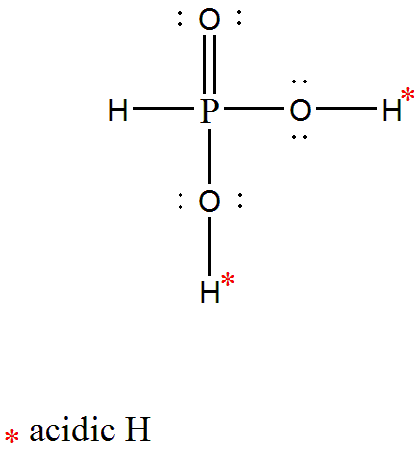
Note that P can have more than 8 electrons (expanded octet) around it as it has empty 3d orbital.
We can verify that our structure has 26 valence electrons by counting the bond pairs and lone pairs.
There are 7 bond pair and 6 lone pairs on O atoms. Hence, 13 bp+lp. Hence, total of 26 valence electrons.
The H atoms attached to O are acidic in nature as the electronegative O atom holds on to the bond electron pair making the deprotonation easier.
b)
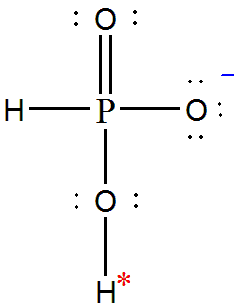
The conjugate base of the above acid can be drawn by deprotonation of one of the acidic hydrogen.

Hence, the Lewis structure of the conjguate base of the above acid in 4a) is
c)
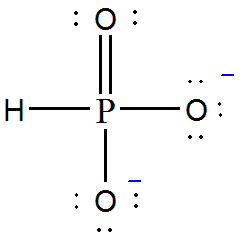
The structure in 4b) still has one more deprotonable H.

Hence, the conjugate base of the structure in 4b) can be drawn as
d)
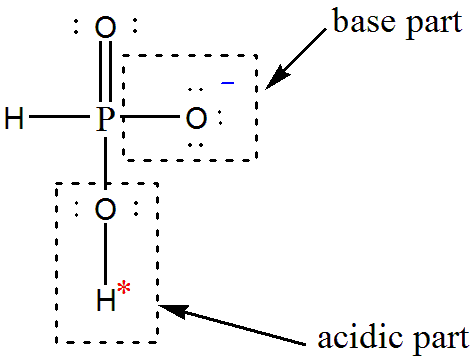
Structure in 4b) acts as both an acid and as a base.
The equation in which it can act as a base is

The equation in which it can act as an acid is
This is possible because, structure in 4b) has one negative charge on O atom which can deprotonate an acid and thereby making the molecule a base. Also, it has a deprotonable H on it, hence, it can also act as an acid.
Add Answer to:
Please refer to data set D
do the following: 4. For the acid in Option_ drogen(s)...
Please refer to data set D 1. For each data set, the volume of acid being...
 Please refer to data set D
1. For each data set, the volume of acid being analyzed is 10.00 mL and the concentration of NAOH is 0.100 M. 2nd Volume of pH at 1st eq. pt pH at pt Conc. of Volume of Data Set eq. acid (g/L) NaOH at 1st NAOH at 2nd eq.point (mL) eq.point (mL) 9.12 4.1 15.98 9.6 8.06 9.2 15.12 11.95 4.3 24.09 В 3.9 18.10 12.42 8.96 8.8 С D 21.00 14.08 27.96 9.1...
Please refer to data set D
1. For each data set, the volume of acid being analyzed is 10.00 mL and the concentration of NAOH is 0.100 M. 2nd Volume of pH at 1st eq. pt pH at pt Conc. of Volume of Data Set eq. acid (g/L) NaOH at 1st NAOH at 2nd eq.point (mL) eq.point (mL) 9.12 4.1 15.98 9.6 8.06 9.2 15.12 11.95 4.3 24.09 В 3.9 18.10 12.42 8.96 8.8 С D 21.00 14.08 27.96 9.1...
DETERMINATION OF MOLECULAR WEIGHT OF AN UNKNOWN DIPROTIC ACID Use Data Set to answer the followin...
 DETERMINATION OF MOLECULAR WEIGHT OF AN UNKNOWN DIPROTIC ACID Use Data Set to answer the following questions 1. Using the data, sketch a titration curve for the titration of the acid with 0.1 M NaOH pH 0 volume of NaOH added 2. Using the first equivalence point, determine the molecular weight of the acid. Use the sequence of steps employed in the in-class exercise. Homework Molecular Weight of an Unknown Diprotic Acid 3. Using the second equivalence point, determine the...
4. Explain things in the following question(s) In each reaction, identify the Brønsted-Lowry acid, the Brønsted-Lowry...
 4. Explain things in the following question(s) In each reaction, identify the Brønsted-Lowry acid, the Brønsted-Lowry base, the conjugate acid, and the conjugate base. (a) H2SO4(aq) + H2O(l) —— HSO4 (aq) + H30+(aq) (b) HCO3(aq) + H20(1) = H,CO3(aq) + OH(aq) 5. Using examples, distinguish between a Nucleophile vs Electrophile. Give at least 2 differences between the 2 concepts 6. What are curved arrows or "curly arrows" in Organic Chemistry? What do they represent? Give an example (b) Using Ammonia...
DATA AND CALCULATIONS Time at equivalence point (s) Time of color Trial *Equation for acid-base reaction...
 DATA AND CALCULATIONS Time at equivalence point (s) Time of color Trial *Equation for acid-base reaction change (s) NaOH+HCI - 21 0s 1 250.5 NaOH+ HC2H3O2- 2 8l.55 99s 3 NH3+ HCl- 930s 4 NH3 + HC2H3O2- 90.55 81.Os Complete the reactions above. Attach copies of all four graphs to this report. 1. 2. Examine the time data for each of the Trials 1- -4. In which trial(s) did the indicator change color at about the same time as the...
can someone help me answer these 5 questions and figire this graph out please? Acid-Base Titration...
 can
someone help me answer these 5 questions and figire this graph out
please?
Acid-Base Titration of a Weak Acid with a Strong Base: Determination of K. Introduction: You will be titrating a solution of a weak acid with 0.100 M NaOH, while monitoring the reaction using a pH meter. Weak acids have characteristic acid-ionization constants, K. The purpose of this lab is to use the titration to determine the value of this constant for the weak acid called “benzoic...
can
someone help me answer these 5 questions and figire this graph out
please?
Acid-Base Titration of a Weak Acid with a Strong Base: Determination of K. Introduction: You will be titrating a solution of a weak acid with 0.100 M NaOH, while monitoring the reaction using a pH meter. Weak acids have characteristic acid-ionization constants, K. The purpose of this lab is to use the titration to determine the value of this constant for the weak acid called “benzoic...
It's a weak acid strong base titration Experiment 4: Identification of an unknown acid by titration...
 It's a weak acid strong base titration
Experiment 4: Identification of an unknown acid by titration Page 2 of 15 Background In this experiment, you will use both qualitative and quantitative properties to determine an unknown acid's identity and concentration. To do this analysis, you will perform a titration of your unknown acid sample-specifically a potentiometric titration where you use a pH meter and record pH values during the titration, combined with a visual titration using a color indi- cator...
It's a weak acid strong base titration
Experiment 4: Identification of an unknown acid by titration Page 2 of 15 Background In this experiment, you will use both qualitative and quantitative properties to determine an unknown acid's identity and concentration. To do this analysis, you will perform a titration of your unknown acid sample-specifically a potentiometric titration where you use a pH meter and record pH values during the titration, combined with a visual titration using a color indi- cator...
1) Write a Reaction equation using 4- aminobenzenesulfulfonic acid (aniline derivative) and 8-ani...
 1) Write a Reaction equation using 4- aminobenzenesulfulfonic
acid (aniline derivative) and 8-anilino-1-naphthalenesulfonic acid
(coupling agent). Write the mechanism.
SYNTHESIS OF AZO DYES INTRODUCTION Humans' love of color dates back almost to prehistoric times, yet it is not actually until the modern era that the full range of the rainbow has been accessible to the majority of people irn their clothes and other textiles. Ancient or medieval times have often been described as being quite splendid with their "tyrian purple"...
1) Write a Reaction equation using 4- aminobenzenesulfulfonic
acid (aniline derivative) and 8-anilino-1-naphthalenesulfonic acid
(coupling agent). Write the mechanism.
SYNTHESIS OF AZO DYES INTRODUCTION Humans' love of color dates back almost to prehistoric times, yet it is not actually until the modern era that the full range of the rainbow has been accessible to the majority of people irn their clothes and other textiles. Ancient or medieval times have often been described as being quite splendid with their "tyrian purple"...
 Please refer to data set D
1. For each data set, the volume of acid being analyzed is 10.00 mL and the concentration of NAOH is 0.100 M. 2nd Volume of pH at 1st eq. pt pH at pt Conc. of Volume of Data Set eq. acid (g/L) NaOH at 1st NAOH at 2nd eq.point (mL) eq.point (mL) 9.12 4.1 15.98 9.6 8.06 9.2 15.12 11.95 4.3 24.09 В 3.9 18.10 12.42 8.96 8.8 С D 21.00 14.08 27.96 9.1...
Please refer to data set D
1. For each data set, the volume of acid being analyzed is 10.00 mL and the concentration of NAOH is 0.100 M. 2nd Volume of pH at 1st eq. pt pH at pt Conc. of Volume of Data Set eq. acid (g/L) NaOH at 1st NAOH at 2nd eq.point (mL) eq.point (mL) 9.12 4.1 15.98 9.6 8.06 9.2 15.12 11.95 4.3 24.09 В 3.9 18.10 12.42 8.96 8.8 С D 21.00 14.08 27.96 9.1...
 DETERMINATION OF MOLECULAR WEIGHT OF AN UNKNOWN DIPROTIC ACID Use Data Set to answer the following questions 1. Using the data, sketch a titration curve for the titration of the acid with 0.1 M NaOH pH 0 volume of NaOH added 2. Using the first equivalence point, determine the molecular weight of the acid. Use the sequence of steps employed in the in-class exercise. Homework Molecular Weight of an Unknown Diprotic Acid 3. Using the second equivalence point, determine the...
 4. Explain things in the following question(s) In each reaction, identify the Brønsted-Lowry acid, the Brønsted-Lowry base, the conjugate acid, and the conjugate base. (a) H2SO4(aq) + H2O(l) —— HSO4 (aq) + H30+(aq) (b) HCO3(aq) + H20(1) = H,CO3(aq) + OH(aq) 5. Using examples, distinguish between a Nucleophile vs Electrophile. Give at least 2 differences between the 2 concepts 6. What are curved arrows or "curly arrows" in Organic Chemistry? What do they represent? Give an example (b) Using Ammonia...
 DATA AND CALCULATIONS Time at equivalence point (s) Time of color Trial *Equation for acid-base reaction change (s) NaOH+HCI - 21 0s 1 250.5 NaOH+ HC2H3O2- 2 8l.55 99s 3 NH3+ HCl- 930s 4 NH3 + HC2H3O2- 90.55 81.Os Complete the reactions above. Attach copies of all four graphs to this report. 1. 2. Examine the time data for each of the Trials 1- -4. In which trial(s) did the indicator change color at about the same time as the...
 can
someone help me answer these 5 questions and figire this graph out
please?
Acid-Base Titration of a Weak Acid with a Strong Base: Determination of K. Introduction: You will be titrating a solution of a weak acid with 0.100 M NaOH, while monitoring the reaction using a pH meter. Weak acids have characteristic acid-ionization constants, K. The purpose of this lab is to use the titration to determine the value of this constant for the weak acid called “benzoic...
can
someone help me answer these 5 questions and figire this graph out
please?
Acid-Base Titration of a Weak Acid with a Strong Base: Determination of K. Introduction: You will be titrating a solution of a weak acid with 0.100 M NaOH, while monitoring the reaction using a pH meter. Weak acids have characteristic acid-ionization constants, K. The purpose of this lab is to use the titration to determine the value of this constant for the weak acid called “benzoic...
 It's a weak acid strong base titration
Experiment 4: Identification of an unknown acid by titration Page 2 of 15 Background In this experiment, you will use both qualitative and quantitative properties to determine an unknown acid's identity and concentration. To do this analysis, you will perform a titration of your unknown acid sample-specifically a potentiometric titration where you use a pH meter and record pH values during the titration, combined with a visual titration using a color indi- cator...
It's a weak acid strong base titration
Experiment 4: Identification of an unknown acid by titration Page 2 of 15 Background In this experiment, you will use both qualitative and quantitative properties to determine an unknown acid's identity and concentration. To do this analysis, you will perform a titration of your unknown acid sample-specifically a potentiometric titration where you use a pH meter and record pH values during the titration, combined with a visual titration using a color indi- cator...
 1) Write a Reaction equation using 4- aminobenzenesulfulfonic
acid (aniline derivative) and 8-anilino-1-naphthalenesulfonic acid
(coupling agent). Write the mechanism.
SYNTHESIS OF AZO DYES INTRODUCTION Humans' love of color dates back almost to prehistoric times, yet it is not actually until the modern era that the full range of the rainbow has been accessible to the majority of people irn their clothes and other textiles. Ancient or medieval times have often been described as being quite splendid with their "tyrian purple"...
1) Write a Reaction equation using 4- aminobenzenesulfulfonic
acid (aniline derivative) and 8-anilino-1-naphthalenesulfonic acid
(coupling agent). Write the mechanism.
SYNTHESIS OF AZO DYES INTRODUCTION Humans' love of color dates back almost to prehistoric times, yet it is not actually until the modern era that the full range of the rainbow has been accessible to the majority of people irn their clothes and other textiles. Ancient or medieval times have often been described as being quite splendid with their "tyrian purple"...
Most questions answered within 3 hours.
-
Where is the error in this code sequence?
String s1 = "Hello";
String s2 = "ello";...
asked 10 months ago -
Financial data for Joel de Paris, Inc., for last year
follow:
Joel de Paris, Inc.
Balance...
asked 10 months ago -
Consider this reaction:
Al2(SO4)3 (aq)+ BaCl3
(aq) Al2Cl6 (aq)- +
3BaSO4(s) . What is the...
asked 10 months ago -
Suppose that Savneet is considering increasing her
recent random sample from 20 car rentals to 40...
asked 10 months ago -
Trucks arrive at an unloading terminal at an average rate of 120
per hour.
Trucks arrive...
asked 10 months ago -
Why are methanol and ethanol completely soluble in water while
octanol is not very little soluble....
asked 10 months ago -
A facilities manager at a university reads in a research report
that the mean amount of...
asked 10 months ago -
When the CuSO4 is rehydrated by adding water to the anhydrous
compound, is this an endothermic...
asked 10 months ago -
A ray of sunlight is passing from diamond into crown glass; the
angle of incidence is...
asked 10 months ago -
A block of mass 0.249 kg is placed on top of a light, vertical
spring of...
asked 10 months ago -
how do the kidneys compensate in the presences of acidosis
a) trigger hyperventilate
b) reserve acid...
asked 10 months ago -
Question 501 pts
The rental rate of capital to the firm increases. Which of the
following...
asked 10 months ago