
Homework Answers
Add Answer to:
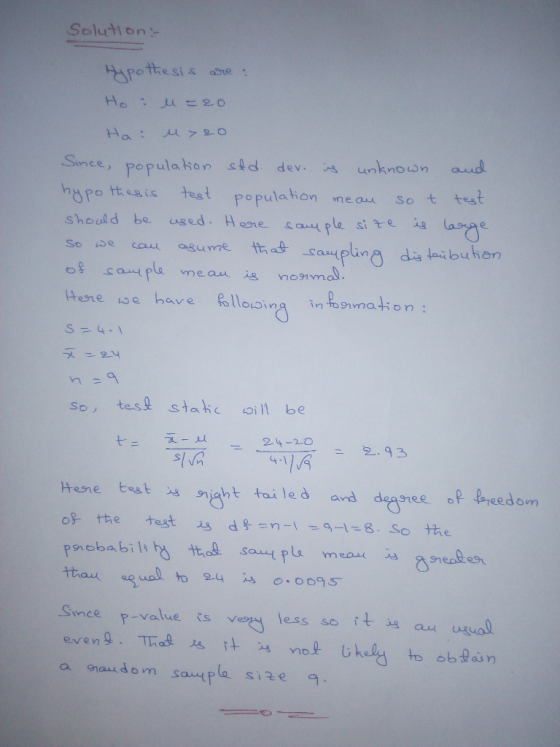
10. A normal population with an unknown variance has a mean of 20. Is one likely...
1. A population of values follows a normal distribution with standard deviation 5 and unknown mean....
 1. A population of values follows a normal distribution with standard deviation 5 and unknown mean. A random sample of size 16 has mean 24. a) Write what each number represents. b) Find and interpret the 95% CI for the unknown population mean. c) Is 30 a plausible population mean? Explain.
11. Bonus problem (6 points) Assume X,...Xm come from a normal population with unknown variance σ...
 11. Bonus problem (6 points) Assume X,...Xm come from a normal population with unknown variance σ' and Y1, Yn come from another normal population with unknown variance and the two samples are independent of each other. Write the 5 steps you will follow to test the hypotheses: Ho-1 Vs Hao #1 Make sure to specify the test statistic and the null distribution (don't forget degrees of freedom), and the rejection region. Hint Remember that-4 ~Xa-1 and-严 (m-1)s2 -X2-1, what do...
Bonus problem (6 points:) Assume X1, ... Xm come from a normal population with unknown variance...
 Bonus problem (6 points:) Assume X1, ... Xm come from a normal population with unknown variance oị and Y... Y come from another normal population with unknown variance o, and the two samples are independent of each other. Write the 5 steps you will follow to test the hypotheses: Hoi = 1 VS HQI # 1 Make sure to specify the test statistic and the null distribution (don't forget the degrees of freedom), and the rejection region. Hint: Remember that...
Consider the following statements concerning Student's t distribution: A. The variance of the t distribution decreases...
Consider the following statements concerning Student's t distribution: A. The variance of the t distribution decreases as the degrees of freedom decrease. B. The t statistic follows a t distribution, when the sample size is small, provided the random variable used to construct the t statistic follows a normal distribution C. In practice, the t distribution can be used to determine the critical value for a confidence interval estimate for the population mean when the population variance is unknown provided...
Assume Y1, ...,Yn are IID normal random variables where mean μ and variance "2 are both...
Assume Y1, ...,Yn are IID normal random variables where mean μ and variance "2 are both unknown. Assume that ¯ Y = 0, and s, the sample standard deviation, equals sqrt(n). Compute a 1 − a confidence interval for the mean μ. Leave your answer in terms of ta/2, the critical value for a t distribution. How many degrees of freedom does this t distribution have?
Consider a normally distributed population with unknown variance ơ2. To test the null hypothesis that σ2 is equal t...
 Consider a normally distributed population with unknown variance ơ2. To test the null hypothesis that σ2 is equal to σ. we collect a sample of size n form the population and then calculate the sample variance S2. It is well known that we would fail-to-reject the null hypothesis if the following holds: 1-2n-1n-1 Note: χ2.v is such that P(x:Xp.v), and χ is a chi-squared random variable with v degrees of freedom. Use the above result to develop a hypothesis testing...
4 pts Question 20 Consider taking random samples of size 50 from Population A with mean...
 4 pts Question 20 Consider taking random samples of size 50 from Population A with mean 15 and standard deviation 3 and random samples of size 75 from Population B with mean 10 and standard deviation 5. Use the provided formula sheet to calculate the standard error of the distribution of differences in sample means, T-58 Standard error = (Select) How many degrees of freedom should be used when conducting inference for ид - ив with samples of this size?...
5. Do you agree with the first three statements below? If yes, justify briefly. If not, correct it. For the last part, describe in a paragraph. If X is the mean of a random sample of size n froma pop...
 5. Do you agree with the first three statements below? If yes, justify briefly. If not, correct it. For the last part, describe in a paragraph. If X is the mean of a random sample of size n froma population with the mean μ and the variance σ2, then its sampling distribution is a normal with the mean μ and the variance σ-, Agree Disagree If S2 is the variance of a random sample of size n taken from any...
(21) A sample of size 20 is drawn from a normal distribution with unknown variance and...
 (21) A sample of size 20 is drawn from a normal distribution with unknown variance and mean. The sample variance s2 = 0.012. Find a 95% two-sided confidence interval for the standard deviation o of the population. A. [0.0833,0.1600] B. (0.010,0.0130] C. (0.0069,0.0256] D. None of the above
1- Suppose a simple random sample of sizen is drawn froma large population with mean u...
 1- Suppose a simple random sample of sizen is drawn froma large population with mean u and standard deviation o. The sampling distribution of x has mean ug and standard deviation= 2- As the number of degrees of freedom in the t-distribution increase, the spread of the distribution 3- True or False: The value of to.10 with 5 degrees of freedom is greater than the value of to.10 with 10 degrees of freedom. 4- True or False: To construct a...
 1. A population of values follows a normal distribution with standard deviation 5 and unknown mean. A random sample of size 16 has mean 24. a) Write what each number represents. b) Find and interpret the 95% CI for the unknown population mean. c) Is 30 a plausible population mean? Explain.
 11. Bonus problem (6 points) Assume X,...Xm come from a normal population with unknown variance σ' and Y1, Yn come from another normal population with unknown variance and the two samples are independent of each other. Write the 5 steps you will follow to test the hypotheses: Ho-1 Vs Hao #1 Make sure to specify the test statistic and the null distribution (don't forget degrees of freedom), and the rejection region. Hint Remember that-4 ~Xa-1 and-严 (m-1)s2 -X2-1, what do...
 Bonus problem (6 points:) Assume X1, ... Xm come from a normal population with unknown variance oị and Y... Y come from another normal population with unknown variance o, and the two samples are independent of each other. Write the 5 steps you will follow to test the hypotheses: Hoi = 1 VS HQI # 1 Make sure to specify the test statistic and the null distribution (don't forget the degrees of freedom), and the rejection region. Hint: Remember that...
 Consider a normally distributed population with unknown variance ơ2. To test the null hypothesis that σ2 is equal to σ. we collect a sample of size n form the population and then calculate the sample variance S2. It is well known that we would fail-to-reject the null hypothesis if the following holds: 1-2n-1n-1 Note: χ2.v is such that P(x:Xp.v), and χ is a chi-squared random variable with v degrees of freedom. Use the above result to develop a hypothesis testing...
 4 pts Question 20 Consider taking random samples of size 50 from Population A with mean 15 and standard deviation 3 and random samples of size 75 from Population B with mean 10 and standard deviation 5. Use the provided formula sheet to calculate the standard error of the distribution of differences in sample means, T-58 Standard error = (Select) How many degrees of freedom should be used when conducting inference for ид - ив with samples of this size?...
 5. Do you agree with the first three statements below? If yes, justify briefly. If not, correct it. For the last part, describe in a paragraph. If X is the mean of a random sample of size n froma population with the mean μ and the variance σ2, then its sampling distribution is a normal with the mean μ and the variance σ-, Agree Disagree If S2 is the variance of a random sample of size n taken from any...
 (21) A sample of size 20 is drawn from a normal distribution with unknown variance and mean. The sample variance s2 = 0.012. Find a 95% two-sided confidence interval for the standard deviation o of the population. A. [0.0833,0.1600] B. (0.010,0.0130] C. (0.0069,0.0256] D. None of the above
 1- Suppose a simple random sample of sizen is drawn froma large population with mean u and standard deviation o. The sampling distribution of x has mean ug and standard deviation= 2- As the number of degrees of freedom in the t-distribution increase, the spread of the distribution 3- True or False: The value of to.10 with 5 degrees of freedom is greater than the value of to.10 with 10 degrees of freedom. 4- True or False: To construct a...
Most questions answered within 3 hours.
-
Where is the error in this code sequence?
String s1 = "Hello";
String s2 = "ello";...
asked 10 months ago -
Financial data for Joel de Paris, Inc., for last year
follow:
Joel de Paris, Inc.
Balance...
asked 10 months ago -
Consider this reaction:
Al2(SO4)3 (aq)+ BaCl3
(aq) Al2Cl6 (aq)- +
3BaSO4(s) . What is the...
asked 10 months ago -
Suppose that Savneet is considering increasing her
recent random sample from 20 car rentals to 40...
asked 10 months ago -
Trucks arrive at an unloading terminal at an average rate of 120
per hour.
Trucks arrive...
asked 10 months ago -
Why are methanol and ethanol completely soluble in water while
octanol is not very little soluble....
asked 10 months ago -
A facilities manager at a university reads in a research report
that the mean amount of...
asked 10 months ago -
When the CuSO4 is rehydrated by adding water to the anhydrous
compound, is this an endothermic...
asked 10 months ago -
A ray of sunlight is passing from diamond into crown glass; the
angle of incidence is...
asked 10 months ago -
A block of mass 0.249 kg is placed on top of a light, vertical
spring of...
asked 10 months ago -
how do the kidneys compensate in the presences of acidosis
a) trigger hyperventilate
b) reserve acid...
asked 10 months ago -
Question 501 pts
The rental rate of capital to the firm increases. Which of the
following...
asked 10 months ago