Assume Y1, ...,Yn are IID normal random variables where mean μ and variance "2 are both...
Assume Y1, ...,Yn are IID normal random variables where mean μ
and variance "2 are both unknown. Assume
that ¯ Y = 0, and s, the sample standard deviation, equals sqrt(n).
Compute a 1 − a confidence interval for the
mean μ. Leave your answer in terms of ta/2, the critical value for
a t distribution. How many degrees of freedom does this t
distribution have?
Homework Answers

Add Answer to:
Assume Y1, ...,Yn are IID normal random variables where mean μ
and variance "2 are both...
Let Y1, Y2, , Yn be independent, normal random variables, each with mean μ and variance...
 Let Y1, Y2, , Yn be independent, normal random variables, each
with mean μ and variance σ^2.
(a) Find the density function of
f Y(u) =
(b) If σ^2 = 25 and n = 9, what is the
probability that the sample mean, Y, takes on a value that is
within one unit of the population mean, μ?
That is, find P(|Y − μ| ≤ 1). (Round your answer to four decimal
places.)
P(|Y − μ| ≤ 1) =
(c)...
Let Y1, Y2, , Yn be independent, normal random variables, each
with mean μ and variance σ^2.
(a) Find the density function of
f Y(u) =
(b) If σ^2 = 25 and n = 9, what is the
probability that the sample mean, Y, takes on a value that is
within one unit of the population mean, μ?
That is, find P(|Y − μ| ≤ 1). (Round your answer to four decimal
places.)
P(|Y − μ| ≤ 1) =
(c)...
8.5 Random variables Y1,... , Yn have a joint normal distribution with mean 0 if there exist inde...
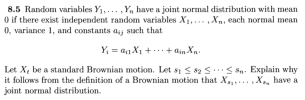 8.5 Random variables Y1,... , Yn have a joint normal distribution with mean 0 if there exist independent random variables Xi,... , Xn, each normal mearn 0, variance 1, and constants aij such that Y aiX1+.. +ainXn Let Xt be a standard Brownian motion. Let s1 s2 sn. Explain why it follows from the definition of a Brownian motion that Xs1,... , Xs, have a joint normal distribution.
8.5 Random variables Y1,... , Yn have a joint normal distribution with...
8.5 Random variables Y1,... , Yn have a joint normal distribution with mean 0 if there exist independent random variables Xi,... , Xn, each normal mearn 0, variance 1, and constants aij such that Y aiX1+.. +ainXn Let Xt be a standard Brownian motion. Let s1 s2 sn. Explain why it follows from the definition of a Brownian motion that Xs1,... , Xs, have a joint normal distribution.
8.5 Random variables Y1,... , Yn have a joint normal distribution with...
Could I grab some help on problem 2? Thank you 2. Suppose Yi, Yn are iid...
 Could I grab some help on problem 2? Thank you
2. Suppose Yi, Yn are iid normal random variables with normal distribution with unknown mean and variance, μ and ơ2. Let Y ni Y. For this problem you may not assume that n is large. n (a) What is the distribution of Y? (b) What is the distribution of Z = (yo)' + ( μ)' + (⅓ュ)? (o) What is the distribution of ta yis (d) What is the distribution...
Could I grab some help on problem 2? Thank you
2. Suppose Yi, Yn are iid normal random variables with normal distribution with unknown mean and variance, μ and ơ2. Let Y ni Y. For this problem you may not assume that n is large. n (a) What is the distribution of Y? (b) What is the distribution of Z = (yo)' + ( μ)' + (⅓ュ)? (o) What is the distribution of ta yis (d) What is the distribution...
Problem 1. Assume, the observations X1, X2, . . . , Xn are iid. normal distributed...
Problem 1. Assume, the observations X1, X2, . . . , Xn are iid. normal distributed random variables with unknown mean θ. You observe n = 16 many variables with the empirical mean 1.45 and a sample variance of 0.512. a) Determine a 90% two-sided confidence interval for the mean. b)HowcanwedecideonthehypothesisH0 :μ=2vsH1 :μ̸=2onthe significance level 10%, using just the answer for part a) and no additional computations? c) Now assume that, instead of using the sample variance, you know that...
Assume X1, . . . , Xn iid normal with mean and variance ^2 , show...
 Assume X1, . . . , Xn iid normal with mean
and variance
^2 , show that
a. X¯ and X^2 are independent.
b. Proof that X¯ is normally distributed with mean
and variance
^2/n.
c. Proof that (n ? 1)S^2/?2 is chi-squared distributed with (n ?
1) degrees of freedom.
d. Show that X¯ S/is
t distributed with (n ? 1) degrees of freedom
Assume X1, . . . , Xn iid normal with mean
and variance
^2 , show that
a. X¯ and X^2 are independent.
b. Proof that X¯ is normally distributed with mean
and variance
^2/n.
c. Proof that (n ? 1)S^2/?2 is chi-squared distributed with (n ?
1) degrees of freedom.
d. Show that X¯ S/is
t distributed with (n ? 1) degrees of freedom
2. Suppose i, ơ2. Let Y are iid normal random variables with nornnal distribution with unknown...
 2. Suppose i, ơ2. Let Y are iid normal random variables with nornnal distribution with unknown mean and variance, μ and is: 1 . For this problem you may not assume that n is large. n (a) What is the distribution of Y? (b) What is the distribution of z-(ga), (n-e), (y, e)2? (c) What is the distribution of (a- (d) What is the distribution ofw)? Justify your answer. (e) Let Zi (y e) 2 (3 ) 2 + (y...
Q- If Y1,…,Yn is an i.i.d. random sample from a population with mean μY and variance...
Q- If Y1,…,Yn is an i.i.d. random sample from a population with mean μY and variance σ2Y, which of the following is not true? 1) Y1,…,Yn are identically distributed random variables 2) Y1,…,Yn are mutually independent random variables 3) Var(Y¯)=σ2Y 4) E(Y¯)=μY
2. Suppose Yi,.. narei normal random variables with normal distribution with unknown mean and variance, μ...
 2. Suppose Yi,.. narei normal random variables with normal distribution with unknown mean and variance, μ and or. Let Y-욤 Σ;..x. For this problem, you may not assume that n is large. (a) What is the distribution of Y? (b) what is the distribution of z-(yo), (en, (n-) (c) what is the distribution of (n-p? (d) What is the distribution of Justify your answer. (e) Let Zi-(ga)' + (-)' + (yo)", z2 = (속)' + (n-e)' what is the distribution...
Suppose that Y1 , Y2 ,..., Yn denote a random sample of size n from a...
 Suppose
that Y1 , Y2 ,..., Yn denote a random sample of size n from a
normal population with mean μ and variance 2 .
Problem # 2: Suppose that Y , Y,,...,Y, denote a random sample of size n from a normal population with mean u and variance o . Then it can be shown that (n-1)S2 p_has a chi-square distribution with (n-1) degrees of freedom. o2 a. Show that S2 is an unbiased estimator of o. b....
Suppose
that Y1 , Y2 ,..., Yn denote a random sample of size n from a
normal population with mean μ and variance 2 .
Problem # 2: Suppose that Y , Y,,...,Y, denote a random sample of size n from a normal population with mean u and variance o . Then it can be shown that (n-1)S2 p_has a chi-square distribution with (n-1) degrees of freedom. o2 a. Show that S2 is an unbiased estimator of o. b....
11. Bonus problem (6 points) Assume X,...Xm come from a normal population with unknown variance σ...
 11. Bonus problem (6 points) Assume X,...Xm come from a normal population with unknown variance σ' and Y1, Yn come from another normal population with unknown variance and the two samples are independent of each other. Write the 5 steps you will follow to test the hypotheses: Ho-1 Vs Hao #1 Make sure to specify the test statistic and the null distribution (don't forget degrees of freedom), and the rejection region. Hint Remember that-4 ~Xa-1 and-严 (m-1)s2 -X2-1, what do...
 Let Y1, Y2, , Yn be independent, normal random variables, each
with mean μ and variance σ^2.
(a) Find the density function of
f Y(u) =
(b) If σ^2 = 25 and n = 9, what is the
probability that the sample mean, Y, takes on a value that is
within one unit of the population mean, μ?
That is, find P(|Y − μ| ≤ 1). (Round your answer to four decimal
places.)
P(|Y − μ| ≤ 1) =
(c)...
Let Y1, Y2, , Yn be independent, normal random variables, each
with mean μ and variance σ^2.
(a) Find the density function of
f Y(u) =
(b) If σ^2 = 25 and n = 9, what is the
probability that the sample mean, Y, takes on a value that is
within one unit of the population mean, μ?
That is, find P(|Y − μ| ≤ 1). (Round your answer to four decimal
places.)
P(|Y − μ| ≤ 1) =
(c)...
 8.5 Random variables Y1,... , Yn have a joint normal distribution with mean 0 if there exist independent random variables Xi,... , Xn, each normal mearn 0, variance 1, and constants aij such that Y aiX1+.. +ainXn Let Xt be a standard Brownian motion. Let s1 s2 sn. Explain why it follows from the definition of a Brownian motion that Xs1,... , Xs, have a joint normal distribution.
8.5 Random variables Y1,... , Yn have a joint normal distribution with...
8.5 Random variables Y1,... , Yn have a joint normal distribution with mean 0 if there exist independent random variables Xi,... , Xn, each normal mearn 0, variance 1, and constants aij such that Y aiX1+.. +ainXn Let Xt be a standard Brownian motion. Let s1 s2 sn. Explain why it follows from the definition of a Brownian motion that Xs1,... , Xs, have a joint normal distribution.
8.5 Random variables Y1,... , Yn have a joint normal distribution with...
 Could I grab some help on problem 2? Thank you
2. Suppose Yi, Yn are iid normal random variables with normal distribution with unknown mean and variance, μ and ơ2. Let Y ni Y. For this problem you may not assume that n is large. n (a) What is the distribution of Y? (b) What is the distribution of Z = (yo)' + ( μ)' + (⅓ュ)? (o) What is the distribution of ta yis (d) What is the distribution...
Could I grab some help on problem 2? Thank you
2. Suppose Yi, Yn are iid normal random variables with normal distribution with unknown mean and variance, μ and ơ2. Let Y ni Y. For this problem you may not assume that n is large. n (a) What is the distribution of Y? (b) What is the distribution of Z = (yo)' + ( μ)' + (⅓ュ)? (o) What is the distribution of ta yis (d) What is the distribution...
 Assume X1, . . . , Xn iid normal with mean
and variance
^2 , show that
a. X¯ and X^2 are independent.
b. Proof that X¯ is normally distributed with mean
and variance
^2/n.
c. Proof that (n ? 1)S^2/?2 is chi-squared distributed with (n ?
1) degrees of freedom.
d. Show that X¯ S/is
t distributed with (n ? 1) degrees of freedom
Assume X1, . . . , Xn iid normal with mean
and variance
^2 , show that
a. X¯ and X^2 are independent.
b. Proof that X¯ is normally distributed with mean
and variance
^2/n.
c. Proof that (n ? 1)S^2/?2 is chi-squared distributed with (n ?
1) degrees of freedom.
d. Show that X¯ S/is
t distributed with (n ? 1) degrees of freedom
 2. Suppose i, ơ2. Let Y are iid normal random variables with nornnal distribution with unknown mean and variance, μ and is: 1 . For this problem you may not assume that n is large. n (a) What is the distribution of Y? (b) What is the distribution of z-(ga), (n-e), (y, e)2? (c) What is the distribution of (a- (d) What is the distribution ofw)? Justify your answer. (e) Let Zi (y e) 2 (3 ) 2 + (y...
 2. Suppose Yi,.. narei normal random variables with normal distribution with unknown mean and variance, μ and or. Let Y-욤 Σ;..x. For this problem, you may not assume that n is large. (a) What is the distribution of Y? (b) what is the distribution of z-(yo), (en, (n-) (c) what is the distribution of (n-p? (d) What is the distribution of Justify your answer. (e) Let Zi-(ga)' + (-)' + (yo)", z2 = (속)' + (n-e)' what is the distribution...
 Suppose
that Y1 , Y2 ,..., Yn denote a random sample of size n from a
normal population with mean μ and variance 2 .
Problem # 2: Suppose that Y , Y,,...,Y, denote a random sample of size n from a normal population with mean u and variance o . Then it can be shown that (n-1)S2 p_has a chi-square distribution with (n-1) degrees of freedom. o2 a. Show that S2 is an unbiased estimator of o. b....
Suppose
that Y1 , Y2 ,..., Yn denote a random sample of size n from a
normal population with mean μ and variance 2 .
Problem # 2: Suppose that Y , Y,,...,Y, denote a random sample of size n from a normal population with mean u and variance o . Then it can be shown that (n-1)S2 p_has a chi-square distribution with (n-1) degrees of freedom. o2 a. Show that S2 is an unbiased estimator of o. b....
 11. Bonus problem (6 points) Assume X,...Xm come from a normal population with unknown variance σ' and Y1, Yn come from another normal population with unknown variance and the two samples are independent of each other. Write the 5 steps you will follow to test the hypotheses: Ho-1 Vs Hao #1 Make sure to specify the test statistic and the null distribution (don't forget degrees of freedom), and the rejection region. Hint Remember that-4 ~Xa-1 and-严 (m-1)s2 -X2-1, what do...
Most questions answered within 3 hours.
-
Where is the error in this code sequence?
String s1 = "Hello";
String s2 = "ello";...
asked 10 months ago -
Financial data for Joel de Paris, Inc., for last year
follow:
Joel de Paris, Inc.
Balance...
asked 10 months ago -
Consider this reaction:
Al2(SO4)3 (aq)+ BaCl3
(aq) Al2Cl6 (aq)- +
3BaSO4(s) . What is the...
asked 10 months ago -
Suppose that Savneet is considering increasing her
recent random sample from 20 car rentals to 40...
asked 10 months ago -
Trucks arrive at an unloading terminal at an average rate of 120
per hour.
Trucks arrive...
asked 10 months ago -
Why are methanol and ethanol completely soluble in water while
octanol is not very little soluble....
asked 10 months ago -
A facilities manager at a university reads in a research report
that the mean amount of...
asked 10 months ago -
When the CuSO4 is rehydrated by adding water to the anhydrous
compound, is this an endothermic...
asked 10 months ago -
A ray of sunlight is passing from diamond into crown glass; the
angle of incidence is...
asked 10 months ago -
A block of mass 0.249 kg is placed on top of a light, vertical
spring of...
asked 10 months ago -
how do the kidneys compensate in the presences of acidosis
a) trigger hyperventilate
b) reserve acid...
asked 10 months ago -
Question 501 pts
The rental rate of capital to the firm increases. Which of the
following...
asked 10 months ago