Assume X1, . . . , Xn iid normal with mean and variance ^2 , show...
Assume X1, . . . , Xn iid normal with mean  and variance
  ^2 , show that
a. X¯ and X^2 are independent.
b. Proof that X¯ is normally distributed with mean
and variance
^2/n.
c. Proof that (n ? 1)S^2/?2 is chi-squared distributed with (n ? 1) degrees of freedom.
d. Show that X¯ S/ is
t distributed with (n ? 1) degrees of freedom
is
t distributed with (n ? 1) degrees of freedom
Homework Answers
![The ~joint~distribution~X_1,X_2,...,X_n~is\\ \frac{1}{\left ( \sigma\sqrt{2\pi} \right )^n}\exp\left [ -\frac{1}{2\sigma^2}\sum_{i=1}^n(x_i-\mu)^2 \right ]~with~-\infty<x_i<\infty~\forall~i=1,2,...,n\\ Transform~(X_1,X_2,...,X_n)\rightarrow (Y_1,Y_2,...,Y_n)~such~that\\ y_1=\frac{1}{\sqrt{n}}(x_1-\mu)+\frac{1}{\sqrt{n}}(x_2-\mu)+...+\frac{1}{\sqrt{n}}(x_n-\mu)\\ y_2=\frac{1}{\sqrt{6}}(x_1-\mu)+\frac{1}{\sqrt{6}}(x_2-\mu)-\frac{2}{\sqrt{6}}(x_3-\mu)\\ .\\ .\\ .\\ y_n=\frac{1}{\sqrt{n(n-1)}}(x_1-\mu)+\frac{1}{\sqrt{n(n-1)}}(x_2-\mu)+...+\frac{1}{\sqrt{n(n-1)}}(x_{n-1}-\mu)-\frac{n-1}{\sqrt{n(n-1)}}(x_n-\mu)](http://img.homeworklib.com/questions/c55aa2c0-f7df-11eb-a144-d156dd8c4220.png?x-oss-process=image/resize,w_560)
This transformation is called Helmert's transformation (orthogonal transformation).
Under this orthogonal transformation,
![\sum_{i=1}^ny_i^2=\sum_{i=1}^n(x_i-\mu)^2\\ Jacobian, J \left ( \frac{x_1,...,x_n}{y_1,...,y_n} \right )=\pm 1\\ Hence ~the ~joint~p.d.f.~of~Y_1,Y_2,...,Y_n~is\\ \frac{1}{(\sigma\sqrt{2\pi})^n}\exp\left [ -\frac{1}{2\sigma^2}\sum_{i=1}^ny_i^2 \right ]~~with~-\infty<y_i<\infty,~i=1,2,...,n\\ This~shows~that~Y_i~(i=1,2,...,n)~are~mutually~independent~random~variables~each~distributed~as~ a~normal~variable~with~mean~0~and~variance~\sigma^2.\\](http://img.homeworklib.com/questions/c5c9ff10-f7df-11eb-ab66-0fd33745f271.png?x-oss-process=image/resize,w_560)

Add Answer to:
Assume X1, . . . , Xn iid normal with mean
and variance
^2 , show...
Problem 1. Assume, the observations X1, X2, . . . , Xn are iid. normal distributed...
Problem 1. Assume, the observations X1, X2, . . . , Xn are iid. normal distributed random variables with unknown mean θ. You observe n = 16 many variables with the empirical mean 1.45 and a sample variance of 0.512. a) Determine a 90% two-sided confidence interval for the mean. b)HowcanwedecideonthehypothesisH0 :μ=2vsH1 :μ̸=2onthe significance level 10%, using just the answer for part a) and no additional computations? c) Now assume that, instead of using the sample variance, you know that...
X1,...,Xn are IID with N(0,2). a) Determine the mean and variance for (X (subscript 1)^2) b)...
 X1,...,Xn are IID with N(0,2).
a) Determine the mean and variance for (X (subscript 1)^2)
b) Show
sqrt(n)
* [ log ( 1/n ∑(from i=1 to n)
Xi2) − log(σ2 ) ] d → N(0, 2).
We were unable to transcribe this imageWe were unable to transcribe this imageWe were unable to transcribe this image
X1,...,Xn are IID with N(0,2).
a) Determine the mean and variance for (X (subscript 1)^2)
b) Show
sqrt(n)
* [ log ( 1/n ∑(from i=1 to n)
Xi2) − log(σ2 ) ] d → N(0, 2).
We were unable to transcribe this imageWe were unable to transcribe this imageWe were unable to transcribe this image
9 Let Xi, X2, ..., Xn be an independent trials process with normal density of mean 1 and variance 2. Find the moment generating function for (a) X (b) S2 =X1 + X2 . (c) Sn=X1+X2 + . . . + Xn. (d) An...
 9 Let Xi, X2, ..., Xn be an independent trials process with normal density of mean 1 and variance 2. Find the moment generating function for (a) X (b) S2 =X1 + X2 . (c) Sn=X1+X2 + . . . + Xn. (d) An -Sn/n
9 Let Xi, X2, ..., Xn be an independent trials process with normal density of mean 1 and variance 2. Find the moment generating function for (a) X (b) S2 =X1 + X2 . (c)...
9 Let Xi, X2, ..., Xn be an independent trials process with normal density of mean 1 and variance 2. Find the moment generating function for (a) X (b) S2 =X1 + X2 . (c) Sn=X1+X2 + . . . + Xn. (d) An -Sn/n
9 Let Xi, X2, ..., Xn be an independent trials process with normal density of mean 1 and variance 2. Find the moment generating function for (a) X (b) S2 =X1 + X2 . (c)...
Assume Y1, ...,Yn are IID normal random variables where mean μ and variance "2 are both...
Assume Y1, ...,Yn are IID normal random variables where mean μ and variance "2 are both unknown. Assume that ¯ Y = 0, and s, the sample standard deviation, equals sqrt(n). Compute a 1 − a confidence interval for the mean μ. Leave your answer in terms of ta/2, the critical value for a t distribution. How many degrees of freedom does this t distribution have?
3. Let X1, . . . , Xn be iid random variables with mean μ and...
 3. Let X1, . . . , Xn be iid random variables with mean μ and variance σ2. Let X denote the sample mean and V-Σ,(X,-X)2 a) Derive the expected values of X and V b) Further suppose that Xi,...,Xn are normally distributed. Let Anxn - ((a) be an orthogonal matrix whose first row is (mVm Y = (y, . . . ,%), and X = (Xi, , Xn), are (column) vectors. (It is not necessary to know aij for...
,X, be iid N(μχ, σ*), Yi, ,Yn be iid N(Pv, σ*), and X's and Question 2:...
 ,X, be iid N(μχ, σ*), Yi, ,Yn be iid N(Pv, σ*), and X's and Question 2: Let X1, Y's are independent. Let be the pooled variance. Show that Sg(0/n+1/m) is distributed at t with (n+m-2) degrees of freedom.
7. Let Xn Xi++X2, where the Xi's are iid standard normal random variables (a) Show that Sn is a c...
 7. Let Xn Xi++X2, where the Xi's are iid standard normal random variables (a) Show that Sn is a chi-square random variable with n de- grees of freedom. Hint: Show that X is chi-square with one degree of freedom, and then use Problem 6. (b) Find the pdf of (c) Show that T2 is a Rayleigh random variable. (d) Find the pdf for Ts. The random variable Ts is used to model the speed of molecules in a gas. It...
Let X1, ..., Xn be a random sample from a Normal distribution with mean zero and...
Let X1, ..., Xn be a random sample from a Normal distribution with mean zero and standard deviation sigma. Let X bar and S^2 be the sample mean and sample variance, respectively. a. Find the constant c such that c(Xbar2) / S^2 has an F distribution. b. How many degrees of freedom are associated with this F distribution?
1. (40) Suppose that X1, X2, .. , Xn, forms an normal distribution with mean /u and variance o2, both unknown: independ...
 1. (40) Suppose that X1, X2, .. , Xn, forms an normal distribution with mean /u and variance o2, both unknown: independent and identically distributed sample from 2. 1 f(ru,02) x < 00, -00 < u < 00, o20 - 00 27TO2 (a) Derive the sample variance, S2, for this random sample (b) Derive the maximum likelihood estimator (MLE) of u and o2, denoted fi and o2, respectively (c) Find the MLE of 2 (d) Derive the method of moment...
andom variables Xi, .. . , Xn are iid with mean fu- 12 and variance ?2...
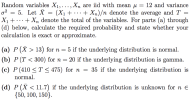 andom variables Xi, .. . , Xn are iid with mean fu- 12 and variance ?2 = 5. Let X (X + Xn)/n denote the average and T- Xi+.. + Xn denote the total of the variables. For parts (a) through (d) below, calculate the required probability and state whether your calculation is exact or approximate (a) P(X> 13) for n 5 if the underlying distribution is normal (b) P(T < 300) for n -20 if the underlying distribution is...
 X1,...,Xn are IID with N(0,2).
a) Determine the mean and variance for (X (subscript 1)^2)
b) Show
sqrt(n)
* [ log ( 1/n ∑(from i=1 to n)
Xi2) − log(σ2 ) ] d → N(0, 2).
We were unable to transcribe this imageWe were unable to transcribe this imageWe were unable to transcribe this image
X1,...,Xn are IID with N(0,2).
a) Determine the mean and variance for (X (subscript 1)^2)
b) Show
sqrt(n)
* [ log ( 1/n ∑(from i=1 to n)
Xi2) − log(σ2 ) ] d → N(0, 2).
We were unable to transcribe this imageWe were unable to transcribe this imageWe were unable to transcribe this image
 9 Let Xi, X2, ..., Xn be an independent trials process with normal density of mean 1 and variance 2. Find the moment generating function for (a) X (b) S2 =X1 + X2 . (c) Sn=X1+X2 + . . . + Xn. (d) An -Sn/n
9 Let Xi, X2, ..., Xn be an independent trials process with normal density of mean 1 and variance 2. Find the moment generating function for (a) X (b) S2 =X1 + X2 . (c)...
9 Let Xi, X2, ..., Xn be an independent trials process with normal density of mean 1 and variance 2. Find the moment generating function for (a) X (b) S2 =X1 + X2 . (c) Sn=X1+X2 + . . . + Xn. (d) An -Sn/n
9 Let Xi, X2, ..., Xn be an independent trials process with normal density of mean 1 and variance 2. Find the moment generating function for (a) X (b) S2 =X1 + X2 . (c)...
 3. Let X1, . . . , Xn be iid random variables with mean μ and variance σ2. Let X denote the sample mean and V-Σ,(X,-X)2 a) Derive the expected values of X and V b) Further suppose that Xi,...,Xn are normally distributed. Let Anxn - ((a) be an orthogonal matrix whose first row is (mVm Y = (y, . . . ,%), and X = (Xi, , Xn), are (column) vectors. (It is not necessary to know aij for...
 ,X, be iid N(μχ, σ*), Yi, ,Yn be iid N(Pv, σ*), and X's and Question 2: Let X1, Y's are independent. Let be the pooled variance. Show that Sg(0/n+1/m) is distributed at t with (n+m-2) degrees of freedom.
 7. Let Xn Xi++X2, where the Xi's are iid standard normal random variables (a) Show that Sn is a chi-square random variable with n de- grees of freedom. Hint: Show that X is chi-square with one degree of freedom, and then use Problem 6. (b) Find the pdf of (c) Show that T2 is a Rayleigh random variable. (d) Find the pdf for Ts. The random variable Ts is used to model the speed of molecules in a gas. It...
 1. (40) Suppose that X1, X2, .. , Xn, forms an normal distribution with mean /u and variance o2, both unknown: independent and identically distributed sample from 2. 1 f(ru,02) x < 00, -00 < u < 00, o20 - 00 27TO2 (a) Derive the sample variance, S2, for this random sample (b) Derive the maximum likelihood estimator (MLE) of u and o2, denoted fi and o2, respectively (c) Find the MLE of 2 (d) Derive the method of moment...
 andom variables Xi, .. . , Xn are iid with mean fu- 12 and variance ?2 = 5. Let X (X + Xn)/n denote the average and T- Xi+.. + Xn denote the total of the variables. For parts (a) through (d) below, calculate the required probability and state whether your calculation is exact or approximate (a) P(X> 13) for n 5 if the underlying distribution is normal (b) P(T < 300) for n -20 if the underlying distribution is...
Most questions answered within 3 hours.
-
Where is the error in this code sequence?
String s1 = "Hello";
String s2 = "ello";...
asked 10 months ago -
Financial data for Joel de Paris, Inc., for last year
follow:
Joel de Paris, Inc.
Balance...
asked 10 months ago -
Consider this reaction:
Al2(SO4)3 (aq)+ BaCl3
(aq) Al2Cl6 (aq)- +
3BaSO4(s) . What is the...
asked 10 months ago -
Suppose that Savneet is considering increasing her
recent random sample from 20 car rentals to 40...
asked 10 months ago -
Trucks arrive at an unloading terminal at an average rate of 120
per hour.
Trucks arrive...
asked 10 months ago -
Why are methanol and ethanol completely soluble in water while
octanol is not very little soluble....
asked 10 months ago -
A facilities manager at a university reads in a research report
that the mean amount of...
asked 10 months ago -
When the CuSO4 is rehydrated by adding water to the anhydrous
compound, is this an endothermic...
asked 10 months ago -
A ray of sunlight is passing from diamond into crown glass; the
angle of incidence is...
asked 10 months ago -
A block of mass 0.249 kg is placed on top of a light, vertical
spring of...
asked 10 months ago -
how do the kidneys compensate in the presences of acidosis
a) trigger hyperventilate
b) reserve acid...
asked 10 months ago -
Question 501 pts
The rental rate of capital to the firm increases. Which of the
following...
asked 10 months ago