
Homework Answers
Add Answer to:
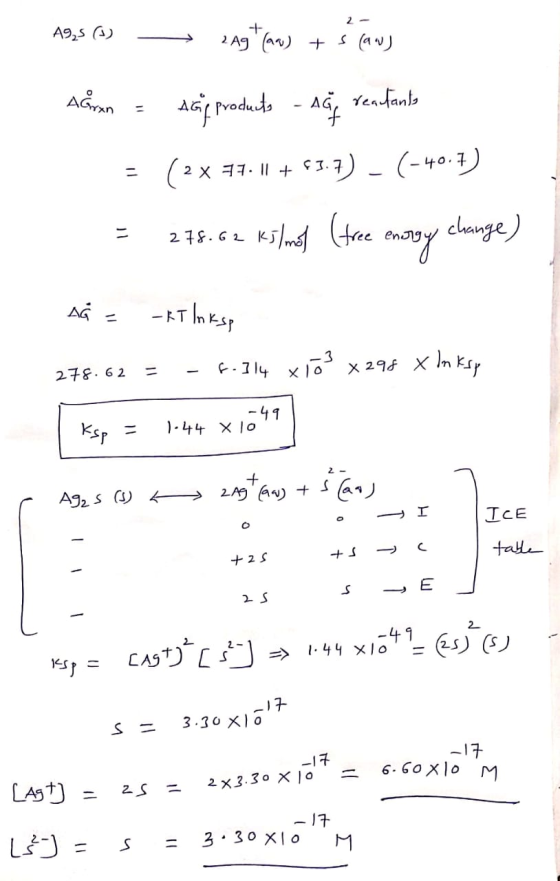
(please show all work and ice table, thanks)
2. Calculate the solubility product, Kop, for Ag2S13)...
second time posting! please show work that includes and ICE table for this equation and explinations. thanks! ther...
 second time posting! please show work that includes and ICE
table for this equation and explinations. thanks!
there isn't a given concentration. please solve without.
d R. Calculate the solubility product, Kop, for Ag2S(s) using the standard free energies Xus! of formation from Appendix G in Open-Stax Calculate the molar solubility apper of [Ag*] (silver ion) and for [S] (sulfur ion). (30 points) Agas(s) = 2 Ag+ + 5a K= [Agt?? so ] Isramics ity appendex in book
second time posting! please show work that includes and ICE
table for this equation and explinations. thanks!
there isn't a given concentration. please solve without.
d R. Calculate the solubility product, Kop, for Ag2S(s) using the standard free energies Xus! of formation from Appendix G in Open-Stax Calculate the molar solubility apper of [Ag*] (silver ion) and for [S] (sulfur ion). (30 points) Agas(s) = 2 Ag+ + 5a K= [Agt?? so ] Isramics ity appendex in book
Calculate Ksp for Ag2S(s), then using standard free energies of formation, calculate molar solubility of Ag+...
Calculate Ksp for Ag2S(s), then using standard free energies of formation, calculate molar solubility of Ag+ and S2-. Delta G of Ag2S = -40.7KJ/mol Delta G of Ag+ = 77.11KJ/mol Delta G of S2- = 83.7KJ/mol
please show all work! thanks 4. The solubility product of PbCl2m is 1.7 x 10⁻⁵, The...
 please show all work! thanks
4. The solubility product of PbCl2m is 1.7 x 10⁻⁵, The AGⓇ for PbCl2() and Pb2e are -314 kJ moland -24.3 kJ mol"! Calculate the standard free energy, AGs, change for the formation of Clov. (15 points) > G- Btenkop Pocla - Dbat tac!
please show all work! thanks
4. The solubility product of PbCl2m is 1.7 x 10⁻⁵, The AGⓇ for PbCl2() and Pb2e are -314 kJ moland -24.3 kJ mol"! Calculate the standard free energy, AGs, change for the formation of Clov. (15 points) > G- Btenkop Pocla - Dbat tac!
Muyuulin (1JJ. Part III: Determination of a Solubility Product In Part Ill you will prepare a...
 Muyuulin (1JJ. Part III: Determination of a Solubility Product In Part Ill you will prepare a saturated solution of silver carbonate (Ag2CO3) and deten solubility product constant of Ag2CO3. Ag2CO3(s) = 2 Agt(aq) + CO32-(aq) (17) In making the solution, 1.0 mL of 0.10 mol/L AgNO3 will be added to specified volume mol/L Na2CO3. The limiting reagent in this reaction will be the silver ions. Use of an excess an of anion allows for a relatively simple calculation of the...
please explain how you got all your answers 20. Calculate the MOLAR SOLUBILITY of silver bromide...
 please explain how you got all your answers
20. Calculate the MOLAR SOLUBILITY of silver bromide (Kp - 5.40 x 10¹³) in 1.0 M NH. Complex ion [Ag(NHs)2] can be formed (K, 1.70 x 10). Ag(NH,) (aq)+ Br' (aq) Overall Reaction: AgBr(s)+2 NH,(aq) 21. The pH of a 0.0412 M solution of a monoprotic acid is 1.39. Is this a STRONG ACID? a. Yes b. No c. Not enough information d. Unknown
please explain how you got all your answers
20. Calculate the MOLAR SOLUBILITY of silver bromide (Kp - 5.40 x 10¹³) in 1.0 M NH. Complex ion [Ag(NHs)2] can be formed (K, 1.70 x 10). Ag(NH,) (aq)+ Br' (aq) Overall Reaction: AgBr(s)+2 NH,(aq) 21. The pH of a 0.0412 M solution of a monoprotic acid is 1.39. Is this a STRONG ACID? a. Yes b. No c. Not enough information d. Unknown
please help me This question has multiple parts. Work all the parts to get the most...
 please help me
This question has multiple parts. Work all the parts to get the most points. Calculate the solubility (in moles per liter) of Fe(OH)3 (Ksp = 4 x 10-58) in each of the following. a water Solubility = mol/L b a solution buffered at pH 6.0 mol/L Solubility C a solution buffered at pH = 10.0 Solubility = mol/L A 55.0-ml sample of 0.00150 M AgNO, is added to 55.0 ml. of 0.0300 M Nalog. What is the...
please help me
This question has multiple parts. Work all the parts to get the most points. Calculate the solubility (in moles per liter) of Fe(OH)3 (Ksp = 4 x 10-58) in each of the following. a water Solubility = mol/L b a solution buffered at pH 6.0 mol/L Solubility C a solution buffered at pH = 10.0 Solubility = mol/L A 55.0-ml sample of 0.00150 M AgNO, is added to 55.0 ml. of 0.0300 M Nalog. What is the...
1) Write the solubility-product expression for the following mercury salts: Hg2Cl2 and HgCl2. 2) Exactly 0.133...
1) Write the solubility-product expression for the following mercury salts: Hg2Cl2 and HgCl2. 2) Exactly 0.133 mg of AgBr will dissolve in 1.00 L of water. What is the value of Ksp for AgBr? 3) By experiment, it is found that 1.2 x 10⁻³ mol of lead (II) iodide, PbI2, dissolves in 1.0 L of water at 25°C. What is the Ksp at this temperature? 4) What is the molar solubility of silver chloride in 1.0 L of solution that...
help please and thanks Calculate the molar solubility of lead (II) iodide, Pbl2, in water at 25°C (Kp= 1.4 x 10) 2....
 help please and thanks
Calculate the molar solubility of lead (II) iodide, Pbl2, in water at 25°C (Kp= 1.4 x 10) 2. 3. Caleulate the molar solubility of lead (II) iodide, Pbl, in 0.1M Nal solution at 25°C (K- 1.4 x 10)
help please and thanks
Calculate the molar solubility of lead (II) iodide, Pbl2, in water at 25°C (Kp= 1.4 x 10) 2. 3. Caleulate the molar solubility of lead (II) iodide, Pbl, in 0.1M Nal solution at 25°C (K- 1.4 x 10)
can you please show me the detailed steps for solving each of the problems thanks 4)...
 can you please show me the detailed steps for solving
each of the problems
thanks
4) Calculate the molar solubility of a barium fluoride solution that contains 6.5 x 10 M barium nitrate. 5) Calcium nitrate is slowly added to a solution that contains 0.10 M PO ions and 0.10 M OH ions. a) Which ion will precipitate first? Kp of Ca (PO4)2 1.2 x 10 25, Kp of Ca(OH), 4.68 x 10 b) When the second precipitate starts to...
can you please show me the detailed steps for solving
each of the problems
thanks
4) Calculate the molar solubility of a barium fluoride solution that contains 6.5 x 10 M barium nitrate. 5) Calcium nitrate is slowly added to a solution that contains 0.10 M PO ions and 0.10 M OH ions. a) Which ion will precipitate first? Kp of Ca (PO4)2 1.2 x 10 25, Kp of Ca(OH), 4.68 x 10 b) When the second precipitate starts to...
show all your work please Question 1 Calculate the molar solubility of silver chloride in the...
show all your work please Question 1 Calculate the molar solubility of silver chloride in the following solutions: (Ksp = 1.6 x 10⁻¹⁰) a) In pure water b) In 0.10 M FeCl3 Question 2 The density of a solution is determined using a class A 25-mL volumetric flask and an analytical balance. If the mass of the empty volumetric flask is 26.9872 ± 0.0003 g, the mass of the flask filled with solution is 53.9820 ± 0.0003 g. The absolute...
 second time posting! please show work that includes and ICE
table for this equation and explinations. thanks!
there isn't a given concentration. please solve without.
d R. Calculate the solubility product, Kop, for Ag2S(s) using the standard free energies Xus! of formation from Appendix G in Open-Stax Calculate the molar solubility apper of [Ag*] (silver ion) and for [S] (sulfur ion). (30 points) Agas(s) = 2 Ag+ + 5a K= [Agt?? so ] Isramics ity appendex in book
second time posting! please show work that includes and ICE
table for this equation and explinations. thanks!
there isn't a given concentration. please solve without.
d R. Calculate the solubility product, Kop, for Ag2S(s) using the standard free energies Xus! of formation from Appendix G in Open-Stax Calculate the molar solubility apper of [Ag*] (silver ion) and for [S] (sulfur ion). (30 points) Agas(s) = 2 Ag+ + 5a K= [Agt?? so ] Isramics ity appendex in book
 please show all work! thanks
4. The solubility product of PbCl2m is 1.7 x 10⁻⁵, The AGⓇ for PbCl2() and Pb2e are -314 kJ moland -24.3 kJ mol"! Calculate the standard free energy, AGs, change for the formation of Clov. (15 points) > G- Btenkop Pocla - Dbat tac!
please show all work! thanks
4. The solubility product of PbCl2m is 1.7 x 10⁻⁵, The AGⓇ for PbCl2() and Pb2e are -314 kJ moland -24.3 kJ mol"! Calculate the standard free energy, AGs, change for the formation of Clov. (15 points) > G- Btenkop Pocla - Dbat tac!
 Muyuulin (1JJ. Part III: Determination of a Solubility Product In Part Ill you will prepare a saturated solution of silver carbonate (Ag2CO3) and deten solubility product constant of Ag2CO3. Ag2CO3(s) = 2 Agt(aq) + CO32-(aq) (17) In making the solution, 1.0 mL of 0.10 mol/L AgNO3 will be added to specified volume mol/L Na2CO3. The limiting reagent in this reaction will be the silver ions. Use of an excess an of anion allows for a relatively simple calculation of the...
 please explain how you got all your answers
20. Calculate the MOLAR SOLUBILITY of silver bromide (Kp - 5.40 x 10¹³) in 1.0 M NH. Complex ion [Ag(NHs)2] can be formed (K, 1.70 x 10). Ag(NH,) (aq)+ Br' (aq) Overall Reaction: AgBr(s)+2 NH,(aq) 21. The pH of a 0.0412 M solution of a monoprotic acid is 1.39. Is this a STRONG ACID? a. Yes b. No c. Not enough information d. Unknown
please explain how you got all your answers
20. Calculate the MOLAR SOLUBILITY of silver bromide (Kp - 5.40 x 10¹³) in 1.0 M NH. Complex ion [Ag(NHs)2] can be formed (K, 1.70 x 10). Ag(NH,) (aq)+ Br' (aq) Overall Reaction: AgBr(s)+2 NH,(aq) 21. The pH of a 0.0412 M solution of a monoprotic acid is 1.39. Is this a STRONG ACID? a. Yes b. No c. Not enough information d. Unknown
 please help me
This question has multiple parts. Work all the parts to get the most points. Calculate the solubility (in moles per liter) of Fe(OH)3 (Ksp = 4 x 10-58) in each of the following. a water Solubility = mol/L b a solution buffered at pH 6.0 mol/L Solubility C a solution buffered at pH = 10.0 Solubility = mol/L A 55.0-ml sample of 0.00150 M AgNO, is added to 55.0 ml. of 0.0300 M Nalog. What is the...
please help me
This question has multiple parts. Work all the parts to get the most points. Calculate the solubility (in moles per liter) of Fe(OH)3 (Ksp = 4 x 10-58) in each of the following. a water Solubility = mol/L b a solution buffered at pH 6.0 mol/L Solubility C a solution buffered at pH = 10.0 Solubility = mol/L A 55.0-ml sample of 0.00150 M AgNO, is added to 55.0 ml. of 0.0300 M Nalog. What is the...
 help please and thanks
Calculate the molar solubility of lead (II) iodide, Pbl2, in water at 25°C (Kp= 1.4 x 10) 2. 3. Caleulate the molar solubility of lead (II) iodide, Pbl, in 0.1M Nal solution at 25°C (K- 1.4 x 10)
help please and thanks
Calculate the molar solubility of lead (II) iodide, Pbl2, in water at 25°C (Kp= 1.4 x 10) 2. 3. Caleulate the molar solubility of lead (II) iodide, Pbl, in 0.1M Nal solution at 25°C (K- 1.4 x 10)
 can you please show me the detailed steps for solving
each of the problems
thanks
4) Calculate the molar solubility of a barium fluoride solution that contains 6.5 x 10 M barium nitrate. 5) Calcium nitrate is slowly added to a solution that contains 0.10 M PO ions and 0.10 M OH ions. a) Which ion will precipitate first? Kp of Ca (PO4)2 1.2 x 10 25, Kp of Ca(OH), 4.68 x 10 b) When the second precipitate starts to...
can you please show me the detailed steps for solving
each of the problems
thanks
4) Calculate the molar solubility of a barium fluoride solution that contains 6.5 x 10 M barium nitrate. 5) Calcium nitrate is slowly added to a solution that contains 0.10 M PO ions and 0.10 M OH ions. a) Which ion will precipitate first? Kp of Ca (PO4)2 1.2 x 10 25, Kp of Ca(OH), 4.68 x 10 b) When the second precipitate starts to...
Most questions answered within 3 hours.
-
Where is the error in this code sequence?
String s1 = "Hello";
String s2 = "ello";...
asked 10 months ago -
Financial data for Joel de Paris, Inc., for last year
follow:
Joel de Paris, Inc.
Balance...
asked 10 months ago -
Consider this reaction:
Al2(SO4)3 (aq)+ BaCl3
(aq) Al2Cl6 (aq)- +
3BaSO4(s) . What is the...
asked 10 months ago -
Suppose that Savneet is considering increasing her
recent random sample from 20 car rentals to 40...
asked 10 months ago -
Trucks arrive at an unloading terminal at an average rate of 120
per hour.
Trucks arrive...
asked 10 months ago -
Why are methanol and ethanol completely soluble in water while
octanol is not very little soluble....
asked 10 months ago -
A facilities manager at a university reads in a research report
that the mean amount of...
asked 10 months ago -
When the CuSO4 is rehydrated by adding water to the anhydrous
compound, is this an endothermic...
asked 10 months ago -
A ray of sunlight is passing from diamond into crown glass; the
angle of incidence is...
asked 10 months ago -
A block of mass 0.249 kg is placed on top of a light, vertical
spring of...
asked 10 months ago -
how do the kidneys compensate in the presences of acidosis
a) trigger hyperventilate
b) reserve acid...
asked 10 months ago -
Question 501 pts
The rental rate of capital to the firm increases. Which of the
following...
asked 10 months ago