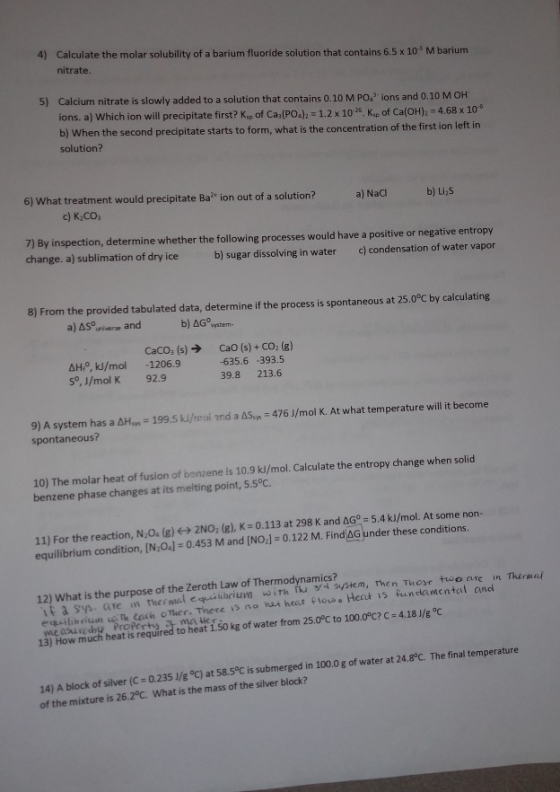
can you please show me the detailed steps for solving
each of the problems
thanks
Homework Answers
Question 4.
The solubility product of BaF2 (Ksp) = 10-6
Here, Ksp = [Ba2+][F-]2
i.e. 10-6 = [Ba(NO3)2]*[F-]2
i.e. 10-6 = 6.5*10-3 *[F-]2
i.e. [F-]2 = 0.153846*10-3
i.e. [F-] = 0.0124 M
Therefore, the molar sollubility of BaF2 in 6.5*10-3 M Ba(NO3)2 = 0.0124/2 = 6.2*10-3 M
Question 5.
a) Ca3(PO4)2 will precipitate first because the Ksp of Ca3(PO4)2 is less than that of Ca(OH)2.
b) Ksp of Ca3(PO4)2 = 1.2*10-25 = [Ca2+]3*[PO43-]2 = (3s)3*(2s)2 = 81 s5
i.e. s = 4.307*10-6 M
i.e. [Ca2+] = 3s = 1.292*10-5 M
Now, Ksp of Ca(OH)2 = [Ca2+][OH-]2
i.e. 4.68*10-6 = 1.292*10-5 * [OH-]2
i.e. [OH-]2 = 0.362
i.e. [OH-]= 0.602 M
Add Answer to:
can you please show me the detailed steps for solving
each of the problems
thanks
4)...
please help me with all the steps. 15. Which of the following mixtures would result in...
 please help me with all the steps.
15. Which of the following mixtures would result in a buffered solution? a. Mixing 100.0 mL of 0.100 M HCl with 100.0 mL of 0.100 M NaOH. b. Mixing 100.0 mL of 0.100 M NH3 (K5=1.8 x 10⁻⁵) with 100.0 mL of 0.100 M NaOH. c. Mixing 100.0 mL of 0.100 M HCl with 100.0 mL of 0.100 M NH; (K =18x 10 %. d. Mixing 50.0 mL of 0.100 M HCl with...
please help me with all the steps.
15. Which of the following mixtures would result in a buffered solution? a. Mixing 100.0 mL of 0.100 M HCl with 100.0 mL of 0.100 M NaOH. b. Mixing 100.0 mL of 0.100 M NH3 (K5=1.8 x 10⁻⁵) with 100.0 mL of 0.100 M NaOH. c. Mixing 100.0 mL of 0.100 M HCl with 100.0 mL of 0.100 M NH; (K =18x 10 %. d. Mixing 50.0 mL of 0.100 M HCl with...
please please answer all question 17. How many JOULES of energy are needed to warm 4.37...
 please please answer all question
17. How many JOULES of energy are needed to warm 4.37 g of silver (Ag) from 25.0 c to 27.5 C? The specific heat of silver is 0.24c a. 0.14J b. 2.6 c. 46 J d. 0.022 18. Given the table below of specific heat capacities, which one will experience the SMALLEST increase in temperature if 10.0 J of heat is added to 1.00 g of each of these substances? Water Cast iron Lead (Pb)...
please please answer all question
17. How many JOULES of energy are needed to warm 4.37 g of silver (Ag) from 25.0 c to 27.5 C? The specific heat of silver is 0.24c a. 0.14J b. 2.6 c. 46 J d. 0.022 18. Given the table below of specific heat capacities, which one will experience the SMALLEST increase in temperature if 10.0 J of heat is added to 1.00 g of each of these substances? Water Cast iron Lead (Pb)...
Print Name: Recitation 11 but 0.5% FCG Print Name: Print Name: Situation: 10.0 mL of 1,00...
 Print Name: Recitation 11 but 0.5% FCG Print Name: Print Name: Situation: 10.0 mL of 1,00 M silver(I) nitrate and 10.0 mL of 1.00 M sodium chloride aqueous solutions are thoroughly mixed in a calorimeter that has a heat capacity of 20.1/°C. A white dense precipitate is formed and settles to the bottom calorimeter (cup). The gram specific heat of the final product solution is 3.861J/g °C. The density of the final product solution is 1.10 /cm at the final...
Can you please provide detailed answers to the below question Question B2: (a) 100 mL of...
 Can you please provide detailed answers to the below
question
Question B2: (a) 100 mL of a 0.5 M solution of potassium nitrate is mixed with 100 mL of a 0.5 M solution of potassium chloride. What is the final concentration of hydrated potassium ions in this solution? (1 out of 5 marks) (b) How many moles of silver nitrate can be added to 100 mL of a 0.1 M aqueous sodium chloride solution before precipitation of solid silver chloride...
Can you please provide detailed answers to the below
question
Question B2: (a) 100 mL of a 0.5 M solution of potassium nitrate is mixed with 100 mL of a 0.5 M solution of potassium chloride. What is the final concentration of hydrated potassium ions in this solution? (1 out of 5 marks) (b) How many moles of silver nitrate can be added to 100 mL of a 0.1 M aqueous sodium chloride solution before precipitation of solid silver chloride...
Please answer 12-17 and show work. I’m not sure which equations to use 15. The gas...
 Please answer 12-17 and show work. I’m not sure which
equations to use
15. The gas above the liquid in a sealed bottle of soda is primarily carbon dioxide. Carbon dioxide is also dissolved in the soda. When the distribution of carbon dioxide between the gas and liquid is hase , , at equilibrium, molecules ofcarbon dioxide in the gas phase can stilldissolve in the iquid they strike the surface and are captured. Similarly, molecules of carbon dioxide can escape...
Please answer 12-17 and show work. I’m not sure which
equations to use
15. The gas above the liquid in a sealed bottle of soda is primarily carbon dioxide. Carbon dioxide is also dissolved in the soda. When the distribution of carbon dioxide between the gas and liquid is hase , , at equilibrium, molecules ofcarbon dioxide in the gas phase can stilldissolve in the iquid they strike the surface and are captured. Similarly, molecules of carbon dioxide can escape...
this is the rest of one of the problems can you please help (e) For each...
 this is the rest of one of the problems can you please help
(e) For each pairing, circle the system (State 1 or State 2) that has the higher entropy (or choose “SAME"). Assume that T and P are the same for each system unless stated otherwise. **NOTE: You must make THREE circles here--this is not a "multiple choice" question.** State 1 State 2 i) 1 mol Na(s) OR 1 mol Li(s) OR SAME ii) 2 mol CH4(g) in 10...
this is the rest of one of the problems can you please help
(e) For each pairing, circle the system (State 1 or State 2) that has the higher entropy (or choose “SAME"). Assume that T and P are the same for each system unless stated otherwise. **NOTE: You must make THREE circles here--this is not a "multiple choice" question.** State 1 State 2 i) 1 mol Na(s) OR 1 mol Li(s) OR SAME ii) 2 mol CH4(g) in 10...
Please can I have a detailed explanation of ALL QUESTIONS IN THIS PAGE ( CLEAR HANDWRITING)...
 Please can I have a detailed
explanation of ALL QUESTIONS IN THIS PAGE ( CLEAR HANDWRITING) +
PLEASE ANSWER THEM ALL!!
Question 4 (no working required in parts (a) and (b)) Data: specific heat capacities of silver, gold, ice, water respectively: G 234;c,-126; c,-2100; cw-4190 (all in J kg-"K-1) latent heat of fusion of water: lf density of silver: p1.05 x 104 kg m-3 assume specific heat capacities are constant (a) Which one of the following is true? (A) specific...
Please can I have a detailed
explanation of ALL QUESTIONS IN THIS PAGE ( CLEAR HANDWRITING) +
PLEASE ANSWER THEM ALL!!
Question 4 (no working required in parts (a) and (b)) Data: specific heat capacities of silver, gold, ice, water respectively: G 234;c,-126; c,-2100; cw-4190 (all in J kg-"K-1) latent heat of fusion of water: lf density of silver: p1.05 x 104 kg m-3 assume specific heat capacities are constant (a) Which one of the following is true? (A) specific...
please show work and maybe explanations ? Practice Problem 1 Calculate AH and AS for the...
 please show work and maybe explanations ?
Practice Problem 1 Calculate AH and AS for the following reaction (the Haber process for the manufacture of ammonia) and calculate if the reaction is favorable at STP. N2(g) + 3 H2(g) 2 NH3(g) (The following information may also be obtained from Appendix C in the Jespersen text.) Compound Enthalpy (kJ/mol) Entropy (J/mol-K) N2(9) H2(g) NH3(g) 0 191.61 130.68 192.45 -46.11 Practice Problem 2 Use the values of AH and AS calculated in...
please show work and maybe explanations ?
Practice Problem 1 Calculate AH and AS for the following reaction (the Haber process for the manufacture of ammonia) and calculate if the reaction is favorable at STP. N2(g) + 3 H2(g) 2 NH3(g) (The following information may also be obtained from Appendix C in the Jespersen text.) Compound Enthalpy (kJ/mol) Entropy (J/mol-K) N2(9) H2(g) NH3(g) 0 191.61 130.68 192.45 -46.11 Practice Problem 2 Use the values of AH and AS calculated in...
show all the steps please. I. What is the heat capacity of 185g of liquid water?...
 show all the steps please.
I. What is the heat capacity of 185g of liquid water? How many Kilojoules are needed to raise the temperature of 10 kg of liquid water from 24.6°C to 46.2°C and 38.5 mol of water from 38.1°C to 79.4°C? Ans: 774.04J/gC, 903.74Kj, 119.75KJ 2. A 2.200 g sample of quinone, C&402. is burned in a bomb Calorimeter whose total heat capacity is 7.854 kJ C. The temperature of calorimeter increases from 23.44°C to 30.57C. What...
show all the steps please.
I. What is the heat capacity of 185g of liquid water? How many Kilojoules are needed to raise the temperature of 10 kg of liquid water from 24.6°C to 46.2°C and 38.5 mol of water from 38.1°C to 79.4°C? Ans: 774.04J/gC, 903.74Kj, 119.75KJ 2. A 2.200 g sample of quinone, C&402. is burned in a bomb Calorimeter whose total heat capacity is 7.854 kJ C. The temperature of calorimeter increases from 23.44°C to 30.57C. What...
please answer the full thing 1. What would be the AE (in kJ) for the following...
 please answer the full thing
1. What would be the AE (in kJ) for the following reaction if 6.300 moles of H20 were decomposed? 2 H2O + 2H2 + O AE = 483.6 kJ (for reaction as written) 2. The value of AE for the reaction below is -336 kJ. Determine the amount of heat (in kJ) evolved when 13.0 g of HCl is formed. CH4(9) + 3 Cl2(g) - CHCI) + 3HCIO) 3. If 1.00 cal = 4.18 J,...
please answer the full thing
1. What would be the AE (in kJ) for the following reaction if 6.300 moles of H20 were decomposed? 2 H2O + 2H2 + O AE = 483.6 kJ (for reaction as written) 2. The value of AE for the reaction below is -336 kJ. Determine the amount of heat (in kJ) evolved when 13.0 g of HCl is formed. CH4(9) + 3 Cl2(g) - CHCI) + 3HCIO) 3. If 1.00 cal = 4.18 J,...
 please help me with all the steps.
15. Which of the following mixtures would result in a buffered solution? a. Mixing 100.0 mL of 0.100 M HCl with 100.0 mL of 0.100 M NaOH. b. Mixing 100.0 mL of 0.100 M NH3 (K5=1.8 x 10⁻⁵) with 100.0 mL of 0.100 M NaOH. c. Mixing 100.0 mL of 0.100 M HCl with 100.0 mL of 0.100 M NH; (K =18x 10 %. d. Mixing 50.0 mL of 0.100 M HCl with...
please help me with all the steps.
15. Which of the following mixtures would result in a buffered solution? a. Mixing 100.0 mL of 0.100 M HCl with 100.0 mL of 0.100 M NaOH. b. Mixing 100.0 mL of 0.100 M NH3 (K5=1.8 x 10⁻⁵) with 100.0 mL of 0.100 M NaOH. c. Mixing 100.0 mL of 0.100 M HCl with 100.0 mL of 0.100 M NH; (K =18x 10 %. d. Mixing 50.0 mL of 0.100 M HCl with...
 please please answer all question
17. How many JOULES of energy are needed to warm 4.37 g of silver (Ag) from 25.0 c to 27.5 C? The specific heat of silver is 0.24c a. 0.14J b. 2.6 c. 46 J d. 0.022 18. Given the table below of specific heat capacities, which one will experience the SMALLEST increase in temperature if 10.0 J of heat is added to 1.00 g of each of these substances? Water Cast iron Lead (Pb)...
please please answer all question
17. How many JOULES of energy are needed to warm 4.37 g of silver (Ag) from 25.0 c to 27.5 C? The specific heat of silver is 0.24c a. 0.14J b. 2.6 c. 46 J d. 0.022 18. Given the table below of specific heat capacities, which one will experience the SMALLEST increase in temperature if 10.0 J of heat is added to 1.00 g of each of these substances? Water Cast iron Lead (Pb)...
 Print Name: Recitation 11 but 0.5% FCG Print Name: Print Name: Situation: 10.0 mL of 1,00 M silver(I) nitrate and 10.0 mL of 1.00 M sodium chloride aqueous solutions are thoroughly mixed in a calorimeter that has a heat capacity of 20.1/°C. A white dense precipitate is formed and settles to the bottom calorimeter (cup). The gram specific heat of the final product solution is 3.861J/g °C. The density of the final product solution is 1.10 /cm at the final...
 Can you please provide detailed answers to the below
question
Question B2: (a) 100 mL of a 0.5 M solution of potassium nitrate is mixed with 100 mL of a 0.5 M solution of potassium chloride. What is the final concentration of hydrated potassium ions in this solution? (1 out of 5 marks) (b) How many moles of silver nitrate can be added to 100 mL of a 0.1 M aqueous sodium chloride solution before precipitation of solid silver chloride...
Can you please provide detailed answers to the below
question
Question B2: (a) 100 mL of a 0.5 M solution of potassium nitrate is mixed with 100 mL of a 0.5 M solution of potassium chloride. What is the final concentration of hydrated potassium ions in this solution? (1 out of 5 marks) (b) How many moles of silver nitrate can be added to 100 mL of a 0.1 M aqueous sodium chloride solution before precipitation of solid silver chloride...
 Please answer 12-17 and show work. I’m not sure which
equations to use
15. The gas above the liquid in a sealed bottle of soda is primarily carbon dioxide. Carbon dioxide is also dissolved in the soda. When the distribution of carbon dioxide between the gas and liquid is hase , , at equilibrium, molecules ofcarbon dioxide in the gas phase can stilldissolve in the iquid they strike the surface and are captured. Similarly, molecules of carbon dioxide can escape...
Please answer 12-17 and show work. I’m not sure which
equations to use
15. The gas above the liquid in a sealed bottle of soda is primarily carbon dioxide. Carbon dioxide is also dissolved in the soda. When the distribution of carbon dioxide between the gas and liquid is hase , , at equilibrium, molecules ofcarbon dioxide in the gas phase can stilldissolve in the iquid they strike the surface and are captured. Similarly, molecules of carbon dioxide can escape...
 this is the rest of one of the problems can you please help
(e) For each pairing, circle the system (State 1 or State 2) that has the higher entropy (or choose “SAME"). Assume that T and P are the same for each system unless stated otherwise. **NOTE: You must make THREE circles here--this is not a "multiple choice" question.** State 1 State 2 i) 1 mol Na(s) OR 1 mol Li(s) OR SAME ii) 2 mol CH4(g) in 10...
this is the rest of one of the problems can you please help
(e) For each pairing, circle the system (State 1 or State 2) that has the higher entropy (or choose “SAME"). Assume that T and P are the same for each system unless stated otherwise. **NOTE: You must make THREE circles here--this is not a "multiple choice" question.** State 1 State 2 i) 1 mol Na(s) OR 1 mol Li(s) OR SAME ii) 2 mol CH4(g) in 10...
 Please can I have a detailed
explanation of ALL QUESTIONS IN THIS PAGE ( CLEAR HANDWRITING) +
PLEASE ANSWER THEM ALL!!
Question 4 (no working required in parts (a) and (b)) Data: specific heat capacities of silver, gold, ice, water respectively: G 234;c,-126; c,-2100; cw-4190 (all in J kg-"K-1) latent heat of fusion of water: lf density of silver: p1.05 x 104 kg m-3 assume specific heat capacities are constant (a) Which one of the following is true? (A) specific...
Please can I have a detailed
explanation of ALL QUESTIONS IN THIS PAGE ( CLEAR HANDWRITING) +
PLEASE ANSWER THEM ALL!!
Question 4 (no working required in parts (a) and (b)) Data: specific heat capacities of silver, gold, ice, water respectively: G 234;c,-126; c,-2100; cw-4190 (all in J kg-"K-1) latent heat of fusion of water: lf density of silver: p1.05 x 104 kg m-3 assume specific heat capacities are constant (a) Which one of the following is true? (A) specific...
 please show work and maybe explanations ?
Practice Problem 1 Calculate AH and AS for the following reaction (the Haber process for the manufacture of ammonia) and calculate if the reaction is favorable at STP. N2(g) + 3 H2(g) 2 NH3(g) (The following information may also be obtained from Appendix C in the Jespersen text.) Compound Enthalpy (kJ/mol) Entropy (J/mol-K) N2(9) H2(g) NH3(g) 0 191.61 130.68 192.45 -46.11 Practice Problem 2 Use the values of AH and AS calculated in...
please show work and maybe explanations ?
Practice Problem 1 Calculate AH and AS for the following reaction (the Haber process for the manufacture of ammonia) and calculate if the reaction is favorable at STP. N2(g) + 3 H2(g) 2 NH3(g) (The following information may also be obtained from Appendix C in the Jespersen text.) Compound Enthalpy (kJ/mol) Entropy (J/mol-K) N2(9) H2(g) NH3(g) 0 191.61 130.68 192.45 -46.11 Practice Problem 2 Use the values of AH and AS calculated in...
 show all the steps please.
I. What is the heat capacity of 185g of liquid water? How many Kilojoules are needed to raise the temperature of 10 kg of liquid water from 24.6°C to 46.2°C and 38.5 mol of water from 38.1°C to 79.4°C? Ans: 774.04J/gC, 903.74Kj, 119.75KJ 2. A 2.200 g sample of quinone, C&402. is burned in a bomb Calorimeter whose total heat capacity is 7.854 kJ C. The temperature of calorimeter increases from 23.44°C to 30.57C. What...
show all the steps please.
I. What is the heat capacity of 185g of liquid water? How many Kilojoules are needed to raise the temperature of 10 kg of liquid water from 24.6°C to 46.2°C and 38.5 mol of water from 38.1°C to 79.4°C? Ans: 774.04J/gC, 903.74Kj, 119.75KJ 2. A 2.200 g sample of quinone, C&402. is burned in a bomb Calorimeter whose total heat capacity is 7.854 kJ C. The temperature of calorimeter increases from 23.44°C to 30.57C. What...
 please answer the full thing
1. What would be the AE (in kJ) for the following reaction if 6.300 moles of H20 were decomposed? 2 H2O + 2H2 + O AE = 483.6 kJ (for reaction as written) 2. The value of AE for the reaction below is -336 kJ. Determine the amount of heat (in kJ) evolved when 13.0 g of HCl is formed. CH4(9) + 3 Cl2(g) - CHCI) + 3HCIO) 3. If 1.00 cal = 4.18 J,...
please answer the full thing
1. What would be the AE (in kJ) for the following reaction if 6.300 moles of H20 were decomposed? 2 H2O + 2H2 + O AE = 483.6 kJ (for reaction as written) 2. The value of AE for the reaction below is -336 kJ. Determine the amount of heat (in kJ) evolved when 13.0 g of HCl is formed. CH4(9) + 3 Cl2(g) - CHCI) + 3HCIO) 3. If 1.00 cal = 4.18 J,...
Most questions answered within 3 hours.
-
Where is the error in this code sequence?
String s1 = "Hello";
String s2 = "ello";...
asked 10 months ago -
Financial data for Joel de Paris, Inc., for last year
follow:
Joel de Paris, Inc.
Balance...
asked 10 months ago -
Consider this reaction:
Al2(SO4)3 (aq)+ BaCl3
(aq) Al2Cl6 (aq)- +
3BaSO4(s) . What is the...
asked 10 months ago -
Suppose that Savneet is considering increasing her
recent random sample from 20 car rentals to 40...
asked 10 months ago -
Trucks arrive at an unloading terminal at an average rate of 120
per hour.
Trucks arrive...
asked 10 months ago -
Why are methanol and ethanol completely soluble in water while
octanol is not very little soluble....
asked 10 months ago -
A facilities manager at a university reads in a research report
that the mean amount of...
asked 10 months ago -
When the CuSO4 is rehydrated by adding water to the anhydrous
compound, is this an endothermic...
asked 10 months ago -
A ray of sunlight is passing from diamond into crown glass; the
angle of incidence is...
asked 10 months ago -
A block of mass 0.249 kg is placed on top of a light, vertical
spring of...
asked 10 months ago -
how do the kidneys compensate in the presences of acidosis
a) trigger hyperventilate
b) reserve acid...
asked 10 months ago -
Question 501 pts
The rental rate of capital to the firm increases. Which of the
following...
asked 10 months ago