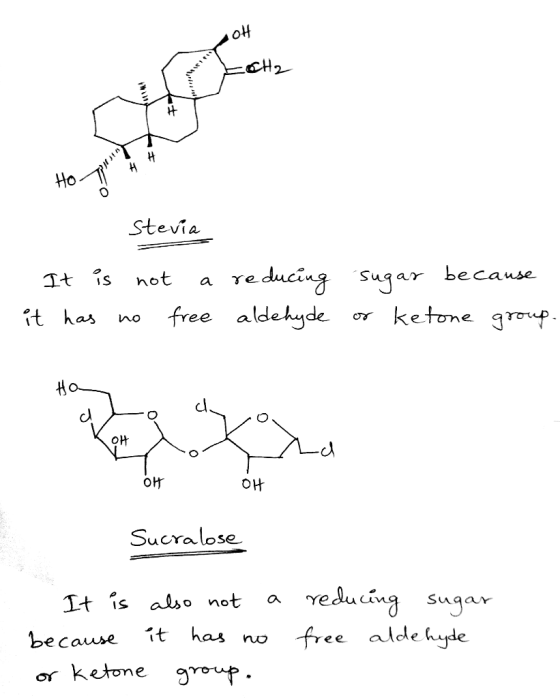
are stevia and sucralose reducing sugars?
Homework Answers
Reducing sugars are the sugars which can which can act as reducing agents. Usually the sugars which have atleast one free aldehyde or ketone functional group.
Which of the following are reducing sugars? (Circle the reducing sugars)
 Which of the following are reducing sugars? (Circle the reducing sugars).Explain why.14 (5).pdf
Classify the following carbohydrates as either reducing sugars or non-reducing sugars. PLEASE explain why / what...
 Classify the following carbohydrates as either reducing sugars or
non-reducing sugars. PLEASE explain why / what your reasoning
is.
Classify the following carbohydrates as either reducing sugars or non-reducing sugars.
Classify the following carbohydrates as either reducing sugars or
non-reducing sugars. PLEASE explain why / what your reasoning
is.
Classify the following carbohydrates as either reducing sugars or non-reducing sugars.
Which of the following sugars are reducing sugars? Why?
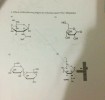 Which of the following sugars are reducing sugars? Why?
True Falsealdehyde groups are easily oxidizedall aldoses are reducing sugars reducing sugars are so named because...
 True Falsealdehyde groups are easily oxidizedall aldoses are reducing sugars reducing sugars are so named because the sugar is reduced in thereaction with Benedict?s reagentthe oxidation of a reducingsugar produces an alcohol reducing sugars react with Cu2+in Benedict?s reagentin the presence of Benedict?s reagentsome ketoses can be reducing sugars
Classify the following compounds as reducing sugars, non-reducing sugars, or neither: CH2OH CH2OH HONO CH2OH НО...
 Classify the following compounds as reducing sugars, non-reducing sugars, or neither: CH2OH CH2OH HONO CH2OH НО НО CH2OH CH2OH НО- ONOH но но- HONO CH2OH но. HONO но от OCH3 OH но- ОН OH HO A с но но сHOH но снон CH OH CH2OH HONO ноу. НОА но -о но I H NH₂ HO но ОН N o="cs но і HO Но, IZ но го Е сн,он 1. non-reducing sugar - АА. C- B 2. reducing sugar - с...
What is a biology solution that doesn't contain starch or lipids but contains reducing (simple sugars)...
What is a biology solution that doesn't contain starch or lipids but contains reducing (simple sugars) and proteins?
7. Circle the reducing sugars in the following: Glucose Glyceraldehyde Ribose Sucrose Lactose Trehalose Maltose
 7. Circle the reducing sugars in the following: Glucose Glyceraldehyde Ribose Sucrose Lactose Trehalose Maltose
Classify all the following statements regarding reducing sugars as either true or false. Note: If any...
 Classify all the following statements regarding reducing sugars as either true or false.
Note: If any part of this question is answered incorrectly, a single red X will appear indicating that one or more phrases have been placed incorrectly.
Classify all the following statements regarding reducing sugars as either true or false.
Note: If any part of this question is answered incorrectly, a single red X will appear indicating that one or more phrases have been placed incorrectly.
IJ PLS a. Benedict's reagent is used to identify reducing sugars. What produces the color that...
 IJ PLS a. Benedict's reagent is used to identify reducing sugars. What produces the color that indicated a positive result? b. What type of carbohydrate is glycogen? Which test would you use to check for its presence in an unknown sample? c. What color indicated the presence of ketohexoses in your carbohydrate sample! B I V A - A - HTML Editora IX E
During baking, reducing sugars react with proteins in food to generate adducts with brown color and...
During baking, reducing sugars react with proteins in food to generate adducts with brown color and different flavors (this is why bread becomes darker and has a different taste when toasted). The first step in this process is a condensation between a carbonyl group and an amino group. For example, the carbonyl carbon of glucose can condense with the ϵ-amino group of a lysine side chain to form a Schiff base. Draw the product of this reaction.
 Classify the following carbohydrates as either reducing sugars or
non-reducing sugars. PLEASE explain why / what your reasoning
is.
Classify the following carbohydrates as either reducing sugars or non-reducing sugars.
Classify the following carbohydrates as either reducing sugars or
non-reducing sugars. PLEASE explain why / what your reasoning
is.
Classify the following carbohydrates as either reducing sugars or non-reducing sugars.
 Which of the following sugars are reducing sugars? Why?
 True Falsealdehyde groups are easily oxidizedall aldoses are reducing sugars reducing sugars are so named because the sugar is reduced in thereaction with Benedict?s reagentthe oxidation of a reducingsugar produces an alcohol reducing sugars react with Cu2+in Benedict?s reagentin the presence of Benedict?s reagentsome ketoses can be reducing sugars
 Classify the following compounds as reducing sugars, non-reducing sugars, or neither: CH2OH CH2OH HONO CH2OH НО НО CH2OH CH2OH НО- ONOH но но- HONO CH2OH но. HONO но от OCH3 OH но- ОН OH HO A с но но сHOH но снон CH OH CH2OH HONO ноу. НОА но -о но I H NH₂ HO но ОН N o="cs но і HO Но, IZ но го Е сн,он 1. non-reducing sugar - АА. C- B 2. reducing sugar - с...
 7. Circle the reducing sugars in the following: Glucose Glyceraldehyde Ribose Sucrose Lactose Trehalose Maltose
 Classify all the following statements regarding reducing sugars as either true or false.
Note: If any part of this question is answered incorrectly, a single red X will appear indicating that one or more phrases have been placed incorrectly.
Classify all the following statements regarding reducing sugars as either true or false.
Note: If any part of this question is answered incorrectly, a single red X will appear indicating that one or more phrases have been placed incorrectly.
 IJ PLS a. Benedict's reagent is used to identify reducing sugars. What produces the color that indicated a positive result? b. What type of carbohydrate is glycogen? Which test would you use to check for its presence in an unknown sample? c. What color indicated the presence of ketohexoses in your carbohydrate sample! B I V A - A - HTML Editora IX E
Most questions answered within 3 hours.
-
Where is the error in this code sequence?
String s1 = "Hello";
String s2 = "ello";...
asked 11 months ago -
Financial data for Joel de Paris, Inc., for last year
follow:
Joel de Paris, Inc.
Balance...
asked 11 months ago -
Consider this reaction:
Al2(SO4)3 (aq)+ BaCl3
(aq) Al2Cl6 (aq)- +
3BaSO4(s) . What is the...
asked 11 months ago -
Suppose that Savneet is considering increasing her
recent random sample from 20 car rentals to 40...
asked 11 months ago -
Trucks arrive at an unloading terminal at an average rate of 120
per hour.
Trucks arrive...
asked 11 months ago -
Why are methanol and ethanol completely soluble in water while
octanol is not very little soluble....
asked 11 months ago -
A facilities manager at a university reads in a research report
that the mean amount of...
asked 11 months ago -
When the CuSO4 is rehydrated by adding water to the anhydrous
compound, is this an endothermic...
asked 11 months ago -
A ray of sunlight is passing from diamond into crown glass; the
angle of incidence is...
asked 11 months ago -
A block of mass 0.249 kg is placed on top of a light, vertical
spring of...
asked 11 months ago -
how do the kidneys compensate in the presences of acidosis
a) trigger hyperventilate
b) reserve acid...
asked 11 months ago -
Question 501 pts
The rental rate of capital to the firm increases. Which of the
following...
asked 11 months ago