explain the physiological importance of the liver, pancreas, and the kidneys for the proper functioning of...
explain the physiological importance of the liver, pancreas, and the kidneys for the proper functioning of the human body
Homework Answers
Answer: Liver is the vital part of our body as it regulates and performs many functions. The liver cells, called hepatocytes and it contains many essential enzymes which perform major metabolic functions. The physiological importance of liver are:
- The liver produces bile and it is stored in the gall bladder as bile is secreted by the liver in a day. Bile salts such as sodium bicarbonate, sodium glycocholate, sodium taurocholate helps in the digestion of fats in the small intestine.
- Due to the proper functioning of the liver and its process ammonia group is removed from the amino acids resulting in urea. This helps to deaminate the presence of harmful ammonia from our body.
- The major role liver play is the conversion of the excess of glucose into glycogen by liver cells with the help of insulin secreted by the pancreas i.e. also known as glycogenesis.
- Liver helps in clotting of blood by producing blood proteins such as pro-thrombin and fibrinogen.
The physiological importance of pancreas:
- The pancreas performs two major functions an endocrine function that regulates blood sugar and an exocrine function that helps in digestion. As soon as food enters the stomach, the pancreatic juices are released into a system of pancreatic duct which combined with the common bile duct to the small intestine i.e. duodenum. The liver and the gallbladder produces important digestive juice called bile. The pancreatic juices and bile that are released into the duodenum, help the body to digest fats, carbohydrates, and proteins.
- The endocrine function is maintaining proper blood sugar levels as it contributes in the functioning of vital organs including the brain, liver, and kidneys.
The physiological importance of kidney:
- It maintains overall body fluid balance.
- It regulates and filter minerals from blood.
- It creates hormones that help produce red blood cells and regulate blood pressure.
Add Answer to:
explain the physiological importance of the liver, pancreas, and
the kidneys for the proper functioning of...
Component Function Location in the body (anterior, posterior, quadrant?) Liver Gallbladder Kidneys Duodenum Colon, ascending, transverse,...
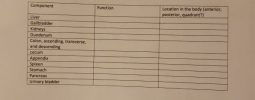 Component Function Location in the body (anterior, posterior, quadrant?) Liver Gallbladder Kidneys Duodenum Colon, ascending, transverse, and descending cecum Appendix Spleen Stomach Pancreas Urinary bladder
In general, which organ must be functioning for proper excretion? Question 8 options: The heart The...
In general, which organ must be functioning for proper excretion? Question 8 options: The heart The kidneys The liver The brain In general, which organ must be function for proper metabolism of drugs? Question 9 options: The liver The kidneys The heart The brain True or False, if either of the organs that were answers to the previous two questions are not fully functioning, the patient's response to medication may be altered. Question 10 options: True False Who is MOST...
Model 2 - Feedback Control of Blood Glucose Pancreas .. Liver Other cells OO Blood glucose...
 Model 2 - Feedback Control of Blood Glucose Pancreas .. Liver Other cells OO Blood glucose is too high. Cycle A Blood glucose drops. Baseline blood glucose level. Blood glucose rises. Glucose Insulin Glycogen Glucagon Cycle B Blood glucose is too low. 7. Where in the body does insulin and glucagon originate? 8. In what form is glucose stored in the liver and what is the consequence in terms of glucose blood levels? 10. Which hormone (insulin or glucagon) helps...
Discuss the metabolic importance and implications of malonyl CoA functioning as a negative allosteric regulator of...
Discuss the metabolic importance and implications of malonyl CoA functioning as a negative allosteric regulator of carnitine palmitoyl transferase-1 (CPT-1; also known as as carnitine acyltransferase-1 or CAT-1)? (Explain and answer thoroughly)
Role of the Pancreas Key: pancreas glucagon &n
Role of the Pancreas Key: pancreas glucagon endocrine insulin exocrine Type II diabetes Type I diabetes ________________ is gland located under the stomach that produces insulin and glucagon The pancreas has an _______________ function to secrete sodium bicarbonate and digestive enzymes and also an ________________function to secrete insulin and glucagon hormones _____________ is the only hormone that causes blood sugar levels to lower as it signals cells to take up glucose for their energy source and signals the liver...
what is the structural importance of the cell membrane to the cell and explain in detail...
what is the structural importance of the cell membrane to the cell and explain in detail the physiological importance and function in the cell.
Background: Functioning of any organ or a component of an organ in the human body can...
Background: Functioning of any organ or a component of an organ in the human body can be modeled as a system with inputs and outputs. Although most biological systems are non-linear, simplified linear models are valuable in various applications such as designing biomedical instruments, drug dosage, and process control. Conduct a comprehensive literature search to find linear models of physiological system/process. Based on your search, choose a physiological system to model. Identify the inputs/outputs and the system equation/s that relate...
QUESTION 20 Neurons release neurotransmitters to perform a certain task necessary for the proper functioning of...
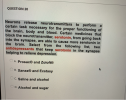 QUESTION 20 Neurons release neurotransmitters to perform a certain task necessary for the proper functioning of the brain, body and blood. Certain medicines that block the neurotransmitter, serotonin, from going back into the synapse, are able to cause more serotonin in the brain. Select from the following list, two antidepressants that keep serotonin in the synapse helping to relieve depression. A. Prosac® and Zoloft® B. Xanax® and Ecstasy C. Saline and alcohol OD. Alcohol and sugar
Which statement about energy metabolism is correct? a. Glycogen stored in the pancreas provides a reserve...
Which statement about energy metabolism is correct? a. Glycogen stored in the pancreas provides a reserve supply of glucose. b. Vitamins stored in the gallbladder are released as needed. c. During an extended fast, fat reserves stored in fat cells provide energy for cellular processes. d. Liver cells hold reserves of calcium and sodium that can be drawn on to keep blood levels constant. e. Amino acids stored in the kidneys can supply protein needs on a long-term basis. Which...
Section A – Answer only ONE question from this section 1. Explain the physiological concept of...
Section A – Answer only ONE question from this section 1. Explain the physiological concept of flow down gradients and illustrate your understanding by presenting three examples from at least two different body systems. In your answer include the terms gradient and resistance. 2. Explain the physiological concept of structure-function relationships (structure enables function) and illustrate your understanding by presenting three examples from at least two different body systems. Section B – Answer only ONE question from this section 3....
 Component Function Location in the body (anterior, posterior, quadrant?) Liver Gallbladder Kidneys Duodenum Colon, ascending, transverse, and descending cecum Appendix Spleen Stomach Pancreas Urinary bladder
 Model 2 - Feedback Control of Blood Glucose Pancreas .. Liver Other cells OO Blood glucose is too high. Cycle A Blood glucose drops. Baseline blood glucose level. Blood glucose rises. Glucose Insulin Glycogen Glucagon Cycle B Blood glucose is too low. 7. Where in the body does insulin and glucagon originate? 8. In what form is glucose stored in the liver and what is the consequence in terms of glucose blood levels? 10. Which hormone (insulin or glucagon) helps...
 QUESTION 20 Neurons release neurotransmitters to perform a certain task necessary for the proper functioning of the brain, body and blood. Certain medicines that block the neurotransmitter, serotonin, from going back into the synapse, are able to cause more serotonin in the brain. Select from the following list, two antidepressants that keep serotonin in the synapse helping to relieve depression. A. Prosac® and Zoloft® B. Xanax® and Ecstasy C. Saline and alcohol OD. Alcohol and sugar
Most questions answered within 3 hours.
-
Where is the error in this code sequence?
String s1 = "Hello";
String s2 = "ello";...
asked 10 months ago -
Financial data for Joel de Paris, Inc., for last year
follow:
Joel de Paris, Inc.
Balance...
asked 10 months ago -
Consider this reaction:
Al2(SO4)3 (aq)+ BaCl3
(aq) Al2Cl6 (aq)- +
3BaSO4(s) . What is the...
asked 10 months ago -
Suppose that Savneet is considering increasing her
recent random sample from 20 car rentals to 40...
asked 10 months ago -
Trucks arrive at an unloading terminal at an average rate of 120
per hour.
Trucks arrive...
asked 10 months ago -
Why are methanol and ethanol completely soluble in water while
octanol is not very little soluble....
asked 10 months ago -
A facilities manager at a university reads in a research report
that the mean amount of...
asked 10 months ago -
When the CuSO4 is rehydrated by adding water to the anhydrous
compound, is this an endothermic...
asked 10 months ago -
A ray of sunlight is passing from diamond into crown glass; the
angle of incidence is...
asked 10 months ago -
A block of mass 0.249 kg is placed on top of a light, vertical
spring of...
asked 10 months ago -
how do the kidneys compensate in the presences of acidosis
a) trigger hyperventilate
b) reserve acid...
asked 10 months ago -
Question 501 pts
The rental rate of capital to the firm increases. Which of the
following...
asked 10 months ago