Example 7.7 Buckle Up for Safety Goal Calculate the frictional force that causes an object to...
| Example 7.7 Buckle Up for Safety | |||||||||||
|
 |
||||||||||
 Solution Solution |
|||||||||||
|
|
|
|||||||||
 |
|||||||||||

 n = mg
|
||||||||||||||||


Homework Answers
Add Answer to:
Example 7.7 Buckle Up for
Safety
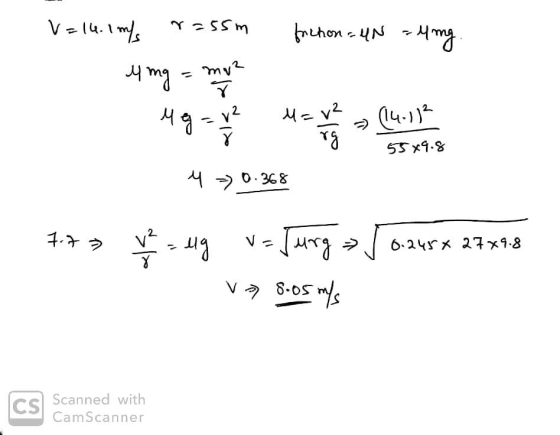
Goal Calculate the frictional force that
causes an object to...
Problem A car travels at a constant speed of 29.5 mi/h (13.2 m/s) on a level...
 Problem A car travels at a constant speed of 29.5 mi/h (13.2 m/s) on a level circular turn of radius 46.0 m, as shown in the bird's-eye view in Figure 7.13a. What minimum coefficient of static friction, Aus, between the tires and the roadway will allow the car to make the circular turn without sliding? Strategy In the car's free-body diagram (Fig. 7.13b) the normal direction is vertical and the tangential direction is into the page (step 2). Use Newton's...
A civil engineer wishes to redesign the curved roadway in the figure in such a way...
A civil engineer wishes to redesign the curved roadway in the figure in such a way that a car will not have to rely on friction to round the curve without skidding. In other words, a car moving at the designated speed can negotiate the curve even when the road is covered with ice. Such a ramp is usually banked, which means that the roadway is tilted toward the inside of the curve. Suppose the designated speed for the road...
A car travels at a constant speed of 32.5 mi/h (14.5 m/s) on a level circular...
A car travels at a constant speed of 32.5 mi/h (14.5 m/s) on a level circular turn of radius 49.0 m, as shown in the bird's-eye view in figure a. What minimum coefficient of static friction, μs, between the tires and the roadway will allow the car to make the circular turn without sliding? 1 ) make the circular turn without sliding? 2 ) At what maximum speed can a car negotiate a turn on a wet road with coefficient...
Banked curves are designed so that the radial component of the normal force on the car rounding
Banked curves are designed so that the radial component of the normal force on the car rounding the curve provides the centripetal force required to execute uniform clrcular motion and safely negotlate the curve. A car rounds a banked curve with banking angle θ-27.1° and radius of curvature 157 m. (a) It the coefficient of static friction between the car's tires and the road is -0.316, what is the range ot speeds for which the car can safely negotiate the turn...
Please show and explain work. A driver is turning around a curve of radius 300 in...
 Please show and explain work.
A driver is turning around a curve of radius 300 in on Hat ground. The 1500 kg car is trawling a constant speed of 30 m/s. What is the magnitude and direction of the force causing the car to move in a circular path? What type of force is this? (Normal, friction, tension, etc...) If the static friction coefficient is 0.7, how fast could the car take the turn without slipping or deviating from the...
Please show and explain work.
A driver is turning around a curve of radius 300 in on Hat ground. The 1500 kg car is trawling a constant speed of 30 m/s. What is the magnitude and direction of the force causing the car to move in a circular path? What type of force is this? (Normal, friction, tension, etc...) If the static friction coefficient is 0.7, how fast could the car take the turn without slipping or deviating from the...
Brake or turn? Figure 6-45 depicts an overhead view of a car's path as the car...
 Brake or turn? Figure 6-45 depicts an overhead view of
a car's path as the car travels toward a wall. Assume that the
driver begins to brake the car when the distance to the wall is
d = 109 m, and take the car's mass as m = 1430
kg, its initial speed as v0 = 37.0 m/s, and the
coefficient of static friction as μs = 0.530.
Assume that the car's weight is distributed evenly on the four
wheels,...
Brake or turn? Figure 6-45 depicts an overhead view of
a car's path as the car travels toward a wall. Assume that the
driver begins to brake the car when the distance to the wall is
d = 109 m, and take the car's mass as m = 1430
kg, its initial speed as v0 = 37.0 m/s, and the
coefficient of static friction as μs = 0.530.
Assume that the car's weight is distributed evenly on the four
wheels,...
Flying Circus of Physics Brake or turn? The figure depicts an overhead view of a car's...
 Flying Circus of Physics Brake or turn? The figure depicts an overhead view of a car's path as the car travels toward a wall. Assume that the driver begins to brake the car when the distance to the walls d - 111 m, and take the car's massas m - 1400 kg, its initial speed as 35.0 m/s, and the coefident of static friction -0.540. Assume that the car's is distributed evenly on the four wheels, even during braking. (a)...
Help please I don't no how to do these The curved section of a horizontal highway...
 Help please I don't no how to do these
The curved section of a horizontal highway is a circular unbanked areof radius 760 m. If the coefficient of statiefriction between this roadway and typical tires is 0.40m, what would be the maximum safe driving speed for this horizontal curved section of highway? When a car goes around a banked circular curve at the proper speed for the banking angle, what force cause it to follow the circular path? gravity the...
Help please I don't no how to do these
The curved section of a horizontal highway is a circular unbanked areof radius 760 m. If the coefficient of statiefriction between this roadway and typical tires is 0.40m, what would be the maximum safe driving speed for this horizontal curved section of highway? When a car goes around a banked circular curve at the proper speed for the banking angle, what force cause it to follow the circular path? gravity the...
As a car drives with its tires rolling freely without any slippage, the type of friction...
 As a car drives with its tires rolling freely without any slippage, the type of friction acting between the tires and the road is A) static friction. B) kinetic friction. C) a combination of static and kinetic friction. D) neither static nor kinetic friction but some other type of friction. E) It is impossible to tell what type of friction acts in this situation. A car of mass m goes around a banked curve of radius r with speed v....
Calculate the maximum acceleration of a car that is heading up a 6∘ slope (one that...
Calculate the maximum acceleration of a car that is heading up a 6∘ slope (one that makes an angle of 6∘ with the horizontal) under the following road conditions. Assume that only half the weight of the car is supported by the two drive wheels and that the coefficient of static friction is involvedthat is, the tires are not allowed to slip during the acceleration. (Ignore rolling). a) On dry concrete: b) On wet concrete: c) On ice, assuming that...
 Problem A car travels at a constant speed of 29.5 mi/h (13.2 m/s) on a level circular turn of radius 46.0 m, as shown in the bird's-eye view in Figure 7.13a. What minimum coefficient of static friction, Aus, between the tires and the roadway will allow the car to make the circular turn without sliding? Strategy In the car's free-body diagram (Fig. 7.13b) the normal direction is vertical and the tangential direction is into the page (step 2). Use Newton's...
 Please show and explain work.
A driver is turning around a curve of radius 300 in on Hat ground. The 1500 kg car is trawling a constant speed of 30 m/s. What is the magnitude and direction of the force causing the car to move in a circular path? What type of force is this? (Normal, friction, tension, etc...) If the static friction coefficient is 0.7, how fast could the car take the turn without slipping or deviating from the...
Please show and explain work.
A driver is turning around a curve of radius 300 in on Hat ground. The 1500 kg car is trawling a constant speed of 30 m/s. What is the magnitude and direction of the force causing the car to move in a circular path? What type of force is this? (Normal, friction, tension, etc...) If the static friction coefficient is 0.7, how fast could the car take the turn without slipping or deviating from the...
 Brake or turn? Figure 6-45 depicts an overhead view of
a car's path as the car travels toward a wall. Assume that the
driver begins to brake the car when the distance to the wall is
d = 109 m, and take the car's mass as m = 1430
kg, its initial speed as v0 = 37.0 m/s, and the
coefficient of static friction as μs = 0.530.
Assume that the car's weight is distributed evenly on the four
wheels,...
Brake or turn? Figure 6-45 depicts an overhead view of
a car's path as the car travels toward a wall. Assume that the
driver begins to brake the car when the distance to the wall is
d = 109 m, and take the car's mass as m = 1430
kg, its initial speed as v0 = 37.0 m/s, and the
coefficient of static friction as μs = 0.530.
Assume that the car's weight is distributed evenly on the four
wheels,...
 Flying Circus of Physics Brake or turn? The figure depicts an overhead view of a car's path as the car travels toward a wall. Assume that the driver begins to brake the car when the distance to the walls d - 111 m, and take the car's massas m - 1400 kg, its initial speed as 35.0 m/s, and the coefident of static friction -0.540. Assume that the car's is distributed evenly on the four wheels, even during braking. (a)...
 Help please I don't no how to do these
The curved section of a horizontal highway is a circular unbanked areof radius 760 m. If the coefficient of statiefriction between this roadway and typical tires is 0.40m, what would be the maximum safe driving speed for this horizontal curved section of highway? When a car goes around a banked circular curve at the proper speed for the banking angle, what force cause it to follow the circular path? gravity the...
Help please I don't no how to do these
The curved section of a horizontal highway is a circular unbanked areof radius 760 m. If the coefficient of statiefriction between this roadway and typical tires is 0.40m, what would be the maximum safe driving speed for this horizontal curved section of highway? When a car goes around a banked circular curve at the proper speed for the banking angle, what force cause it to follow the circular path? gravity the...
 As a car drives with its tires rolling freely without any slippage, the type of friction acting between the tires and the road is A) static friction. B) kinetic friction. C) a combination of static and kinetic friction. D) neither static nor kinetic friction but some other type of friction. E) It is impossible to tell what type of friction acts in this situation. A car of mass m goes around a banked curve of radius r with speed v....
Most questions answered within 3 hours.
-
Where is the error in this code sequence?
String s1 = "Hello";
String s2 = "ello";...
asked 10 months ago -
Financial data for Joel de Paris, Inc., for last year
follow:
Joel de Paris, Inc.
Balance...
asked 10 months ago -
Consider this reaction:
Al2(SO4)3 (aq)+ BaCl3
(aq) Al2Cl6 (aq)- +
3BaSO4(s) . What is the...
asked 10 months ago -
Suppose that Savneet is considering increasing her
recent random sample from 20 car rentals to 40...
asked 10 months ago -
Trucks arrive at an unloading terminal at an average rate of 120
per hour.
Trucks arrive...
asked 10 months ago -
Why are methanol and ethanol completely soluble in water while
octanol is not very little soluble....
asked 10 months ago -
A facilities manager at a university reads in a research report
that the mean amount of...
asked 10 months ago -
When the CuSO4 is rehydrated by adding water to the anhydrous
compound, is this an endothermic...
asked 10 months ago -
A ray of sunlight is passing from diamond into crown glass; the
angle of incidence is...
asked 10 months ago -
A block of mass 0.249 kg is placed on top of a light, vertical
spring of...
asked 10 months ago -
how do the kidneys compensate in the presences of acidosis
a) trigger hyperventilate
b) reserve acid...
asked 10 months ago -
Question 501 pts
The rental rate of capital to the firm increases. Which of the
following...
asked 10 months ago