Calculate the maximum acceleration of a car that is heading up a 6∘ slope (one that...
Calculate the maximum acceleration of a car that is heading up a 6∘ slope (one that makes an angle of 6∘ with the horizontal) under the following road conditions. Assume that only half the weight of the car is supported by the two drive wheels and that the coefficient of static friction is involvedthat is, the tires are not allowed to slip during the acceleration. (Ignore rolling).
a) On dry concrete:
b) On wet concrete:
c) On ice, assuming that the coefficient of static friction is the same as for shoes on ice:
Hint: For each of (a), (b), and (c), you will need to determine the appropriate coefficient of static friction. What forces (or components thereof) act on the car? How is the normal force affected, given that the drive wheels only support half of the car's weight?
Homework Answers


Add Answer to:
Calculate the maximum acceleration of a car that is heading up a
6∘ slope (one that...
Calculate the maximum acceleration (in m/s2) of a car that is heading down a 6.290 slope...
 Calculate the maximum acceleration (in m/s2) of a car that is heading down a 6.290 slope (one that makes an angle of 6.290 with the horizontal) under the following road conditions. You may assume that the weight of the car is evenly distributed on all four tires and that the static coefficient of friction is involved-that is, the tires are not allowed to slip during the acceleration. (Ignore rolling friction. Assume the positive direction is down the slope. Indicate the...
I just need help with part C please! I'm struggling! Thank you. a) If half of...
 I just need help with part C please! I'm struggling! Thank
you.
a) If half of the weight of a flatbed truck is supported by its two
drive wheels, what is the maximum acceleration (in m/s^2) it can
achieve on dry concrete where the coefficient of kinetic friction
is 0.7 and the coefficient of static friction is 1.
The answer is 4.9 m/s^2.
b) Will a metal cabinet lying on the wooden bed if the truck
slip if it accelerates...
I just need help with part C please! I'm struggling! Thank
you.
a) If half of the weight of a flatbed truck is supported by its two
drive wheels, what is the maximum acceleration (in m/s^2) it can
achieve on dry concrete where the coefficient of kinetic friction
is 0.7 and the coefficient of static friction is 1.
The answer is 4.9 m/s^2.
b) Will a metal cabinet lying on the wooden bed if the truck
slip if it accelerates...
can someone answer C, I feel like im doing it correctly but keep gettting told my...
 can
someone answer C, I feel like im doing it correctly but keep
gettting told my answer is wrong. thank you.
Calculate the maximum deceleration (in assume that the weight of the car is evenly )of a car that is heading down a 12.5 slope one that makes an angle of 12.5° with the horontal) under the following road condition. You may tributed on all four tres and that the state coefficient of friction is involved that is, the tires...
can
someone answer C, I feel like im doing it correctly but keep
gettting told my answer is wrong. thank you.
Calculate the maximum deceleration (in assume that the weight of the car is evenly )of a car that is heading down a 12.5 slope one that makes an angle of 12.5° with the horontal) under the following road condition. You may tributed on all four tres and that the state coefficient of friction is involved that is, the tires...
oad conditions. You may assume that the weight of the car is evenly distributed on all...
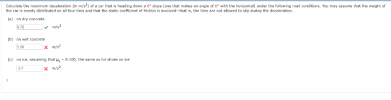 oad conditions. You may assume that the weight of the car is evenly distributed on all four tires and that the statlc coefficient of friction is involved-that is the tires are not allowed to slin duriog the deceleration (a) on dry concrete m/s2 8.72 (b) on wet concrete 5 56 x m/s2 (c) on ice, assuming that u- 0.100, the same as for shoes on ice x m/s2 3.7
You are driving your car along a flat, curved road; the curve in the road is...
You are driving your car along a flat, curved road; the curve in the road is a segment of a circle with radius 50 meters. (We call this a "radius of curvature"). How fast can the car drive around the curve if the coefficient of static friction between the tires and the road is 1.0 (tires on dry pavement)? What if the coefficient of friction is 0.2 (tires on ice)?
Calculate the maximal friction force for a parked car between the rubber tires and a wet...
Calculate the maximal friction force for a parked car between the rubber tires and a wet street. Assume the car's mass is 1600 kg with a weight of 15680 N. The static friction coefficient for rubber and wet asphalt is μs=0.8.
please do as many as you can please thanks alot VU22475 Apply Scientific Principles to Engineering...
 please do as many as you can
please
thanks alot
VU22475 Apply Scientific Principles to Engineering Problems Calculate the maximum deceleration of a car that is heading down a 8 slope (one that makes an angle of 8 with the horizontal). You may assume that the weight of the car is evenly distributed on all four tires and that the coefficient of static friction is involved - that is, the tires are not allowed to slip during the deceleration. The...
please do as many as you can
please
thanks alot
VU22475 Apply Scientific Principles to Engineering Problems Calculate the maximum deceleration of a car that is heading down a 8 slope (one that makes an angle of 8 with the horizontal). You may assume that the weight of the car is evenly distributed on all four tires and that the coefficient of static friction is involved - that is, the tires are not allowed to slip during the deceleration. The...
Brake or turn? Figure 6-45 depicts an overhead view of a car's path as the car...
 Brake or turn? Figure 6-45 depicts an overhead view of
a car's path as the car travels toward a wall. Assume that the
driver begins to brake the car when the distance to the wall is
d = 109 m, and take the car's mass as m = 1430
kg, its initial speed as v0 = 37.0 m/s, and the
coefficient of static friction as μs = 0.530.
Assume that the car's weight is distributed evenly on the four
wheels,...
Brake or turn? Figure 6-45 depicts an overhead view of
a car's path as the car travels toward a wall. Assume that the
driver begins to brake the car when the distance to the wall is
d = 109 m, and take the car's mass as m = 1430
kg, its initial speed as v0 = 37.0 m/s, and the
coefficient of static friction as μs = 0.530.
Assume that the car's weight is distributed evenly on the four
wheels,...
Question 2. The all-wheel drive car shown in Figure 2 is at rest on a level...
 Question 2. The all-wheel drive car shown in Figure 2 is at rest on a level road. The car's mass centre is at G. The car starts moving with an initial acceleration. For this car: (a) Draw the free body diagram showing all the forces acting on the car. (b) Assuming the coefficient of static friction between the tyres and the track is uy for front tyres and H2 for rear tyres, obtain an expression for the maximum possible initial...
A 1500-kg car starts from rest and accelerates uniformly to 18.0 m/s in 12.0 s over...
A 1500-kg car starts from rest and accelerates uniformly to 18.0 m/s in 12.0 s over a dry concrete road. Assume that kinetic friction remains constant at 400 N during this time. – (a) Find the net work done on the car and the work done by the engine. – (b) How many revolutions does each tire make over the 12.0 s interval? What is the angular speed of the wheels when the car has traveled half the total distance?...
 Calculate the maximum acceleration (in m/s2) of a car that is heading down a 6.290 slope (one that makes an angle of 6.290 with the horizontal) under the following road conditions. You may assume that the weight of the car is evenly distributed on all four tires and that the static coefficient of friction is involved-that is, the tires are not allowed to slip during the acceleration. (Ignore rolling friction. Assume the positive direction is down the slope. Indicate the...
 I just need help with part C please! I'm struggling! Thank
you.
a) If half of the weight of a flatbed truck is supported by its two
drive wheels, what is the maximum acceleration (in m/s^2) it can
achieve on dry concrete where the coefficient of kinetic friction
is 0.7 and the coefficient of static friction is 1.
The answer is 4.9 m/s^2.
b) Will a metal cabinet lying on the wooden bed if the truck
slip if it accelerates...
I just need help with part C please! I'm struggling! Thank
you.
a) If half of the weight of a flatbed truck is supported by its two
drive wheels, what is the maximum acceleration (in m/s^2) it can
achieve on dry concrete where the coefficient of kinetic friction
is 0.7 and the coefficient of static friction is 1.
The answer is 4.9 m/s^2.
b) Will a metal cabinet lying on the wooden bed if the truck
slip if it accelerates...
 can
someone answer C, I feel like im doing it correctly but keep
gettting told my answer is wrong. thank you.
Calculate the maximum deceleration (in assume that the weight of the car is evenly )of a car that is heading down a 12.5 slope one that makes an angle of 12.5° with the horontal) under the following road condition. You may tributed on all four tres and that the state coefficient of friction is involved that is, the tires...
can
someone answer C, I feel like im doing it correctly but keep
gettting told my answer is wrong. thank you.
Calculate the maximum deceleration (in assume that the weight of the car is evenly )of a car that is heading down a 12.5 slope one that makes an angle of 12.5° with the horontal) under the following road condition. You may tributed on all four tres and that the state coefficient of friction is involved that is, the tires...
 oad conditions. You may assume that the weight of the car is evenly distributed on all four tires and that the statlc coefficient of friction is involved-that is the tires are not allowed to slin duriog the deceleration (a) on dry concrete m/s2 8.72 (b) on wet concrete 5 56 x m/s2 (c) on ice, assuming that u- 0.100, the same as for shoes on ice x m/s2 3.7
 please do as many as you can
please
thanks alot
VU22475 Apply Scientific Principles to Engineering Problems Calculate the maximum deceleration of a car that is heading down a 8 slope (one that makes an angle of 8 with the horizontal). You may assume that the weight of the car is evenly distributed on all four tires and that the coefficient of static friction is involved - that is, the tires are not allowed to slip during the deceleration. The...
please do as many as you can
please
thanks alot
VU22475 Apply Scientific Principles to Engineering Problems Calculate the maximum deceleration of a car that is heading down a 8 slope (one that makes an angle of 8 with the horizontal). You may assume that the weight of the car is evenly distributed on all four tires and that the coefficient of static friction is involved - that is, the tires are not allowed to slip during the deceleration. The...
 Brake or turn? Figure 6-45 depicts an overhead view of
a car's path as the car travels toward a wall. Assume that the
driver begins to brake the car when the distance to the wall is
d = 109 m, and take the car's mass as m = 1430
kg, its initial speed as v0 = 37.0 m/s, and the
coefficient of static friction as μs = 0.530.
Assume that the car's weight is distributed evenly on the four
wheels,...
Brake or turn? Figure 6-45 depicts an overhead view of
a car's path as the car travels toward a wall. Assume that the
driver begins to brake the car when the distance to the wall is
d = 109 m, and take the car's mass as m = 1430
kg, its initial speed as v0 = 37.0 m/s, and the
coefficient of static friction as μs = 0.530.
Assume that the car's weight is distributed evenly on the four
wheels,...
 Question 2. The all-wheel drive car shown in Figure 2 is at rest on a level road. The car's mass centre is at G. The car starts moving with an initial acceleration. For this car: (a) Draw the free body diagram showing all the forces acting on the car. (b) Assuming the coefficient of static friction between the tyres and the track is uy for front tyres and H2 for rear tyres, obtain an expression for the maximum possible initial...
Most questions answered within 3 hours.
-
Where is the error in this code sequence?
String s1 = "Hello";
String s2 = "ello";...
asked 10 months ago -
Financial data for Joel de Paris, Inc., for last year
follow:
Joel de Paris, Inc.
Balance...
asked 10 months ago -
Consider this reaction:
Al2(SO4)3 (aq)+ BaCl3
(aq) Al2Cl6 (aq)- +
3BaSO4(s) . What is the...
asked 10 months ago -
Suppose that Savneet is considering increasing her
recent random sample from 20 car rentals to 40...
asked 10 months ago -
Trucks arrive at an unloading terminal at an average rate of 120
per hour.
Trucks arrive...
asked 10 months ago -
Why are methanol and ethanol completely soluble in water while
octanol is not very little soluble....
asked 10 months ago -
A facilities manager at a university reads in a research report
that the mean amount of...
asked 10 months ago -
When the CuSO4 is rehydrated by adding water to the anhydrous
compound, is this an endothermic...
asked 10 months ago -
A ray of sunlight is passing from diamond into crown glass; the
angle of incidence is...
asked 10 months ago -
A block of mass 0.249 kg is placed on top of a light, vertical
spring of...
asked 10 months ago -
how do the kidneys compensate in the presences of acidosis
a) trigger hyperventilate
b) reserve acid...
asked 10 months ago -
Question 501 pts
The rental rate of capital to the firm increases. Which of the
following...
asked 10 months ago