
Homework Answers


Add Answer to:
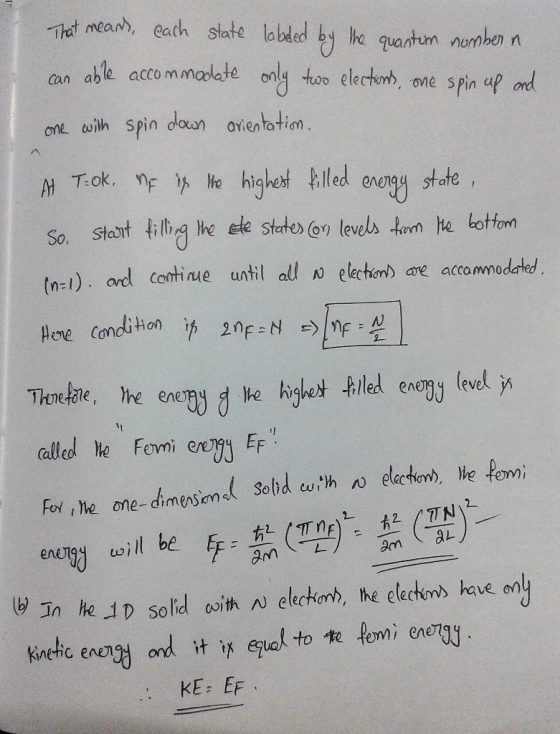
In a one-dimensional solid with free electrons and T-0K, assuming the free electron concentration is n,...
In a metal, explain how to determine electron concentration (# of electrons per unit energy) within...
In a metal, explain how to determine electron concentration (# of electrons per unit energy) within an energy interval dE for two different temperatures of T=0K and T=300K. In your answer, draw the energy band model (with indicating Fermi energy level, workfunction) and show the diagram of Density of state and Fermi-Dirac function with respect to energy (the energy interval from zero to a certain energy level E (E> EF)).
Still considering the T=0K limit, what fraction of the total number Ntotal of free electrons in...
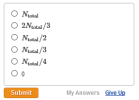 Still considering the T=0K limit, what fraction
of the total number Ntotal of free
electrons in the metal will be at energies above the Fermi
energy?
total O 2Notal/3 total total total Submit My Answers Give Up
Still considering the T=0K limit, what fraction
of the total number Ntotal of free
electrons in the metal will be at energies above the Fermi
energy?
total O 2Notal/3 total total total Submit My Answers Give Up
(10 points) Lithium has one valence electron per atom that can be modeled as free electrons. Consider a Lithium sample made up of n 4.7 x 10² e/cm a) Determine the Fermi energy of Lithium. b) Calc...
 (10 points) Lithium has one valence electron per atom that can be modeled as free electrons. Consider a Lithium sample made up of n 4.7 x 10² e/cm a) Determine the Fermi energy of Lithium. b) Calculate the Fermi temperature and the electron velocity at the Fermi surface c) Determine the value of the relaxation time and the mean free path of the conduction 2. electrons if the resistivity is approximately 10-5n.cm at room temperature. d) Calculate the specific heat...
Consider N non-interacting electrons confined to a two-dimensional square well of dimensions a × a. Derive...
Consider N non-interacting electrons confined to a two-dimensional square well of dimensions a × a. Derive an expression for the Fermi energy of this system in terms of the areal density σ = N/a2 and calculate the corresponding density of states. Show all steps.
b. At TR, calculate the number of free electrons (n) per mº for Ag assuming the...
 b. At TR, calculate the number of free electrons (n) per mº for Ag assuming the electron mobility of Ag is; He. Ag = 0.012 m?NV-S c. For the same number of free electrons determined in b., if you were able to purify the Ag material and increase the electron mobility to 0.15 m²N - S, what is the new conductivity of Ag, Ag? Would this conductivity be greater or lesser than for the Ag in b.? LAANI UJ points...
Calculate the Fermi energy for beryllium, assuming two free electrons per atom. (The density of beryllium...
 Calculate the Fermi energy for beryllium, assuming two free electrons per atom. (The density of beryllium is 1.85 g/cm3, and its molar mass is 9.01 g/mol.) eV
Consider a free electron gas model for a system of Nq fermions that are confined to...
Consider a free electron gas model for a system of Nq fermions that are confined to move in two dimensions instead of three (for example, Nq non-interacting electrons that are confined to move on a surface). The dimensions of this system are lx by ly so that the particles move in the region 0 < x < lx, 0 < y < ly; the potential is zero inside that region and infinite outside. a) Find the Fermi energy for this...
Fermi Energy Eqn. 4.22 in Kasap gives the Fermi energy (at 0 K) as is the conduction electron con...
 Fermi Energy Eqn. 4.22 in Kasap gives the Fermi energy (at 0 K) as is the conduction electron concentration. This is equivalent to the equation we derived in class. Kasap Eqn. 4.23 gives the Fermi energy as a function of temperature: EFEF1 a. If each copper atom contributes one conduction electron, what is the Fermi energy of copper at 29:3 b. Since this Fermi energy was derived from the Sommerfeld model, the energy is entirely kinetic 12 LEFo K? energy...
Consider a one-dimensional tight binding model of electrons hopping between atoms. Let the distance between atoms be ca...
 Consider a one-dimensional tight binding model of electrons hopping between atoms. Let the distance between atoms be called a, and here let us label the atomic orbital on atom ln) for n-1,..,N (you may assume orthonormality of orbitals, ie., (1m)- nm). n as Suppose there is an on-site energy e and a hopping matrix element -t. In other words, suppose (IH|m) = E for n-m and (1비m)=-t for n=m±1. (a) Derive and sketch the dispersion curve for electrons. (b) How...
An x-ray photon is scattered from a free electron (mass m) at rest. The wavelength of...
An x-ray photon is scattered from a free electron (mass m) at rest. The wavelength of the scattered photon is λ′, and the final speed of the struck electron is v. Part A Part complete What was the initial wavelength λ of the photon? Express your answer in terms of λ′, v, m, and the appropriate constants. For the wavelength of the scattered photon λ′ use the notation λf. (Hint: Use the relativistic expression for the electron kinetic energy.) Express...
 Still considering the T=0K limit, what fraction
of the total number Ntotal of free
electrons in the metal will be at energies above the Fermi
energy?
total O 2Notal/3 total total total Submit My Answers Give Up
Still considering the T=0K limit, what fraction
of the total number Ntotal of free
electrons in the metal will be at energies above the Fermi
energy?
total O 2Notal/3 total total total Submit My Answers Give Up
 (10 points) Lithium has one valence electron per atom that can be modeled as free electrons. Consider a Lithium sample made up of n 4.7 x 10² e/cm a) Determine the Fermi energy of Lithium. b) Calculate the Fermi temperature and the electron velocity at the Fermi surface c) Determine the value of the relaxation time and the mean free path of the conduction 2. electrons if the resistivity is approximately 10-5n.cm at room temperature. d) Calculate the specific heat...
 b. At TR, calculate the number of free electrons (n) per mº for Ag assuming the electron mobility of Ag is; He. Ag = 0.012 m?NV-S c. For the same number of free electrons determined in b., if you were able to purify the Ag material and increase the electron mobility to 0.15 m²N - S, what is the new conductivity of Ag, Ag? Would this conductivity be greater or lesser than for the Ag in b.? LAANI UJ points...
 Calculate the Fermi energy for beryllium, assuming two free electrons per atom. (The density of beryllium is 1.85 g/cm3, and its molar mass is 9.01 g/mol.) eV
 Fermi Energy Eqn. 4.22 in Kasap gives the Fermi energy (at 0 K) as is the conduction electron concentration. This is equivalent to the equation we derived in class. Kasap Eqn. 4.23 gives the Fermi energy as a function of temperature: EFEF1 a. If each copper atom contributes one conduction electron, what is the Fermi energy of copper at 29:3 b. Since this Fermi energy was derived from the Sommerfeld model, the energy is entirely kinetic 12 LEFo K? energy...
 Consider a one-dimensional tight binding model of electrons hopping between atoms. Let the distance between atoms be called a, and here let us label the atomic orbital on atom ln) for n-1,..,N (you may assume orthonormality of orbitals, ie., (1m)- nm). n as Suppose there is an on-site energy e and a hopping matrix element -t. In other words, suppose (IH|m) = E for n-m and (1비m)=-t for n=m±1. (a) Derive and sketch the dispersion curve for electrons. (b) How...
Most questions answered within 3 hours.
-
Where is the error in this code sequence?
String s1 = "Hello";
String s2 = "ello";...
asked 10 months ago -
Financial data for Joel de Paris, Inc., for last year
follow:
Joel de Paris, Inc.
Balance...
asked 10 months ago -
Consider this reaction:
Al2(SO4)3 (aq)+ BaCl3
(aq) Al2Cl6 (aq)- +
3BaSO4(s) . What is the...
asked 10 months ago -
Suppose that Savneet is considering increasing her
recent random sample from 20 car rentals to 40...
asked 10 months ago -
Trucks arrive at an unloading terminal at an average rate of 120
per hour.
Trucks arrive...
asked 10 months ago -
Why are methanol and ethanol completely soluble in water while
octanol is not very little soluble....
asked 10 months ago -
A facilities manager at a university reads in a research report
that the mean amount of...
asked 10 months ago -
When the CuSO4 is rehydrated by adding water to the anhydrous
compound, is this an endothermic...
asked 10 months ago -
A ray of sunlight is passing from diamond into crown glass; the
angle of incidence is...
asked 10 months ago -
A block of mass 0.249 kg is placed on top of a light, vertical
spring of...
asked 10 months ago -
how do the kidneys compensate in the presences of acidosis
a) trigger hyperventilate
b) reserve acid...
asked 10 months ago -
Question 501 pts
The rental rate of capital to the firm increases. Which of the
following...
asked 10 months ago