Consider a free electron gas model for a system of Nq fermions that are confined to...
Consider a free electron gas model for a system of Nq fermions
that are confined to move in two dimensions instead of three (for
example, Nq non-interacting electrons that are confined to move on
a surface). The dimensions of this system are lx by ly so that the
particles move in the region 0 < x < lx, 0 < y < ly;
the potential is zero inside that region and infinite
outside.
a) Find the Fermi energy for this system in terms of the number of
particles and the dimensions of the system.
b) Find the total energy of the system and express it in terms of
the Fermi energy.
Homework Answers

Add Answer to:
Consider a free electron gas model for a system of Nq fermions
that are confined to...
Problem 4. Low-dimensional materials play an important role in nanotechnology. Consider a two-dimensional Fermi gas of...
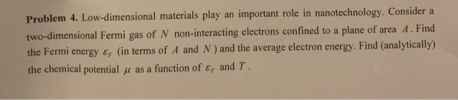 Problem 4. Low-dimensional materials play an important role in nanotechnology. Consider a two-dimensional Fermi gas of N non-interacting electrons confined to a plane of area A. Find the Fermi energy &r (in terms of A and N) and the average electron energy. Find (analytically) the chemical potential p as a function of er and T.
Consider a two-dimensional non-interacting and non-relativistic gas of N spin-1/2 fermions at T 0 in a...
 Consider a two-dimensional non-interacting and non-relativistic gas of N spin-1/2 fermions at T 0 in a box of area A. (a) Find the Fermi energy εF. (b) Show that the total energy is given by E- NE. 2
(12%) Consider a system of non-interacting fermions in equilibrium with a heat bath at temperature T...
 (12%) Consider a system of non-interacting fermions in equilibrium with a heat bath at temperature T and a particle reservoir at chemical potential fl. Assume that we can neglect different spin orientations of the fermions. Each particle can be in one of three single-partiele states with energies 0, A and 2A. (a) Find the grand partition function of the system. (b) Find the mean number of particles and mean energy of the system. (C) Find the most probable microstate of...
3. Consider a hypothetical non-ideal gas of particles confined to exist along a line in one dimension. The particles are in thermal equilibrium but due to their complex interactions the velocity...
 3. Consider a hypothetical non-ideal gas of particles confined to exist along a line in one dimension. The particles are in thermal equilibrium but due to their complex interactions the velocity distribution function is not Maxwellian, but rather has the form: where C and vo are constants. Note that v is the velocity (not the speed) and can take on negative values. Express your answers below in terms of vo- a. Solve for the constant C b. Draw a sketch...
1-r' Problem 16.12 (30 pts) This chapter examines the two-state system but consider instead the infinite-state...
 1-r' Problem 16.12 (30 pts) This chapter examines the two-state system but consider instead the infinite-state system consisting of N non-interacting particles. Each particle i can be in one of an infinite number of states designated by an integer, n; = 0,1,2, .... The energy of particle i is given by a = en; where e is a constant. Note: you may need the series sum Li-ori = a) If the particles are distinguishable, compute QIT,N) and A(T,N) for this...
Question 14. Consider the following 3-state model: a system of 21 non-interacting particles that can occupy...
 Question 14. Consider the following 3-state model: a system of 21 non-interacting particles that can occupy one of three energy levels. This is analogous to electrons filling a number of orbitals. The energies associated with the states are E0, El and E2 respectively. Consider no external constraints on the system (i.e. thermal or pressure baths) and that the system is isolated a) What is the value of entropy change associated with the states of E0 = 21, El=E2=0. b) What...
Consider an infinite slab of thickness 2a and uniform volume charge density ρ. This is essentially...
 Consider an infinite slab of thickness 2a and uniform volume charge density ρ. This is essentially an infinite plane with a non-negligible thickness. Since the planar symmetry involves:艹-2 reflection symmetry, as well as the translation symmetry along the and y direc- tions, we place the origin at a point on the midplane of the slab. In other words, the midplane corresponds to oo = 0 (i.e., the ry plane) and the surfaces of the slab are at a (a) Use...
A NON stationary state A particle of mass m is in an infinite square well potential of width L, a...
 A NON stationary state A particle of mass m is in an infinite square well potential of width L, as in McIntyre's section 5.4. Suppose we have an initial state vector lv(t -0) results from Mclntrye without re-deriving them, and you may use a computer for your math as long as you include your code in your solution A(3E1) 4iE2)). You may use E. (4 pts) Use a computer to plot this probability density at 4 times: t 0, t2...
HOMERWORK SET1-Electrostatics Due Date Thu, Sept 20th fv-22y2 V in free space, fnd the eergy stored...
 HOMERWORK SET1-Electrostatics Due Date Thu, Sept 20th fv-22y2 V in free space, fnd the eergy stored in a lme defined by 1 sI, Hint: Given V(x.y). we can get the eectric field since E-grad(V) A spherical conductor ofradíus α carries a surface charge with density pa-Determine the potential energy in terms of a. 2. 3 IfE-3,5a V/m, calculate the potential energy stored within the vokume defined by o r< 1,0<y<2,0fc3 4. In free space, Vpe sinip) (a) find E (b)...
3. Fill the blanks and the Proof - J.J. Thomson's experiment to fine the charge-to-mass ratio of the tt) (25 po...
 3. Fill the blanks and the Proof - J.J. Thomson's experiment to fine the charge-to-mass ratio of the tt) (25 points) electron (i.e. e/m; The first is the experiment of Joseph John Thomson, who first demonstrated that atoms are actually composed of aggregates of charged particles. Prior to his work, it was believed that atoms were the fundamental building blocks of matter. The first evidence contrary to this notion came when people began studying the properties of atoms in large...
 Problem 4. Low-dimensional materials play an important role in nanotechnology. Consider a two-dimensional Fermi gas of N non-interacting electrons confined to a plane of area A. Find the Fermi energy &r (in terms of A and N) and the average electron energy. Find (analytically) the chemical potential p as a function of er and T.
 Consider a two-dimensional non-interacting and non-relativistic gas of N spin-1/2 fermions at T 0 in a box of area A. (a) Find the Fermi energy εF. (b) Show that the total energy is given by E- NE. 2
 (12%) Consider a system of non-interacting fermions in equilibrium with a heat bath at temperature T and a particle reservoir at chemical potential fl. Assume that we can neglect different spin orientations of the fermions. Each particle can be in one of three single-partiele states with energies 0, A and 2A. (a) Find the grand partition function of the system. (b) Find the mean number of particles and mean energy of the system. (C) Find the most probable microstate of...
 3. Consider a hypothetical non-ideal gas of particles confined to exist along a line in one dimension. The particles are in thermal equilibrium but due to their complex interactions the velocity distribution function is not Maxwellian, but rather has the form: where C and vo are constants. Note that v is the velocity (not the speed) and can take on negative values. Express your answers below in terms of vo- a. Solve for the constant C b. Draw a sketch...
 1-r' Problem 16.12 (30 pts) This chapter examines the two-state system but consider instead the infinite-state system consisting of N non-interacting particles. Each particle i can be in one of an infinite number of states designated by an integer, n; = 0,1,2, .... The energy of particle i is given by a = en; where e is a constant. Note: you may need the series sum Li-ori = a) If the particles are distinguishable, compute QIT,N) and A(T,N) for this...
 Question 14. Consider the following 3-state model: a system of 21 non-interacting particles that can occupy one of three energy levels. This is analogous to electrons filling a number of orbitals. The energies associated with the states are E0, El and E2 respectively. Consider no external constraints on the system (i.e. thermal or pressure baths) and that the system is isolated a) What is the value of entropy change associated with the states of E0 = 21, El=E2=0. b) What...
 Consider an infinite slab of thickness 2a and uniform volume charge density ρ. This is essentially an infinite plane with a non-negligible thickness. Since the planar symmetry involves:艹-2 reflection symmetry, as well as the translation symmetry along the and y direc- tions, we place the origin at a point on the midplane of the slab. In other words, the midplane corresponds to oo = 0 (i.e., the ry plane) and the surfaces of the slab are at a (a) Use...
 A NON stationary state A particle of mass m is in an infinite square well potential of width L, as in McIntyre's section 5.4. Suppose we have an initial state vector lv(t -0) results from Mclntrye without re-deriving them, and you may use a computer for your math as long as you include your code in your solution A(3E1) 4iE2)). You may use E. (4 pts) Use a computer to plot this probability density at 4 times: t 0, t2...
 HOMERWORK SET1-Electrostatics Due Date Thu, Sept 20th fv-22y2 V in free space, fnd the eergy stored in a lme defined by 1 sI, Hint: Given V(x.y). we can get the eectric field since E-grad(V) A spherical conductor ofradíus α carries a surface charge with density pa-Determine the potential energy in terms of a. 2. 3 IfE-3,5a V/m, calculate the potential energy stored within the vokume defined by o r< 1,0<y<2,0fc3 4. In free space, Vpe sinip) (a) find E (b)...
 3. Fill the blanks and the Proof - J.J. Thomson's experiment to fine the charge-to-mass ratio of the tt) (25 points) electron (i.e. e/m; The first is the experiment of Joseph John Thomson, who first demonstrated that atoms are actually composed of aggregates of charged particles. Prior to his work, it was believed that atoms were the fundamental building blocks of matter. The first evidence contrary to this notion came when people began studying the properties of atoms in large...
Most questions answered within 3 hours.
-
Where is the error in this code sequence?
String s1 = "Hello";
String s2 = "ello";...
asked 10 months ago -
Financial data for Joel de Paris, Inc., for last year
follow:
Joel de Paris, Inc.
Balance...
asked 10 months ago -
Consider this reaction:
Al2(SO4)3 (aq)+ BaCl3
(aq) Al2Cl6 (aq)- +
3BaSO4(s) . What is the...
asked 10 months ago -
Suppose that Savneet is considering increasing her
recent random sample from 20 car rentals to 40...
asked 10 months ago -
Trucks arrive at an unloading terminal at an average rate of 120
per hour.
Trucks arrive...
asked 10 months ago -
Why are methanol and ethanol completely soluble in water while
octanol is not very little soluble....
asked 10 months ago -
A facilities manager at a university reads in a research report
that the mean amount of...
asked 10 months ago -
When the CuSO4 is rehydrated by adding water to the anhydrous
compound, is this an endothermic...
asked 10 months ago -
A ray of sunlight is passing from diamond into crown glass; the
angle of incidence is...
asked 10 months ago -
A block of mass 0.249 kg is placed on top of a light, vertical
spring of...
asked 10 months ago -
how do the kidneys compensate in the presences of acidosis
a) trigger hyperventilate
b) reserve acid...
asked 10 months ago -
Question 501 pts
The rental rate of capital to the firm increases. Which of the
following...
asked 10 months ago