 Answer is in bold. Need to know
how to work the problem. Thanks!
Answer is in bold. Need to know
how to work the problem. Thanks!
Homework Answers
Option 1
Initial cost = $4,000
Annual cost = $4,000
Annual benefits = $6,480
Time period = 20 years
MARR = 6%
Calculate the PW of cost -
PW = Initial cost + Annual cost(P/A, i, n)
PW = 4000 + 4000(P/A, i, n)
PW = 4000 + 4000(P/A, 6%, 20)
PW = 4000 + [4000 * 11.4699]
PW = 4000 + 45,879.60
PW = 49879.60
The PW of cost is $49,879.60
Calculate the PW of benefits -
PW = Annual benefits(P/A, i, n)
PW = 6480(P/A, 6%, 20)
PW = 6480 * 11.4699
PW = 74324.95
The PW of benefits is $74,324.95
Calculate the B/C ratio -
B/C ratio = PW of benefits/PW of cost
B/C ratio = $74,324.95/$49,879.60
B/C ratio = 1.49
The B/C ratio of Option 1 is 1.49
Option 2
Initial cost = $8,200
Annual cost = $9,000
Annual benefits = $11,250
Time period = 20 years
MARR = 6%
Calculate the PW of cost -
PW = Initial cost + Annual cost(P/A, i, n)
PW = 8200 + 9000(P/A, i, n)
PW = 8200 + 9000(P/A, 6%, 20)
PW = 8200 + [9000 * 11.4699]
PW = 8200 + 103229.10
PW = 111429.10
The PW of cost is $111,429.10
Calculate the PW of benefits -
PW = Annual benefits(P/A, i, n)
PW = 11250(P/A, 6%, 20)
PW = 11250 * 11.4699
PW = 129036.37
The PW of benefits is $129,036.37
Calculate the B/C ratio -
B/C ratio = PW of benefits/PW of cost
B/C ratio = $129,036.37/$111,429.10
B/C ratio = 1.16
The B/C ratio of Option 2 is 1.16
Option 3
Initial cost = $5,500
Annual cost = $6,000
Annual benefits = $5,700
Time period = 20 years
MARR = 6%
Calculate the PW of cost -
PW = Initial cost + Annual cost(P/A, i, n)
PW = 5500 + 6000(P/A, i, n)
PW = 5500 + 6000(P/A, 6%, 20)
PW = 5500 + [6000 * 11.4699]
PW = 5500 + 68819.40
PW = 74319.40
The PW of cost is $74,319.40
Calculate the PW of benefits -
PW = Annual benefits(P/A, i, n)
PW = 5700(P/A, 6%, 20)
PW = 5700 * 11.4699
PW = 65378.43
The PW of benefits is $65,378.43
Calculate the B/C ratio -
B/C ratio = PW of benefits/PW of cost
B/C ratio = $65,378.43/$74,319.40
B/C ratio = 0.88
The B/C ratio of Option 3 is 0.88
Option 4
Initial cost = $3,700
Annual cost = $2,000
Annual benefits = $4,400
Time period = 20 years
MARR = 6%
Calculate the PW of cost -
PW = Initial cost + Annual cost(P/A, i, n)
PW = 3700 + 2000(P/A, i, n)
PW = 3700 + 2000(P/A, 6%, 20)
PW = 3700 + [2000 * 11.4699]
PW = 3700 + 22,939.80
PW = 26639.80
The PW of cost is $26,639.80
Calculate the PW of benefits -
PW = Annual benefits(P/A, i, n)
PW = 4400(P/A, 6%, 20)
PW = 4400 * 11.4699
PW = 50467.56
The PW of benefits is $50,467.56
Calculate the B/C ratio -
B/C ratio = PW of benefits/PW of cost
B/C ratio = $50,467.56/$26,639.80
B/C ratio = 1.89
The B/C ratio of Option 4 is 1.89
The B/C ratio of option 4 is highest.
So,
Option 4 should be selected.
Add Answer to:
Answer is in bold. Need to know
how to work the problem. Thanks!
Problem 2 Four...
please show excel formulas so I can understand the problem THANKS 9-50 Consider four mutually exclusive...
 please show excel formulas so I can understand the problem
THANKS
9-50 Consider four mutually exclusive alternatives: (Α) A B C D Cost $75.0 $50.0 $15.0 $90.0 Uniform annual 18.8 13.9 4.5 23.8 benefit Each alternative has a 5-year useful life and no sal- vage value. The MARR is 10%. Which alternative should be selected, based on (a) The payback period (b) Future worth analysis (c) Benefit-cost ratio analysis
please show excel formulas so I can understand the problem
THANKS
9-50 Consider four mutually exclusive alternatives: (Α) A B C D Cost $75.0 $50.0 $15.0 $90.0 Uniform annual 18.8 13.9 4.5 23.8 benefit Each alternative has a 5-year useful life and no sal- vage value. The MARR is 10%. Which alternative should be selected, based on (a) The payback period (b) Future worth analysis (c) Benefit-cost ratio analysis
2) [Problem 9-50) Consider four mutually exclusive alternatives: A B C D Cost $65 $55 $25...
 2) [Problem 9-50) Consider four mutually exclusive alternatives: A B C D Cost $65 $55 $25 $80 Uniform annual benefit 16.3 15.1 2 5. 2 1.3 AL Each alternative has a 6-yeatuseful life and no salvage value. The MARR is 9%. Which alternative should be selected, based on, ? a) The payback period b) Future worth analysis c) Benefit-cost ratio analysis
4. (10 points) A firm is considering three mutually exclusive alternatives as part of a production...
 4. (10 points) A firm is considering three mutually exclusive alternatives as part of a production improvement program. The alternatives are: Initial Cost $20,000 $30,000 $50,000 Uniform Annual Benefit $4,000 $5,000 $6,500 Useful Life Salvage Value $2,000 $9,000 The MARR is 10%. Which alternative do you recommend? Be sure to use the proper technique when comparing alternatives with different useful lives.
Consider 3 mutually exclusive alternatives, each with a 10-year useful life. If the MARR (Minimum acceptable...
 Consider 3 mutually exclusive alternatives, each with a 10-year useful life. If the MARR (Minimum acceptable rate of return) is 14.5%, which alternative should be selected? Solve the problem using benefit-cost ratio analysis. Alternative Choice Choice Choice #1 #2 #3 Cost 810 131 305 62 145 36 Uniform Annual benefit
Need cash flow diagram 04) Three mutually exclusive alternative are being considered Initial Cost Benefit at the end of the first Year Uniform Annual Benefits at end of subsequent years Useful Lif...
 Need cash flow diagram
04) Three mutually exclusive alternative are being considered Initial Cost Benefit at the end of the first Year Uniform Annual Benefits at end of subsequent years Useful Life in years $500 $200 $100 $400 $200 $125 $300 $200 $100 At the end of its useful life, an alternative is not replaced. If MARR is 10%, which alternatives should be selected? a) Based on the payback period? b) Based on benefit-cost ratio analysis c) Benefit/Costs Analysis using...
Need cash flow diagram
04) Three mutually exclusive alternative are being considered Initial Cost Benefit at the end of the first Year Uniform Annual Benefits at end of subsequent years Useful Life in years $500 $200 $100 $400 $200 $125 $300 $200 $100 At the end of its useful life, an alternative is not replaced. If MARR is 10%, which alternatives should be selected? a) Based on the payback period? b) Based on benefit-cost ratio analysis c) Benefit/Costs Analysis using...
Consider three mutually exclusive alternatives, each with a 15-year useful life. If the MARR is 12%,...
Consider three mutually exclusive alternatives, each with a 15-year useful life. If the MARR is 12%, which alternative should be selected? Solve the problem by using benefit-cost ratio analysis, Net Present Value, and Internal Rate of Return. A B C Cost $800 $300 $150 Uniform Annual Benefit 130 60 35
Answer is in bold. Need to know how to work the problem. Thanks! Problem 5 15...
 Answer is in bold. Need to know
how to work the problem. Thanks!
Problem 5 15 points Your lawn care service is considering two commercial mowers for purchase, as indicated below. Assume that you can replace each machine with identical equipment at the end of their useful lives. If your MARR is 12%, which mower would you choose? Purchase Price Net Annual Revenues Salvage Value Useful Life Small $2,000 $1,000 $500 5 years Large $5,000 $1,500 $700 10 years PW(small)...
Answer is in bold. Need to know
how to work the problem. Thanks!
Problem 5 15 points Your lawn care service is considering two commercial mowers for purchase, as indicated below. Assume that you can replace each machine with identical equipment at the end of their useful lives. If your MARR is 12%, which mower would you choose? Purchase Price Net Annual Revenues Salvage Value Useful Life Small $2,000 $1,000 $500 5 years Large $5,000 $1,500 $700 10 years PW(small)...
Answer is in bold. Need to know how to work the problem. Thanks! Problem 3 A...
 Answer is in bold. Need to know
how to work the problem. Thanks!
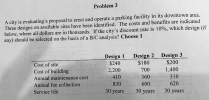
Problem 3 A city is evaluating a proposal to erect and operate a parking facility in its downtown area. Three designs on available sites have been identified. The costs and benefits are indicated below, where all dollars are in thousands. If the city's discount rate is 10 %, which design (if any) should be selected on the basis of a B/C analysis? Choose 1 Design 3 $200...
Answer is in bold. Need to know
how to work the problem. Thanks!
Problem 3 A city is evaluating a proposal to erect and operate a parking facility in its downtown area. Three designs on available sites have been identified. The costs and benefits are indicated below, where all dollars are in thousands. If the city's discount rate is 10 %, which design (if any) should be selected on the basis of a B/C analysis? Choose 1 Design 3 $200...
Problem (2): Consider the following three mutually exclusive alternatives. MARR is 10%. Alternative 1 10,000 Alternative...
 Problem (2): Consider the following three mutually exclusive alternatives. MARR is 10%. Alternative 1 10,000 Alternative 2 14,500 Alternative 3 20,000 $3,000 increasing by 500 each year thereafter negligible $5,000 Initial investment Annual yielded returns Salvage Value Service life $5,000 $5,000 negligible 6 a) Compute the payback (PB) period and discounted PB period of each alternative. Based on the PB period, which alternative do you recommend? b) Using Annual-worth analysis, which alternative do you recommend?
i dont want excel answer 5- The Larkspur Furniture Company needs a new grinder. 37 Compute...
 i dont want excel answer
5- The Larkspur Furniture Company needs a new grinder. 37 Compute the present worth for these mutually exclusive alternatives and identify which you would recommend given i = 6% per year. Larkspur uses a 10-year planning horizon. Alternative B A Initial cost $4500 $5500 Annual costs $300 $400 Salvage value $500 $0 Life 5 years 10 years
i dont want excel answer
5- The Larkspur Furniture Company needs a new grinder. 37 Compute the present worth for these mutually exclusive alternatives and identify which you would recommend given i = 6% per year. Larkspur uses a 10-year planning horizon. Alternative B A Initial cost $4500 $5500 Annual costs $300 $400 Salvage value $500 $0 Life 5 years 10 years
 please show excel formulas so I can understand the problem
THANKS
9-50 Consider four mutually exclusive alternatives: (Α) A B C D Cost $75.0 $50.0 $15.0 $90.0 Uniform annual 18.8 13.9 4.5 23.8 benefit Each alternative has a 5-year useful life and no sal- vage value. The MARR is 10%. Which alternative should be selected, based on (a) The payback period (b) Future worth analysis (c) Benefit-cost ratio analysis
please show excel formulas so I can understand the problem
THANKS
9-50 Consider four mutually exclusive alternatives: (Α) A B C D Cost $75.0 $50.0 $15.0 $90.0 Uniform annual 18.8 13.9 4.5 23.8 benefit Each alternative has a 5-year useful life and no sal- vage value. The MARR is 10%. Which alternative should be selected, based on (a) The payback period (b) Future worth analysis (c) Benefit-cost ratio analysis
 2) [Problem 9-50) Consider four mutually exclusive alternatives: A B C D Cost $65 $55 $25 $80 Uniform annual benefit 16.3 15.1 2 5. 2 1.3 AL Each alternative has a 6-yeatuseful life and no salvage value. The MARR is 9%. Which alternative should be selected, based on, ? a) The payback period b) Future worth analysis c) Benefit-cost ratio analysis
 4. (10 points) A firm is considering three mutually exclusive alternatives as part of a production improvement program. The alternatives are: Initial Cost $20,000 $30,000 $50,000 Uniform Annual Benefit $4,000 $5,000 $6,500 Useful Life Salvage Value $2,000 $9,000 The MARR is 10%. Which alternative do you recommend? Be sure to use the proper technique when comparing alternatives with different useful lives.
 Consider 3 mutually exclusive alternatives, each with a 10-year useful life. If the MARR (Minimum acceptable rate of return) is 14.5%, which alternative should be selected? Solve the problem using benefit-cost ratio analysis. Alternative Choice Choice Choice #1 #2 #3 Cost 810 131 305 62 145 36 Uniform Annual benefit
 Need cash flow diagram
04) Three mutually exclusive alternative are being considered Initial Cost Benefit at the end of the first Year Uniform Annual Benefits at end of subsequent years Useful Life in years $500 $200 $100 $400 $200 $125 $300 $200 $100 At the end of its useful life, an alternative is not replaced. If MARR is 10%, which alternatives should be selected? a) Based on the payback period? b) Based on benefit-cost ratio analysis c) Benefit/Costs Analysis using...
Need cash flow diagram
04) Three mutually exclusive alternative are being considered Initial Cost Benefit at the end of the first Year Uniform Annual Benefits at end of subsequent years Useful Life in years $500 $200 $100 $400 $200 $125 $300 $200 $100 At the end of its useful life, an alternative is not replaced. If MARR is 10%, which alternatives should be selected? a) Based on the payback period? b) Based on benefit-cost ratio analysis c) Benefit/Costs Analysis using...
 Answer is in bold. Need to know
how to work the problem. Thanks!
Problem 5 15 points Your lawn care service is considering two commercial mowers for purchase, as indicated below. Assume that you can replace each machine with identical equipment at the end of their useful lives. If your MARR is 12%, which mower would you choose? Purchase Price Net Annual Revenues Salvage Value Useful Life Small $2,000 $1,000 $500 5 years Large $5,000 $1,500 $700 10 years PW(small)...
Answer is in bold. Need to know
how to work the problem. Thanks!
Problem 5 15 points Your lawn care service is considering two commercial mowers for purchase, as indicated below. Assume that you can replace each machine with identical equipment at the end of their useful lives. If your MARR is 12%, which mower would you choose? Purchase Price Net Annual Revenues Salvage Value Useful Life Small $2,000 $1,000 $500 5 years Large $5,000 $1,500 $700 10 years PW(small)...
 Answer is in bold. Need to know
how to work the problem. Thanks!
Problem 3 A city is evaluating a proposal to erect and operate a parking facility in its downtown area. Three designs on available sites have been identified. The costs and benefits are indicated below, where all dollars are in thousands. If the city's discount rate is 10 %, which design (if any) should be selected on the basis of a B/C analysis? Choose 1 Design 3 $200...
Answer is in bold. Need to know
how to work the problem. Thanks!
Problem 3 A city is evaluating a proposal to erect and operate a parking facility in its downtown area. Three designs on available sites have been identified. The costs and benefits are indicated below, where all dollars are in thousands. If the city's discount rate is 10 %, which design (if any) should be selected on the basis of a B/C analysis? Choose 1 Design 3 $200...
 Problem (2): Consider the following three mutually exclusive alternatives. MARR is 10%. Alternative 1 10,000 Alternative 2 14,500 Alternative 3 20,000 $3,000 increasing by 500 each year thereafter negligible $5,000 Initial investment Annual yielded returns Salvage Value Service life $5,000 $5,000 negligible 6 a) Compute the payback (PB) period and discounted PB period of each alternative. Based on the PB period, which alternative do you recommend? b) Using Annual-worth analysis, which alternative do you recommend?
 i dont want excel answer
5- The Larkspur Furniture Company needs a new grinder. 37 Compute the present worth for these mutually exclusive alternatives and identify which you would recommend given i = 6% per year. Larkspur uses a 10-year planning horizon. Alternative B A Initial cost $4500 $5500 Annual costs $300 $400 Salvage value $500 $0 Life 5 years 10 years
i dont want excel answer
5- The Larkspur Furniture Company needs a new grinder. 37 Compute the present worth for these mutually exclusive alternatives and identify which you would recommend given i = 6% per year. Larkspur uses a 10-year planning horizon. Alternative B A Initial cost $4500 $5500 Annual costs $300 $400 Salvage value $500 $0 Life 5 years 10 years
Most questions answered within 3 hours.
-
Where is the error in this code sequence?
String s1 = "Hello";
String s2 = "ello";...
asked 10 months ago -
Financial data for Joel de Paris, Inc., for last year
follow:
Joel de Paris, Inc.
Balance...
asked 10 months ago -
Consider this reaction:
Al2(SO4)3 (aq)+ BaCl3
(aq) Al2Cl6 (aq)- +
3BaSO4(s) . What is the...
asked 10 months ago -
Suppose that Savneet is considering increasing her
recent random sample from 20 car rentals to 40...
asked 10 months ago -
Trucks arrive at an unloading terminal at an average rate of 120
per hour.
Trucks arrive...
asked 10 months ago -
Why are methanol and ethanol completely soluble in water while
octanol is not very little soluble....
asked 10 months ago -
A facilities manager at a university reads in a research report
that the mean amount of...
asked 10 months ago -
When the CuSO4 is rehydrated by adding water to the anhydrous
compound, is this an endothermic...
asked 10 months ago -
A ray of sunlight is passing from diamond into crown glass; the
angle of incidence is...
asked 10 months ago -
A block of mass 0.249 kg is placed on top of a light, vertical
spring of...
asked 10 months ago -
how do the kidneys compensate in the presences of acidosis
a) trigger hyperventilate
b) reserve acid...
asked 10 months ago -
Question 501 pts
The rental rate of capital to the firm increases. Which of the
following...
asked 10 months ago