
Homework Answers
Initial concentration of OCl2 = mol of OCl2 / volume in L
= 0.90 mol / 0.500 L
= 1.8 M
Initial concentration of BrOCl = mol of BrOCl / volume in L
= 0.20 mol / 0.500 L
= 0.40 M
Initial concentration of BrCl = mol of BrCl / volume in L
= 1.4 mol / 0.500 L
= 2.8 M
ICE Table:
![ICE Table: [0012] [Br2] [Brocul [Brcl] 1.8 0.4 2.8 initial change equilibrium +1x +1x -1x - 1x 1.8+1x +1x 0.4-1x 2.8-1x](http://img.homeworklib.com/questions/91f718b0-74ce-11ea-bf12-299a44480df3.png?x-oss-process=image/resize,w_560)
Equilibrium constant expression is
Kc = [BrOCl]*[BrCl]/[OCl2]*[Br2]
0.798 = (0.4-1*x)(2.8-1*x)/((1.8 + 1*x)(1*x))
0.798 = (1.12-3.2*x + 1*x^2)/(1.8*x + 1*x^2)
1.436*x + 0.798*x^2 = 1.12-3.2*x + 1*x^2
-1.12 + 4.636*x-0.202*x^2 = 0
This is quadratic equation (ax^2+bx+c=0)
a = -0.202
b = 4.636
c = -1.12
Roots can be found by
x = {-b + sqrt(b^2-4*a*c)}/2a
x = {-b - sqrt(b^2-4*a*c)}/2a
b^2-4*a*c = 20.59
roots are :
x = 0.2442 and x = 22.71
x can't be 22.71 as this will make the concentration negative.so,
x = 0.2442
At equilibrium:
[Br2] = +1x = +1*0.2442 = 0.244 M
Answer: 0.24 M
Add Answer to:
Suppose a 500. mL flask is filled with 0.90 mol of OC1,, 0.20 mol of BroCl...
Suppose a 500. ml flask is filled with 1.3 mol of Br2, 2.0 mol of OC1,...
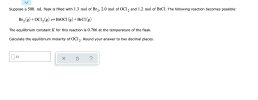 Suppose a 500. ml flask is filled with 1.3 mol of Br2, 2.0 mol of OC1, and 1.2 mol of BrCl. The following reaction becomes possible: Br2(g) + OC12(g) = BroCl (g) + BrCl (g) The equilibrium constant K for this reaction is 0.766 at the temperature of the flask. Calculate the equilibrium molarity of OC12. Round your answer to two decimal places. xs ?
Suppose a 250. ml flask is filled with 1.8 mol of OC1, 0.70 mol of BroCl and 0.50 mol of BrCl. The following reaction b...
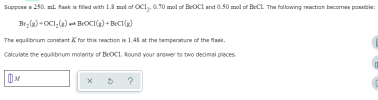 Suppose a 250. ml flask is filled with 1.8 mol of OC1, 0.70 mol of BroCl and 0.50 mol of BrCl. The following reaction becomes possible: Br2(g) + OC12(g) – Brocl(g) +BrCl(g) The equilibrium constant K for this reaction is 1.48 at the temperature of the flask. Calculate the equilibrium molarity of BroCl. Round your answer to two decimal places. x 5 ?
Suppose a 500. ml flask is filled with 0.90 mol of NO,, 0.10 mol of CO...
 Suppose a 500. ml flask is filled with 0.90 mol of NO,, 0.10 mol of CO and 0.50 mol of NO. The following reaction becomes possible: NO2(g) +CO(g) = NO(g) + CO2(g) The equilibrium constant K for this reaction is 0.172 at the temperature of the flask. Calculate the equilibrium molarity of CO. Round your answer to two decimal places. IM xs ?
A 500 mL flask was filled with 1.5 mol of OCl2, 0.70 mol of BrOCl and...
A 500 mL flask was filled with 1.5 mol of OCl2, 0.70 mol of BrOCl and 1.9 mol of BrCl. The reaction becomes: Br2+OCl2--> BrOCl+BrCl The equilibrium constant K for the reaction is 0.966. Calculate the equilibrium molarity of Br2.
Suppose a 500. ml flask is filled with 0.90 mol of NO, and 0.80 mol of...
 Suppose a 500. ml flask is filled with 0.90 mol of NO, and 0.80 mol of NO. The following reaction becomes possible: NO2(g) + NO(g) + 2NO, (g) The equilibrium constant K for this reaction is 8.41 at the temperature of the flask. Calculate the equilibrium molarity of NO. Round your answer to two decimal places. IM x 3 ?
Suppose a 250. mL flask is filled with 2.0 mol of OCl 2 , 1.4 mol...
Suppose a 250. mL flask is filled with 2.0 mol of OCl 2 , 1.4 mol of BrOCl and 1.5 mol of BrCl . The following reaction becomes possible: + Br 2 g OCl 2 g + BrOCl g BrCl g The equilibrium constant K for this reaction is 7.62 at the temperature of the flask. Calculate the equilibrium molarity of Br 2 . Round your answer to two decimal places.
Suppose a 250. mL flask is filled with 2.0 mol of Br2, 1.1 mol of OCI,...
 Suppose a 250. mL flask is filled with 2.0 mol of Br2, 1.1 mol of OCI, and 0.80 mol of BroCl. The following reaction becomes possible: Br2(g) + Oci (g) Broci (g) + Brci(g) The equilibrium constant K for this reaction is 0.624 at the temperature of the flask. Calculate the equilibrium molarity of BroCl. Round your answer to two decimal places. Пм xs ?
= Objective Knowledge Check Question 12 Suppose a 250 ml flask is filled with 1.6 mol...
 = Objective Knowledge Check Question 12 Suppose a 250 ml flask is filled with 1.6 mol of Bry, 1.7 mol of Oct, and 1.0 mol of BrCl. The following reaction becomes possible: Br2(8) +OC1,() - BrOCI(g) +BrCl(g) The equilibrium constant K for this reaction is 2.54 at the temperature of the flask. Calculate the equilibrium molarity of Brz. Round your answer to two decimal places. OM X 5 ?
Suppose a 500. mL flask is filled with 0.20 mol of NO2, 1.7 mol of NO...
 Suppose a 500. mL flask is filled with 0.20 mol of NO2, 1.7 mol of NO and 0.80 mol of CO2. The following reaction becomes possible: NO2(g) +CO(g) = NO(g) + CO2(g) The equilibrium constant K for this reaction is 0.457 at the temperature of the flask. Calculate the equilibrium molarity of NO. Round your answer to two decimal places. MM x 6 ?
Suppose a 500. mL flask is filled with 1.5 mol of CO, 1.8 mol of H,O...
 Suppose a 500. mL flask is filled with 1.5 mol of CO, 1.8 mol of H,O and 0.60 mol of CO,. The following reaction becomes possible: CO(g) +H2O(g) + CO2(g)+H2(g) The equilibrium constant K for this reaction is 3.75 at the temperature of the flask. Calculate the equilibrium molarity of 1,0. Round your answer to two decimal places. IM | xs ?
 Suppose a 500. ml flask is filled with 1.3 mol of Br2, 2.0 mol of OC1, and 1.2 mol of BrCl. The following reaction becomes possible: Br2(g) + OC12(g) = BroCl (g) + BrCl (g) The equilibrium constant K for this reaction is 0.766 at the temperature of the flask. Calculate the equilibrium molarity of OC12. Round your answer to two decimal places. xs ?
 Suppose a 250. ml flask is filled with 1.8 mol of OC1, 0.70 mol of BroCl and 0.50 mol of BrCl. The following reaction becomes possible: Br2(g) + OC12(g) – Brocl(g) +BrCl(g) The equilibrium constant K for this reaction is 1.48 at the temperature of the flask. Calculate the equilibrium molarity of BroCl. Round your answer to two decimal places. x 5 ?
 Suppose a 500. ml flask is filled with 0.90 mol of NO,, 0.10 mol of CO and 0.50 mol of NO. The following reaction becomes possible: NO2(g) +CO(g) = NO(g) + CO2(g) The equilibrium constant K for this reaction is 0.172 at the temperature of the flask. Calculate the equilibrium molarity of CO. Round your answer to two decimal places. IM xs ?
 Suppose a 500. ml flask is filled with 0.90 mol of NO, and 0.80 mol of NO. The following reaction becomes possible: NO2(g) + NO(g) + 2NO, (g) The equilibrium constant K for this reaction is 8.41 at the temperature of the flask. Calculate the equilibrium molarity of NO. Round your answer to two decimal places. IM x 3 ?
 Suppose a 250. mL flask is filled with 2.0 mol of Br2, 1.1 mol of OCI, and 0.80 mol of BroCl. The following reaction becomes possible: Br2(g) + Oci (g) Broci (g) + Brci(g) The equilibrium constant K for this reaction is 0.624 at the temperature of the flask. Calculate the equilibrium molarity of BroCl. Round your answer to two decimal places. Пм xs ?
 = Objective Knowledge Check Question 12 Suppose a 250 ml flask is filled with 1.6 mol of Bry, 1.7 mol of Oct, and 1.0 mol of BrCl. The following reaction becomes possible: Br2(8) +OC1,() - BrOCI(g) +BrCl(g) The equilibrium constant K for this reaction is 2.54 at the temperature of the flask. Calculate the equilibrium molarity of Brz. Round your answer to two decimal places. OM X 5 ?
 Suppose a 500. mL flask is filled with 0.20 mol of NO2, 1.7 mol of NO and 0.80 mol of CO2. The following reaction becomes possible: NO2(g) +CO(g) = NO(g) + CO2(g) The equilibrium constant K for this reaction is 0.457 at the temperature of the flask. Calculate the equilibrium molarity of NO. Round your answer to two decimal places. MM x 6 ?
 Suppose a 500. mL flask is filled with 1.5 mol of CO, 1.8 mol of H,O and 0.60 mol of CO,. The following reaction becomes possible: CO(g) +H2O(g) + CO2(g)+H2(g) The equilibrium constant K for this reaction is 3.75 at the temperature of the flask. Calculate the equilibrium molarity of 1,0. Round your answer to two decimal places. IM | xs ?
Most questions answered within 3 hours.
-
Where is the error in this code sequence?
String s1 = "Hello";
String s2 = "ello";...
asked 10 months ago -
Financial data for Joel de Paris, Inc., for last year
follow:
Joel de Paris, Inc.
Balance...
asked 10 months ago -
Consider this reaction:
Al2(SO4)3 (aq)+ BaCl3
(aq) Al2Cl6 (aq)- +
3BaSO4(s) . What is the...
asked 10 months ago -
Suppose that Savneet is considering increasing her
recent random sample from 20 car rentals to 40...
asked 10 months ago -
Trucks arrive at an unloading terminal at an average rate of 120
per hour.
Trucks arrive...
asked 10 months ago -
Why are methanol and ethanol completely soluble in water while
octanol is not very little soluble....
asked 10 months ago -
A facilities manager at a university reads in a research report
that the mean amount of...
asked 10 months ago -
When the CuSO4 is rehydrated by adding water to the anhydrous
compound, is this an endothermic...
asked 10 months ago -
A ray of sunlight is passing from diamond into crown glass; the
angle of incidence is...
asked 10 months ago -
A block of mass 0.249 kg is placed on top of a light, vertical
spring of...
asked 10 months ago -
how do the kidneys compensate in the presences of acidosis
a) trigger hyperventilate
b) reserve acid...
asked 10 months ago -
Question 501 pts
The rental rate of capital to the firm increases. Which of the
following...
asked 10 months ago