


Homework Answers
Add Answer to:
The rate constant of a chemical reaction increased from 0.100 s from 25.0 °C to 49.0...
The rate constant of a chemical reaction increased from 0.100 s-1 to 3.00 s-1 upon raising...
The rate constant of a chemical reaction increased from 0.100 s-1 to 3.00 s-1 upon raising the temperature from 25.0 ∘C to 55.0 ∘C. Part A: Calculate the value of ((1/T2)-(1/T1)) where T1 is the initial temperature and T2 is the final temperature. Express your answer numerically in K-1 Part B: Calculate the value of ln (k1/k2) where k1 and k2 correspond to the rate constants at the initial and the final temperatures as defined in part A. Express your...
The rate constant of a chemical reaction increased from 0.100 s−1 to 3.00 s−1 upon raising...
The rate constant of a chemical reaction increased from 0.100 s−1 to 3.00 s−1 upon raising the temperature from 25.0 ∘C to 39.0 ∘C . Part A Calculate the value of (1T2−1T1) where T1 is the initial temperature and T2 is the final temperature. Express your answer numerically. Calculate the value of ln(k1k2) where k1 and k2 correspond to the rate constants at the initial and the final temperatures as defined in part A. Express your answer numerically. What is...
The rate constant of a chemical reaction increased from 0.100 s −1 to 2.70 s −1...
The rate constant of a chemical reaction increased from 0.100 s −1 to 2.70 s −1 upon raising the temperature from 25.0 ∘ C to 43.0 ∘ C . Calculate the value of ( 1 /T 2 − 1 /T 1 ) where T 1 is the initial temperature and T 2 is the final temperature. Then calculate the value of ln(k1/k2) where k1 and k2 correspond to the rate constants at the initial and the final temperatures. What is...
The rate constant of a chemical reaction increased from 0.100 s−1s−1 to 3.00 s−1s−1 upon raising...
The rate constant of a chemical reaction increased from 0.100 s−1s−1 to 3.00 s−1s−1 upon raising the temperature from 25.0 ∘C∘C to 37.0 ∘C∘C . Part A Calculate the value of (1T2−1T1)(1T2−1T1) where T1T1 is the initial temperature and T2T2 is the final temperature. Express your answer numerically. View Available Hint(s) (1T2−1T1)(1T2−1T1) = K−1K−1 SubmitPrevious Answers Incorrect; Try Again; 5 attempts remaining Part B Calculate the value of ln(k1k2)ln(k1k2) where k1k1 and k2k2 correspond to the rate constants at the...
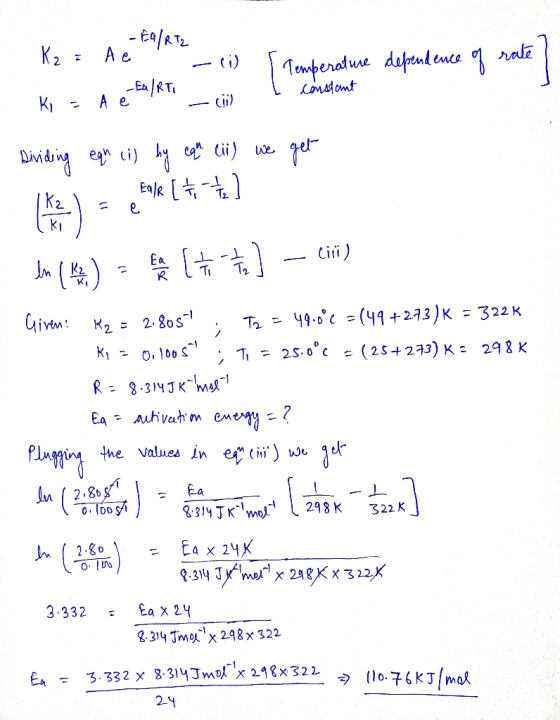
The rate constant of a chemical reaction increased from 0.100 s−1 to 2.80 s−1 upon raising...
The rate constant of a chemical reaction increased from 0.100 s−1 to 2.80 s−1 upon raising the temperature from 25.0∘C to 55.0 ∘C a) Calculate the value of (1/T2−1/T1) where T1 is the initial temperature and T2 is the final temperature. (in K^-1) b)Calculate the value of ln(k1/k2) where k1 and k2 correspond to the rate constants at the initial and the final temperatures as defined in part A. c) What is the activation energy of the reaction? (in kJ/mol)
The rate constant of a chemical reaction increased from 0.100 s−1 to 3.10 s−1 upon raising...
The rate constant of a chemical reaction increased from 0.100 s−1 to 3.10 s−1 upon raising the temperature from 25.0 ∘C to 47.0 ∘C . part A : Calculate the value of (1/T2−1/T1) where T1 is the initial temperature and T2 is the final temperature. = K−1 Part B : Calculate the value of ln(k1/ k2) where k1 and k2 correspond to the rate constants at the initial and the final temperatures as defined in part A. Part C :...
The rate constant of a chemical reaction increased from 0.100.5 to 2.80 s upon raising the...
 The rate constant of a chemical reaction increased from 0.100.5 to 2.80 s upon raising the temperature from 250 to 30.0 C Part B Calculate the value of lo w here 1 and 2 correspond to the rate constants at the initial and the final temperatures as defined in part A Express your answer numerically. View Available Hint() emppes Symbol odo redo reslet keyboard shortcuts help Submit Part C What is the activation energy of the reaction? Express your answer...
The rate constant of a chemical reaction increased from 0.100 s−1 to 3.00 s−1 upon raising...
The rate constant of a chemical reaction increased from 0.100 s−1 to 3.00 s−1 upon raising the temperature from 25.0 ∘C to 53.0 ∘C . Calculate the value of (1T2−1T1) where T1 is the initial temperature and T2 is the final temperature. Calculate the value of ln(k1k2) where k1 and k2 correspond to the rate constants at the initial and the final temperatures as defined in part A. What is the activation energy of the reaction?
Use the Arrhenius equation to calculate the activation energy. The rate constant of a chemical reaction...
Use the Arrhenius equation to calculate the activation energy. The rate constant of a chemical reaction increased from 0.100 s−1 to 2.70 s−1 upon raising the temperature from 25.0 ∘C to 43.0 ∘C . a) Calculate the value of (1/T2−1/T1) where T1 is the initial temperature and T2 is the final temperature. (in units of k-1) b) Calculate the value of ln(k1/k2) where k1 and k2 correspond to the rate constants at the initial and the final temperatures as defined...
Reaction Rates and Temperature 31 Review Constants i Peric The rate constant of a chemical reaction...
 Reaction Rates and Temperature 31 Review Constants i Peric The rate constant of a chemical reaction increased from 0.100 - 2005 - pon raising the temperature from 250 C 350 C Learning Goal To use the Athenius equation to calculate the activation energy As temperature rises, the average kinetic energy of molecules increases. In a chemical reaction, this means at a higher percentage of the molecules possess the required activation energy and the reaction goes faster. This relationship is shown...
 The rate constant of a chemical reaction increased from 0.100.5 to 2.80 s upon raising the temperature from 250 to 30.0 C Part B Calculate the value of lo w here 1 and 2 correspond to the rate constants at the initial and the final temperatures as defined in part A Express your answer numerically. View Available Hint() emppes Symbol odo redo reslet keyboard shortcuts help Submit Part C What is the activation energy of the reaction? Express your answer...
 Reaction Rates and Temperature 31 Review Constants i Peric The rate constant of a chemical reaction increased from 0.100 - 2005 - pon raising the temperature from 250 C 350 C Learning Goal To use the Athenius equation to calculate the activation energy As temperature rises, the average kinetic energy of molecules increases. In a chemical reaction, this means at a higher percentage of the molecules possess the required activation energy and the reaction goes faster. This relationship is shown...
Most questions answered within 3 hours.
-
Where is the error in this code sequence?
String s1 = "Hello";
String s2 = "ello";...
asked 11 months ago -
Financial data for Joel de Paris, Inc., for last year
follow:
Joel de Paris, Inc.
Balance...
asked 11 months ago -
Consider this reaction:
Al2(SO4)3 (aq)+ BaCl3
(aq) Al2Cl6 (aq)- +
3BaSO4(s) . What is the...
asked 11 months ago -
Suppose that Savneet is considering increasing her
recent random sample from 20 car rentals to 40...
asked 11 months ago -
Trucks arrive at an unloading terminal at an average rate of 120
per hour.
Trucks arrive...
asked 11 months ago -
Why are methanol and ethanol completely soluble in water while
octanol is not very little soluble....
asked 11 months ago -
A facilities manager at a university reads in a research report
that the mean amount of...
asked 11 months ago -
When the CuSO4 is rehydrated by adding water to the anhydrous
compound, is this an endothermic...
asked 11 months ago -
A ray of sunlight is passing from diamond into crown glass; the
angle of incidence is...
asked 11 months ago -
A block of mass 0.249 kg is placed on top of a light, vertical
spring of...
asked 11 months ago -
how do the kidneys compensate in the presences of acidosis
a) trigger hyperventilate
b) reserve acid...
asked 11 months ago -
Question 501 pts
The rental rate of capital to the firm increases. Which of the
following...
asked 11 months ago