explain mechanical barriers for immune responses
Homework Answers
Ans) Mechanical barriers physically block pathogens from entering the body. The skin is the most important mechanical barrier. In fact, it is the single most important defense the body has.
- Mucous membranes secrete mucus, a slimy substance that traps pathogens. The membranes also have hair-like cilia.
Explain the major responsibility of the spleen with regards to the immune surveillance responses, compared to...
Explain the major responsibility of the spleen with regards to the immune surveillance responses, compared to the major responsibilities of the lymph nodes and the mucosal tissues?
6. Immune responses mediated by memory T/B cells generally produce better, stronger, faster responses than immune...
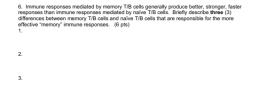 6. Immune responses mediated by memory T/B cells generally produce better, stronger, faster responses than immune responses mediated by naïve T/B cells. Briefly describe three (3) differences between memory T/B cells and naive T/B cells that are responsible for the more effective memory" immune responses. (6 pts) 1. 2. 3.
discuss some examples of altered immune responses.
discuss some examples of altered immune responses.
Describe the barriers, cells, and proteins involved in the different phases of the immune response
Describe the barriers, cells, and proteins involved in the different phases of the immune response
Outline the type of immune responses to diphtheria. Innate and/or adaptive?
Outline the type of immune responses to diphtheria. Innate and/or adaptive?
list the immune responses characterized as specific (aquired) immunity.
list the immune responses characterized as specific (aquired) immunity.
. How can innate immune responses be enhanced? Use the table and figure below to discuss...
. How can innate immune responses be enhanced? Use the table and figure below to discuss this. Also, include direct and indirect ways to enhance the capability of DCs. How can innate immune responses be enhanced?
Briefly describe the adaptive immune responses to the African swine fever virus?
Briefly describe the adaptive immune responses to the African swine fever virus?
The innate immune system tends to have non-specific responses to pathogens with antimicrobial peptides. However, scientists...
The innate immune system tends to have non-specific responses to pathogens with antimicrobial peptides. However, scientists create antimicrobial compounds which are very target specific. Explain the differences in strategy (specific vs non-specific).
Antigen presenting cells link innate and adaptive immune responses. In the theoretical scenario where phagosomes cannot...
Antigen presenting cells link innate and adaptive immune responses. In the theoretical scenario where phagosomes cannot be formed, phagocytosis is made ineffective. a. Would any cytotoxic T cells activity be observed? Explain in less than 25 words.
 6. Immune responses mediated by memory T/B cells generally produce better, stronger, faster responses than immune responses mediated by naïve T/B cells. Briefly describe three (3) differences between memory T/B cells and naive T/B cells that are responsible for the more effective memory" immune responses. (6 pts) 1. 2. 3.
Most questions answered within 3 hours.
-
Where is the error in this code sequence?
String s1 = "Hello";
String s2 = "ello";...
asked 10 months ago -
Financial data for Joel de Paris, Inc., for last year
follow:
Joel de Paris, Inc.
Balance...
asked 10 months ago -
Consider this reaction:
Al2(SO4)3 (aq)+ BaCl3
(aq) Al2Cl6 (aq)- +
3BaSO4(s) . What is the...
asked 10 months ago -
Suppose that Savneet is considering increasing her
recent random sample from 20 car rentals to 40...
asked 10 months ago -
Trucks arrive at an unloading terminal at an average rate of 120
per hour.
Trucks arrive...
asked 10 months ago -
Why are methanol and ethanol completely soluble in water while
octanol is not very little soluble....
asked 10 months ago -
A facilities manager at a university reads in a research report
that the mean amount of...
asked 10 months ago -
When the CuSO4 is rehydrated by adding water to the anhydrous
compound, is this an endothermic...
asked 10 months ago -
A ray of sunlight is passing from diamond into crown glass; the
angle of incidence is...
asked 10 months ago -
A block of mass 0.249 kg is placed on top of a light, vertical
spring of...
asked 10 months ago -
how do the kidneys compensate in the presences of acidosis
a) trigger hyperventilate
b) reserve acid...
asked 10 months ago -
Question 501 pts
The rental rate of capital to the firm increases. Which of the
following...
asked 10 months ago