list the immune responses characterized as specific (aquired) immunity.
list the immune responses characterized as specific (aquired) immunity.
Homework Answers
The list of immune responses characterized as acquired or specific immunity are
1) The humoral and the cell mediated immune responses
The adaptive immunity is usually not resent in a human's body during birth , it is acquired after birth. It is very specific to the antigen that attacks the body
The T cells and the B cells are the active immune cells , that are responsible for elucidating the specific immune response
T cells
The T cells are the T lymphocytes destroy a foreign antigen or abnormal cells of the body by recognizing them through specific fragments that are attached on the surface of the antigens . These fragments are laid by various cells such as
- Killer T cells
- Helper T cells
- Suppressor T cells
With the help of the cells mentioned above the T cells destroy the pathogen
B cell
B cells are the cells that produce the antibodies against the antigens that encounter the body. They elucidate 2 types of responses
The primary response
The antibody is created for the first time when the pathogen enters the body
Secondary response
This is caused by the memory B cells , that remembers the antigen during its second attack to the body . This time the defense mechanism gets stronger and more effective against the pathogen . The vaccinations are designed by exploiting this character of the B cells
The acquired immunity may be natural or artificial
Natural Acquired immunity
It is of 2 types Passive and active. Passive natural acquired immunity is attained from the mother to the infant through breast milk . Active natural acquired immunity is attained when there is an infection encountered by the body by the B memory cells
Artificial Acquired immunity
Artificial acquired immunity is also of 2 types , the active and the passive
The active artificial acquired immunity is attained by vaccines , the passive artificial acquired immunity is given by injecting antibodies to provide immunity
Add Answer to:
list the immune responses characterized as specific (aquired)
immunity.
Immunity When we say that we are immune to a specific infectious agent, what are we...
Immunity When we say that we are immune to a specific infectious agent, what are we talking about? How many different types of immunity are there? Tell us a bit about each and how it works.
The main difference between "systemic" and mucosal immunity is: a. Mucosal immunity is characterized by a...
The main difference between "systemic" and mucosal immunity is: a. Mucosal immunity is characterized by a constant low level of inflammation b. Systemic immunity is characterized by a constant low level of inflammation c. No antibodies are involved in mucosal immunity d. No T cells are involved in mucosal immunity e. Intestinal macrophages are more responsive than normal tissue-resident macrophages
What’s the difference between a primary immune response and secondary immune response? Answer both in terms...
What’s the difference between a primary immune response and secondary immune response? Answer both in terms of the physiological responses and in terms of the mechanism by which it is achieved. Adaptive immunity is a response to a specific antigen. How does the adaptive immune system mount a specific response to an invading antigen? How is it possible to mount such a response to a wide array of antigens?
Discuss the following: immunology, innate immunity, nonspecific immune, Acquired or adaptive immunity, Antigens, Antibodies, immunoglobulins, antigen-antibody...
Discuss the following: immunology, innate immunity, nonspecific immune, Acquired or adaptive immunity, Antigens, Antibodies, immunoglobulins, antigen-antibody reaction, significance of antibodies in rapid diagnostic tests that are used in clinical, primary antibodies. Enzyme-linked Secondary antibodies, Substrate specific for the enzyme.
Describe the mechanisms of type III hypersensitivity. List five (5) immune responses to cancer.
Describe the mechanisms of type III hypersensitivity. List five (5) immune responses to cancer.
The innate immune system tends to have non-specific responses to pathogens with antimicrobial peptides. However, scientists...
The innate immune system tends to have non-specific responses to pathogens with antimicrobial peptides. However, scientists create antimicrobial compounds which are very target specific. Explain the differences in strategy (specific vs non-specific).
Helllpppppp on this two immunology question pleaseee? 1. Describe how Treg negatively regulate immune responses? 2....
Helllpppppp on this two immunology question pleaseee? 1. Describe how Treg negatively regulate immune responses? 2. Describe how innate immunity collaborates with adaptive immunity to protect the host by using DC (dendritic cells) as an example?
List each of the mechanisms of the innate or non- specific immune system. Explain why there...
List each of the mechanisms of the innate or non- specific immune system. Explain why there mechanisms are considered non-specific.
Immune responses to foreign antigens result from cascades of cellular interactions, starting with the uptake of...
Immune responses to foreign antigens result from cascades of cellular interactions, starting with the uptake of the antigen by accessory cells and its subsequent presentation to the effector cells. Using the knowledge you have accumulated from this course, discuss and show in reasonable details how humoral immunity to herpes simplex virus type-2 is achieved in infected individuals.
6. Immune responses mediated by memory T/B cells generally produce better, stronger, faster responses than immune...
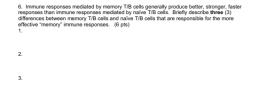 6. Immune responses mediated by memory T/B cells generally produce better, stronger, faster responses than immune responses mediated by naïve T/B cells. Briefly describe three (3) differences between memory T/B cells and naive T/B cells that are responsible for the more effective memory" immune responses. (6 pts) 1. 2. 3.
 6. Immune responses mediated by memory T/B cells generally produce better, stronger, faster responses than immune responses mediated by naïve T/B cells. Briefly describe three (3) differences between memory T/B cells and naive T/B cells that are responsible for the more effective memory" immune responses. (6 pts) 1. 2. 3.
Most questions answered within 3 hours.
-
Where is the error in this code sequence?
String s1 = "Hello";
String s2 = "ello";...
asked 10 months ago -
Financial data for Joel de Paris, Inc., for last year
follow:
Joel de Paris, Inc.
Balance...
asked 10 months ago -
Consider this reaction:
Al2(SO4)3 (aq)+ BaCl3
(aq) Al2Cl6 (aq)- +
3BaSO4(s) . What is the...
asked 10 months ago -
Suppose that Savneet is considering increasing her
recent random sample from 20 car rentals to 40...
asked 10 months ago -
Trucks arrive at an unloading terminal at an average rate of 120
per hour.
Trucks arrive...
asked 10 months ago -
Why are methanol and ethanol completely soluble in water while
octanol is not very little soluble....
asked 10 months ago -
A facilities manager at a university reads in a research report
that the mean amount of...
asked 10 months ago -
When the CuSO4 is rehydrated by adding water to the anhydrous
compound, is this an endothermic...
asked 10 months ago -
A ray of sunlight is passing from diamond into crown glass; the
angle of incidence is...
asked 10 months ago -
A block of mass 0.249 kg is placed on top of a light, vertical
spring of...
asked 10 months ago -
how do the kidneys compensate in the presences of acidosis
a) trigger hyperventilate
b) reserve acid...
asked 10 months ago -
Question 501 pts
The rental rate of capital to the firm increases. Which of the
following...
asked 10 months ago