Why does a higher utilization rate lead to higher productive efficiency?
Why does a higher utilization rate lead to higher productive efficiency?
Homework Answers
Why does a higher utilization rate lead to Higer productive Efficiency :
Capacity Utilization mean = Actual Output /Potential Output * 100
Capacity Utilization rate is an important operational metric for business purpose . The concept of capacity Utilization is best applied to the production
Capacity utilization rate is also a key economic indicator . A company wit less than 100% utilization can theoretically increase production without incurring any expensive overhead cost
Capacity utilization rate will help us to understand any companies current Operating Efficiency and it will definitely helpful to understand cost structure of the company
Definitely capacity utilization rate changes according to production volume in relates to change in demand.
Whenever economy is down or increase in unemployment rate , demand automatically going down and impact on Utilization
Definitely low capacity Utilization is concern for company as well as Economy
Capacity utilization is an important measurement relates to Productive efficiency
Higher utilization rate can reduce unit cost , making business more competitive
We noticed that business run with lower capacity mainly due to lower demand in the market , loss of market share and seasonal disturbance
Need to ensure that excess demand with excess capacity utilization sometime disturb Quality + Employee effectiveness
Add Answer to:
Why does a higher utilization rate lead to higher productive efficiency?
5. In perfect competition, a. Allocative efficiency holds and productive efficiency does not hold. b. Allocative...
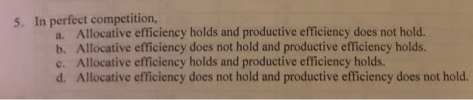 5. In perfect competition, a. Allocative efficiency holds and productive efficiency does not hold. b. Allocative efficiency does not hold and productive efficiency holds. c. Allocative efficiency holds and productive efficiency holds. d. Allocative efficiency does not hold and productive efficiency does not hold.
For efficiency and flow rate curve for a pump, why does the curve fall off after...
For efficiency and flow rate curve for a pump, why does the curve fall off after the best efficiency point? Why does a high flow rate mean higher efficiency? For hydraulic power vs flow rate curve for a pump, what is the relationship? why does a high flow rate mean higher hydraulic power? concept behind this?
Use the data below to calculate efficiency and utilization: a. John's Car Repair service repairs an...
 Use the data below to calculate efficiency and utilization: a. John's Car Repair service repairs an average of 6 cars every week. The design capacity of the shop is 18 repairs per week and the effective capacity is 16 repairs per week. (Round your answer to 1 decimal place. Omit the "%" sign in your response.) Utilization Efficiency b. The average output of a manufacturing process is 4 widgets per hour. The design capacity is 8 widgets per hour. The...
How does an understanding of management and organizational behavior lead to organizational effectiveness and efficiency? Why...
How does an understanding of management and organizational behavior lead to organizational effectiveness and efficiency? Why is the study of management theories (classical, behavioral and modern management) relevant today?
Determine the utilization and the efficiency for each of these situations: a. A loan processing operation...
 Determine the utilization and the efficiency for each of these situations: a. A loan processing operation that processes an average of 5 loans per day. The operation has a design capacity of 11 loans per day and an effective capacity of 9 loans per day. (Round your answer to 1 decimal place. Omit the "%" sign in your response.) Utilization Efficiency b. A furnace repair team that services an average of 4 furnaces a day if the design capacity is...
Determine the utilization and the efficiency for each of these situations: a. A loan processing operation...
Determine the utilization and the efficiency for each of these situations: a. A loan processing operation that processes an average of 5 loans per day. The operation has a design capacity of 11 loans per day and an effective capacity of 9 loans per day. (Round your answer to 1 decimal place. Omit the "%" sign in your response.) Utilization % Efficiency % b. A furnace repair team that services an average of 4 furnaces a day if the design...
Problem 5-1 Determine the utilization and the efficiency for each of these situations: a. A loan...
 Problem 5-1 Determine the utilization and the efficiency for each of these situations: a. A loan processing operation that processes an average of 6 loans per day. The operation has a design capacity of 13 loans per day and an effective capacity of 10 loans per day. (Round your answer to 1 decimal place. Omit the "%" sign in your response.) Utilization Efficiency b. A furnace repair team that services an average of 3 furnaces a day if the design...
Does the monopolistically-competitive firm achieve productive and allocative efficiency in the long run? How does this...
Does the monopolistically-competitive firm achieve productive and allocative efficiency in the long run? How does this affect consumers in the market? How might this be different from perfect competition in the long run?
Perfect competition results in productive efficiency and allocative efficiency, while monopolistic competition results in ________. a....
Perfect competition results in productive efficiency and allocative efficiency, while monopolistic competition results in ________. a. both allocative and productive efficiency b. allocative efficiency, but not productive efficiency c. productive efficiency, but not allocative efficiency d. neither allocative nor productive efficiency
Why are maintenance and long-term management of chronic conditions essential to reduce utilization costs over time?...
Why are maintenance and long-term management of chronic conditions essential to reduce utilization costs over time? How does clinical integration and alignment of stakeholders’ interests lead to a reduction in utilization costs?
 5. In perfect competition, a. Allocative efficiency holds and productive efficiency does not hold. b. Allocative efficiency does not hold and productive efficiency holds. c. Allocative efficiency holds and productive efficiency holds. d. Allocative efficiency does not hold and productive efficiency does not hold.
 Use the data below to calculate efficiency and utilization: a. John's Car Repair service repairs an average of 6 cars every week. The design capacity of the shop is 18 repairs per week and the effective capacity is 16 repairs per week. (Round your answer to 1 decimal place. Omit the "%" sign in your response.) Utilization Efficiency b. The average output of a manufacturing process is 4 widgets per hour. The design capacity is 8 widgets per hour. The...
 Determine the utilization and the efficiency for each of these situations: a. A loan processing operation that processes an average of 5 loans per day. The operation has a design capacity of 11 loans per day and an effective capacity of 9 loans per day. (Round your answer to 1 decimal place. Omit the "%" sign in your response.) Utilization Efficiency b. A furnace repair team that services an average of 4 furnaces a day if the design capacity is...
 Problem 5-1 Determine the utilization and the efficiency for each of these situations: a. A loan processing operation that processes an average of 6 loans per day. The operation has a design capacity of 13 loans per day and an effective capacity of 10 loans per day. (Round your answer to 1 decimal place. Omit the "%" sign in your response.) Utilization Efficiency b. A furnace repair team that services an average of 3 furnaces a day if the design...
Most questions answered within 3 hours.
-
Where is the error in this code sequence?
String s1 = "Hello";
String s2 = "ello";...
asked 10 months ago -
Financial data for Joel de Paris, Inc., for last year
follow:
Joel de Paris, Inc.
Balance...
asked 10 months ago -
Consider this reaction:
Al2(SO4)3 (aq)+ BaCl3
(aq) Al2Cl6 (aq)- +
3BaSO4(s) . What is the...
asked 10 months ago -
Suppose that Savneet is considering increasing her
recent random sample from 20 car rentals to 40...
asked 10 months ago -
Trucks arrive at an unloading terminal at an average rate of 120
per hour.
Trucks arrive...
asked 10 months ago -
Why are methanol and ethanol completely soluble in water while
octanol is not very little soluble....
asked 10 months ago -
A facilities manager at a university reads in a research report
that the mean amount of...
asked 10 months ago -
When the CuSO4 is rehydrated by adding water to the anhydrous
compound, is this an endothermic...
asked 10 months ago -
A ray of sunlight is passing from diamond into crown glass; the
angle of incidence is...
asked 10 months ago -
A block of mass 0.249 kg is placed on top of a light, vertical
spring of...
asked 10 months ago -
how do the kidneys compensate in the presences of acidosis
a) trigger hyperventilate
b) reserve acid...
asked 10 months ago -
Question 501 pts
The rental rate of capital to the firm increases. Which of the
following...
asked 10 months ago