
Homework Answers
Add Answer to:
Item 10: Question (10 pts.) Given the following reactions, AgBr(s) = Ag+(aq) + Br-(aq) Kap =...
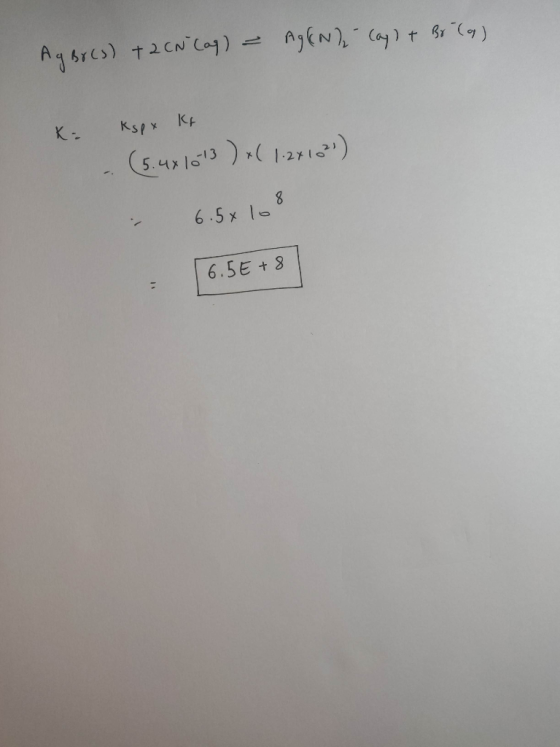
Given the following reactions, AgBr(s) Ag (aq) + Br(aq) Ag*(aq)2 CN (aq)=Ag(CN)2(aq) K 1.2E+21 determine the...
 Given the following reactions, AgBr(s) Ag (aq) + Br(aq) Ag*(aq)2 CN (aq)=Ag(CN)2(aq) K 1.2E+21 determine the equilibrium constant for the reaction below AgBr(s)2 CN-(aq)= Ag(CN)2 (aq) Brr(aq) Ksp 5.4E-13
Given the following reactions, AgBr(s) = Ag+ (aq) + Br(aq) Ksp = 5.8 x 10⁻¹³ Ag+...
 Given the following reactions, AgBr(s) = Ag+ (aq) + Br(aq) Ksp = 5.8 x 10⁻¹³ Ag+ (aq) + 2 CN"(aq) = Ag(CN)2(aq) Kf = 9.5 x 10²¹ determine the equilibrium constant for the reaction below. AgBr(s) + 2 CN"(aq) =Ag(CN)2(aq) + Br(aq) Answer: 1.2E21 Check
Question 22 (5 points) Given the following half reactions: - AgBr(s) + e- Ag+ (aq) +...
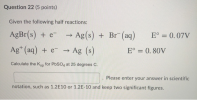 Question 22 (5 points) Given the following half reactions: - AgBr(s) + e- Ag+ (aq) + e- Ag(s) + Br- (aq) E° = 0.07V → Ag (s) E° = 0.80V - Calculate the Ksp for PbSO4 at 25 degrees C. Please enter your answer in scientific notation, such as 1.2E10 or 1.2E-10 and keep two significant figures.
Consider the following information at 25 ºC: AgBr(s) + e- → Ag(s) + Br-(aq) Eº(AgBr(s),Ag(s)) =...
Consider the following information at 25 ºC: AgBr(s) + e- → Ag(s) + Br-(aq) Eº(AgBr(s),Ag(s)) = 0.07133 V Ag+(aq) + e- → Ag(s) Eº(Ag+(aq),Ag(s)) = 0.7996 V What is the value of the solubility product equilibrium constant Ksp(AgBr) of silver bromide? AgBr(s) ↔ Ag+(aq) + Br-(aq) Ksp(AgBr)
the equilibrium constant for the reaction AgBr(s)<—>Ag(aq)+Br-(aq) is the solubility product constant Ksp=7.7*10^-13 at 25 degrees...
the equilibrium constant for the reaction AgBr(s)<—>Ag(aq)+Br-(aq) is the solubility product constant Ksp=7.7*10^-13 at 25 degrees C calculate the delta G for the reaction [Ag]= 1.0*10^-2 M and [Br]= 1.0*10^3 M. is the reaction spontaneous or nonspontaneous at these concentrations
Item 15: Question 4 pts whun of the following protons (Ha He. and Ho) is most...
 Item 15: Question 4 pts whun of the following protons (Ha He. and Ho) is most acidic? HA N He Ho O HA OHв ОНp They all have the same acidity Submit Submit and Next Mark this question for later review Skip to Previous Skip to Next → s, Amherst, MA USA
1. Given the two equilibria below, Ag(NH3)2(aq) = Agt(aq) + 2NH3(aq); Kd = 5.9 x 10⁻⁸...
 1. Given the two equilibria below, Ag(NH3)2(aq) = Agt(aq) + 2NH3(aq); Kd = 5.9 x 10⁻⁸ AgBr(s) Ag+(aq) + Br" (aq); Ksp = 5 x 10-13 what is K, for the following equilibrium? AgBr(s) + 2NH3(aq) = Ag(NH3)2(aq) + Br" (aq) a. 3 x 10-20 b.2.7 x 100 c. 7.2 x 10⁻¹¹ d. 8.5 x 10⁻⁶ e. 1.2 x 10⁵
Consider the following Gibbs energies at 25 "C Substance Ag (aq) Cr(aq) AgCI(s) Br(aq) AgBr(s) 77.1...
 Consider the following Gibbs energies at 25 "C Substance Ag (aq) Cr(aq) AgCI(s) Br(aq) AgBr(s) 77.1 - 131.2 - 109.8 - 104.0 -96.9 (a) Calculate AG rn for the dissolution of AgCl(s). (b) Calculate the solubility-product constant of AgCl Number Number kJ mol (c) Calculate Δ3rxn for the dissolution of AgBr(s). (d) Calculate the solubility-product constant of AgBr Number Number kJ mol
2.5 pts. each Question 6 a) HNO3(aq) ??? H* (aq) + NO; (aq) b) Br (aq)...
 2.5 pts. each Question 6 a) HNO3(aq) ??? H* (aq) + NO; (aq) b) Br (aq) + HOH (1) ??? HBr + OH' (aq) c) CH,COOH (aq) + HOH (U) ??? CH3COO- (aq) + H+ (aq) d) CH3COO(aq) + HOH (1) ??? CH3COOH (aq) + OH (aq) Which of these chemical reactions, if any, _D_ Represent(s) an equilibrium reaction Ad Represent(s) a one-way forward reaction -a Represent(s) a reaction that cannot occur Represent(s) an Acid/Base reaction Question 7 10 pts....
Item 7: Question (10 pts.) Chemical Formulas Scientific Notation Periodic Table Tables In the laboratory you...
 Item 7: Question (10 pts.) Chemical Formulas Scientific Notation Periodic Table Tables In the laboratory you are given the task of separating Ca2 and Zn2 lons in aqueous solution For each reagent listed below indicate if it can be used to separate the lons. Type "Y" for yes or "N" for no. If the reagent CAN be used to separate the ions, give the formula of the precipitate. If it cannot, type "No Y or N Reagent Formula of Precipitate...
 Given the following reactions, AgBr(s) Ag (aq) + Br(aq) Ag*(aq)2 CN (aq)=Ag(CN)2(aq) K 1.2E+21 determine the equilibrium constant for the reaction below AgBr(s)2 CN-(aq)= Ag(CN)2 (aq) Brr(aq) Ksp 5.4E-13
 Given the following reactions, AgBr(s) = Ag+ (aq) + Br(aq) Ksp = 5.8 x 10⁻¹³ Ag+ (aq) + 2 CN"(aq) = Ag(CN)2(aq) Kf = 9.5 x 10²¹ determine the equilibrium constant for the reaction below. AgBr(s) + 2 CN"(aq) =Ag(CN)2(aq) + Br(aq) Answer: 1.2E21 Check
 Question 22 (5 points) Given the following half reactions: - AgBr(s) + e- Ag+ (aq) + e- Ag(s) + Br- (aq) E° = 0.07V → Ag (s) E° = 0.80V - Calculate the Ksp for PbSO4 at 25 degrees C. Please enter your answer in scientific notation, such as 1.2E10 or 1.2E-10 and keep two significant figures.
 Item 15: Question 4 pts whun of the following protons (Ha He. and Ho) is most acidic? HA N He Ho O HA OHв ОНp They all have the same acidity Submit Submit and Next Mark this question for later review Skip to Previous Skip to Next → s, Amherst, MA USA
 1. Given the two equilibria below, Ag(NH3)2(aq) = Agt(aq) + 2NH3(aq); Kd = 5.9 x 10⁻⁸ AgBr(s) Ag+(aq) + Br" (aq); Ksp = 5 x 10-13 what is K, for the following equilibrium? AgBr(s) + 2NH3(aq) = Ag(NH3)2(aq) + Br" (aq) a. 3 x 10-20 b.2.7 x 100 c. 7.2 x 10⁻¹¹ d. 8.5 x 10⁻⁶ e. 1.2 x 10⁵
 Consider the following Gibbs energies at 25 "C Substance Ag (aq) Cr(aq) AgCI(s) Br(aq) AgBr(s) 77.1 - 131.2 - 109.8 - 104.0 -96.9 (a) Calculate AG rn for the dissolution of AgCl(s). (b) Calculate the solubility-product constant of AgCl Number Number kJ mol (c) Calculate Δ3rxn for the dissolution of AgBr(s). (d) Calculate the solubility-product constant of AgBr Number Number kJ mol
 2.5 pts. each Question 6 a) HNO3(aq) ??? H* (aq) + NO; (aq) b) Br (aq) + HOH (1) ??? HBr + OH' (aq) c) CH,COOH (aq) + HOH (U) ??? CH3COO- (aq) + H+ (aq) d) CH3COO(aq) + HOH (1) ??? CH3COOH (aq) + OH (aq) Which of these chemical reactions, if any, _D_ Represent(s) an equilibrium reaction Ad Represent(s) a one-way forward reaction -a Represent(s) a reaction that cannot occur Represent(s) an Acid/Base reaction Question 7 10 pts....
 Item 7: Question (10 pts.) Chemical Formulas Scientific Notation Periodic Table Tables In the laboratory you are given the task of separating Ca2 and Zn2 lons in aqueous solution For each reagent listed below indicate if it can be used to separate the lons. Type "Y" for yes or "N" for no. If the reagent CAN be used to separate the ions, give the formula of the precipitate. If it cannot, type "No Y or N Reagent Formula of Precipitate...
Most questions answered within 3 hours.
-
Where is the error in this code sequence?
String s1 = "Hello";
String s2 = "ello";...
asked 10 months ago -
Financial data for Joel de Paris, Inc., for last year
follow:
Joel de Paris, Inc.
Balance...
asked 10 months ago -
Consider this reaction:
Al2(SO4)3 (aq)+ BaCl3
(aq) Al2Cl6 (aq)- +
3BaSO4(s) . What is the...
asked 10 months ago -
Suppose that Savneet is considering increasing her
recent random sample from 20 car rentals to 40...
asked 10 months ago -
Trucks arrive at an unloading terminal at an average rate of 120
per hour.
Trucks arrive...
asked 10 months ago -
Why are methanol and ethanol completely soluble in water while
octanol is not very little soluble....
asked 10 months ago -
A facilities manager at a university reads in a research report
that the mean amount of...
asked 10 months ago -
When the CuSO4 is rehydrated by adding water to the anhydrous
compound, is this an endothermic...
asked 10 months ago -
A ray of sunlight is passing from diamond into crown glass; the
angle of incidence is...
asked 10 months ago -
A block of mass 0.249 kg is placed on top of a light, vertical
spring of...
asked 10 months ago -
how do the kidneys compensate in the presences of acidosis
a) trigger hyperventilate
b) reserve acid...
asked 10 months ago -
Question 501 pts
The rental rate of capital to the firm increases. Which of the
following...
asked 10 months ago