An LED mounted in the wall of a pool sits 1.6 m below the surface and...
An LED mounted in the wall of a pool sits 1.6 m below the surface and emits light rays in all directions. Some rays move forward and upward towards the water/air interface. Approximate the LED as a small source. For the following, explain your reasoning with a diagram. a. What is the critical angle in degrees for total internal reflection of the rays at the water/air interface? Should be ~48. b. For light rays that escape the pool, what is the smallest angle between the light rays and the normal to the LED surface? Should be ~42 c. What is the greatest distance from the pool wall that light rays escape the surface of the water, in m? The answer is not 2.39 or 2.15
Homework Answers
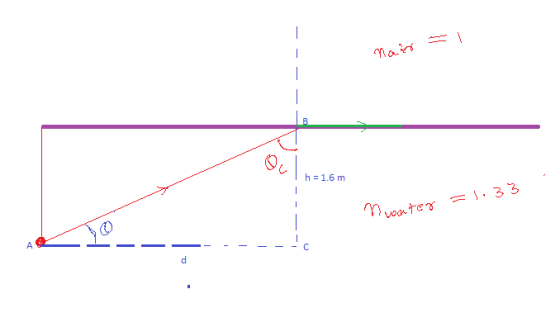
a)
=
critical angle = ?
=
angle of refraction = 90
using snell's law at the air-water interface
nwater Sin =
nair Sin
nwater Sin =
nair Sin90
(1.33) Sin =
1
Sin =
1/1.33 = 0.752
=
Sin-1(0.752)
= 48
deg
b)
In triangle ABC
= 90 -
= 90 - 48
= 42 deg
c)
d = distance
h = height of LED below the surface = 1.6 m
In triangle ABC
tan = BC/AB
tan42 = h/d
d = 1.6/tan42
d = 1.8 m
Add Answer to:
An LED mounted in the wall of a pool sits 1.6 m below the
surface and...
An LED mounted in the wall of a pool sits 1.6 m below the surface and...
An LED mounted in the wall of a pool sits 1.6 m below the surface and emits light rays in all directions. Some rays move forward and upward towards the water/air interface. Approximate the LED as a small source. For the following, explain your reasoning with a diagram. a. What is the critical angle in degrees for total internal reflection of the rays at the water/air interface? Should be ~48. b. For light rays that escape the pool, what is...
A small spotlight mounted in the bottom of a swimming pool that is 3.1 m deep...
A small spotlight mounted in the bottom of a swimming pool that is 3.1 m deep emits light in all directions. On the surface of the pool, directly above the light, the area illuminated is a circle. Determine the maximum radius of this circle. The index of refraction of water is 1.33. _______m
A point source of light is submerged 2.1 m below the surface of a lake and...
A point source of light is submerged 2.1 m below the surface of a lake and emits rays in all directions. On the surface of the lake, directly above the source, the area illuminated is a circle. What is the maximum radius that this circle could have? Take the refraction index of water to be 1.333.
In searching the bottom of a pool at night, a security guard shines a narrow beam...
 In searching the bottom of a pool at night, a security guard shines a narrow beam of light from his flashlight, above the water's surface, onto the waiter at a point 2.5 m from his foot at the edge of the pool. Where does the light hit the bottom of the pool measured from the wall beneath his foot if the pool is 2.1 m deep. A triangular prism made of crown glass, n = 1.52, with base angles of...
A light source at the bottom of a 4.7-m-deep water pool sends a light ray up...
A light source at the bottom of a 4.7-m-deep water pool sends a light ray up at an angle so that the ray strikes the surface 1.6 m from the point straight above the light source. What is the emerging ray's angle (in degrees) with the normal in air? °
water interface (the surface of the lake), it is partly reflected back into the air and...
 water interface (the surface of the lake), it is partly
reflected back into the air and partly refracted
or transmitted into the water. This explains why on the surface of
a lake sometimes you see the reflection of the surrounding
landscape and other times the underwater vegetation.
These effects on light propagation occur because light travels at
different speeds depending on the medium. The index of refraction
of a material, denoted by n, gives an indication of the speed of...
water interface (the surface of the lake), it is partly
reflected back into the air and partly refracted
or transmitted into the water. This explains why on the surface of
a lake sometimes you see the reflection of the surrounding
landscape and other times the underwater vegetation.
These effects on light propagation occur because light travels at
different speeds depending on the medium. The index of refraction
of a material, denoted by n, gives an indication of the speed of...
Problem 3: Consider the situation in the figure - a student diver in a pool and an...
 Problem 3: Consider the situation in
the figure - a student diver in a pool and an instructor on the
edge, outside the water. Since the indices of refraction of air and
water are different, the light rays coming from the diver and the
instructor are refracted at the surface, changing their apparent
position with respect to each other. The diver sees the instructor
at an apparent angle of θa = 26°, measured from
the normal to the interface.
Randomized
Variables: θa...
Problem 3: Consider the situation in
the figure - a student diver in a pool and an instructor on the
edge, outside the water. Since the indices of refraction of air and
water are different, the light rays coming from the diver and the
instructor are refracted at the surface, changing their apparent
position with respect to each other. The diver sees the instructor
at an apparent angle of θa = 26°, measured from
the normal to the interface.
Randomized
Variables: θa...
A flashlight is held at the edge of a swimming pool at a height h = 2.4 m such that its beam makes an angle of θ = 41 degrees with respect to the water's surface
A flashlight is held at the edge of a swimming pool at a height h = 2.4 m such that its beam makes an angle of θ = 41 degrees with respect to the water's surface. The pool is d = 2.25 m deep and the index of refraction for air and water are n1 = 1 and n2 = 1.33, respectively.what is the horizontal distance, D, from the edge of the pool to the point on the bottom of...
(8%) Problem 3: Consider the situation in the figure -a student diver in a pool and...
 (8%) Problem 3: Consider the situation in the figure -a student diver in a pool and an instructor on the edge, outside the water. Since the indices of refraction of air and water are different, the light rays coming from the diver and the instructor are refracted at the surface, changing their apparent position with respect to each other. The diver sees the instructor at an apparent angle of e, - 33", measured from the normal to the interface Randomized...
1) What is the smallest angle with respect to the normal should light be incident onto...
 1) What is the smallest angle with respect to the normal should light be incident onto a water-air interface from the water side so that it does not escape into air (assume the refractive index of water is 1.33): A) 20 B) 10.5 C) 48.8 D) 50.2 2) A fish appears to be 9.00 m below the surface of a pond when viewed almost directly above by a fisherman. What is the actual depth of the fish? (lwater= 1.33) !!...
 In searching the bottom of a pool at night, a security guard shines a narrow beam of light from his flashlight, above the water's surface, onto the waiter at a point 2.5 m from his foot at the edge of the pool. Where does the light hit the bottom of the pool measured from the wall beneath his foot if the pool is 2.1 m deep. A triangular prism made of crown glass, n = 1.52, with base angles of...
 water interface (the surface of the lake), it is partly
reflected back into the air and partly refracted
or transmitted into the water. This explains why on the surface of
a lake sometimes you see the reflection of the surrounding
landscape and other times the underwater vegetation.
These effects on light propagation occur because light travels at
different speeds depending on the medium. The index of refraction
of a material, denoted by n, gives an indication of the speed of...
water interface (the surface of the lake), it is partly
reflected back into the air and partly refracted
or transmitted into the water. This explains why on the surface of
a lake sometimes you see the reflection of the surrounding
landscape and other times the underwater vegetation.
These effects on light propagation occur because light travels at
different speeds depending on the medium. The index of refraction
of a material, denoted by n, gives an indication of the speed of...
 Problem 3: Consider the situation in
the figure - a student diver in a pool and an instructor on the
edge, outside the water. Since the indices of refraction of air and
water are different, the light rays coming from the diver and the
instructor are refracted at the surface, changing their apparent
position with respect to each other. The diver sees the instructor
at an apparent angle of θa = 26°, measured from
the normal to the interface.
Randomized
Variables: θa...
Problem 3: Consider the situation in
the figure - a student diver in a pool and an instructor on the
edge, outside the water. Since the indices of refraction of air and
water are different, the light rays coming from the diver and the
instructor are refracted at the surface, changing their apparent
position with respect to each other. The diver sees the instructor
at an apparent angle of θa = 26°, measured from
the normal to the interface.
Randomized
Variables: θa...
 (8%) Problem 3: Consider the situation in the figure -a student diver in a pool and an instructor on the edge, outside the water. Since the indices of refraction of air and water are different, the light rays coming from the diver and the instructor are refracted at the surface, changing their apparent position with respect to each other. The diver sees the instructor at an apparent angle of e, - 33", measured from the normal to the interface Randomized...
 1) What is the smallest angle with respect to the normal should light be incident onto a water-air interface from the water side so that it does not escape into air (assume the refractive index of water is 1.33): A) 20 B) 10.5 C) 48.8 D) 50.2 2) A fish appears to be 9.00 m below the surface of a pond when viewed almost directly above by a fisherman. What is the actual depth of the fish? (lwater= 1.33) !!...
Most questions answered within 3 hours.
-
Where is the error in this code sequence?
String s1 = "Hello";
String s2 = "ello";...
asked 11 months ago -
Financial data for Joel de Paris, Inc., for last year
follow:
Joel de Paris, Inc.
Balance...
asked 11 months ago -
Consider this reaction:
Al2(SO4)3 (aq)+ BaCl3
(aq) Al2Cl6 (aq)- +
3BaSO4(s) . What is the...
asked 11 months ago -
Suppose that Savneet is considering increasing her
recent random sample from 20 car rentals to 40...
asked 11 months ago -
Trucks arrive at an unloading terminal at an average rate of 120
per hour.
Trucks arrive...
asked 11 months ago -
Why are methanol and ethanol completely soluble in water while
octanol is not very little soluble....
asked 11 months ago -
A facilities manager at a university reads in a research report
that the mean amount of...
asked 11 months ago -
When the CuSO4 is rehydrated by adding water to the anhydrous
compound, is this an endothermic...
asked 11 months ago -
A ray of sunlight is passing from diamond into crown glass; the
angle of incidence is...
asked 11 months ago -
A block of mass 0.249 kg is placed on top of a light, vertical
spring of...
asked 11 months ago -
how do the kidneys compensate in the presences of acidosis
a) trigger hyperventilate
b) reserve acid...
asked 11 months ago -
Question 501 pts
The rental rate of capital to the firm increases. Which of the
following...
asked 11 months ago