what are the requirments for being a director? must a director own stock in the compnay?
Homework Answers
1. The Board of Directors has to exercise strategic oversight over business operations while directly measuring and rewarding management’s performance. Simultaneously the Board has to ensure compliance with the legal framework, integrity of financial accounting and reporting systems and credibility in the eyes of the stakeholders through proper and timely disclosures.
2. Board’s responsibilities inherently demand the exercise of judgment. Therefore the Board necessarily has to be vested with a reasonable level of discretion. While corporate governance may comprise of both legal and behavioral norms, no written set of rules or laws can contemplate every situation that a director or the board collectively may find itself in. Besides, existence of written norms in itself cannot prevent a director from abusing his position while going through the motions of proper deliberation prescribed by written norms. Therefore behavioural norms that include informed and deliberative decision making, division of authority, monitoring of management and even handed performance of duties owed to the company as well as the shareholders are equally important.
3. However in a situation where companies have grown in size and have large public interest potential, it is important to prescribe an appropriate basic framework that needs to be complied with by all companies without sacrificing the basic requirement of allowing exercise of discretion and business judgment in the interest of the company and the stakeholders. The liability of compliance has to be seen in context of the common law framework prevalent in the country along with a wide variety of ownership structures including family run or controlled or otherwise closely held companies.
Board of Directors
4. Obligation to constitute a Board of Directors :-
4.1 The Board of Directors of a company is central to its decision
making and governance process. Its liability to ensure compliance
with the law underpins the corporate governance structure in a
company, the aspirations of the promoters and the rights of
stakeholders, all of which get articulated through the actions of
the Board. There should be an obligation on the part of a Company
to constitute and maintain a Board of Directors as per the
provisions of the law and to disclose particulars of the Directors
so appointed in the public domain through statutory filing of
information.
4.2 Such obligation should extend to the accuracy of the
information and its being updated regularly as well as on
occurrence of specific events such as appointment, resignation,
removal or any change in prescribed particulars of Directors.
Minimum and Maximum Number of Directors
5.1 Law should provide for minimum number of directors necessary
for various classes of companies. The present prescribed
requirement is considered adequate. However new kinds of companies
will evolve to keep pace with emerging business requirements. Law
should therefore include an enabling provision to prescribe
specific categories of companies for which a different minimum
number may be laid down
5.2 The obligation of maintaining the required minimum number of
directors on the Board should be that of the Company
5.3 There need not be any limit to the maximum numbers of directors
that a Company may have. Limit to maximum number of directors
should be decided by the company by/in the Articles of
Association.
5.4 Every Company should have at least one director resident in
India to ensure availability in case any issue arises with regard
to the accountability of the Board.
Manner of appointment, removal and resignation of Directors
6.1 The ultimate responsibility to appoint/remove directors
should be that of the Company (Shareholders). If the Directors
themselves are legally disqualified to hold directorships, they
should have an equal responsibility for disclosing the fact and
reasons for their disqualification.
6.2 Government should not intervene in the process of appointment
and removal of Directors in non-Government companies. It is
important that role and powers of Government, under the present
provisions to intervene in appointment of Directors be reviewed and
revised, vesting the responsibility on the shareholders of the
company.
6.3 Presently, as per the provisions of Schedule XIII to the
Companies Act, it is necessary to obtain the approval of the
Central Government for appointing a person who is not resident in
India, i.e. a person who has not been staying in India for a
continuous period of not less than 12 months immediately preceding
the date of his appointment as a managerial person.
6.4 In today’s competitive environment, it may be necessary for a
company to appoint a person as Managing Director or Whole-time
Director or Manager who is “best suited for the job”. The Company
should, therefore, have an option to choose such person not only
from within India, but from other countries as well. In the light
of the above, it is recommended that requirement of obtaining the
Central Government’s approval under the Companies Act for such
non-resident managerial person should be done away with. Such
person would continue to be subject to passport/visa, RBI and other
Government requirements.
6.5 Duty to inform ROC of particulars regarding directors including
their appointment and removal/ resignation/ death, or otherwise
ceasing to be Directors should be with the company. Every Director,
in turn, should be required to disclose his residence and other
particulars, as may be prescribed, to the Company.
6.6 Resignation should be recognized as a right to be exercised by
the director and should be considered in light of the
recommendations indicated at para 21.1-21.8 below).
Age limit for Directors
7.1 No age limit need be prescribed as per law. There should be
adequate disclosure of age in the company’s documents. It should be
the duty of the Director to disclose his age correctly.
7.2 In case of a public company, appointment of directors beyond a
prescribed age say 70 years, should be subject to a special
resolution by the shareholders which should also prescribe his
term. Continuation of a director above the age of 70 years, beyond
such term, should be subject to a fresh resolution.
Independent Directors
The Concept and Numbers of Independent Directors
8.1 The Committee is of the view that given the responsibility
of the Board to balance various interests, the presence of
Independent directors on the Board of a Company would improve
corporate governance. This is particularly important for public
companies or companies with a significant public interest. While
directors representing specific interests would be confined to the
perspective dictated by such interests, independent directors would
be able to bring an element of objectivity to Board process in the
general interests of the company and thereby to the benefit of
minority interests and smaller shareholders. Independence,
therefore, is not to be viewed merely as independence from Promoter
Interests but from the point of view of vulnerable stakeholders who
cannot otherwise get their voice heard. Law should, therefore,
recognize the principle of independent directors and spell out
their role, qualifications and liability. However requirement of
presence of Independent directors may vary depending on the size
and type of company. There cannot be a single prescription to suit
all companies. Therefore number of Independent directors may be
prescribed through rules for different categories of companies.
However a definition of independent director should be incorporated
in the Company law.
8.2 In general, in view of the Committee a minimum of one third of
the total number of directors as independent directors should be
adequate for a company having significant public interest,
irrespective of whether the Chairman is executive or non-executive,
independent or not. In the first instance this requirement should
be extended to public listed companies and companies accepting
public deposits. The requirements for other types of companies may
be considered in due course.
8.3 In certain cases Regulators may specify requirement of
Independent Directors for companies falling within their regulatory
domain. Such Regulators may specify the number where provision for
appointment of Independent Directors has been extended to a
particular class of companies under the Companies Act.
8.4 Nominee directors appointed by any institution or in pursuance
of any agreement or Government appointees representing Government
shareholding should not be deemed to be independent directors. A
view point was expressed that nominees of Banks/Financial
Institutions (FIs) on the Boards of companies may be treated as
“Independent”. After detailed deliberation, the Committee took the
view that such nominees represented specific interests and could
not, therefore, be correctly termed as independent.
8.5 There should be no requirement for a subsidiary company to
necessarily co-opt an independent director of the holding company
as an independent director on its board. Definition of
Independent
Director/ Attributes of Independent Directors
9.1 The Committee was of the view that definition of an
Independent Director should be provided in law.
9.2 The expression ‘independent director’ should mean a
non-executive director of the company who :- a) Apart from
receiving director’s remuneration, does not have, and none of his
relatives or firms/companies controlled by him have, any material
pecuniary relationships or transactions with the company, its
promoters, its directors, its senior management or its holding
company, its subsidiaries and associate companies which may affect
independence of the director. For this purpose “control” should be
defined in law. b) is not, and none of his relatives is, related to
promoters or persons occupying management positions at the board
level or at one level below the board; c) is not affiliated to any
non-profit organization that receives significant funding from the
company, its promoters, its directors, its senior management or its
holding or subsidiary company; d) has not been, and none of his
relatives has been, employee of the company in the immediately
preceding year; e) is not, and none of his relatives is, a partner
or part of senior management (or has not been a partner or part of
senior management) during the preceding one year, of any of the
following:- i] the statutory audit firm or the internal audit firm
that is associated with the company, its holding and subsidiary
companies; ii) the legal firm(s) and consulting firm(s) that have a
material association with the company, its holding and subsidiary
companies; f) is not, and none of his relatives is, a material
supplier, service provider or customer or a lessor or lessee of the
company, which may affect independence of the director; g) is not,
and none of his relatives is, a substantial shareholder of the
company i.e. owning two percent or more of voting power.
9.3 Explanation :- For the above purposes :- (i) “Affiliate” should
mean a promoter, director or employee of the non-profit
organization. (ii) “Relative” should mean the husband, the wife,
brother or sister or one immediate lineal ascendant and all lineal
descendents of that individual whether by blood, marriage or
adoption. (iii) “Senior management” should mean personnel of the
company who are members of its core management team excluding Board
of Directors. Normally, this would comprise all members of
management one level below the executive directors, including all
functional heads. (iv) “Significant Funding” – Should mean 25% or
more of funding of the Non Profit Organization. (v) “Associate
Company” – Associate shall mean a company which is an “associate”
as defined in Accounting Standard (AS) 23, “Accounting for
Investments in Associates in Consolidated Financial Statements”,
issued by the Institute of Chartered Accountants of India.
Mode of Appointment of Independent Directors
10. The appointment of independent directors should be made by the company from amongst persons, who in the opinion of the company, are persons with integrity, possessing relevant expertise and experience and who satisfy the above criteria for independence.
‘Material’ Transactions
11.1 The term material pecuniary relationship should also be
clearly defined for the purpose of determining whether the director
is independent or not. The concept of “Materiality’ is relevant
from the recipient’s point of view and not from that of the
company.
11.2 The term ‘material’ needs to be defined in terms of
percentage. In view of the Committee, 10% or more of recipient’s
consolidated gross revenue / receipts for the preceding year should
form a material condition affecting independence.
11.3 For determining materiality of pecuniary relationship,
transactions with an entity in which the director or his relatives
hold more than 2% shareholding, should also be considered.
11.4 An independent director should make a self-declaration in
format prescribed to the Board that he satisfies the legal
conditions for being an independent director. Such declaration
should be given at the time of appointment of the independent
director and at the time of change in status. 11.5 Board should
disclose in the Director’s Report that independent directors have
given self-declaration and that also in the judgment of the Board
they are independent. The Board should also disclose the basis for
determination that a particular relationship is not material.
Number Of Directorships and Alternate Directors
12.1 The total number of Directorships any one individual may
hold should be limited to a maximum of 15.
12.2 The number of alternate directorships a person holds should
fall within the overall limit of directorships (Total 15). This is
necessitated so that the same person is not an alternate director
in a large number of companies which may result in deficiency in
discharge of duties.
12.3 An individual should not be appointed as an alternate director
for more than one director in the same company.
12.4 An alternate director may be allowed to be appointed for an
independent director. However, such alternate director should also
be an independent director.
12.5 Same liability structure as would be applicable to Independent
Directors should also apply to Alternate Directors to Independent
Directors.
Directors’ Remuneration
13. There is a need for comprehensive revision of provisions of
the Companies Act 1956 relating to payment of managerial
remuneration.
13.1 Companies need to adopt remuneration policies that attract and
maintain talented and motivated directors and employees so as to
encourage enhanced performance of the company. Decision on how to
remunerate directors should be left to the Company. However this
should be transparent and based on principles that ensure fairness,
reasonableness and accountability.
13.2 It is important that there should be a clear relationship
between responsibility and performance vis-à-vis remuneration, and
that the policy underlying Directors’ remuneration be articulated,
disclosed and understood by investors/ stakeholders.
13.3 Presently managerial remuneration is subject to Government
approvals, both in terms of total remuneration permissible and
through specified sub-limits. In view of the Committee, emphasis
should be more on disclosures (both on quantity and quality) rather
than providing limits/ceilings.
13.4 The Committee examined the relevance of Government approvals
on managerial remuneration and its application to any class or
classes of companies. It was noted that in the current competitive
environment, where Indian companies would be competing for
specialized man-power globally, it may not be feasible or
appropriate for the Government to intervene in such decisions. The
Committee acknowledged the outstanding quality of Indian
professionals and the high esteem and remuneration commanded by
them internationally. The international practice does not impose
limits on managerial remuneration. A restrictive regime based on
Government approvals, apart from introducing delays may also result
in best and the brightest moving away across borders in search of
higher compensation.
13.5 The Committee felt that the issue of remuneration had to be
decided by the shareholders in context of the circumstances of the
company. To enable proper decision making in this regard, it was
important to subject this aspect to proper corporate governance
processes on the basis of correct disclosures. Therefore, the
Committee felt that this decision need not be taken by the
Government on behalf of the company but should be left to its
shareholders whose approval should necessarily be taken. Such
approval should take into account the recommendations of
Remuneration Committee, where prescribed or in existence, through
the Board.
13.6 However, what comprises remuneration should be provided for
under the Rules to the Act. No quantified limits need be
prescribed. Remuneration received by the directors of the holding
company from subsidiary companies need not be barred but should be
disclosed in the Annual Report of the holding company.
13.7 In case of inadequacy of profits (or no profits), the company
should be allowed to pay remuneration as recommended by
Remuneration Committee, where such Committee is prescribed or
exists, through the Board and approved by shareholders.
13.8 Though the Committee has separately recommended that the issue
of managerial remuneration should be determined by the shareholders
only, the Committee also felt that the existing method of
computation of net profits for the purpose of managerial
remuneration, in the manner laid down in Sections 349 and 350 of
the Act, should be done away with since the current provisions of
the Companies Act adequately ensure that a true and fair picture of
the company’s profit is presented.
Sitting Fees to Non-Executive Directors
14. There need not be any limit prescribed to sitting fees payable to non-executive directors. The company, with the approval of shareholders may decide the sitting fees payable to such category of directors and should disclose it in its Directors’ Remuneration Report forming part of the Annual Report of the company.
Disclosure of Remuneration
15.1 All type of companies should be required to disclose the
Directors’/Managerial remuneration in the Directors’ Remuneration
Report as a part of the Directors’ Report.
15.2 The information in the Directors’ Remuneration Report may
contain all elements of remuneration package of directors,
including severance package and other details like company’s policy
on directors’ remuneration for the following year, performance
graph etc.
Remuneration of Non-Executive Directors
16. A company should also be able to decide on remuneration to non-executive directors including independent directors. This may be in the form of Sitting fees for Board and committee meetings attended physically or participated in electronically and / or Profit related commissions
Board Committees
17. While recognizing the need for discretion of the Board to
manage and govern the company through collective responsibility,
the Committee recognizes the need for focus on certain core areas
relevant to investor / stakeholder interests. In such areas, law
may mandate the requirement of constitution of specific Committees
of the Board whose recommendations would be available to the Board
while taking the final decisions. These Committees are as follows
:-
Audit Committee for Accounting and Financial matters
17.1 The Committee recommends that :- (a) Majority of the Directors
to be independent directors if the Company is required to appoint
Independent Directors; (b) Chairman of the Committee also to be
independent; (c) At least one member of Audit Committee to have
knowledge of financial management or audit or accounts; (d) The
Chairman of the Audit Committee should be required to attend the
Annual General Meeting of the company to provide any clarification
on matters relating to audit. If he is unable to attend due to
circumstances beyond his control, any other member of the Audit
Committee may be authorized by him to attend the Annual General
Meeting on his behalf; (e) The recommendation of the Audit
Committee if overruled by the Board, should be disclosed in the
Directors’ Report along with the reasons for overruling.
Stakeholders’ Relationship Committee
17.2 Companies having a combined shareholder/deposit holder/
debenture holder base of a thousand or more should be required to
constitute a Stake Holders Relationship Committee to monitor
redressal of their grievances
17.3 The Committee should be chaired by a Non-Executive director.
Remuneration Committee
17.4 There should be an obligation on the Board of a public listed
company, or any company accepting deposits, provided as a part of
substantive law, to constitute a Remuneration Committee, comprising
non-executive directors including at least one Independent Director
in the case of a company where Independent directors have been
prescribed. In such cases, Chairman of the Committee should be an
independent director. Small companies may be exempted from such a
requirement.
17.5 The Remuneration Committee will determine the company’s policy
as well as specific remuneration packages for its
managing/executive directors/senior management. The Chairman or in
his absence at least one member of the Remuneration Committee
should be present in the General Meeting to answer shareholders’
queries.
Duties And Responsibilities Of Directors
18.1 International practice (particularly in U.K.) recognizes a
very wide spectrum of duties to be discharged by directors of a
company. There is an obligation of obedience to the constitution
and decisions of the company lawfully taken under it, or under
rules of law permitting such decisions to be taken, the duty of
loyalty towards the company and, in good faith, to promote its
success to the benefit of members as a whole, to exercise
independence of judgment along with care, skill and diligence in
exercise of duties, to disclose transactions involving conflict of
interest and seek shareholders approval as relevant, not to exploit
company assets or benefits from third parties for personal
purposes, the duty of special care if a company is unable to pay
its debts or is facing a likely prospect of an insolvent situation.
The question is whether all such duties, and more, can be
recognized in law.
18.2 The Committee is of the view that this aspect should be
exposed to a thorough debate. The law may include certain duties
for directors, with civil consequences to follow for
non-performance. However, the law should provide only an inclusive,
and not exhaustive list in view of the fact that no rule of
universal application can be formulated as to the duties of the
directors.
18.3 Certain basic duties should be spelt out in the Act itself
such as (a) duty of care and diligence; (b) exercise of powers in
good faith, i.e., discharge of duties in the best interest of the
company, no improper use of position and information to gain an
advantage for themselves or someone else; (c) duty to have regard
to the interest of the employees, etc.
Disqualification of Directors
19.1 The conditions for disqualification of a director should be
prescribed in the Act itself as they relate to the substantive law
and may not require much change once the law is framed.
19.2 Director proposed to be appointed should be required to give a
declaration to the Board that he is not disqualified to be
appointed as a director under provisions of the Act.
19.3 Provision of Section 274 (1) (g) of the present Companies Act,
prescribing the dis-qualifications of directors, inter alia,
provides that a person is disqualified for being appointed as a
director in other companies for a period of five years, if such
person is a director of a public company which has failed to repay
its deposits or interest thereon on due date or redeem its
debentures on due date or pay dividend and such failure continues
for one year or more. This disqualification should be
retained.
19.4 In case of sick companies which have defaulted on payment of
deposits/debentures etc., it is necessary to re-constitute its
Board of Directors for the purpose of rehabilitation of such
companies. The new directors who join boards of such companies are
likely to attract the disqualification under the present Section
274 (1) (g) of the Companies Act. In order to encourage qualified
professionals to join Boards of such companies, it is necessary to
amend Section 274 (1) (g) of the Companies Act to provide that such
disqualification would not be applicable for new directors joining
the boards of such sick companies which have failed to repay their
deposits, debentures etc.
Vacation of office by the Directors
20. Failure to attend Board Meetings for a continuous period of one year should be made a ground for vacation of office by the concerned director regardless of leave of absence being given by the Board for the meetings held during the year.
Resignation Of Directors
21.1 Resignation should be treated as a choice to be exercised
by a director. In case of resignation, it should be sufficient for
the director to establish proof of delivery of such information
with the company to discharge him of any liability in this regard,
or of events taking place subsequent to his having intimated his
decision to resign. A copy of the resignation letter should also be
forwarded to the ROC within a prescribed period by the Director
along with proof of delivery to the company. This is necessary to
avoid misuse of this choice through retroactive
communications.
21.2 There should not be any requirement on the part of the company
to formally accept such resignation for it to be effective. Should
become effective from the date of resignation, provided the filing
with the ROC is within the prescribed period.
21.3 There should be a specific duty on the part of the company to
file information with ROC of a director’s resignation within a
prescribed period of time of its being received.
21.4 Provision should be made that if the number of directors and
the additional directors fall below the minimum strength fixed for
the Board under the law, due to the resignation of director(s), the
remaining directors can co-opt one or more persons as additional
directors.
21.5 If there is a resignation by all directors, then the promoters
or persons having controlling interest should either nominate the
minimum required number of directors or if they do not, they should
be deemed as directors in the intervening period, till the general
body of the company appoints new directors. “Controlling Interest”
should be defined in law. However, in case of companies without any
identifiable promoters, the law will need to specify the manner of
selection of directors.
21.6 The promoters of a company should be identified by each
company at the time of incorporation and in its Annual
Return.
21.7 In the event of all directors vacating office, the promoters
should hold office as directors till the next AGM wherein new
directors should be appointed.
21.8 To prevent directors from diverting funds of companies, it is
necessary to lay down some responsibility on directors who are
appointed on the Boards of companies which come out with public
issues. Sometimes, due to presence of celebrity directors, the
general public gets attracted to invest without heed to the merits
of the issue. This is particularly so when such personalities are
given a ‘larger-than-life’ image by the media. The Indian public,
newly exposed to capital market may easily be misled. Companies may
also raise funds behind such a veneer and later on not use them for
the avowed purpose. Therefore, to lay down more responsibilities on
companies seeking public subscription, they should be required to
preserve the composition of the Board of Directors for two years or
till the procured funds are utilized in accordance with the
objectives stated in the prospectus, whichever is earlier. In case
the director resigns from such a company, his liability under the
prospectus including utilization of funds should continue till the
above period.
Liabilities Of Independent And Non-Executive Directors
22. A non-executive/independent director should be held liable only in respect of any contravention of any provisions of the Act which had taken place with his knowledge (attributable through Board processes) and where he has not acted diligently, or with his consent or connivance. Knowledge Test 22.1 If the independent director does not initiate any action upon knowledge of any wrong, such director should be held liable. 22.2 Knowledge should flow from the processes of the Board. Additionally, upon knowledge of any wrong, follow up action / dissent of such independent directors from the commission of the wrong should be recorded in the minutes of the board meeting.
Directors and Officers (D&O) Insurance
23. Insurance for key-man and for key directors and officers of companies by means of general insurance policies may be taken by companies. Directors and Officers (D&O) insurance is a means by which companies and their directors/ officers may seek to mitigate potential personal liability. Insurance aids independence as the directors are not dependent on the company. Accordingly, S. 201 of the Companies Act should be modified to have the enabling provision for providing insurance / indemnification in case no wrongful act is established. The insurance premium paid by the company for such a policy need not be treated as a perquisite or income in the hands of director. However, if the wrongful act of the director is established, then the proportionate amount of premium attributable to such director should be considered as perquisite/income for the purpose of remuneration.
Rights of Independent/Non-Executive Directors
24. Independent / Non-Executive directors should be able to :- - Call upon the Board for due diligence or obtaining of record for seeking professional opinion by the Board; - have the right to inspect records of the company; - review legal compliance reports prepared by the company; and - in cases of disagreement, record their dissent in the minutes.
Meetings Of Directors- Related Matters
25.1 The requirement of the Companies Act, 1956, to hold a
meeting every three months and at-least 4 meetings in a year should
continue. The gap between two Board Meetings should not exceed four
months.
25.2 The Committee is of the view that law should facilitate use of
technology to carry out statutory processes efficiently. Meetings
of the Board of Directors by electronic means (Teleconferencing and
video conferencing included) to be allowed and directors who
participate through electronic means should be counted for
attendance and form part of Quorum. Minutes should be approved/
accepted by such directors who attended by way of teleconferencing/
videoconferencing (Signature may be accepted by use of digital
signature certification. If any director has some reservation about
the contents of the Minutes, he may raise the issue in succeeding
meeting and the dissent, if any, may be recorded in the minutes of
that meeting.
Quorum for emergency meetings
26. In the case of companies where Independent Directors are prescribed :- - Notice of every meeting of the Board of Directors should be given well in advance to ensure participation by maximum number of directors. In view of the Committee, a period of 7 days is sufficient for the purpose. - The presence of one independent director should be made mandatory for board meetings called at short notice. - Meetings at shorter notices should be held only to transact emergency business. In such meetings the mandatory presence of at least one Independent Director should be required since this would ensure that only well considered decisions are taken. - If even one Independent Director is not present in the emergency meeting, then decisions taken at such meetings should be subject to ratification by at least one Independent Director.
Matters to be discussed at a Board Meeting
27. There is a need to ensure that the meetings of Board of Directors provide sufficient time for consideration of important matters. The Committee was of the view that there should be a clear recognition of vital issues for which Board discussion in the meeting of the Board should be mandatory. These matters should not be left to Resolution by circulation since this practice is open to abuse. The suggestions made in the Companies (Amendment) Bill, 2003 may be taken as the basis.
Restrictions on Board’s Powers
28. Under Section 293 of the present Act certain restrictions have been placed on the Board of Directors of a public company or of a private company, which is a subsidiary of a public company from deciding on certain matters except with the consent of the shareholders of such company in a general meeting. This provision should be reviewed and it should be provided that the consent of the shareholders should be through a special resolution for certain items such as those presently mentioned in 293 (1) (a), (c) and (d) of the present Act. Shareholders’ approval should be required for sale of whole or substantially whole of the undertaking in that financial year. “whole or substantially whole” should mean 20% of the total assets of the company. Further, certain additional items that should require shareholders approval may include sale/transfer of investment in equity shares of other bodies corporate which constitute 20% or more of the total assets of the investing company.
Meetings Of Members
29.1 Every company should be permitted to transact any item of
business as it deems fit through postal ballot apart from items for
which mandatory postal ballot is prescribed. However, the
government should prescribe a negative list of items which should
be transacted only at the AGM and not through postal ballot. These
negative items could be the following items of Ordinary Business :-
(i) consideration of annual accounts and reports of Directors and
Auditors; (ii) declaration of dividends; (iii) appointment of
directors; and (iv) appointment of and fixing the remuneration of
the auditors.
29.2 Similarly, items of business in respect of which
Directors/Auditors have a right to be heard at the meeting (e.g.
when there is a notice for their removal), should not be transacted
through voting by postal ballot.
29.3 Electronic Voting – Law should provide for an enabling clause
for voting through electronic mode.
29.4 Place of Meeting - AGM may also be held at a place other than
the place of its Registered Office, provided at least 10% members
in number reside at such place (In India only).
AGM in Small Companies
30.1 Small Companies may be given an option to dispense with the
requirement of holding an AGM. Such companies may be permitted to
pass Resolutions by circulation.
30.2 (d) The items of negative lists as identified above, may also
be transacted by Small Companies through postal ballot.
Demand For Poll
31.1 The demand for poll can be made by shareholder(s) holding
1/10th of the total voting power or shares of paid up value of Rs.5
lakhs, whichever is less.
31.2 The Committee considered a view that the Chairman of the
meeting should have the discretion to overrule a demand for poll,
if it can be established that a resolution with the requisite
majority can be passed on the basis of representations or proxies
at hand. This view has to be balanced with an appreciation of
minority interests. In some cases, the powers to demand poll have
been misused. The Committee is of the view that the threshold limit
needs to be reviewed to enable conduct of business in an orderly
yet democratic manner and the same may be prescribed by way of
Rules. Alternatively, possibility of vesting the Chairman of the
meeting with the power to overrule a demand for poll in certain
circumstances may be provided.
Other Recommendations
Higher deposit amount for notice regarding nominating/appointing a director.
32. Presently, any person can give nomination for appointment as a director with a deposit of Rs. 500/- Such nomination should be allowed to be made only by shareholders constituting 1% of paid up capital and with a deposit of Rs. 10000/- which should be forfeited if the Director does not get elected.
Option of buy-back for shareholders of de-listed companies
33. To protect the shareholders of a listed company that opts to de-list, one buy-back offer by the company should be mandated within a period of 3 years of its de-listing from all the stock exchanges in India. Appropriate valuation Rules for this purpose should be prescribed.
Corporate Structure
34.1 Stakeholders / Board look towards certain Key Managerial Personnel for formulation and execution of policies and to outside independent professionals for independent assurances on various compliances. The Committee feels it desirable to dwell on such managerial personnel who have a significant role to play in the conduct of affairs of the company and determine the quality of its Governance. The Committee is of the view that such key Managerial Personnel may be recognized by the law, along with their liability in appropriate aspects of company operation.
Key Managerial Personnel
34.2 The Committee identifies the following key Managerial Personnel for all companies:- Chief Executive Officer (CEO)/Managing Director Company Secretary (CS) Chief Finance Officer (CFO] RECOMMENDATIONS – Ø The appointment and removal of the key managerial personnel should be by the Board of Directors. Ø The key managerial personnel including managing / (whole time) Executive Directors should be in the whole-time employment of only one company at any given time. Ø Both the managing director as also the whole time directors should not be appointed for more than 5 years at a time. Ø As provided currently, the option to a company to appoint director by proportional representation may be retained. Ø The present requirement of having managing director/whole time director in a pubic company with a paid up capital of Rs.5 crores may be revised to Rs.10 crores by appropriate amendment of the Rules. The said limit could be reviewed from time to time. Ø Special exemptions may be provided for small companies from appointing such personnel on whole-time basis. Such companies may obtain services that may be considered mandatory under law from qualified professionals in practice.
Interested Shareholders
35. The Committee considered the concept of exclusion of interested shareholders from participation in the General Meeting in events of conflict of interest. The Committee felt that this was an aspect of good Corporate Governance which may be adopted by companies on voluntary basis by making a provision in the Article of Association of the company. In view of the issues related with enforcing compliance of such requirements, there need not be any specific legal provision for the purpose.
General
36.1 Sometimes, board appointees include persons who clearly
lack the experience or the capacity to function as directors.
Low-level employees or un-experienced relatives of shareholders
also sometimes find their way into the boards, with ‘shadow’
directors pulling strings and acting as real decision makers. The
law should provide for a framework that allows attribution by
recognizing the presence of any person in accordance with whose
directions or instructions, the directors of the company are
accustomed to act. There should also be a requirement of disclosure
of directors background, education, training and qualifications, as
well as relationships with managers and shareholders.
36.2 The Committee recognizes that to enable all companies to
access good quality managerial talent, efforts by various
institutions, organizations and associations to train directors
should be encouraged. An important role can be played in this
respect by professional bodies, chambers of commerce, trade
associations, business and law schools. Such efforts, while
upgrading the skills of directors would also expand the pool of
candidates from which such candidates may be selected. Such efforts
should aim at better discharge of fiduciary duties and value
enhancing board activities. There should be specific executive
development programmes aimed at developing the awareness levels of
Board level appointees. Such persons should also be provided an
insight into corporate law compliance requirements.
36.3 It is to recognize that law cannot specify corporate
governance in its entirety. There are several behavioural norms
that cannot be addressed through a legal framework. There is,
therefore, space for Corporate Governance Codes to supplement and
strengthen the legal provisions. There should be an interactive
dialogue between professional bodies and corporate sector to enable
evolution of such Codes.
36.4 Voluntary or Comply-and-Explain codes of conduct for directors
should be developed and disseminated by private sector and
professional organizations. Such codes should detail the minimum
procedures and care that make up due diligence and care. The
presence of such codes would serve to educate both directors and
investing public.
36.5 The corporates should be encouraged to seek independent
assessment/audit of the conduct of polls during general meetings of
the company.
36.6 Punishments for violation of fiduciary duties should be
sufficiently severe so as to deter wrongdoing.
Add Answer to:
what are the requirments for being a director? must a director own
stock in the compnay?
By next year, the stock you own has a 75% chance of being worth $500 and...
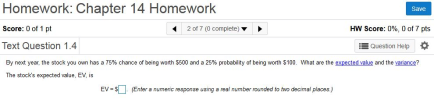 By next year, the stock you own has a 75% chance of being
worth $500 and a 25% probability of being worth $100. What are
the expected value and the variance?
The stock's expected value, EV, is
EV=$???? .(Enter a numeric response using a real number rounded
to two decimal places.)
Homework: Chapter 14 Homework Score: 0 of 1 pt Text Question 1.4 Save 2 of 7 (0 complete) HW Score: 0%, 0 of 7 pts Question Help By next...
By next year, the stock you own has a 75% chance of being
worth $500 and a 25% probability of being worth $100. What are
the expected value and the variance?
The stock's expected value, EV, is
EV=$???? .(Enter a numeric response using a real number rounded
to two decimal places.)
Homework: Chapter 14 Homework Score: 0 of 1 pt Text Question 1.4 Save 2 of 7 (0 complete) HW Score: 0%, 0 of 7 pts Question Help By next...
you are scheduling workers at a plant. what are some constraints ( requirments linitations) and objectives...
you are scheduling workers at a plant. what are some constraints ( requirments linitations) and objectives (goals) thats is all the information given make up some general guidelines that woukd help this situation.
Calculating Portfolio Betas You own a stock portfolio invested 15 percent in Stock Q, 25 percent...
 Calculating Portfolio Betas You own a stock portfolio invested 15 percent in Stock Q, 25 percent in Stock R, 40 percent in Stock S, and 20 percent in Stock T. The betas for these four stocks are . 78, 87, 1.13, and 1.45, respectively. What is the portfolio beta? Calculating Portfolio Betas You own a portfolio equally invested in a risk-free asset and two stocks. If one of the stocks has a beta of 1.29 and the total portfolio is...
An airline security director has been advised that airline gate agents are constantly being interrupted while...
An airline security director has been advised that airline gate agents are constantly being interrupted while waiting on passengers by persons who accidentally bump alarms attached to the “panic” bars on exit doors in the gate area. For example, during the boarding process, if a child or careless adult touches one of the doors leading out to the airplane ramp, the alarm sounds. Consequently, the agent must respond by securing his position, perhaps in the face of a long line...
Describe in your own words what (if anything) is currently being done to protect the species.
Describe in your own words what (if anything) is currently being done to protect the species.
To prepare for the your report, you must analyze the data. You know that the director...
To prepare for the your report, you must analyze the data. You know that the director will ask about outliers and about the shape of the distribution. What summary measures should you compute? What tables or charts should you generate?
What are the categories of negativity in the workplace? 200 words Must be in your own...
What are the categories of negativity in the workplace? 200 words Must be in your own words. Thanks
1. You own a stock portfolio invested 30 percent in Stock Q, 25 percent in Stock...
1. You own a stock portfolio invested 30 percent in Stock Q, 25 percent in Stock R, 25 percent in Stock S, and 20 percent in Stock T. The betas for these four stocks are 0.80, 1.18, 1.19, and 1.36, respectively. What is the portfolio beta? (Do not round intermediate calculations. Round the final answer to 2 decimal places.) what is the Portfolio beta ? 2. A stock has a beta of 0.95, the expected return on the market is...
You own a stock portfolio invested 35 percent in Stock Q, 25 percent in Stock R,...
 You own a stock portfolio invested 35 percent in Stock Q, 25 percent in Stock R, 25 percent in Stock S, and 15 percent in Stock T. The betas for these four stocks are .83, 1.21, 1.22, and 1.39, respectively. What is the portfolio beta? (Do not round intermediate calculations and round your answer to 2 decimal places, e.g., 32.16.) Portfolio beta A stock has an expected return of 12.4 percent, the risk-free rate is 4.5 percent, and the market...
What are your thoughts on States being able to regulate their own medical practices? How does...
What are your thoughts on States being able to regulate their own medical practices? How does it help and how does it hurt patient care?
 By next year, the stock you own has a 75% chance of being
worth $500 and a 25% probability of being worth $100. What are
the expected value and the variance?
The stock's expected value, EV, is
EV=$???? .(Enter a numeric response using a real number rounded
to two decimal places.)
Homework: Chapter 14 Homework Score: 0 of 1 pt Text Question 1.4 Save 2 of 7 (0 complete) HW Score: 0%, 0 of 7 pts Question Help By next...
By next year, the stock you own has a 75% chance of being
worth $500 and a 25% probability of being worth $100. What are
the expected value and the variance?
The stock's expected value, EV, is
EV=$???? .(Enter a numeric response using a real number rounded
to two decimal places.)
Homework: Chapter 14 Homework Score: 0 of 1 pt Text Question 1.4 Save 2 of 7 (0 complete) HW Score: 0%, 0 of 7 pts Question Help By next...
 Calculating Portfolio Betas You own a stock portfolio invested 15 percent in Stock Q, 25 percent in Stock R, 40 percent in Stock S, and 20 percent in Stock T. The betas for these four stocks are . 78, 87, 1.13, and 1.45, respectively. What is the portfolio beta? Calculating Portfolio Betas You own a portfolio equally invested in a risk-free asset and two stocks. If one of the stocks has a beta of 1.29 and the total portfolio is...
 You own a stock portfolio invested 35 percent in Stock Q, 25 percent in Stock R, 25 percent in Stock S, and 15 percent in Stock T. The betas for these four stocks are .83, 1.21, 1.22, and 1.39, respectively. What is the portfolio beta? (Do not round intermediate calculations and round your answer to 2 decimal places, e.g., 32.16.) Portfolio beta A stock has an expected return of 12.4 percent, the risk-free rate is 4.5 percent, and the market...
Most questions answered within 3 hours.
-
Where is the error in this code sequence?
String s1 = "Hello";
String s2 = "ello";...
asked 11 months ago -
Financial data for Joel de Paris, Inc., for last year
follow:
Joel de Paris, Inc.
Balance...
asked 11 months ago -
Consider this reaction:
Al2(SO4)3 (aq)+ BaCl3
(aq) Al2Cl6 (aq)- +
3BaSO4(s) . What is the...
asked 11 months ago -
Suppose that Savneet is considering increasing her
recent random sample from 20 car rentals to 40...
asked 11 months ago -
Trucks arrive at an unloading terminal at an average rate of 120
per hour.
Trucks arrive...
asked 11 months ago -
Why are methanol and ethanol completely soluble in water while
octanol is not very little soluble....
asked 11 months ago -
A facilities manager at a university reads in a research report
that the mean amount of...
asked 11 months ago -
When the CuSO4 is rehydrated by adding water to the anhydrous
compound, is this an endothermic...
asked 11 months ago -
A ray of sunlight is passing from diamond into crown glass; the
angle of incidence is...
asked 11 months ago -
A block of mass 0.249 kg is placed on top of a light, vertical
spring of...
asked 11 months ago -
how do the kidneys compensate in the presences of acidosis
a) trigger hyperventilate
b) reserve acid...
asked 11 months ago -
Question 501 pts
The rental rate of capital to the firm increases. Which of the
following...
asked 11 months ago