what is the pathophysiology for diabetic ketoacidosis?
Homework Answers
Diabetic ketoacidosis is a complication of diabetes .this occurs due to the lack of insulin in the body which leads to excess sugar in the blood.this sugar is released from the liver to the blood stream throgh glycogenesis causing diabetic ketoacidosis.
1) What is ketoacidosis? 2) Why are healthy individuals more resistant to ketoacidosis? 3) Why are...
1) What is ketoacidosis? 2) Why are healthy individuals more resistant to ketoacidosis? 3) Why are diabetic patients more prone to ketoacidosis?
Diabetic ketoacidosis (DKA) is a result of ________. increase in insulin production a decrease in catecholamine...
Diabetic ketoacidosis (DKA) is a result of ________. increase in insulin production a decrease in catecholamine secretion impaired metabolism seen in the elderly increased fat mobilization
A patient presents in DKA (diabetic ketoacidosis), in addition to that they are lethargic and complaining...
A patient presents in DKA (diabetic ketoacidosis), in addition to that they are lethargic and complaining of severe fatigue, nausea and vomiting. What is fluid imbalance is also going on with this patient? What are interventions for this patient? A patient with chronic renal failure presents with a wet cough, bilateral lower extremity and abdominal swelling. What fluid imbalance is also going on with this patient? What are interventions for this patient?
Regular insulin is used to treat Diabetic Ketoacidosis. Explain the rationale of using regular insulin rather...
Regular insulin is used to treat Diabetic Ketoacidosis. Explain the rationale of using regular insulin rather than NPH insulin.
During diabetic ketoacidosis the pH of blood decreases. How does the body respond and why? (has...
During diabetic ketoacidosis the pH of blood decreases. How does the body respond and why? (has to do with the CO2- carbonic acid- bicarb buffer system)
18. Animals in diabetic ketoacidosis often present with O A. hypokalemia. O B. hyponatremia. O C....
 18. Animals in diabetic ketoacidosis often present with O A. hypokalemia. O B. hyponatremia. O C. hyperkalemia. O D. hyperpotassemia.
180. a nurse is collecting data from a client who had diabetic ketoacidosis. Which of the...
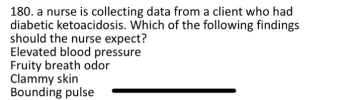 180. a nurse is collecting data from a client who had diabetic ketoacidosis. Which of the following findings should the nurse expect? Elevated blood pressure Fruity breath odor Clammy skin Bounding pulse
1. Diabetic patients more often have a painless myocardial ischemic episode. True False 2. Diabetic Ketoacidosis...
1. Diabetic patients more often have a painless myocardial ischemic episode. True False 2. Diabetic Ketoacidosis can _________________ lead to unconsciousness and be fatal lead to yellowing of the skin cause blotting cause you to have an increase of stamina 3. Hypertrophy is seen in the basal area of the __________________, even before apparent heart disease in diabetes making an ECG a tool for better patient management. a. left atrium b. left ventricle c. right atrium d. right ventricle
A client with diabetic ketoacidosis is to receive a continuous infusion of regular insulin. The physician...
 A client with diabetic ketoacidosis is to receive a continuous infusion of regular insulin. The physician orders 1 L of 5% dextrose and water solution to run at 150 ml/hour once the client's blood glucose has reached 250 mg/dL. The drip factor of the tubing is 15 gtt/mL. How many drops/minute will the nurse deliver? HTML Editor
Explain why the following occur or are associated with diabetic ketoacidosis o Associated with Type 1...
Explain why the following occur or are associated with diabetic ketoacidosis o Associated with Type 1 not Type 2 DM o Increased acetone in blood/urine o Decreased serum pH o Kussmaul respirations o Decreased PCO2 o Increased urination o Increased blood glucose o Little or absent insulin
 18. Animals in diabetic ketoacidosis often present with O A. hypokalemia. O B. hyponatremia. O C. hyperkalemia. O D. hyperpotassemia.
 180. a nurse is collecting data from a client who had diabetic ketoacidosis. Which of the following findings should the nurse expect? Elevated blood pressure Fruity breath odor Clammy skin Bounding pulse
 A client with diabetic ketoacidosis is to receive a continuous infusion of regular insulin. The physician orders 1 L of 5% dextrose and water solution to run at 150 ml/hour once the client's blood glucose has reached 250 mg/dL. The drip factor of the tubing is 15 gtt/mL. How many drops/minute will the nurse deliver? HTML Editor
Most questions answered within 3 hours.
-
Where is the error in this code sequence?
String s1 = "Hello";
String s2 = "ello";...
asked 10 months ago -
Financial data for Joel de Paris, Inc., for last year
follow:
Joel de Paris, Inc.
Balance...
asked 10 months ago -
Consider this reaction:
Al2(SO4)3 (aq)+ BaCl3
(aq) Al2Cl6 (aq)- +
3BaSO4(s) . What is the...
asked 10 months ago -
Suppose that Savneet is considering increasing her
recent random sample from 20 car rentals to 40...
asked 10 months ago -
Trucks arrive at an unloading terminal at an average rate of 120
per hour.
Trucks arrive...
asked 10 months ago -
Why are methanol and ethanol completely soluble in water while
octanol is not very little soluble....
asked 10 months ago -
A facilities manager at a university reads in a research report
that the mean amount of...
asked 10 months ago -
When the CuSO4 is rehydrated by adding water to the anhydrous
compound, is this an endothermic...
asked 10 months ago -
A ray of sunlight is passing from diamond into crown glass; the
angle of incidence is...
asked 10 months ago -
A block of mass 0.249 kg is placed on top of a light, vertical
spring of...
asked 10 months ago -
how do the kidneys compensate in the presences of acidosis
a) trigger hyperventilate
b) reserve acid...
asked 10 months ago -
Question 501 pts
The rental rate of capital to the firm increases. Which of the
following...
asked 10 months ago