

Homework Answers
(a)
Mole fraction is defined as the moles of the substance divided by the total moles present in the system.
Thus, let us consider a system having two species A and B.
So, according to definition of mole fraction:-

Given that:-
 = Moles of A = 4.6 moles
 = Moles of B = 3.6 moles
Applying the values in the above equation as:-

Thus, the mole fraction of B = 0.44
(b)
From the graph, it is clearly stated that the real solution has the higher vapor pressure.
This state is known as non-ideal solutions having positive deviation. This occurs because the vapor pressure by each component is greater than what is being calculated by the Raoult’s law (ideal solutions).
Thus, the total vapor pressure curve of the system appears higher than the vapor pressure of the pure components.
This arises because the solute-solvent interactions in the system are weaker when compared to the solute-solute and solvent-solvent interactions in the system.
(c)
Considering, for a binary system involving two components A and B,
Mole fraction of B = 1 - Mole fraction of A
So, graph can be translated to:-
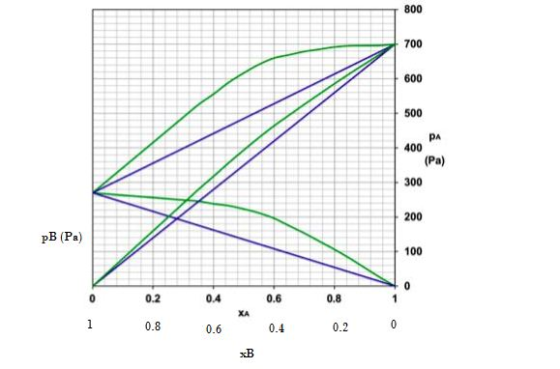
As calculated above,
x_B = 0.44
So, from the graph:-
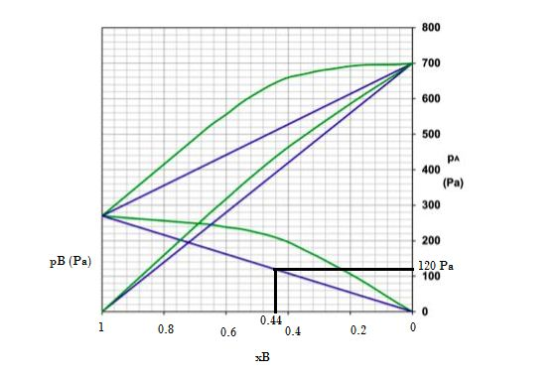
The partial pressure of B if the system is an ideal solution is 120 Pa.
(d)
As calculated above,
x_B = 0.44
So, from the graph:-
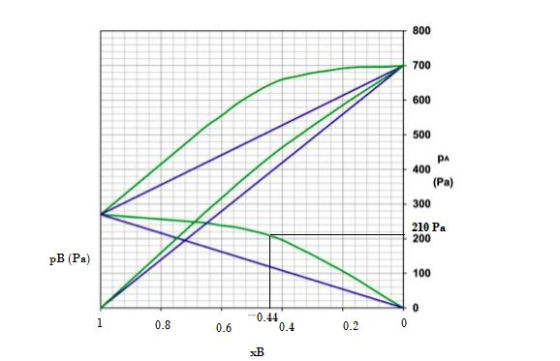
Since, it is between 220 and 200 Pa, the middle should be 210 Pa.
The partial pressure of B if the system is a real solution is 210 Pa.
Add Answer to:
Question 1 Suppose two liquids (A and B) are mixed together and a phase diagram constructed...
12 Study the following phase diagram for an ideal mixture of two liquids A and B...
 12 Study the following phase diagram for an ideal mixture of two liquids A and B and answer the questions that follow: 102 94 81 Pressure/kPa 66 50 43 40 I DET 0 0.2 0.4 0.6 0.81 XA What is the vapour pressure for the pure compound B. 12.1 Page 2 of 4 [2 marks] 12.2 Determine the value for Xin a mixture of composition x = 0.30. [2 marks] 123 At what pressure will a mixture of composition X095...
1) A and B are volatile liquids. In the figure below, the partial pressure of A...
 1) A and B are volatile liquids. In the figure below, the partial pressure of A and B in a liquid solution of these two substances (at T = 40. °C) is plotted against XA, the mole fraction of A in the liquid solution. 800 pitor) 600. 400 200. 0 0.0 0.2 1.0 04 0.6 0.8 mole fraction A a) Do A and B form an ideal liquid solution (yes/no)? [4 points) b) What is the value for psº, the...
1) A and B are volatile liquids. In the figure below, the partial pressure of A...
 1) A and B are volatile liquids. In the figure below, the partial pressure of A and B in a liquid solution of these two substances (at T = 40.°C) is plotted against Xx, the mole fraction of A in the liquid solution. 400. P (tor) Pa 300 200 100 pa 0.0 0.2 0.4 0.8 1.0 0.6 mole fraction A a) Do A and B form an ideal liquid solution (yes/no)? [4 points) b) What is the value for paº,...
Part 2. Short answer questions. 1) A and B are volatile liquids. In the figure below,...
 Part 2. Short answer questions. 1) A and B are volatile liquids. In the figure below, the partial pressure of A and B in a liquid solution of these two substances (at T = 40.°C) is plotted against XA, the mole fraction of A in the liquid solution. 400. P(tor) 300 200 100. 0. 0.0 0.2 0.4 0.8 0.6 mole fraction A 1.0 a) Do A and B form an ideal liquid solution (yes/no)? [4 points) b) What is the...
Part 2. Short answer questions. 1) A and B are volatile liquids. In the figure below,...
 Part 2. Short answer questions. 1) A and B are volatile liquids. In the figure below, the partial pressure of A and B in a liquid solution of these two substances (at T = 40.°C) is plotted against XA, the mole fraction of A in the liquid solution. 400 p(tor) 300 200. 100. PA 0. 0.0 0.2 0.4 0.8 1.0 0.6 mole fraction A a) Do A and B form an ideal liquid solution (yes/no)? [4 points] b) What is...
< PLEASE HELP FILL IN THE BLANKS. > When two liquids A & B are mixed,...
< PLEASE HELP FILL IN THE BLANKS. > When two liquids A & B are mixed, total volume V is expressed in terms of partial molar volumes Vm and amount n, write equation: ____________________________________________________ ? On the other hand, free energy change ΔG of mixing is expressed as:________________________________________ while entropy change ΔS of mixing is expressed as:________________________________________ -Raoult's law: associated with solvent in an ideal solution, expressed as: (write eq.) _______________________________ ? While Henry's law: associated with solute in an...
Two liquids A and B have vapor pressures of 70.3 and 131 mmHg, respectively, at 25°C....
Two liquids A and B have vapor pressures of 70.3 and 131 mmHg, respectively, at 25°C. What is the total vapor pressure of the ideal solution made up of: (a) 1.00 mole of A and 1.00 mole of B (b) 2.00 moles of A and 5.00 moles of B
urgent 1) A and B are volatile liquids. In the figure below, the partial pressure of...
 urgent
1) A and B are volatile liquids. In the figure below, the partial pressure of A and B in a liquid solution of these two substances (at T = 40.°C) is plotted against XX, the mole fraction of A in the liquid solution. 400 I p(tore) 300 200 100 0 0.0 0.2 04 0.8 1.0 0.6 mole fraction A a) Do A and B form an ideal liquid solution (yes/no)? [4 points) b) What is the value for psº,...
urgent
1) A and B are volatile liquids. In the figure below, the partial pressure of A and B in a liquid solution of these two substances (at T = 40.°C) is plotted against XX, the mole fraction of A in the liquid solution. 400 I p(tore) 300 200 100 0 0.0 0.2 04 0.8 1.0 0.6 mole fraction A a) Do A and B form an ideal liquid solution (yes/no)? [4 points) b) What is the value for psº,...
Part 2. Short answer questions 1) A and B are volatile liquids. In the figure below,...
 Part 2. Short answer questions 1) A and B are volatile liquids. In the figure below, the partial pressure of A and B in a liquid solution of these two substances (at T-40. "C) is plotted against the mole fraction of A in the liquid solution po 300 200 100 00 02 10 04 06 mole fraction A a) Do A and B form an ideal liquid sokution (yes/no)? (4 points) b) What is the value for poº, the vapor...
Part 2. Short answer questions. 1) A and B are volatile liquids. In the figure below,...
 Part 2. Short answer questions. 1) A and B are volatile liquids. In the figure below, the partial pressure of A and B in a liquid solution of these two substances (at T = 40.°C) is plotted against X, the mole fraction of A in the liquid solution. 400 p(tor) 300 200 100 0 0.0 0.2 0.8 1.0 04 06 mole fraction A a) Do A and B form an ideal liquid solution (yes/no)? [4 points) b) What is the...
 12 Study the following phase diagram for an ideal mixture of two liquids A and B and answer the questions that follow: 102 94 81 Pressure/kPa 66 50 43 40 I DET 0 0.2 0.4 0.6 0.81 XA What is the vapour pressure for the pure compound B. 12.1 Page 2 of 4 [2 marks] 12.2 Determine the value for Xin a mixture of composition x = 0.30. [2 marks] 123 At what pressure will a mixture of composition X095...
 1) A and B are volatile liquids. In the figure below, the partial pressure of A and B in a liquid solution of these two substances (at T = 40. °C) is plotted against XA, the mole fraction of A in the liquid solution. 800 pitor) 600. 400 200. 0 0.0 0.2 1.0 04 0.6 0.8 mole fraction A a) Do A and B form an ideal liquid solution (yes/no)? [4 points) b) What is the value for psº, the...
 1) A and B are volatile liquids. In the figure below, the partial pressure of A and B in a liquid solution of these two substances (at T = 40.°C) is plotted against Xx, the mole fraction of A in the liquid solution. 400. P (tor) Pa 300 200 100 pa 0.0 0.2 0.4 0.8 1.0 0.6 mole fraction A a) Do A and B form an ideal liquid solution (yes/no)? [4 points) b) What is the value for paº,...
 Part 2. Short answer questions. 1) A and B are volatile liquids. In the figure below, the partial pressure of A and B in a liquid solution of these two substances (at T = 40.°C) is plotted against XA, the mole fraction of A in the liquid solution. 400. P(tor) 300 200 100. 0. 0.0 0.2 0.4 0.8 0.6 mole fraction A 1.0 a) Do A and B form an ideal liquid solution (yes/no)? [4 points) b) What is the...
 Part 2. Short answer questions. 1) A and B are volatile liquids. In the figure below, the partial pressure of A and B in a liquid solution of these two substances (at T = 40.°C) is plotted against XA, the mole fraction of A in the liquid solution. 400 p(tor) 300 200. 100. PA 0. 0.0 0.2 0.4 0.8 1.0 0.6 mole fraction A a) Do A and B form an ideal liquid solution (yes/no)? [4 points] b) What is...
 urgent
1) A and B are volatile liquids. In the figure below, the partial pressure of A and B in a liquid solution of these two substances (at T = 40.°C) is plotted against XX, the mole fraction of A in the liquid solution. 400 I p(tore) 300 200 100 0 0.0 0.2 04 0.8 1.0 0.6 mole fraction A a) Do A and B form an ideal liquid solution (yes/no)? [4 points) b) What is the value for psº,...
urgent
1) A and B are volatile liquids. In the figure below, the partial pressure of A and B in a liquid solution of these two substances (at T = 40.°C) is plotted against XX, the mole fraction of A in the liquid solution. 400 I p(tore) 300 200 100 0 0.0 0.2 04 0.8 1.0 0.6 mole fraction A a) Do A and B form an ideal liquid solution (yes/no)? [4 points) b) What is the value for psº,...
 Part 2. Short answer questions 1) A and B are volatile liquids. In the figure below, the partial pressure of A and B in a liquid solution of these two substances (at T-40. "C) is plotted against the mole fraction of A in the liquid solution po 300 200 100 00 02 10 04 06 mole fraction A a) Do A and B form an ideal liquid sokution (yes/no)? (4 points) b) What is the value for poº, the vapor...
 Part 2. Short answer questions. 1) A and B are volatile liquids. In the figure below, the partial pressure of A and B in a liquid solution of these two substances (at T = 40.°C) is plotted against X, the mole fraction of A in the liquid solution. 400 p(tor) 300 200 100 0 0.0 0.2 0.8 1.0 04 06 mole fraction A a) Do A and B form an ideal liquid solution (yes/no)? [4 points) b) What is the...
Most questions answered within 3 hours.
-
Where is the error in this code sequence?
String s1 = "Hello";
String s2 = "ello";...
asked 10 months ago -
Financial data for Joel de Paris, Inc., for last year
follow:
Joel de Paris, Inc.
Balance...
asked 10 months ago -
Consider this reaction:
Al2(SO4)3 (aq)+ BaCl3
(aq) Al2Cl6 (aq)- +
3BaSO4(s) . What is the...
asked 10 months ago -
Suppose that Savneet is considering increasing her
recent random sample from 20 car rentals to 40...
asked 10 months ago -
Trucks arrive at an unloading terminal at an average rate of 120
per hour.
Trucks arrive...
asked 10 months ago -
Why are methanol and ethanol completely soluble in water while
octanol is not very little soluble....
asked 10 months ago -
A facilities manager at a university reads in a research report
that the mean amount of...
asked 10 months ago -
When the CuSO4 is rehydrated by adding water to the anhydrous
compound, is this an endothermic...
asked 10 months ago -
A ray of sunlight is passing from diamond into crown glass; the
angle of incidence is...
asked 10 months ago -
A block of mass 0.249 kg is placed on top of a light, vertical
spring of...
asked 10 months ago -
how do the kidneys compensate in the presences of acidosis
a) trigger hyperventilate
b) reserve acid...
asked 10 months ago -
Question 501 pts
The rental rate of capital to the firm increases. Which of the
following...
asked 10 months ago