
Homework Answers
Add Answer to:
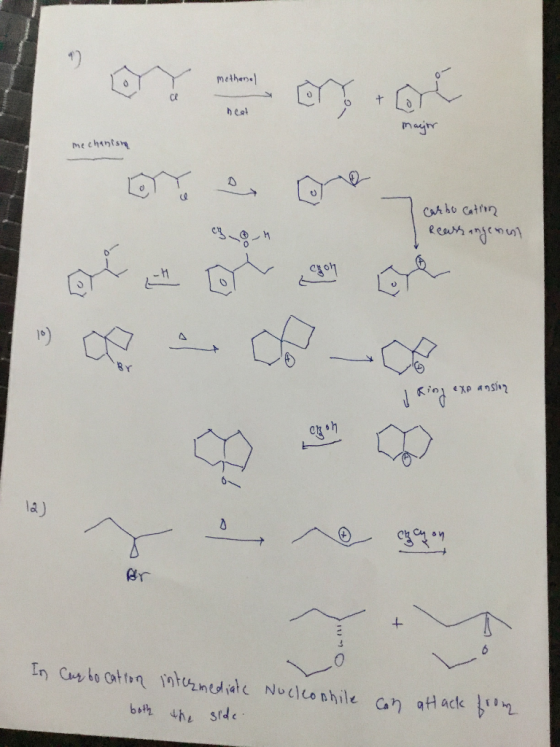
Problem 9: In the reaction below circle the major product. Clearly explain your an Hint: Draw...
Chemistry Organic Chemistry Problems Elimination Reactions Problem 5: Which of the product in the following reaction...
 Chemistry Organic Chemistry Problems Elimination Reactions Problem 5: Which of the product in the following reaction will form and why. Use mechanism and relevant drawings to explain your answer. Br Problem 6: What is the product of the following reaction? sodium methoxide methanol sodium methoxide methanol Organic Chemistry Organic Chemistry Problems Elimination Reactions Problem 10: Use mechanism to explain all of the products for the reaction below. OH H2SO4 heat
I don't quite understand how to draw the shape and how the whole question will progress...
 I don't quite understand how to draw the shape and how
the whole question will progress please explain how it will look
and why and how to solve this question - thank you
HU (S)-(1-Bromoethyl) benzene Planar, achital Figure 7-3 Racemization upon SNT benzene. Initial ionization furnishes a p water, yields racemic alcohol. он (R)-1-Phenylethanol Racemic mixture nization upon Sn1 hydrolysis of the chiral and optically pure (SH1-bromoethyl on Turnishes a planar, achiral carbocation. This ion, when trapped with Exercise...
I don't quite understand how to draw the shape and how
the whole question will progress please explain how it will look
and why and how to solve this question - thank you
HU (S)-(1-Bromoethyl) benzene Planar, achital Figure 7-3 Racemization upon SNT benzene. Initial ionization furnishes a p water, yields racemic alcohol. он (R)-1-Phenylethanol Racemic mixture nization upon Sn1 hydrolysis of the chiral and optically pure (SH1-bromoethyl on Turnishes a planar, achiral carbocation. This ion, when trapped with Exercise...
Draw the major organic product of the following reaction, and select the mechanism which would dominate...
 Draw the major organic product of the following reaction, and select the mechanism which would dominate (Sn1, Sn2, E1, or E2). TSO HS DMSO V 1st attempt Part 1 (2 pts) . See Periodic Table D See Hint Draw all four bonds at chiral centers. SOC B 20
T ylic uelydration reaction, draw the curved arrow mechanism leading to the major alkene product and...
 T ylic uelydration reaction, draw the curved arrow mechanism leading to the major alkene product and one of the minor alkene products. Draw a picture of the hyperconjugation interaction that explains the greater thermodynamic stability of the major product versus the minor product. Concisely explain why the uncatalyzed dehydration reaction would not form the carbocation intermediate Me catalytic H2SO4 -он H,0
B. Determine the major product of part A. Explain. 2. Consider the following reaction. A. Draw...
 B. Determine the major product of part A. Explain.
2. Consider the following reaction. A. Draw the mechanism of the reaction to predict All constitutional products. Show all bonds being made and broken. Show all steps with curved arrows that are necessary to form the products. :B: H H.
B. Determine the major product of part A. Explain.
2. Consider the following reaction. A. Draw the mechanism of the reaction to predict All constitutional products. Show all bonds being made and broken. Show all steps with curved arrows that are necessary to form the products. :B: H H.
please explain the work for both questions please 1. Predict the major organic product for each...
 please explain the work for both questions please
1. Predict the major organic product for each of the following elimination reactions, and indicate whether each one occurs via the E1 or the E2 mechanism. Be sure to clearly indicate the proper stereochemical relationships between groups (if appropriate), and write the word “racemic” under any compound that is formed as a racemic mixture. Br AgNO3 H2O KOt-Bu H3CCH3 H36Br t-BuOH OTS NaOCH3 CH3OH CH3 NaOH H20 2. Draw all possible E2...
please explain the work for both questions please
1. Predict the major organic product for each of the following elimination reactions, and indicate whether each one occurs via the E1 or the E2 mechanism. Be sure to clearly indicate the proper stereochemical relationships between groups (if appropriate), and write the word “racemic” under any compound that is formed as a racemic mixture. Br AgNO3 H2O KOt-Bu H3CCH3 H36Br t-BuOH OTS NaOCH3 CH3OH CH3 NaOH H20 2. Draw all possible E2...
(a) Draw all possible monobromination products for the following reaction. (b) Circle the major product Provide...
 (a) Draw all possible monobromination products for the following reaction. (b) Circle the major product Provide the line angle drawings (skeletal) of the following molecules. (a) 1, 1-dichloro-3-methyl-6-hepten-2-ol (b) 4-chloro-2-ethyleyclohexanethiol
Show mechanism and explain as well please. In the box below draw the organic product(s) expected...
 Show mechanism and explain as well please.
In the box below draw the organic product(s) expected when this compound undergoes the Simmons-Smith reaction. Use the wedge/hash bond tools to indicate stereochemistry. If the reaction produces a racemic mixture, draw both stereoisomers. Draw one structure per sketcher. Add additional sketchers using the drop-down menu in the bottom right corner. Separate multiple products using the + sign from the drop-down menu.
Show mechanism and explain as well please.
In the box below draw the organic product(s) expected when this compound undergoes the Simmons-Smith reaction. Use the wedge/hash bond tools to indicate stereochemistry. If the reaction produces a racemic mixture, draw both stereoisomers. Draw one structure per sketcher. Add additional sketchers using the drop-down menu in the bottom right corner. Separate multiple products using the + sign from the drop-down menu.
can you help me explain these especially number 2 Predict the major organic product for each...
 can you help me explain these especially number 2
Predict the major organic product for each of the following elimination reactions, and indicate 1. whether each one occurs via the E1 or the E2 mechanism. Be sure to clearly indicate the proper stereochemical relationships between groups (if appropriate), and write the word "racemic" under any compound that is formed as a racemic mixture. g. Br AgNO3 Нао h. HасСНз KOt-Bu Hас Br t-BuOH ф- Draw all possible E2 products (including...
can you help me explain these especially number 2
Predict the major organic product for each of the following elimination reactions, and indicate 1. whether each one occurs via the E1 or the E2 mechanism. Be sure to clearly indicate the proper stereochemical relationships between groups (if appropriate), and write the word "racemic" under any compound that is formed as a racemic mixture. g. Br AgNO3 Нао h. HасСНз KOt-Bu Hас Br t-BuOH ф- Draw all possible E2 products (including...
Your organic chemistry study partner has drawn the incorrect product for the following two reactions. Draw...
 Your organic chemistry study partner has drawn the incorrect
product for the following two reactions. Draw the actual, correct
product for these two reactions. Be sure your answers account for
regiochemistry and stereochemistry, where appropriate.
Part 1 (1point) d See Periodic Table See Hint If multiple stereoisomers are formed, be sure to draw all products using appropriate wedges and dashes This question has two parts. Be sure to complete both parts before submitting your answer. Please draw all four bonds...
Your organic chemistry study partner has drawn the incorrect
product for the following two reactions. Draw the actual, correct
product for these two reactions. Be sure your answers account for
regiochemistry and stereochemistry, where appropriate.
Part 1 (1point) d See Periodic Table See Hint If multiple stereoisomers are formed, be sure to draw all products using appropriate wedges and dashes This question has two parts. Be sure to complete both parts before submitting your answer. Please draw all four bonds...
 Chemistry Organic Chemistry Problems Elimination Reactions Problem 5: Which of the product in the following reaction will form and why. Use mechanism and relevant drawings to explain your answer. Br Problem 6: What is the product of the following reaction? sodium methoxide methanol sodium methoxide methanol Organic Chemistry Organic Chemistry Problems Elimination Reactions Problem 10: Use mechanism to explain all of the products for the reaction below. OH H2SO4 heat
 I don't quite understand how to draw the shape and how
the whole question will progress please explain how it will look
and why and how to solve this question - thank you
HU (S)-(1-Bromoethyl) benzene Planar, achital Figure 7-3 Racemization upon SNT benzene. Initial ionization furnishes a p water, yields racemic alcohol. он (R)-1-Phenylethanol Racemic mixture nization upon Sn1 hydrolysis of the chiral and optically pure (SH1-bromoethyl on Turnishes a planar, achiral carbocation. This ion, when trapped with Exercise...
I don't quite understand how to draw the shape and how
the whole question will progress please explain how it will look
and why and how to solve this question - thank you
HU (S)-(1-Bromoethyl) benzene Planar, achital Figure 7-3 Racemization upon SNT benzene. Initial ionization furnishes a p water, yields racemic alcohol. он (R)-1-Phenylethanol Racemic mixture nization upon Sn1 hydrolysis of the chiral and optically pure (SH1-bromoethyl on Turnishes a planar, achiral carbocation. This ion, when trapped with Exercise...
 Draw the major organic product of the following reaction, and select the mechanism which would dominate (Sn1, Sn2, E1, or E2). TSO HS DMSO V 1st attempt Part 1 (2 pts) . See Periodic Table D See Hint Draw all four bonds at chiral centers. SOC B 20
 T ylic uelydration reaction, draw the curved arrow mechanism leading to the major alkene product and one of the minor alkene products. Draw a picture of the hyperconjugation interaction that explains the greater thermodynamic stability of the major product versus the minor product. Concisely explain why the uncatalyzed dehydration reaction would not form the carbocation intermediate Me catalytic H2SO4 -он H,0
 B. Determine the major product of part A. Explain.
2. Consider the following reaction. A. Draw the mechanism of the reaction to predict All constitutional products. Show all bonds being made and broken. Show all steps with curved arrows that are necessary to form the products. :B: H H.
B. Determine the major product of part A. Explain.
2. Consider the following reaction. A. Draw the mechanism of the reaction to predict All constitutional products. Show all bonds being made and broken. Show all steps with curved arrows that are necessary to form the products. :B: H H.
 please explain the work for both questions please
1. Predict the major organic product for each of the following elimination reactions, and indicate whether each one occurs via the E1 or the E2 mechanism. Be sure to clearly indicate the proper stereochemical relationships between groups (if appropriate), and write the word “racemic” under any compound that is formed as a racemic mixture. Br AgNO3 H2O KOt-Bu H3CCH3 H36Br t-BuOH OTS NaOCH3 CH3OH CH3 NaOH H20 2. Draw all possible E2...
please explain the work for both questions please
1. Predict the major organic product for each of the following elimination reactions, and indicate whether each one occurs via the E1 or the E2 mechanism. Be sure to clearly indicate the proper stereochemical relationships between groups (if appropriate), and write the word “racemic” under any compound that is formed as a racemic mixture. Br AgNO3 H2O KOt-Bu H3CCH3 H36Br t-BuOH OTS NaOCH3 CH3OH CH3 NaOH H20 2. Draw all possible E2...
 (a) Draw all possible monobromination products for the following reaction. (b) Circle the major product Provide the line angle drawings (skeletal) of the following molecules. (a) 1, 1-dichloro-3-methyl-6-hepten-2-ol (b) 4-chloro-2-ethyleyclohexanethiol
 Show mechanism and explain as well please.
In the box below draw the organic product(s) expected when this compound undergoes the Simmons-Smith reaction. Use the wedge/hash bond tools to indicate stereochemistry. If the reaction produces a racemic mixture, draw both stereoisomers. Draw one structure per sketcher. Add additional sketchers using the drop-down menu in the bottom right corner. Separate multiple products using the + sign from the drop-down menu.
Show mechanism and explain as well please.
In the box below draw the organic product(s) expected when this compound undergoes the Simmons-Smith reaction. Use the wedge/hash bond tools to indicate stereochemistry. If the reaction produces a racemic mixture, draw both stereoisomers. Draw one structure per sketcher. Add additional sketchers using the drop-down menu in the bottom right corner. Separate multiple products using the + sign from the drop-down menu.
 can you help me explain these especially number 2
Predict the major organic product for each of the following elimination reactions, and indicate 1. whether each one occurs via the E1 or the E2 mechanism. Be sure to clearly indicate the proper stereochemical relationships between groups (if appropriate), and write the word "racemic" under any compound that is formed as a racemic mixture. g. Br AgNO3 Нао h. HасСНз KOt-Bu Hас Br t-BuOH ф- Draw all possible E2 products (including...
can you help me explain these especially number 2
Predict the major organic product for each of the following elimination reactions, and indicate 1. whether each one occurs via the E1 or the E2 mechanism. Be sure to clearly indicate the proper stereochemical relationships between groups (if appropriate), and write the word "racemic" under any compound that is formed as a racemic mixture. g. Br AgNO3 Нао h. HасСНз KOt-Bu Hас Br t-BuOH ф- Draw all possible E2 products (including...
 Your organic chemistry study partner has drawn the incorrect
product for the following two reactions. Draw the actual, correct
product for these two reactions. Be sure your answers account for
regiochemistry and stereochemistry, where appropriate.
Part 1 (1point) d See Periodic Table See Hint If multiple stereoisomers are formed, be sure to draw all products using appropriate wedges and dashes This question has two parts. Be sure to complete both parts before submitting your answer. Please draw all four bonds...
Your organic chemistry study partner has drawn the incorrect
product for the following two reactions. Draw the actual, correct
product for these two reactions. Be sure your answers account for
regiochemistry and stereochemistry, where appropriate.
Part 1 (1point) d See Periodic Table See Hint If multiple stereoisomers are formed, be sure to draw all products using appropriate wedges and dashes This question has two parts. Be sure to complete both parts before submitting your answer. Please draw all four bonds...
Most questions answered within 3 hours.
-
Where is the error in this code sequence?
String s1 = "Hello";
String s2 = "ello";...
asked 10 months ago -
Financial data for Joel de Paris, Inc., for last year
follow:
Joel de Paris, Inc.
Balance...
asked 10 months ago -
Consider this reaction:
Al2(SO4)3 (aq)+ BaCl3
(aq) Al2Cl6 (aq)- +
3BaSO4(s) . What is the...
asked 10 months ago -
Suppose that Savneet is considering increasing her
recent random sample from 20 car rentals to 40...
asked 10 months ago -
Trucks arrive at an unloading terminal at an average rate of 120
per hour.
Trucks arrive...
asked 10 months ago -
Why are methanol and ethanol completely soluble in water while
octanol is not very little soluble....
asked 10 months ago -
A facilities manager at a university reads in a research report
that the mean amount of...
asked 10 months ago -
When the CuSO4 is rehydrated by adding water to the anhydrous
compound, is this an endothermic...
asked 10 months ago -
A ray of sunlight is passing from diamond into crown glass; the
angle of incidence is...
asked 10 months ago -
A block of mass 0.249 kg is placed on top of a light, vertical
spring of...
asked 10 months ago -
how do the kidneys compensate in the presences of acidosis
a) trigger hyperventilate
b) reserve acid...
asked 10 months ago -
Question 501 pts
The rental rate of capital to the firm increases. Which of the
following...
asked 10 months ago